
Built independently by an author, for readers. Read the story and support ChapterPal

keyword

toxicity reduction

Toxicity reduction refers to the process of minimizing, mitigating, or preventing the generation of offensive, abusive, hateful, or otherwise harmful text by artificial intelligence and natural language processing models. Often referred to as language model detoxification, this practice aims to ensure that automated systems produce safe, respectful, and socially acceptable outputs when interacting with users or generating content. Common approaches to toxicity reduction include filtering toxic material from training datasets, applying safety-oriented fine-tuning or reinforcement learning, using controlled decoding algorithms during generation, and manipulating internal model representations during inference, all while striving to maintain the linguistic fluency and factual utility of the generated language.

1 item
Self-Detoxifying Language Models via Toxification Reversal

Self-Detoxifying Language Models via Toxification Reversal

Chak Tou Leong, Yi Cheng, Jiashuo Wang, Jian Wang, Wenjie Li

OrganizationsDepartment of ComputingHong Kong Polytechnic University

Why you should read this

Proposes an inference-time self-detoxification method that steers pretrained language models away from harmful text by identifying and reversing toxification representations within attention layers without requiring model fine-tuning or external classifiers.

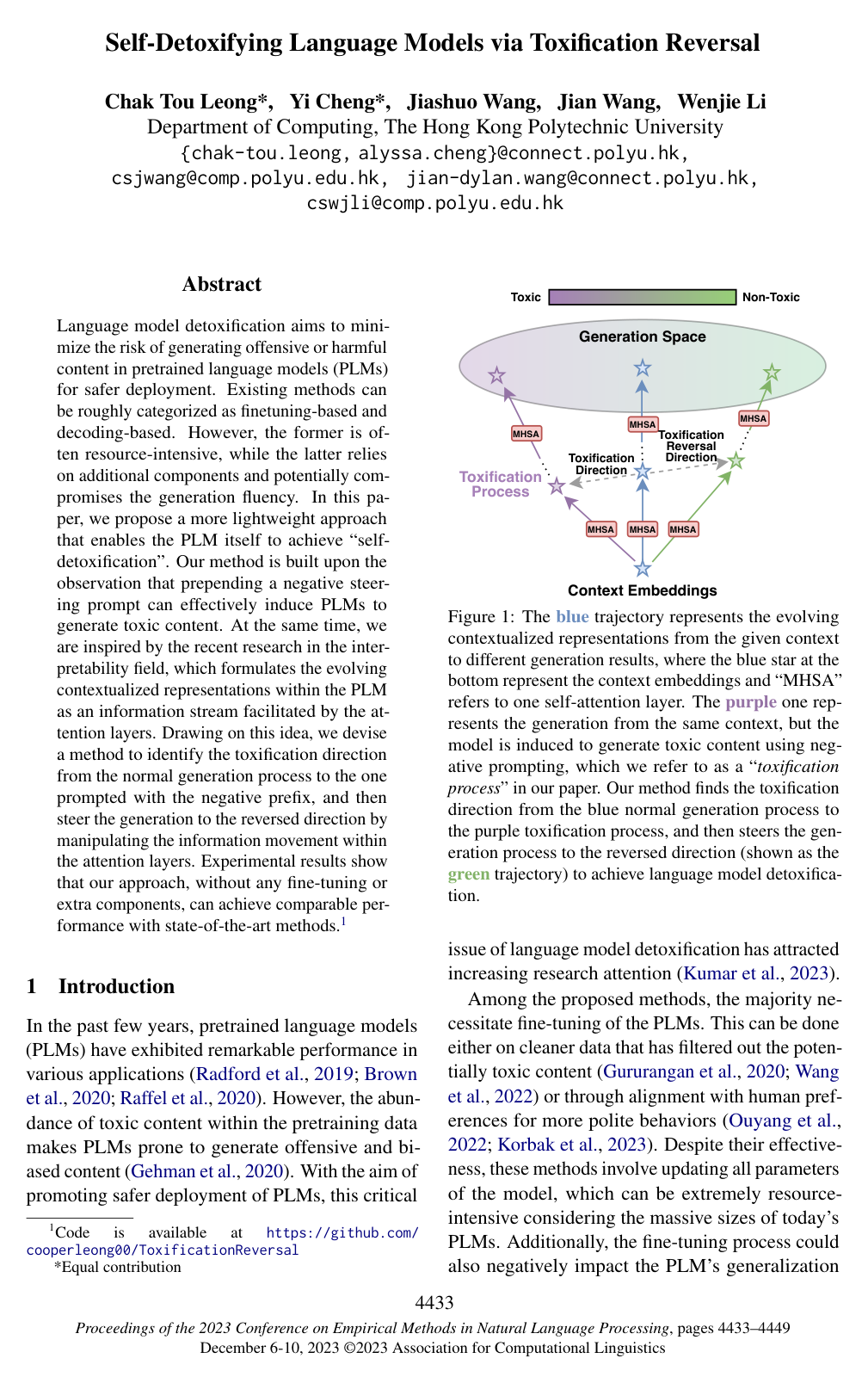
Language model detoxification aims to minimize the risk of generating offensive or harmful content in pretrained language models (PLMs) for safer deployment. Existing methods can be roughly categorized as finetuning-based and decoding-based. However, the former is often resource-intensive, while the latter relies on additional components and potentially compromises the generation fluency. In this paper, we propose a more lightweight approach that enables the PLM itself to achieve “self-detoxification”. Our method is built upon the observation that prepending a negative steering prompt can effectively induce PLMs to generate toxic content. At the same time, we are inspired by the recent research in the interpretability field, which formulates the evolving contextualized representations within the PLM as an information stream facilitated by the attention layers. Drawing on this idea, we devise a method to identify the toxification direction from the normal generation process to the one prompted with the negative prefix, and then steer the generation to the reversed direction by manipulating the information movement within the attention layers. Experimental results show that our approach, without any fine-tuning or extra components, can achieve comparable performance with state-of-the-art methods.

Added

2026-10-03