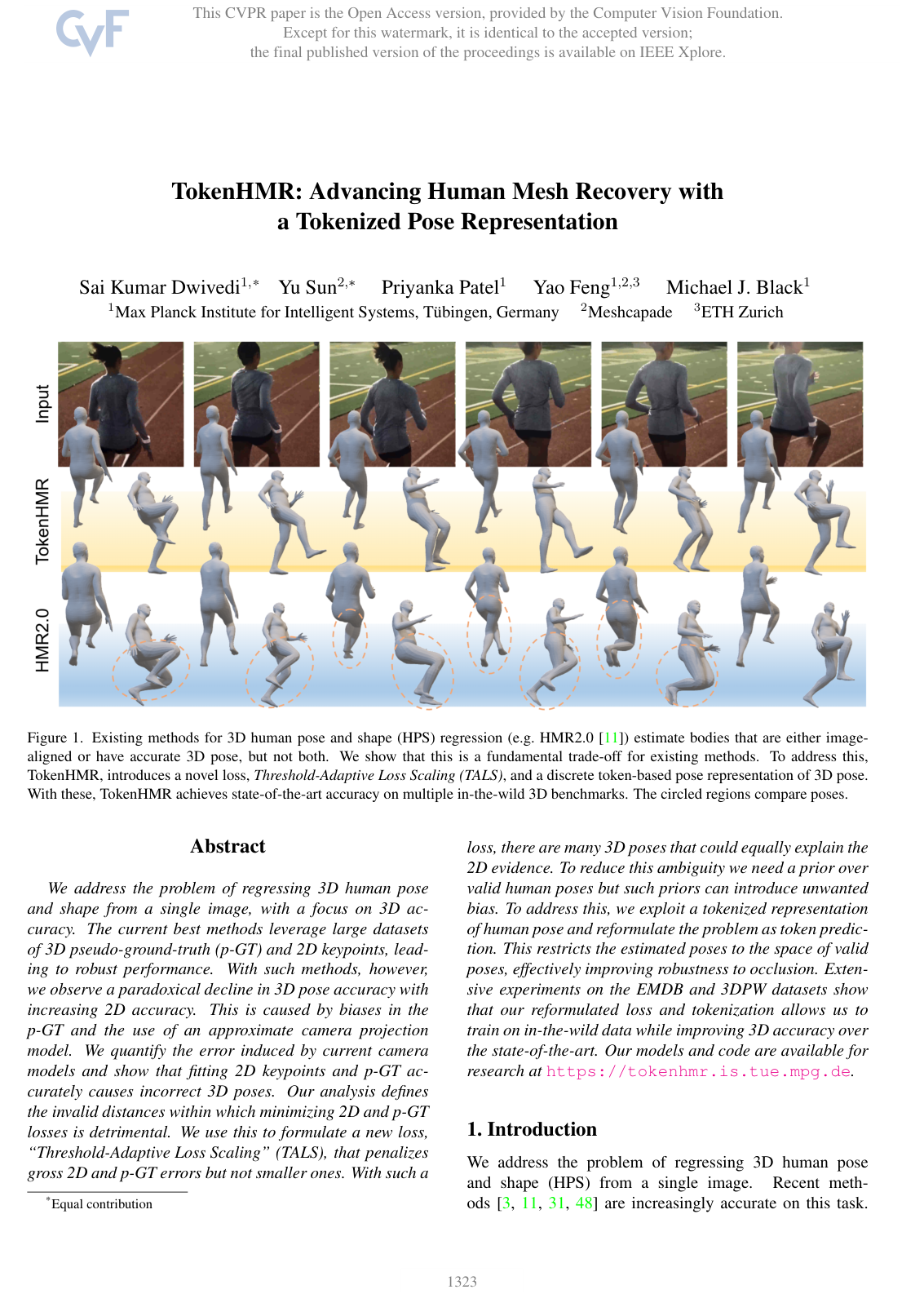
A tokenized pose representation is an approach in computer vision where human body postures are encoded as a collection of discrete tokens selected from a learned codebook instead of continuous joint coordinates or rotation parameters. By mapping continuous body configurations into discrete indices, this technique reframes continuous 3D pose estimation as a token prediction task, effectively constraining predicted postures to a distribution of anatomically valid human poses. This structured representation functions as a strong prior that reduces projection ambiguities, prevents physically implausible joint configurations, and improves the robustness of human mesh recovery when dealing with occlusions or limited visual evidence.