
keyword
time series anomaly detection
Time series anomaly detection is the process of identifying unexpected, rare, or abnormal observations, patterns, and behaviors within data collected sequentially over time. Unlike general anomaly detection on independent or unordered data, this task explicitly accounts for temporal dependencies, periodic trends, seasonality, and dynamic interrelationships between consecutive timestamps. Identified anomalies typically fall into categories such as point anomalies where individual values deviate sharply, contextual anomalies where values are abnormal only in relation to their temporal context, or collective anomalies where entire sub-sequences exhibit irregular behavior. Techniques for time series anomaly detection span statistical modeling, signal processing, and machine learning architectures, frequently employing unsupervised or self-supervised representations to score deviations and flag critical events in domains such as industrial monitoring, IT operations, sensor networks, and environmental analysis.
8 items
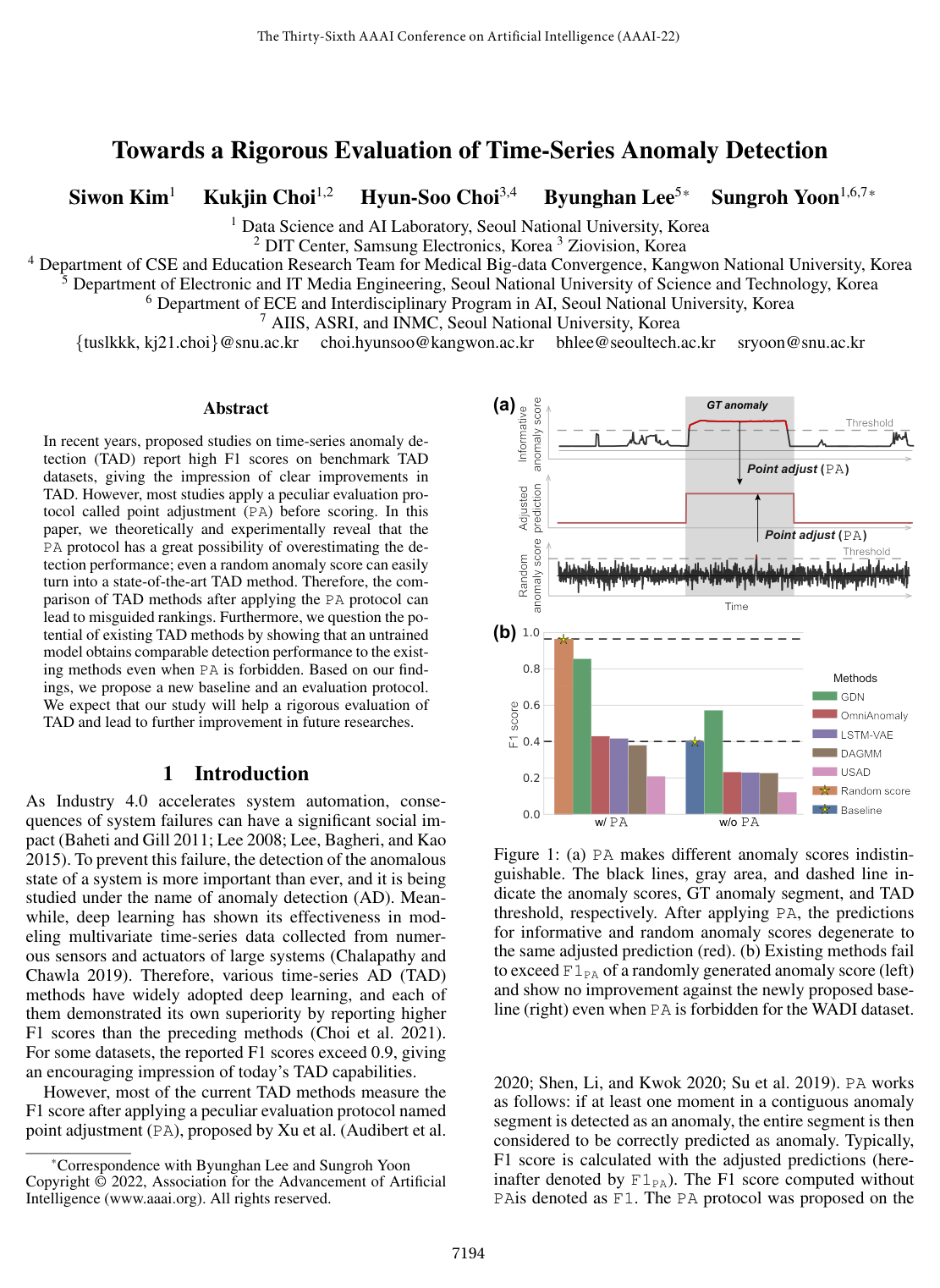
Towards a Rigorous Evaluation of Time-Series Anomaly Detection
Siwon Kim, Kukjin Choi, Hyun-Soo Choi, Byunghan Lee, Sungroh Yoon
Why you should read this
Reveals that the widely used point adjustment evaluation protocol severely inflates time-series anomaly detection performance to the point where random guessing outperforms state-of-the-art models, while establishing a rigorous evaluation protocol and baseline to properly measure genuine progress.
In recent years, proposed studies on time-series anomaly detection (TAD) report high F1 scores on benchmark TAD datasets, giving the impression of clear improvements in TAD. However, most studies apply a peculiar evaluation protocol called point adjustment (PA) before scoring. In this paper, we theoretically and experimentally reveal that the PA protocol has a great possibility of overestimating the detection performance; even a random anomaly score can easily turn into a state-of-the-art TAD method. Therefore, the comparison of TAD methods after applying the PA protocol can lead to misguided rankings. Furthermore, we question the potential of existing TAD methods by showing that an untrained model obtains comparable detection performance to the existing methods even when PA is forbidden. Based on our findings, we propose a new baseline and an evaluation protocol. We expect that our study will help a rigorous evaluation of TAD and lead to further improvement in future researches.
Added
2026-10-05
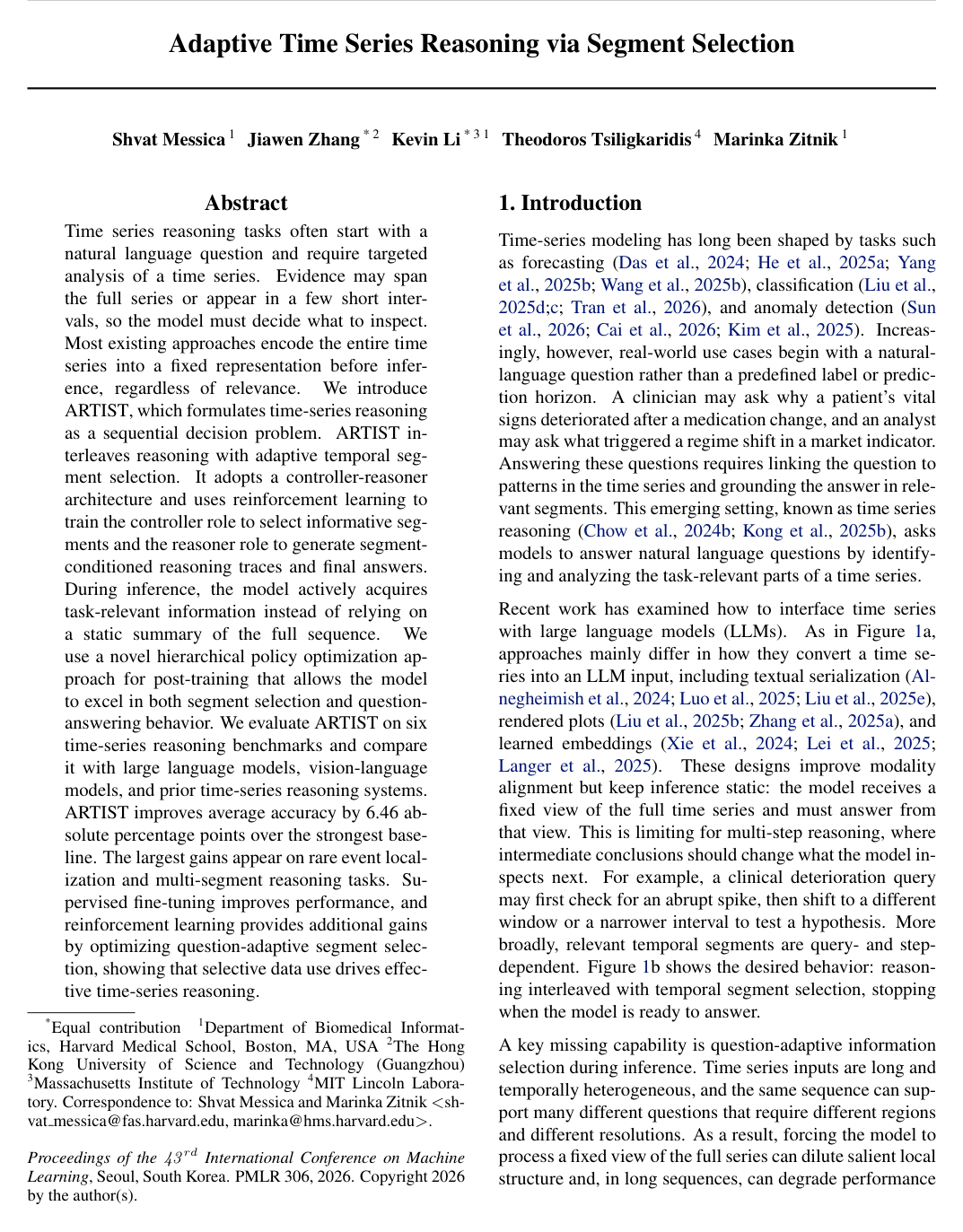
Adaptive Time Series Reasoning via Segment Selection
Shvat Messica, Jiawen Zhang, Kevin Li, Theodoros Tsiligkaridis, Marinka Zitnik
Why you should read this
Introduces ARTIST, a reinforcement learning framework that adaptively selects task-relevant time-series segments during inference to significantly improve accuracy on complex temporal reasoning benchmarks.
Time series reasoning tasks often start with a natural language question and require targeted analysis of a time series. Evidence may span the full series or appear in a few short intervals, so the model must decide what to inspect. Most existing approaches encode the entire time series into a fixed representation before inference, regardless of whether or not the entire sequence is relevant. We introduce ARTIST, which formulates time-series reasoning as a sequential decision problem. ARTIST interleaves reasoning with adaptive temporal segment selection. It adopts a controller-reasoner architecture and uses reinforcement learning to train the controller role to select informative segments and the reasoner role to generate segment-conditioned reasoning traces and final answers. During inference, the model actively acquires task-relevant information instead of relying on a static summary of the full sequence. We use a novel hierarchical policy optimization approach for post-training that allows the model to excel in both segment selection and question-answering behavior. We evaluate ARTIST on six time-series reasoning benchmarks and compare it with large language models, vision-language models, and prior time-series reasoning systems. ARTIST improves average accuracy by 6.46 absolute percentage points over the strongest baseline. The largest gains appear on rare event localization and multi-segment reasoning tasks. Supervised fine-tuning improves performance, and reinforcement learning provides additional gains by optimizing question-adaptive segment selection. These results show that selective data use drives effective time-series reasoning.
Added
2026-09-29
TS2Vec: Towards Universal Representation of Time Series
Zhihan Yue, Yujing Wang, Juanyong Duan, Tianmeng Yang, Congrui Huang, Yunhai Tong, Bixiong Xu
Why you should read this
Proposes a universal contrastive learning framework that uses hierarchical contrasting and contextual consistency to learn multiscale time series representations, achieving state-of-the-art results across classification, forecasting, and anomaly detection benchmarks.
This paper presents TS2Vec, a universal framework for learning representations of time series in an arbitrary semantic level. Unlike existing methods, TS2Vec performs contrastive learning in a hierarchical way over augmented context views, which enables a robust contextual representation for each timestamp. Furthermore, to obtain the representation of an arbitrary sub-sequence in the time series, we can apply a simple aggregation over the representations of corresponding timestamps. We conduct extensive experiments on time series classification tasks to evaluate the quality of time series representations. As a result, TS2Vec achieves significant improvement over existing SOTAs of unsupervised time series representation on 125 UCR datasets and 29 UEA datasets. The learned timestamp-level representations also achieve superior results in time series forecasting and anomaly detection tasks. A linear regression trained on top of the learned representations outperforms previous SOTAs of time series forecasting. Furthermore, we present a simple way to apply the learned representations for unsupervised anomaly detection, which establishes SOTA results in the literature. The source code is publicly available at https://github.com/yuezhihan/ts2vec.
Added
2026-09-26
Anomaly Transformer: Time Series Anomaly Detection with Association Discrepancy
Jiehui Xu, Haixu Wu, Jianmin Wang, Mingsheng Long
Why you should read this
Proposes the Anomaly Transformer, which exploits attention-weight discrepancies between local and global temporal associations through a minimax optimization strategy to achieve state-of-the-art unsupervised time series anomaly detection.
Unsupervised detection of anomaly points in time series is a challenging problem, which requires the model to derive a distinguishable criterion. Previous methods tackle the problem mainly through learning pointwise representation or pairwise association, however, neither is sufficient to reason about the intricate dynamics. Recently, Transformers have shown great power in unified modeling of pointwise representation and pairwise association, and we find that the self-attention weight distribution of each time point can embody rich association with the whole series. Our key observation is that due to the rarity of anomalies, it is extremely difficult to build nontrivial associations from abnormal points to the whole series, thereby, the anomalies' associations shall mainly concentrate on their adjacent time points. This adjacent-concentration bias implies an association-based criterion inherently distinguishable between normal and abnormal points, which we highlight through the \emph{Association Discrepancy}. Technically, we propose the \emph{Anomaly Transformer} with a new \emph{Anomaly-Attention} mechanism to compute the association discrepancy. A minimax strategy is devised to amplify the normal-abnormal distinguishability of the association discrepancy. The Anomaly Transformer achieves state-of-the-art results on six unsupervised time series anomaly detection benchmarks of three applications: service monitoring, space & earth exploration, and water treatment.
Added
2026-09-26
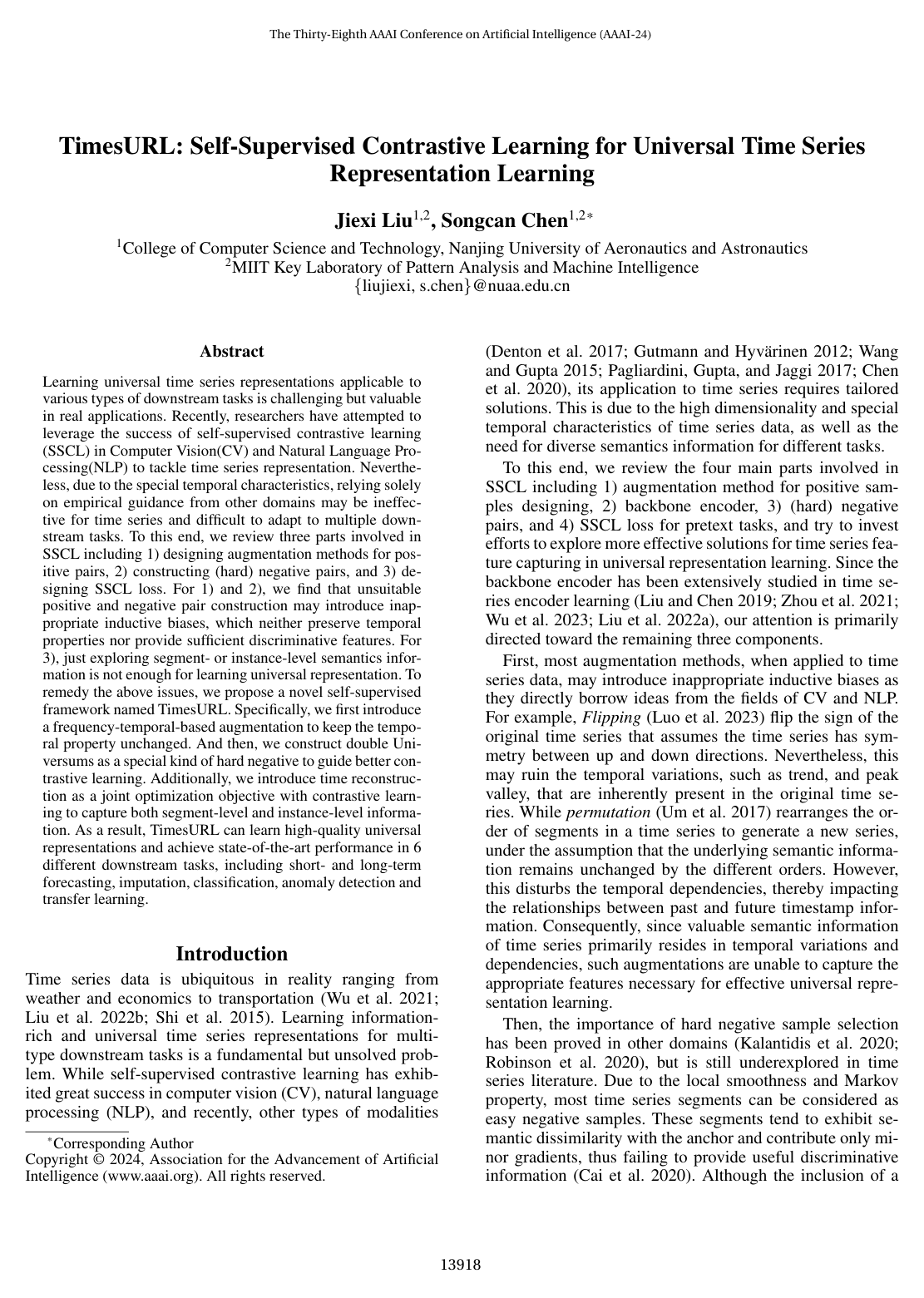
TimesURL: Self-Supervised Contrastive Learning for Universal Time Series Representation Learning
Jiexi Liu, Songcan Chen
Why you should read this
Proposes TimesURL, a self-supervised framework combining frequency-temporal data augmentations, synthesized Universum hard negatives, and a joint reconstruction objective to learn universal time series representations that achieve state-of-the-art results across six distinct downstream tasks.
Learning universal time series representations applicable to various types of downstream tasks is challenging but valuable in real applications. Recently, researchers have attempted to leverage the success of self-supervised contrastive learning (SSCL) in Computer Vision(CV) and Natural Language Processing(NLP) to tackle time series representation. Nevertheless, due to the special temporal characteristics, relying solely on empirical guidance from other domains may be ineffective for time series and difficult to adapt to multiple downstream tasks. To this end, we review three parts involved in SSCL including 1) designing augmentation methods for positive pairs, 2) constructing (hard) negative pairs, and 3) designing SSCL loss. For 1) and 2), we find that unsuitable positive and negative pair construction may introduce inappropriate inductive biases, which neither preserve temporal properties nor provide sufficient discriminative features. For 3), just exploring segment- or instance-level semantics information is not enough for learning universal representation. To remedy the above issues, we propose a novel self-supervised framework named TimesURL. Specifically, we first introduce a frequency-temporal-based augmentation to keep the temporal property unchanged. And then, we construct double Universums as a special kind of hard negative to guide better contrastive learning. Additionally, we introduce time reconstruction as a joint optimization objective with contrastive learning to capture both segment-level and instance-level information. As a result, TimesURL can learn high-quality universal representations and achieve state-of-the-art performance in 6 different downstream tasks, including short- and long-term forecasting, imputation, classification, anomaly detection and transfer learning.
Added
2026-09-26
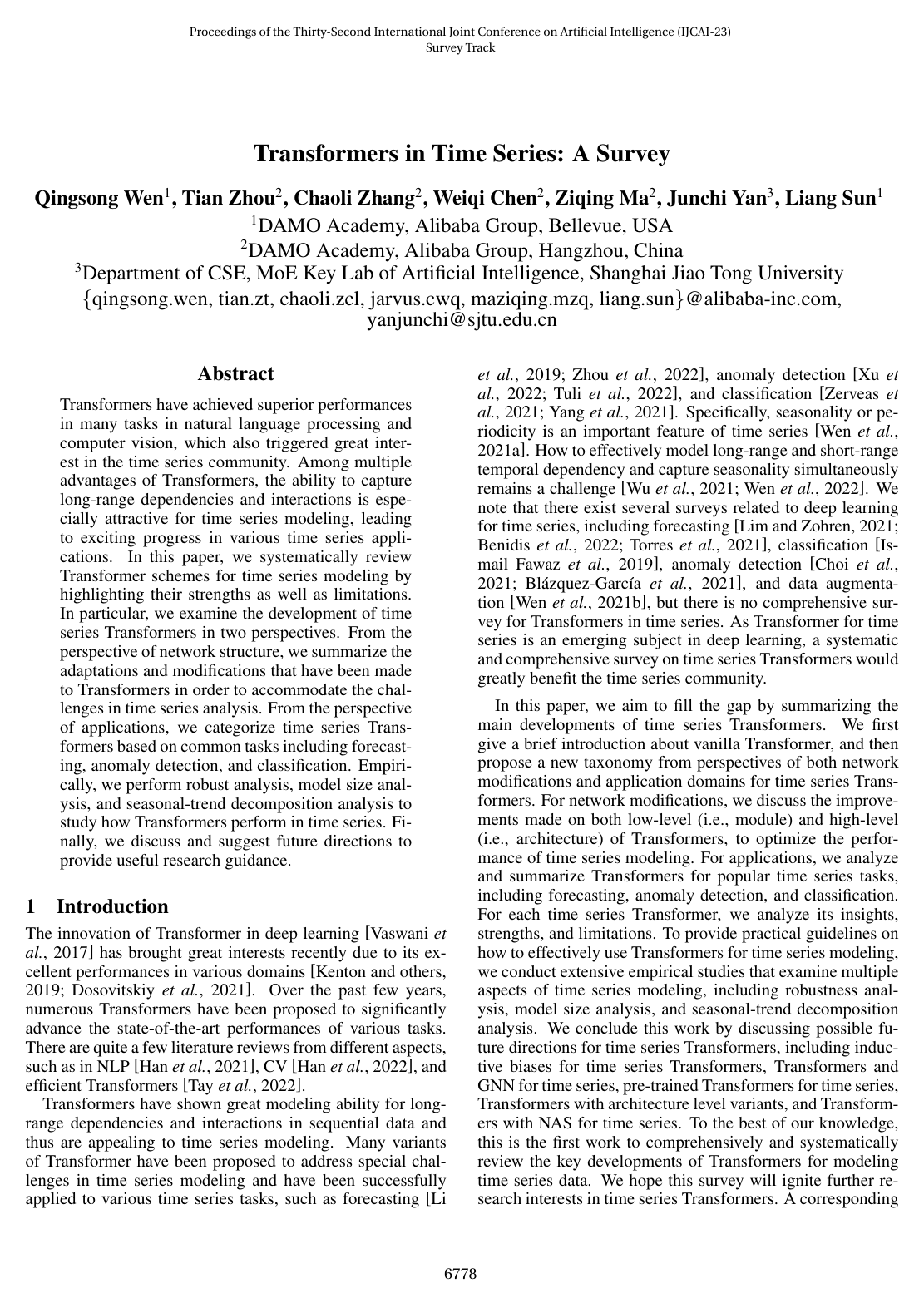
Transformers in Time Series: A Survey
Qingsong Wen, Tian Zhou, Chao Zhang, Weiqiu Chen, Ziqing Ma, Junchi Yan, Liang Sun
Why you should read this
Presents a systematic taxonomy of Transformer adaptations for time series forecasting, anomaly detection, and classification alongside empirical analyses of model size and seasonal decomposition to guide future architectural designs.
Transformers have achieved superior performances in many tasks in natural language processing and computer vision, which also triggered great interest in the time series community. Among multiple advantages of Transformers, the ability to capture long-range dependencies and interactions is especially attractive for time series modeling, leading to exciting progress in various time series applications. In this paper, we systematically review Transformer schemes for time series modeling by highlighting their strengths as well as limitations. In particular, we examine the development of time series Transformers in two perspectives. From the perspective of network structure, we summarize the adaptations and modifications that have been made to Transformers in order to accommodate the challenges in time series analysis. From the perspective of applications, we categorize time series Transformers based on common tasks including forecasting, anomaly detection, and classification. Empirically, we perform robust analysis, model size analysis, and seasonal-trend decomposition analysis to study how Transformers perform in time series. Finally, we discuss and suggest future directions to provide useful research guidance. To the best of our knowledge, this paper is the first work to comprehensively and systematically summarize the recent advances of Transformers for modeling time series data. We hope this survey will ignite further research interests in time series Transformers.
Added
2026-09-24
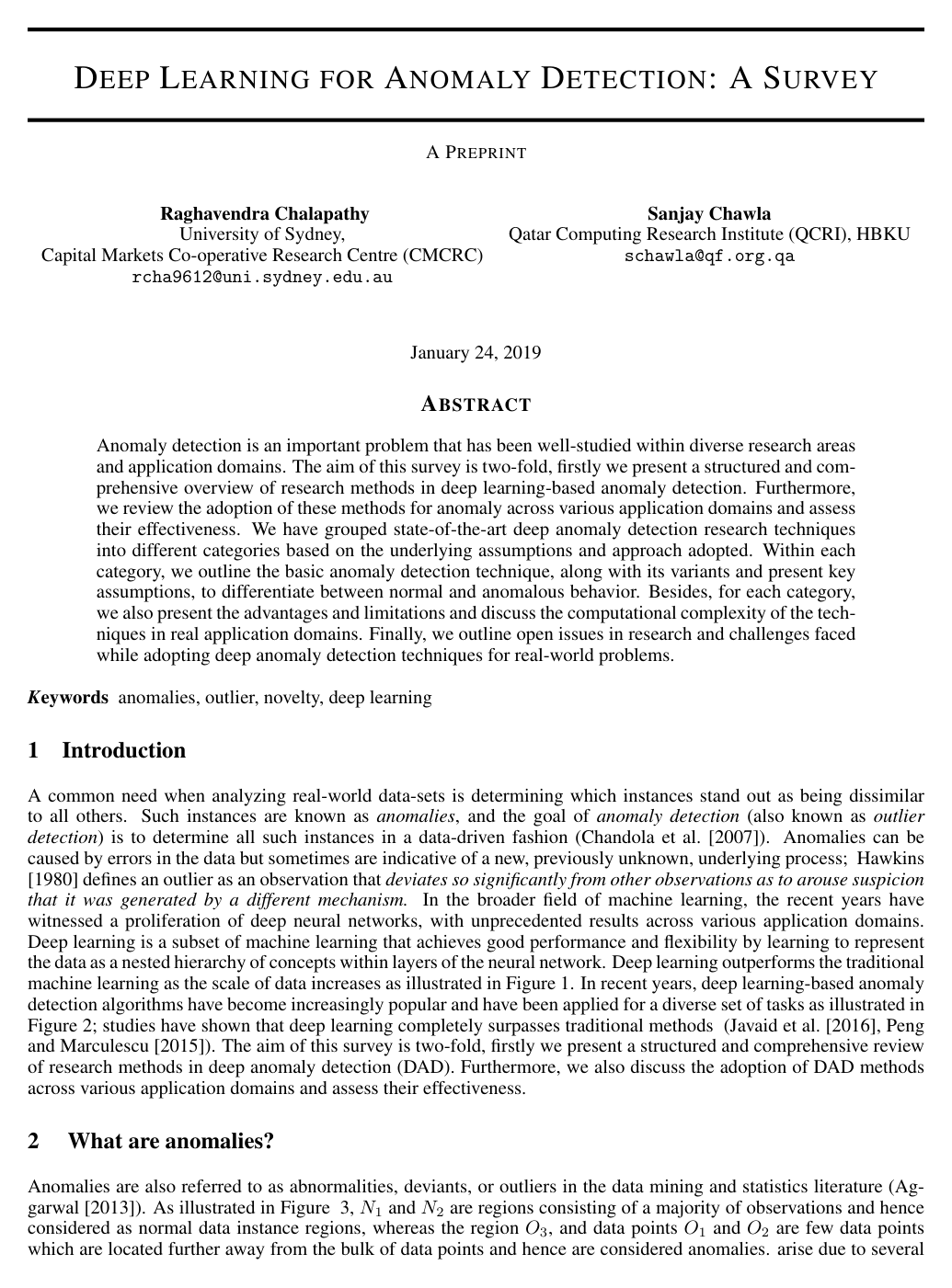
Deep Learning for Anomaly Detection: A Survey
Raghavendra Chalapathy, Sanjay Chawla
Why you should read this
Classifies deep learning anomaly detection methods across diverse application domains, evaluating their underlying assumptions, computational complexities, and practical limitations to guide model selection and identify critical research challenges.
Anomaly detection is an important problem that has been well-studied within diverse research areas and application domains. The aim of this survey is two-fold, firstly we present a structured and comprehensive overview of research methods in deep learning-based anomaly detection. Furthermore, we review the adoption of these methods for anomaly across various application domains and assess their effectiveness. We have grouped state-of-the-art research techniques into different categories based on the underlying assumptions and approach adopted. Within each category we outline the basic anomaly detection technique, along with its variants and present key assumptions, to differentiate between normal and anomalous behavior. For each category, we present we also present the advantages and limitations and discuss the computational complexity of the techniques in real application domains. Finally, we outline open issues in research and challenges faced while adopting these techniques.
Added
2026-09-18
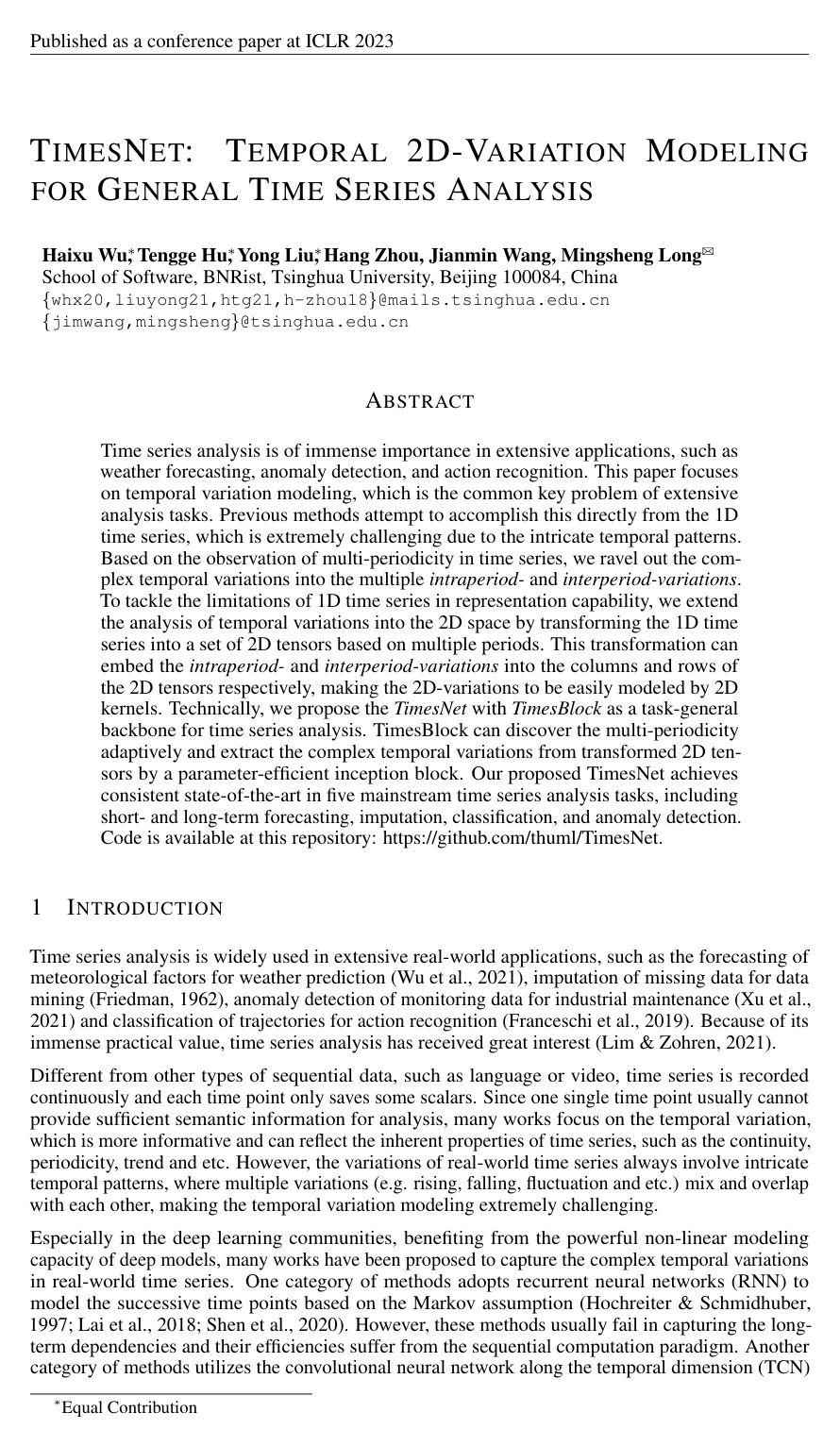
TimesNet: Temporal 2D-Variation Modeling for General Time Series Analysis
Haixu Wu, Teng Hu, Yong Liu, Hang Zhou, Jianmin Wang, Mingsheng Long
Why you should read this
Proposes TimesNet, a general time series backbone that transforms 1D signals into multi-periodic 2D tensors to capture intra- and inter-period variations using 2D kernels, achieving state-of-the-art performance across forecasting, imputation, classification, and anomaly detection.
Time series analysis is of immense importance in extensive applications, such as weather forecasting, anomaly detection, and action recognition. This paper focuses on temporal variation modeling, which is the common key problem of extensive analysis tasks. Previous methods attempt to accomplish this directly from the 1D time series, which is extremely challenging due to the intricate temporal patterns. Based on the observation of multi-periodicity in time series, we ravel out the complex temporal variations into the multiple intraperiod- and interperiod-variations. To tackle the limitations of 1D time series in representation capability, we extend the analysis of temporal variations into the 2D space by transforming the 1D time series into a set of 2D tensors based on multiple periods. This transformation can embed the intraperiod- and interperiod-variations into the columns and rows of the 2D tensors respectively, making the 2D-variations to be easily modeled by 2D kernels. Technically, we propose the TimesNet with TimesBlock as a task-general backbone for time series analysis. TimesBlock can discover the multi-periodicity adaptively and extract the complex temporal variations from transformed 2D tensors by a parameter-efficient inception block. Our proposed TimesNet achieves consistent state-of-the-art in five mainstream time series analysis tasks, including short- and long-term forecasting, imputation, classification, and anomaly detection. Code is available at this repository: this https URL.
Added
2026-09-14