
keyword
text-video alignment
Text-video alignment refers to the degree of semantic and temporal correspondence between a textual prompt and the visual content of a video. In multimodal machine learning and generative artificial intelligence, it measures how accurately a video depicts the specific subjects, attributes, actions, motion dynamics, and spatial relationships described in input text. Achieving strong text-video alignment ensures that generated or retrieved video sequences faithfully reflect the concepts, chronological sequence of events, and compositional details requested in textual instructions without omitting elements or introducing unintended visual hallucinations.
3 items
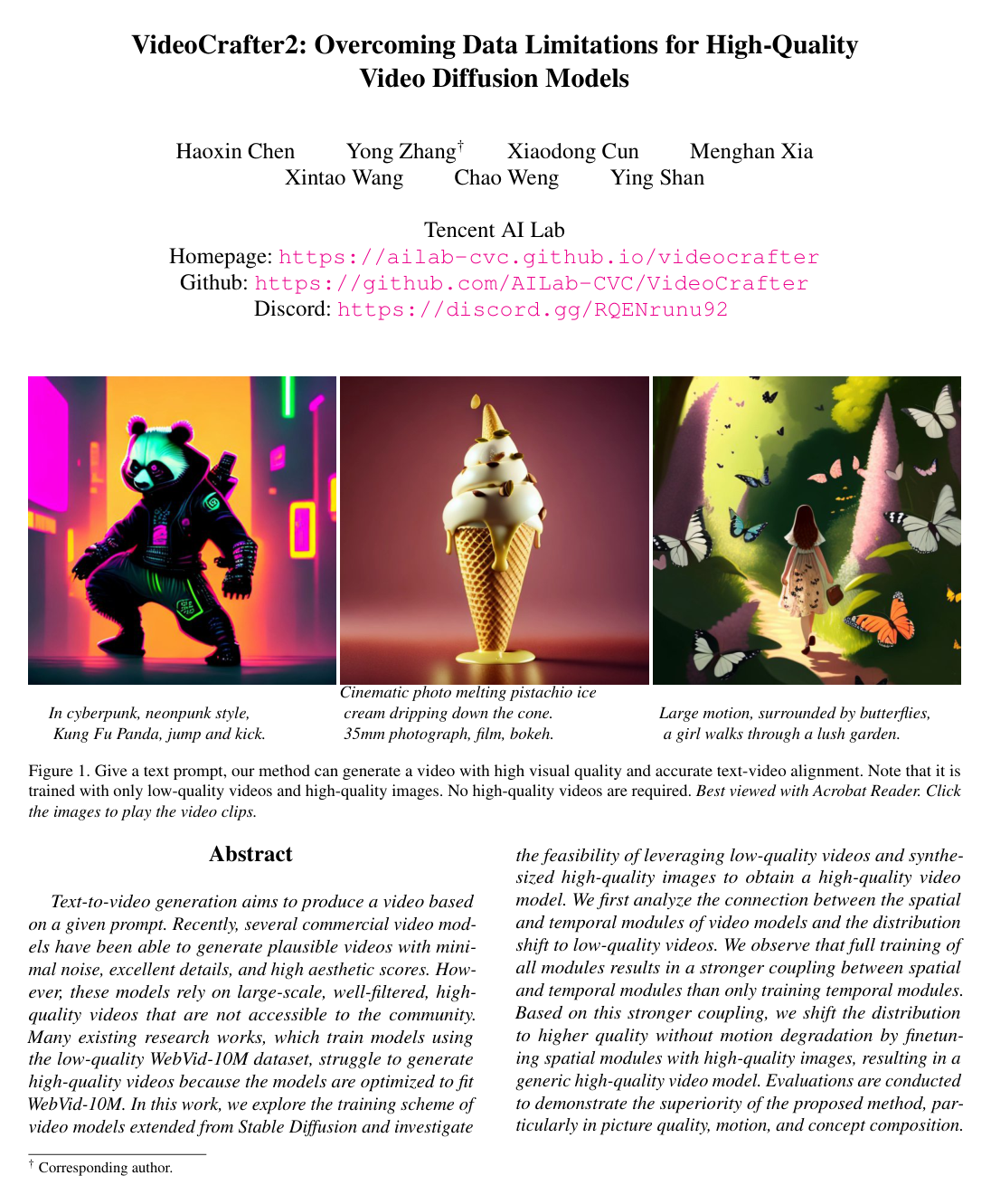
VideoCrafter2: Overcoming Data Limitations for High-Quality Video Diffusion Models
Haoxin Chen, Yong Zhang, Xiaodong Cun, Menghan Xia, Xintao Wang, Chao Weng, Ying Shan
Why you should read this
Presents a training strategy that enables text-to-video diffusion models to overcome low-quality video datasets by finetuning spatial modules with high-quality images without sacrificing motion dynamics.
Text-to-video generation aims to produce a video based on a given prompt. Recently, several commercial video models have been able to generate plausible videos with minimal noise, excellent details, and high aesthetic scores. However, these models rely on large-scale, well-filtered, high-quality videos that are not accessible to the community. Many existing research works, which train models using the low-quality WebVid-10M dataset, struggle to generate high-quality videos because the models are optimized to fit WebVid-10M. In this work, we explore the training scheme of video models extended from Stable Diffusion and investigate the feasibility of leveraging low-quality videos and synthesized high-quality images to obtain a high-quality video model. We first analyze the connection between the spatial and temporal modules of video models and the distribution shift to low-quality videos. We observe that full training of all modules results in a stronger coupling between spatial and temporal modules than only training temporal modules. Based on this stronger coupling, we shift the distribution to higher quality without motion degradation by finetuning spatial modules with high-quality images, resulting in a generic high-quality video model. Evaluations are conducted to demonstrate the superiority of the proposed method, particularly in picture quality, motion, and concept composition.
Added
2026-10-05
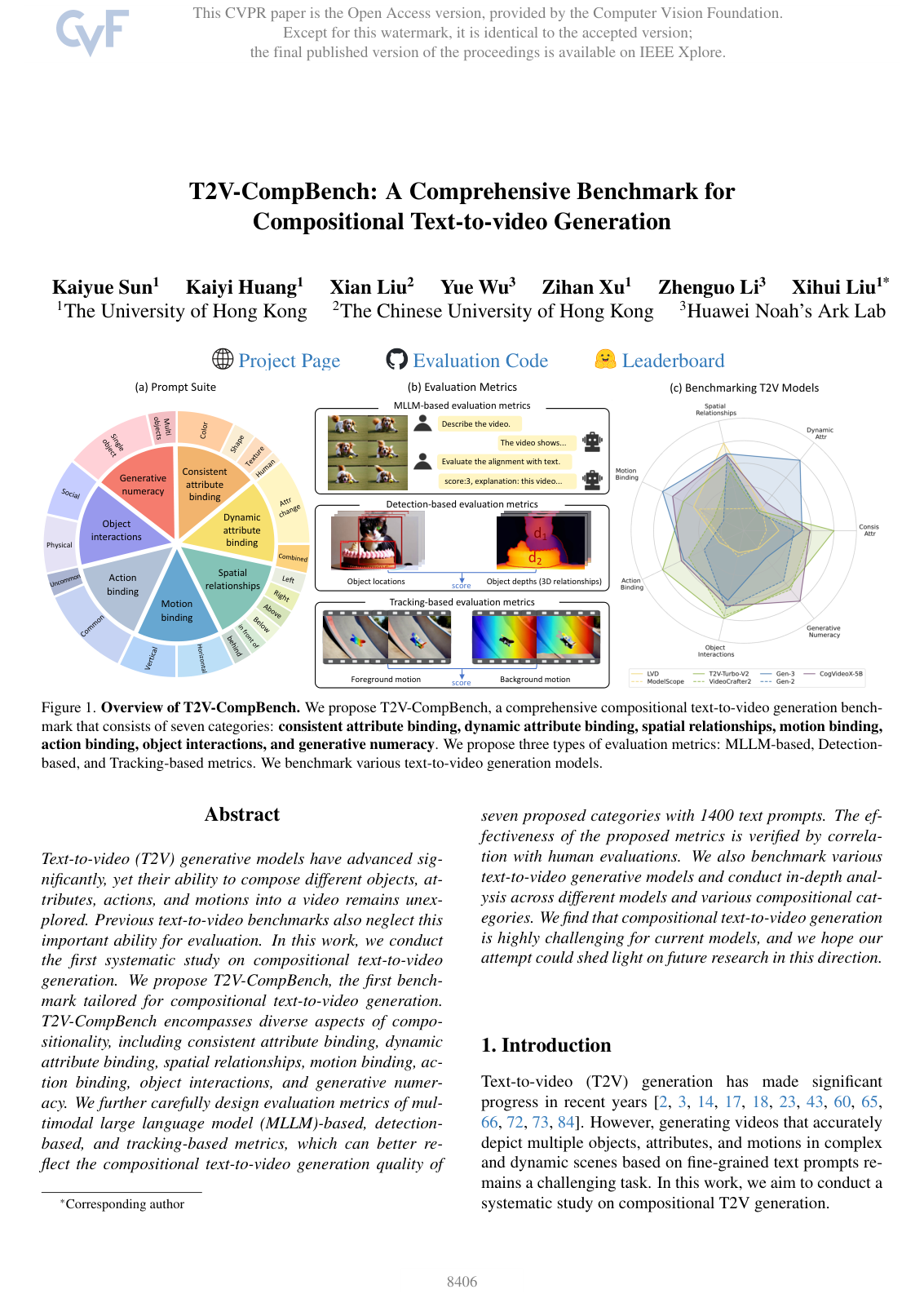
T2V-CompBench: A Comprehensive Benchmark for Compositional Text-to-video Generation
Kaiyue Sun, Kaiyi Huang, Xian Liu, Yue Wu, Zihan Xu, Zhenguo Li, Xihui Liu
Why you should read this
Presents the first systematic benchmark and multi-modal evaluation suite for compositional text-to-video generation across seven spatial and temporal categories, revealing critical limitations in current video generation models.
Text-to-video (T2V) generative models have advanced significantly, yet their ability to compose different objects, attributes, actions, and motions into a video remains unexplored. Previous text-to-video benchmarks also neglect this important ability for evaluation. In this work, we conduct the first systematic study on compositional text-to-video generation. We propose T2V-CompBench, the first benchmark tailored for compositional text-to-video generation. T2V-CompBench encompasses diverse aspects of compositionality, including consistent attribute binding, dynamic attribute binding, spatial relationships, motion binding, action binding, object interactions, and generative numeracy. We further carefully design evaluation metrics of multimodal large language model (MLLM)-based, detection-based, and tracking-based metrics, which can better reflect the compositional text-to-video generation quality of seven proposed categories with 1400 text prompts. The effectiveness of the proposed metrics is verified by correlation with human evaluations. We also benchmark various text-to-video generative models and conduct in-depth analysis across different models and various compositional categories. We find that compositional text-to-video generation is highly challenging for current models, and we hope our attempt could shed light on future research in this direction.
Added
2026-09-26
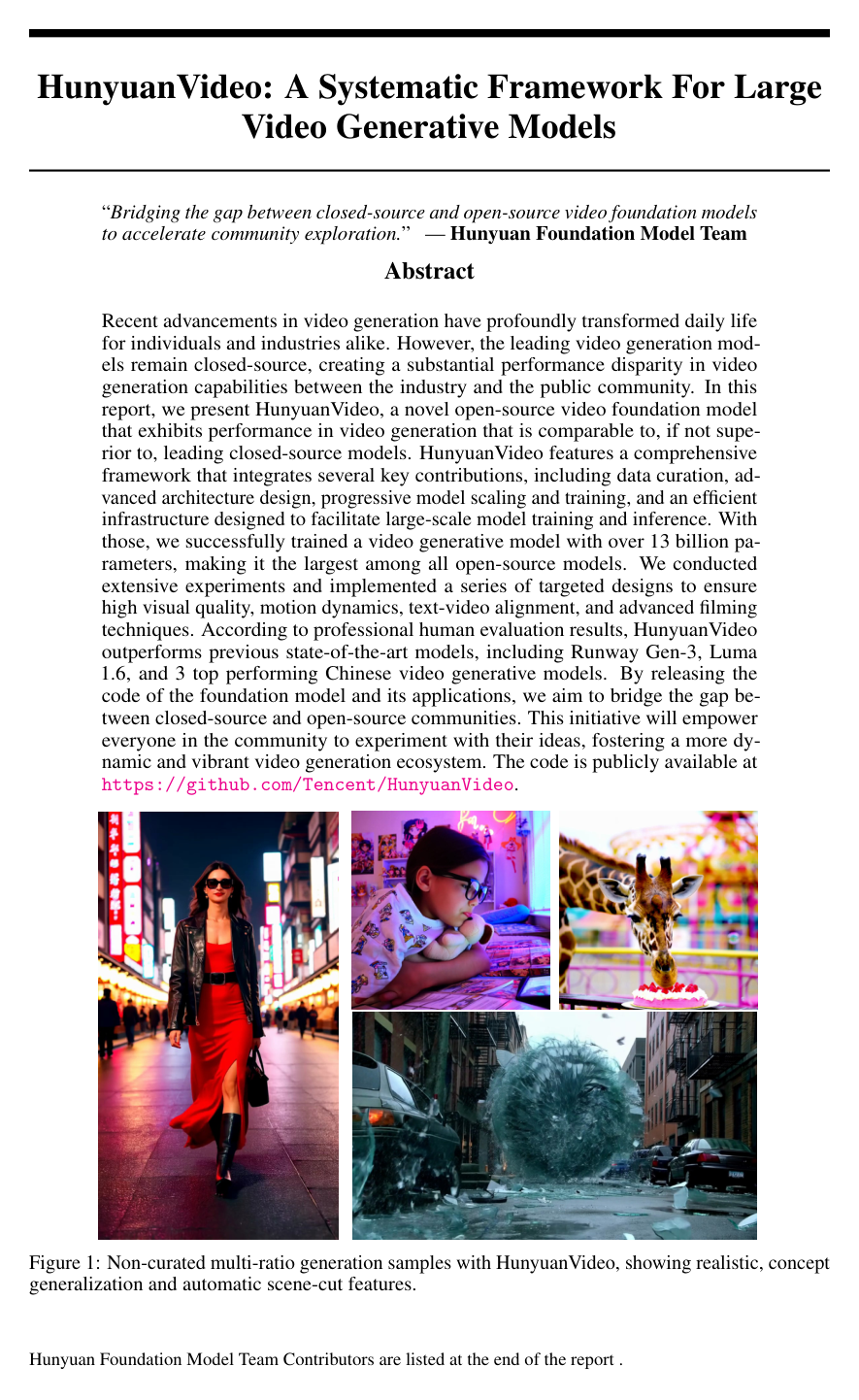
HunyuanVideo: A Systematic Framework For Large Video Generative Models
Weijie Kong, Qi Tian, Zijian Zhang, Rox Min, Zuozhuo Dai, Jin Zhou, Jia-Liang Xiong, Xin Li, Bo Wu, Jianwei Zhang, Kathrina Wu, Qin Lin, Junkun Yuan, Yanxin Long, Aladdin Wang, Andong Wang, Changlin Li, Duojun Huang, Fang Yang, Hao Tan, Hongmei Wang, Jacob Song, Jiawang Bai, Jianbing Wu, Jinbao Xue, Joey Wang, Kai Wang, Meng-Yang Liu, Peng-Yuan Li, Shuai Li, Wei-Yan Wang, Wenqing Yu, Xin-Chi Deng, Yang Li, Yi Chen, Yutao Cui, Yuanbo Peng, Zhen Yu, Zhiyu He, Zhiyong Xu, Zi-Xiang Zhou, Zunnan Xu, Yang-Dan Tao, Qinglin Lu, Songtao Liu, Daquan Zhou, Hongfa Wang, Yong Yang, Di Wang, Yuhong Liu, Jie Jiang, Caesar Zhong
Why you should read this
Presents HunyuanVideo, an open-source, 13-billion-parameter video foundation model with a systematic training and inference framework that rivals leading closed-source systems in visual quality, motion dynamics, and text alignment.
Recent advancements in video generation have significantly impacted daily life for both individuals and industries. However, the leading video generation models remain closed-source, resulting in a notable performance gap between industry capabilities and those available to the public. In this report, we introduce HunyuanVideo, an innovative open-source video foundation model that demonstrates performance in video generation comparable to, or even surpassing, that of leading closed-source models. HunyuanVideo encompasses a comprehensive framework that integrates several key elements, including data curation, advanced architectural design, progressive model scaling and training, and an efficient infrastructure tailored for large-scale model training and inference. As a result, we successfully trained a video generative model with over 13 billion parameters, making it the largest among all open-source models. We conducted extensive experiments and implemented a series of targeted designs to ensure high visual quality, motion dynamics, text-video alignment, and advanced filming techniques. According to evaluations by professionals, HunyuanVideo outperforms previous state-of-the-art models, including Runway Gen-3, Luma 1.6, and three top-performing Chinese video generative models. By releasing the code for the foundation model and its applications, we aim to bridge the gap between closed-source and open-source communities. This initiative will empower individuals within the community to experiment with their ideas, fostering a more dynamic and vibrant video generation ecosystem. The code is publicly available at this https URL.
Added
2026-09-24