
keyword
text retrieval
Text retrieval is the process of searching a collection of textual documents or passages to identify and return the items most relevant to a specific user query. As a foundational task in information retrieval and natural language processing, it aims to score and rank texts based on topical or semantic relevance to satisfy an information need. Retrieval systems employ several technical paradigms, ranging from traditional lexical sparse retrieval based on keyword matching to dense retrieval methods that map queries and documents into shared vector embeddings using neural encoders. Contemporary frameworks also include generative retrieval, where language models directly produce document identifiers, as well as multi-stage architectures that combine high-throughput initial candidate retrieval with neural reranking models to optimize ranking accuracy across diverse domains and languages.
3 items
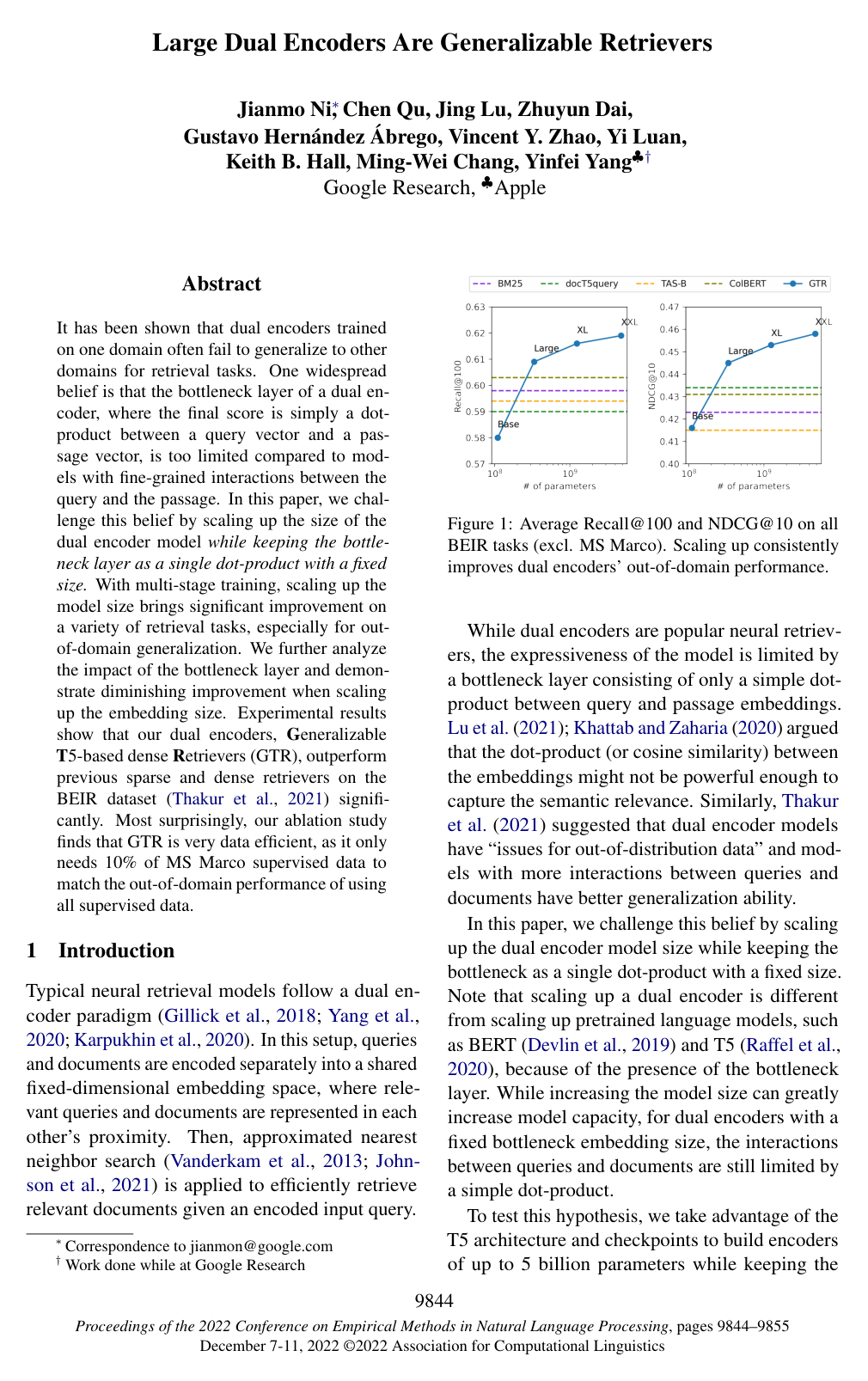
Large Dual Encoders Are Generalizable Retrievers
Jianmo Ni, Chen Qu, Jing Lu, Zhuyun Dai, Gustavo Hernández Ábrego, Ji Ma, Vincent Y. Zhao, Yi Luan, Keith B. Hall, Ming-Wei Chang, Yinfei Yang
Why you should read this
Demonstrates that scaling dual encoder parameters up to billions while maintaining a fixed-size dot-product bottleneck significantly improves out-of-domain retrieval generalization across diverse benchmarks with remarkable data efficiency.
It has been shown that dual encoders trained on one domain often fail to generalize to other domains for retrieval tasks. One widespread belief is that the bottleneck layer of a dual encoder, where the final score is simply a dot-product between a query vector and a passage vector, is too limited compared to models with fine-grained interactions between the query and the passage. In this paper, we challenge this belief by scaling up the size of the dual encoder model while keeping the bottleneck layer as a single dot-product with a fixed size. With multi-stage training, scaling up the model size brings significant improvement on a variety of retrieval tasks, especially for out-of-domain generalization. We further analyze the impact of the bottleneck layer and demonstrate diminishing improvement when scaling up the embedding size. Experimental results show that our dual encoders, Generalizable T5-based dense Retrievers (GTR), outperform previous sparse and dense retrievers on the BEIR dataset (Thakur et al., 2021) significantly. Most surprisingly, our ablation study finds that GTR is very data efficient, as it only needs 10% of MS Marco supervised data to match the out-of-domain performance of using all supervised data.
Added
2026-09-28
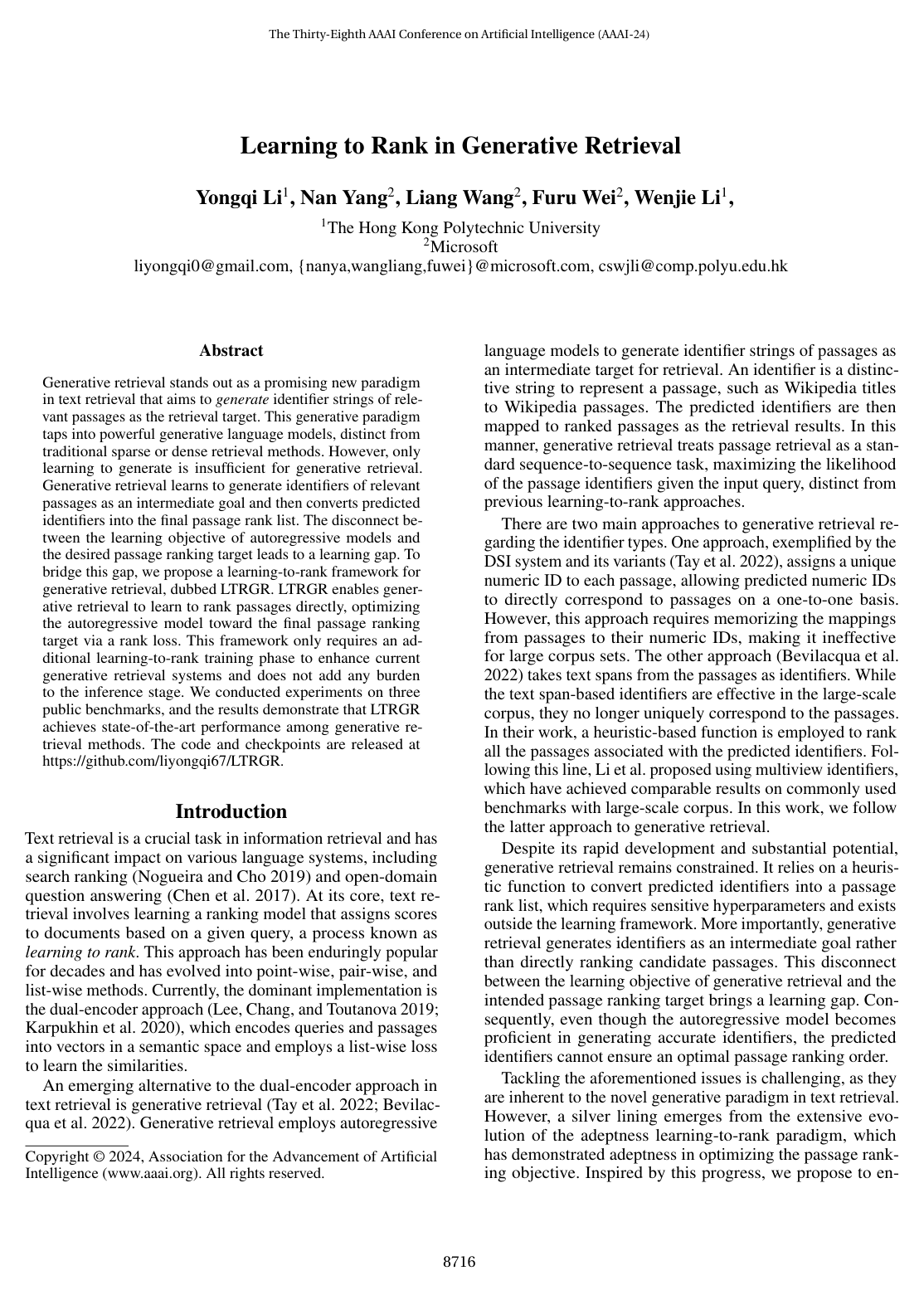
Learning to Rank in Generative Retrieval
Yongqi Li, Nan Yang, Liang Wang, Furu Wei, Wenjie Li
Why you should read this
Proposes LTRGR, a framework that incorporates ranking losses into autoregressive models to bridge the gap between identifier generation and final passage ranking without adding computational overhead during inference.
Generative retrieval stands out as a promising new paradigm in text retrieval that aims to generate identifier strings of relevant passages as the retrieval target. This generative paradigm taps into powerful generative language models, distinct from traditional sparse or dense retrieval methods. However, only learning to generate is insufficient for generative retrieval. Generative retrieval learns to generate identifiers of relevant passages as an intermediate goal and then converts predicted identifiers into the final passage rank list. The disconnect between the learning objective of autoregressive models and the desired passage ranking target leads to a learning gap. To bridge this gap, we propose a learning-to-rank framework for generative retrieval, dubbed LTRGR. LTRGR enables generative retrieval to learn to rank passages directly, optimizing the autoregressive model toward the final passage ranking target via a rank loss. This framework only requires an additional learning-to-rank training phase to enhance current generative retrieval systems and does not add any burden to the inference stage. We conducted experiments on three public benchmarks, and the results demonstrate that LTRGR achieves state-of-the-art performance among generative retrieval methods. The code and checkpoints are released at https://github.com/liyongqi67/LTRGR.
Added
2026-09-26
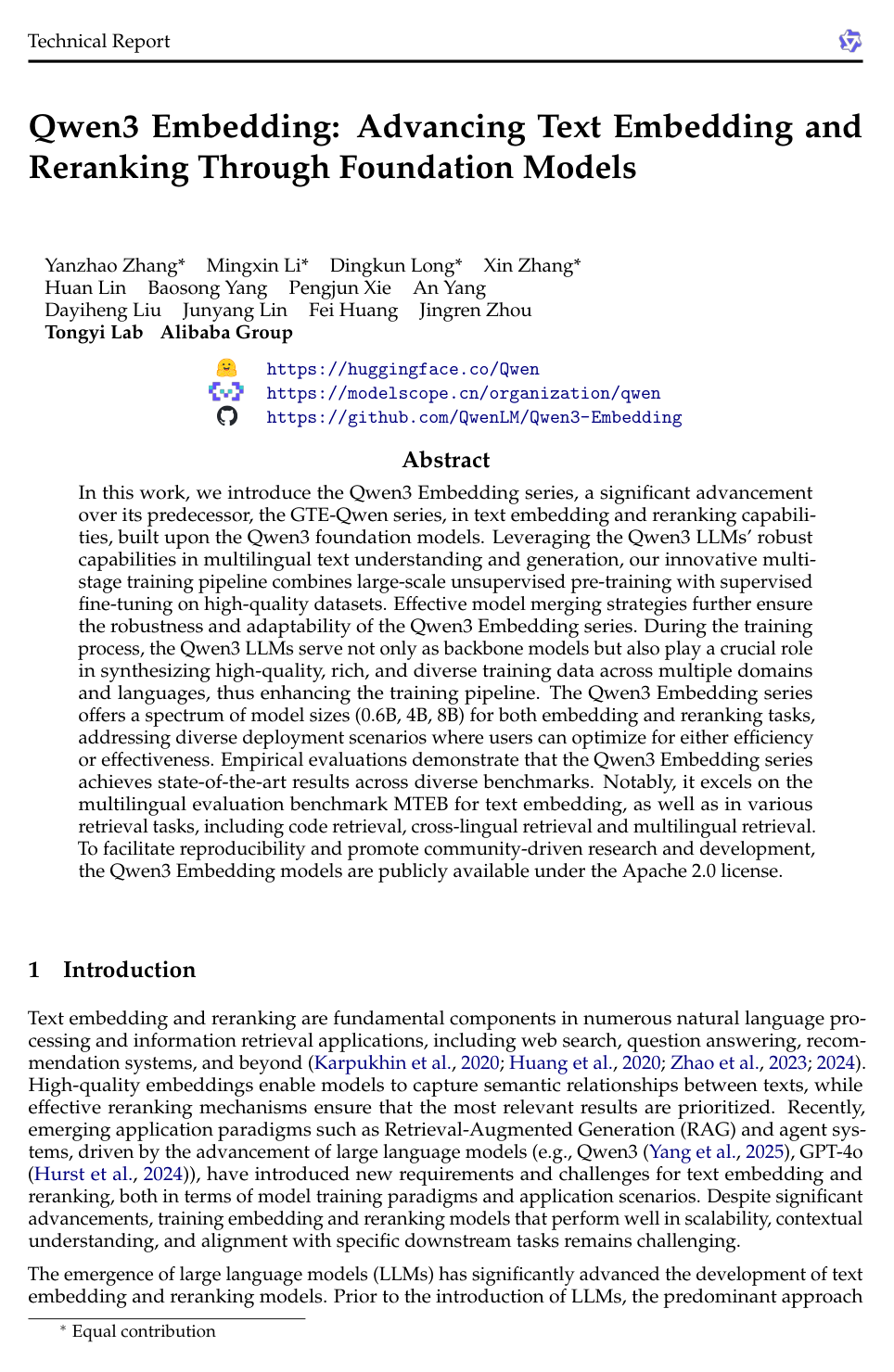
Qwen3 Embedding: Advancing Text Embedding and Reranking Through Foundation Models
Yanzhao Zhang, Mingxin Li, Dingkun Long, Xin Zhang, Huan Lin, Baosong Yang, Pengjun Xie, An Yang, Dayiheng Liu, Junyang Lin, Fei Huang, Jingren Zhou
Why you should read this
Presents the open-source Qwen3 Embedding and reranking model suite across 0.6B to 8B parameters, setting new state-of-the-art performance on multilingual and code retrieval benchmarks through foundation-model-driven synthetic data generation and multi-stage training.
In this work, we introduce the Qwen3 Embedding series, a significant advancement over its predecessor, the GTE-Qwen series, in text embedding and reranking capabilities, built upon the Qwen3 foundation models. Leveraging the Qwen3 LLMs' robust capabilities in multilingual text understanding and generation, our innovative multi-stage training pipeline combines large-scale unsupervised pre-training with supervised fine-tuning on high-quality datasets. Effective model merging strategies further ensure the robustness and adaptability of the Qwen3 Embedding series. During the training process, the Qwen3 LLMs serve not only as backbone models but also play a crucial role in synthesizing high-quality, rich, and diverse training data across multiple domains and languages, thus enhancing the training pipeline. The Qwen3 Embedding series offers a spectrum of model sizes (0.6B, 4B, 8B) for both embedding and reranking tasks, addressing diverse deployment scenarios where users can optimize for either efficiency or effectiveness. Empirical evaluations demonstrate that the Qwen3 Embedding series achieves state-of-the-art results across diverse benchmarks. Notably, it excels on the multilingual evaluation benchmark MTEB for text embedding, as well as in various retrieval tasks, including code retrieval, cross-lingual retrieval and multilingual retrieval. To facilitate reproducibility and promote community-driven research and development, the Qwen3 Embedding models are publicly available under the Apache 2.0 license.
Added
2026-09-25