
keyword
text-image alignment
Text-image alignment refers to the degree of semantic consistency and fidelity between a written text description and visual content in multimodal and generative artificial intelligence systems. In text-to-image generation and editing, strong alignment means that an output image accurately and completely portrays the entities, attributes, quantities, spatial relationships, and styled text specified within an input prompt. Achieving effective text-image alignment relies on training methods, cross-attention mechanisms, and evaluation techniques that guide generative models to faithfully represent the user intent expressed in language without omitting requested elements or introducing conflicting visual details.
7 items
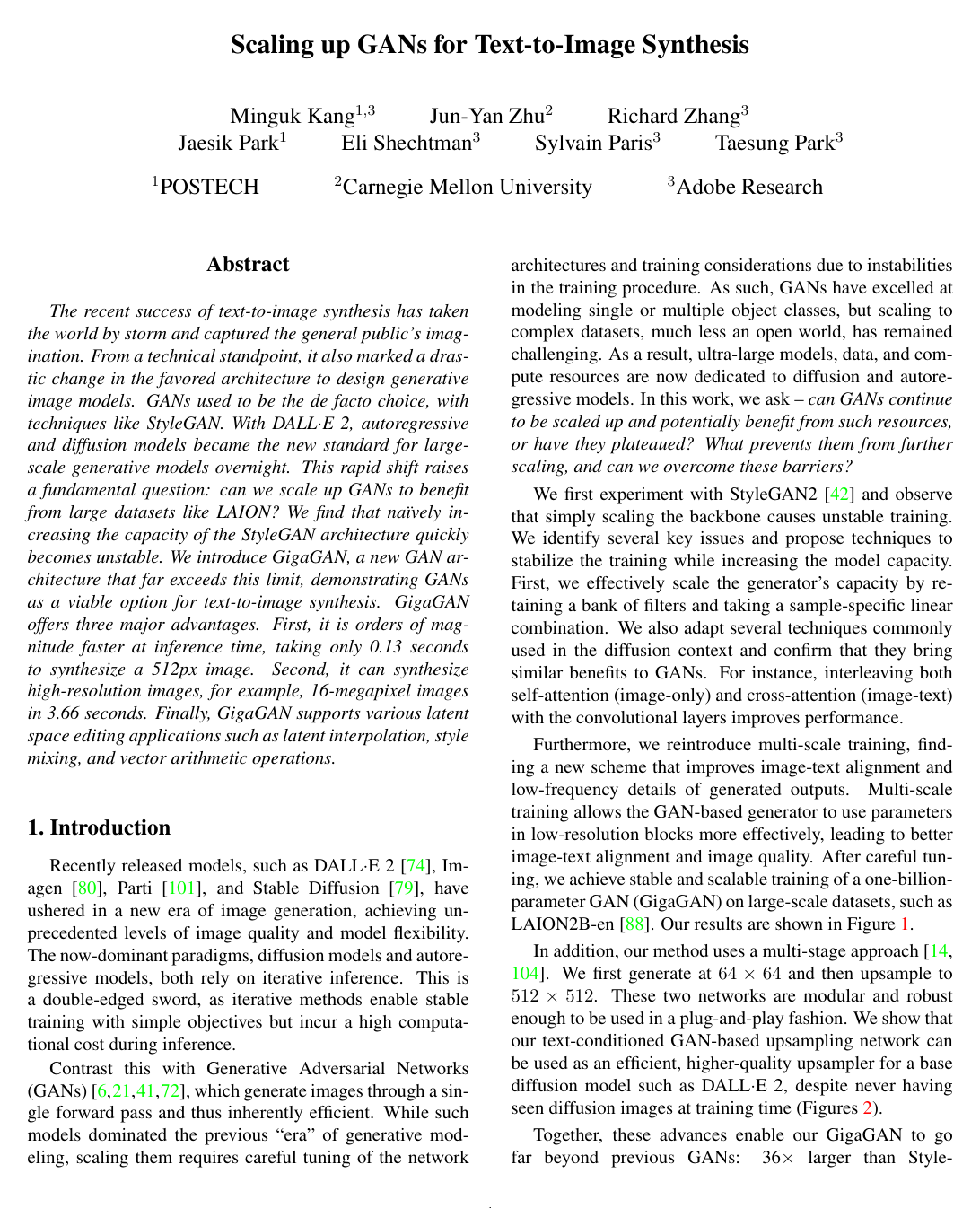
Scaling up GANs for Text-to-Image Synthesis
Minguk Kang, Jun-Yan Zhu, Richard Zhang, Jaesik Park, Eli Shechtman, Sylvain Paris, Taesung Park
Why you should read this
Introduces GigaGAN, a scalable generative adversarial network that generates high-resolution text-to-image outputs orders of magnitude faster than diffusion models while preserving flexible latent space editing.
The recent success of text-to-image synthesis has taken the world by storm and captured the general public's imagination. From a technical standpoint, it also marked a drastic change in the favored architecture to design generative image models. GANs used to be the de facto choice, with techniques like StyleGAN. With DALL-E 2, auto-regressive and diffusion models became the new standard for large-scale generative models overnight. This rapid shift raises a fundamental question: can we scale up GANs to benefit from large datasets like LAION? We find that naÏvely increasing the capacity of the StyleGAN architecture quickly becomes unstable. We introduce GigaGAN, a new GAN architecture that far exceeds this limit, demonstrating GANs as a viable option for text-to-image synthesis. GigaGAN offers three major advantages. First, it is orders of magnitude faster at inference time, taking only 0.13 seconds to synthesize a 512px image. Second, it can synthesize high-resolution images, for example, 16-megapixel pixels in 3.66 seconds. Finally, GigaGAN supports various latent space editing applications such as latent interpolation, style mixing, and vector arithmetic operations.
Added
2026-10-05
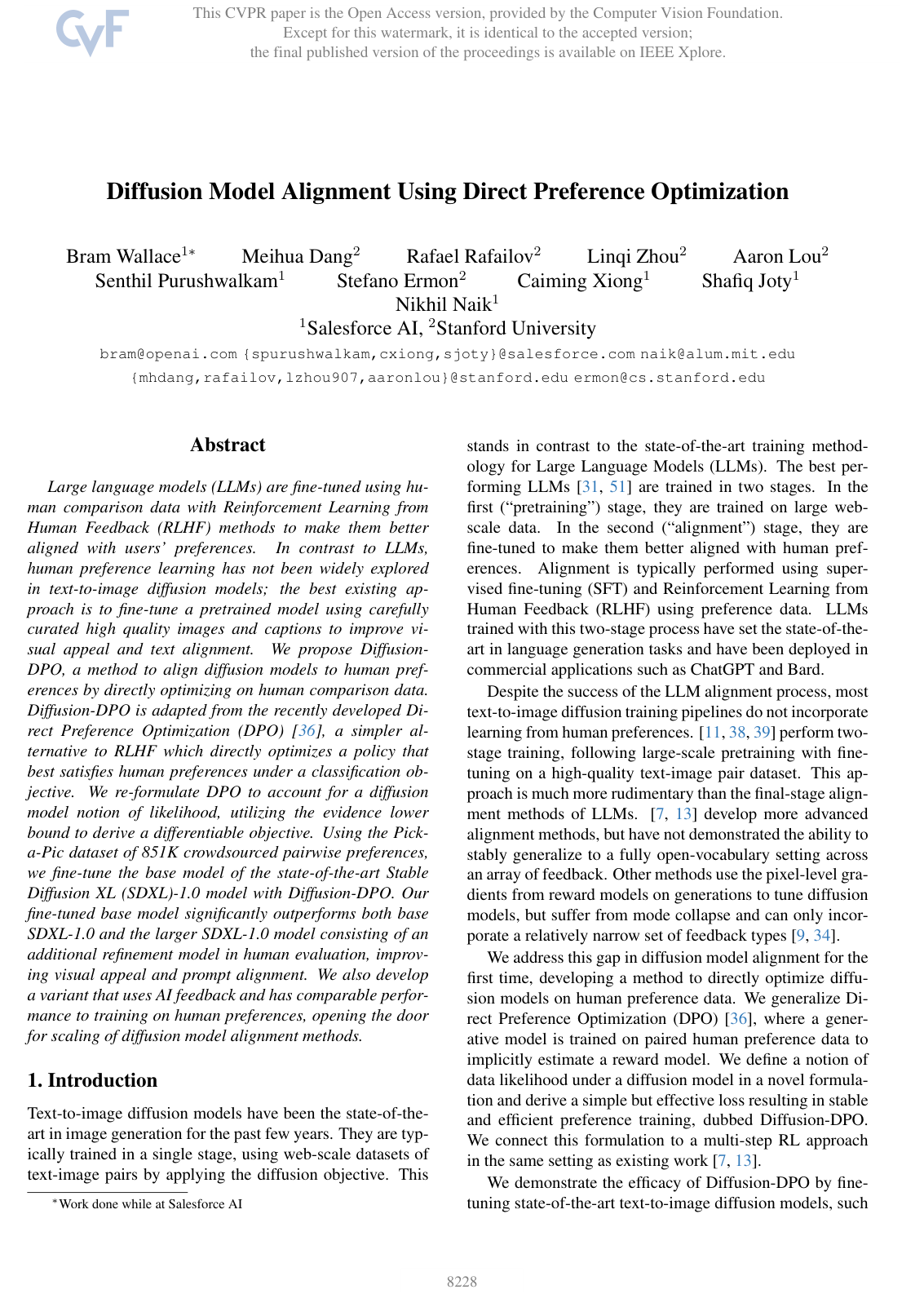
Diffusion Model Alignment Using Direct Preference Optimization
Bram Wallace, Meihua Dang, Rafael Rafailov, Linqi Zhou, Aaron Lou, Senthil Purushwalkam, Stefano Ermon, Caiming Xiong, Shafiq Joty, Nikhil Naik
Why you should read this
Adapts Direct Preference Optimization to text-to-image diffusion models via an evidence lower bound formulation, enabling direct fine-tuning on pairwise preference data to significantly improve image quality and prompt adherence without training a separate reward model.
Large language models (LLMs) are fine-tuned using human comparison data with Reinforcement Learning from Human Feedback (RLHF) methods to make them better aligned with users’ preferences. In contrast to LLMs, human preference learning has not been widely explored in text-to-image diffusion models; the best existing approach is to fine-tune a pretrained model using carefully curated high quality images and captions to improve visual appeal and text alignment. We propose Diffusion-DPO, a method to align diffusion models to human preferences by directly optimizing on human comparison data. Diffusion-DPO is adapted from the recently developed Direct Preference Optimization (DPO) [36], a simpler alternative to RLHF which directly optimizes a policy that best satisfies human preferences under a classification objective. We re-formulate DPO to account for a diffusion model notion of likelihood, utilizing the evidence lower bound to derive a differentiable objective. Using the Pick-a-Pic dataset of 851K crowdsourced pairwise preferences, we fine-tune the base model of the state-of-the-art Stable Diffusion XL (SDXL)-1.0 model with Diffusion-DPO. Our fine-tuned base model significantly outperforms both base SDXL-1.0 and the larger SDXL-1.0 model consisting of an additional refinement model in human evaluation, improving visual appeal and prompt alignment. We also develop a variant that uses AI feedback and has comparable performance to training on human preferences, opening the door for scaling of diffusion model alignment methods.
Added
2026-10-05
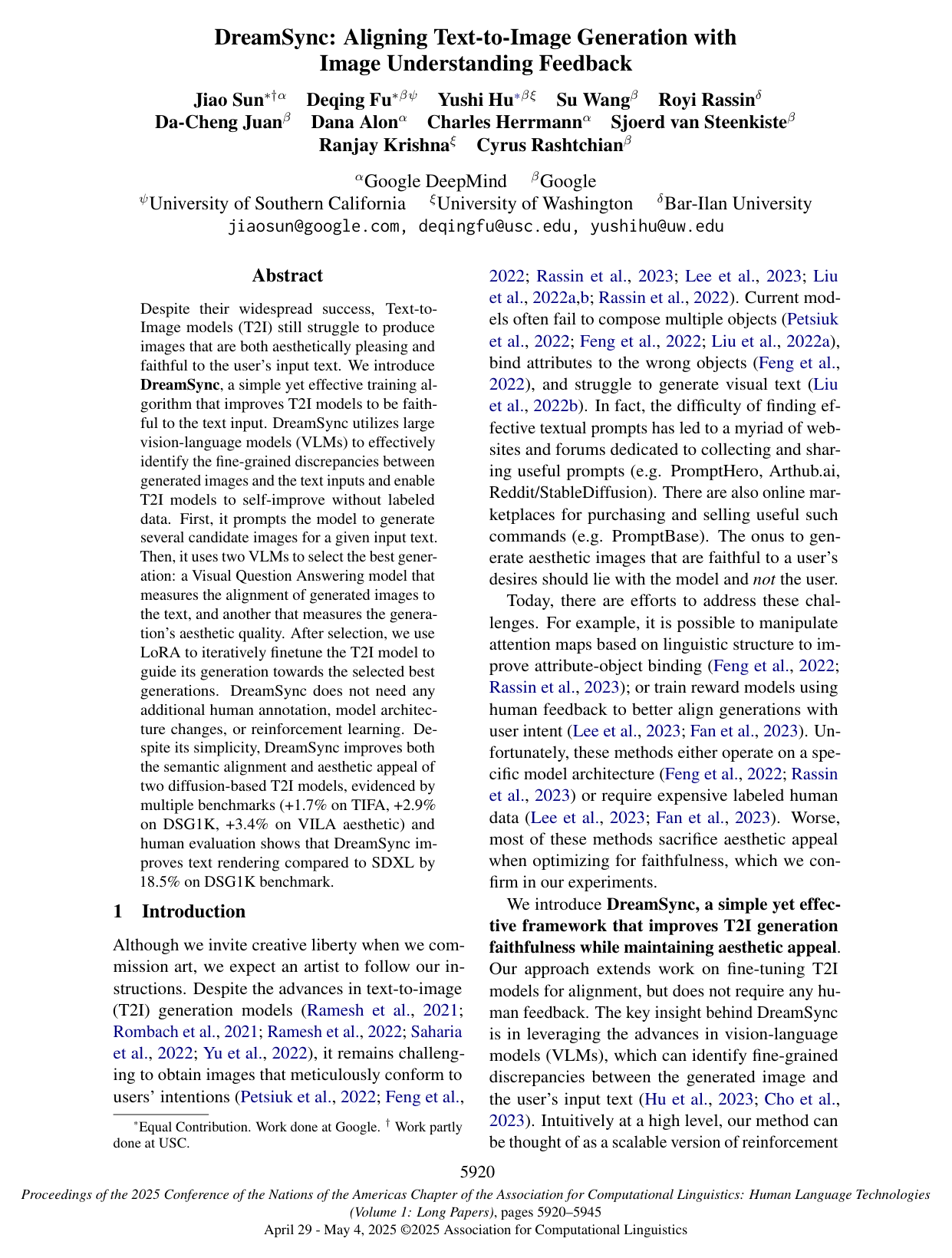
DreamSync: Aligning Text-to-Image Generation with Image Understanding Feedback
Jiao Sun, Deqing Fu, Yushi Hu, Su Wang, Royi Rassin, Da-Cheng Juan, Dana Alon, Charles Herrmann, Sjoerd van Steenkiste, Ranjay Krishna, Cyrus Rashtchian
Why you should read this
Presents DreamSync, an iterative self-training framework that uses vision-language models for automated text-alignment and aesthetic scoring to fine-tune text-to-image diffusion models with LoRA without requiring human labels or reinforcement learning.
Despite their widespread success, Text-to-Image models (T2I) still struggle to produce images that are both aesthetically pleasing and faithful to the user’s input text. We introduce DreamSync, a simple yet effective training algorithm that improves T2I models to be faithful to the text input. DreamSync utilizes large vision-language models (VLMs) to effectively identify the fine-grained discrepancies between generated images and the text inputs and enable T2I models to self-improve without labeled data. First, it prompts the model to generate several candidate images for a given input text. Then, it uses two VLMs to select the best generation: a Visual Question Answering model that measures the alignment of generated images to the text, and another that measures the generation’s aesthetic quality. After selection, we use LoRA to iteratively finetune the T2I model to guide its generation towards the selected best generations. DreamSync does not need any additional human annotation, model architecture changes, or reinforcement learning. Despite its simplicity, DreamSync improves both the semantic alignment and aesthetic appeal of two diffusion-based T2I models, evidenced by multiple benchmarks (+1.7% on TIFA, +2.9% on DSG1K, +3.4% on VILA aesthetic) and human evaluation shows that DreamSync improves text rendering compared to SDXL by 18.5% on DSG1K benchmark.
Added
2026-10-03
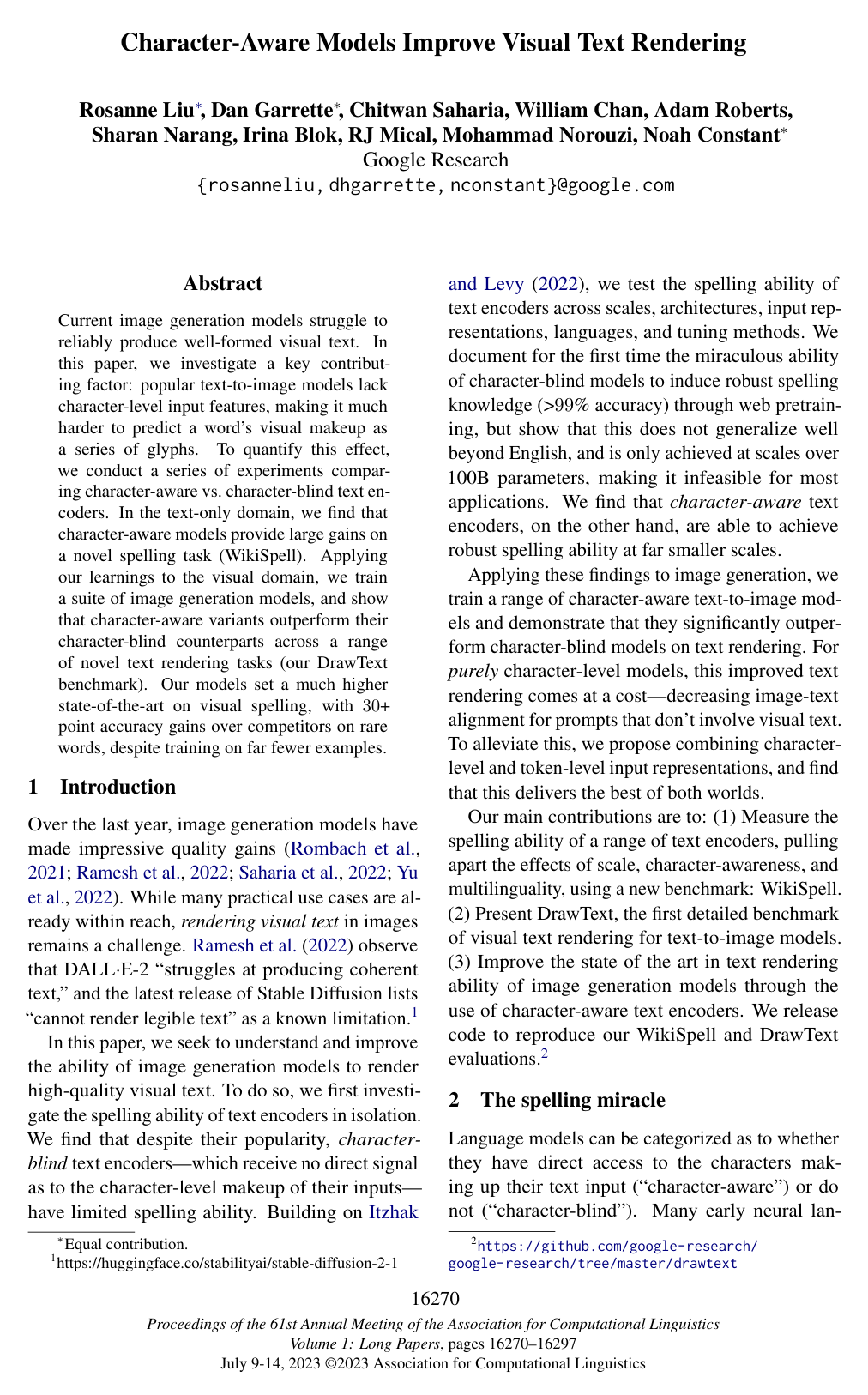
Character-Aware Models Improve Visual Text Rendering
Rosanne Liu, Dan Garrette, Chitwan Saharia, William Chan, Adam Roberts, Sharan Narang, Irina Blok, RJ Mical, Mohammad Norouzi, Noah Constant
Why you should read this
Demonstrates that integrating character-aware text encoders into text-to-image architectures significantly improves visual spelling accuracy, outperforming conventional subword-based models on complex and rare text rendering tasks.
Current image generation models struggle to reliably produce well-formed visual text. In this paper, we investigate a key contributing factor: popular text-to-image models lack character-level input features, making it much harder to predict a word’s visual makeup as a series of glyphs. To quantify this effect, we conduct a series of experiments comparing character-aware vs. character-blind text encoders. In the text-only domain, we find that character-aware models provide large gains on a novel spelling task (WikiSpell). Applying our learnings to the visual domain, we train a suite of image generation models, and show that character-aware variants outperform their character-blind counterparts across a range of novel text rendering tasks (our DrawText benchmark). Our models set a much higher state-of-the-art on visual spelling, with 30+ point accuracy gains over competitors on rare words, despite training on far fewer examples.
Added
2026-10-02
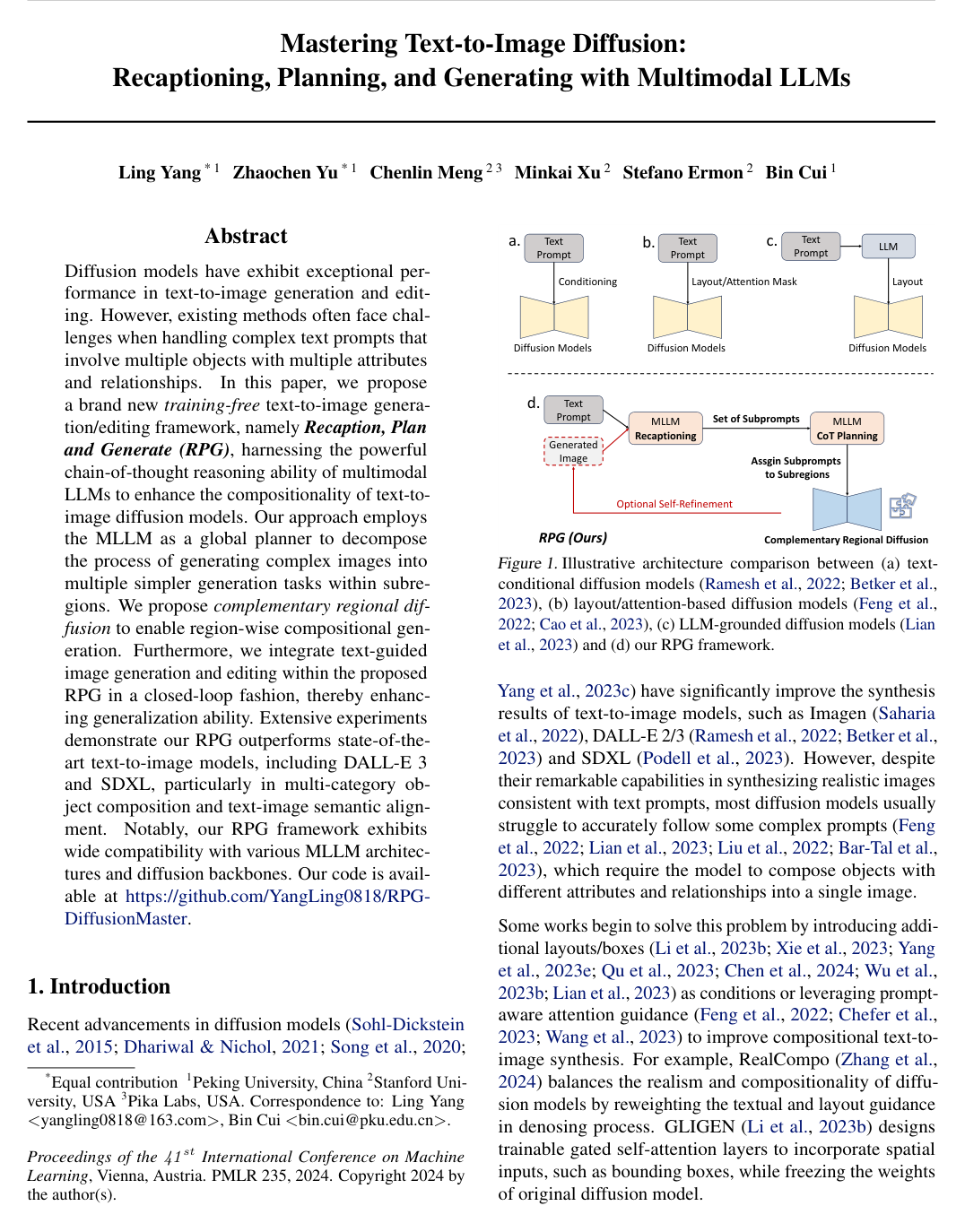
Mastering Text-to-Image Diffusion: Recaptioning, Planning, and Generating with Multimodal LLMs
Ling Yang, Zhaochen Yu, Chenlin Meng, Minkai Xu, Stefano Ermon, Bin Cui
Why you should read this
Proposes a training-free framework that leverages multimodal large language models to decompose complex prompts into spatial sub-tasks for regional diffusion, outperforming DALL-E 3 and SDXL in multi-object compositional image generation and editing.
Diffusion models have exhibit exceptional performance in text-to-image generation and editing. However, existing methods often face challenges when handling complex text prompts that involve multiple objects with multiple attributes and relationships. In this paper, we propose a brand new training-free text-to-image generation/editing framework, namely Recaption, Plan and Generate (RPG), harnessing the powerful chain-of-thought reasoning ability of multimodal LLMs to enhance the compositionality of text-to-image diffusion models. Our approach employs the MLLM as a global planner to decompose the process of generating complex images into multiple simpler generation tasks within subregions. We propose complementary regional diffusion to enable region-wise compositional generation. Furthermore, we integrate text-guided image generation and editing within the proposed RPG in a closed-loop fashion, thereby enhancing generalization ability. Extensive experiments demonstrate our RPG outperforms state-of-the-art text-to-image models, including DALL-E 3 and SDXL, particularly in multi-category object composition and text-image semantic alignment. Notably, our RPG framework exhibits wide compatibility with various MLLM architectures and diffusion backbones. Our code is available at https://github.com/YangLing0818/RPG-DiffusionMaster.
Added
2026-09-28
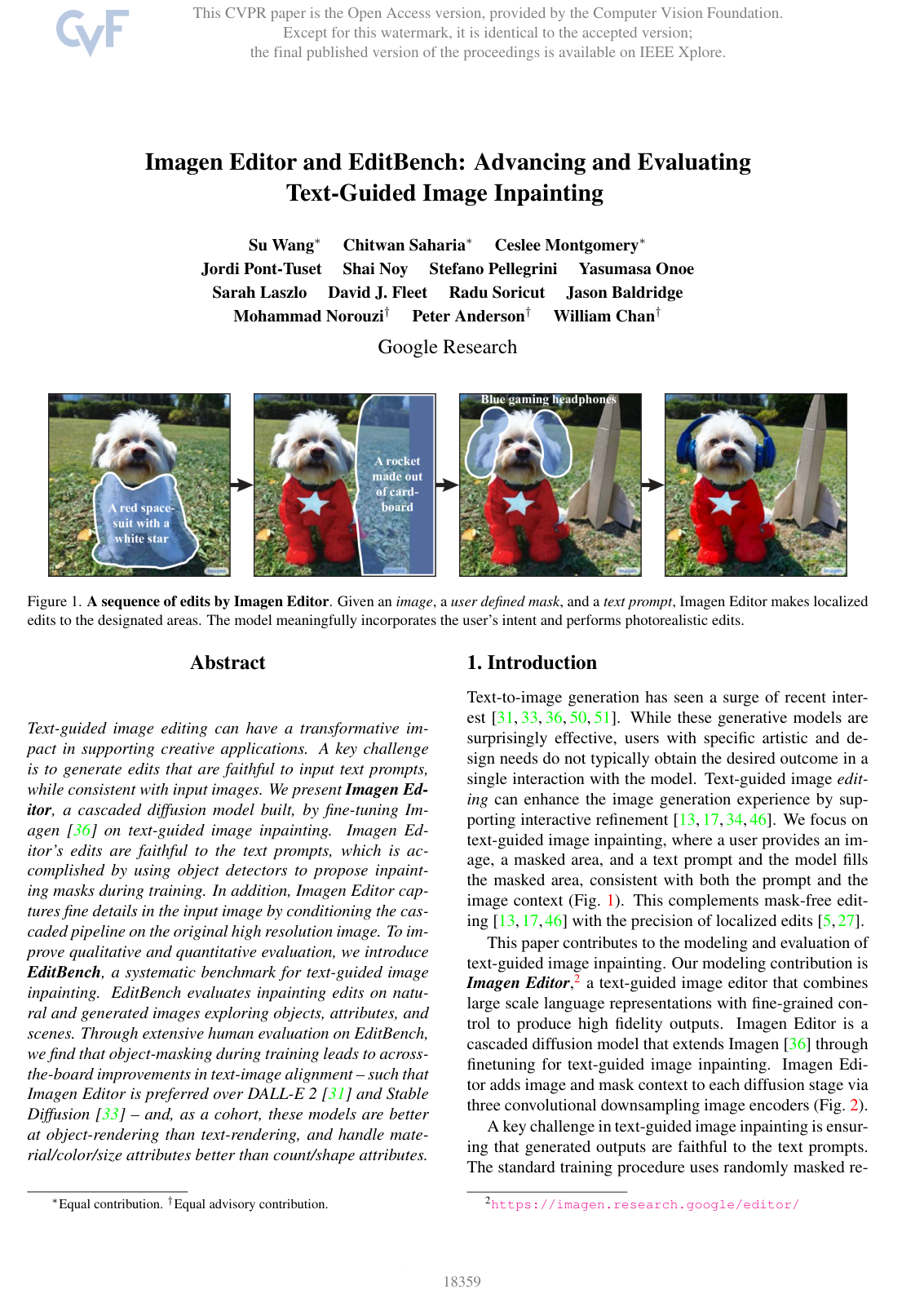
Imagen Editor and EditBench: Advancing and Evaluating Text-Guided Image Inpainting
Su Wang, Chitwan Saharia, Ceslee Montgomery, Jordi Pont-Tuset, Shai Noy, Stefano Pellegrini, Yasumasa Onoe, Sarah Laszlo, David J. Fleet, Radu Soricut, Jason Baldridge, Mohammad Norouzi, Peter Anderson, William Chan
Why you should read this
Presents Imagen Editor, a high-resolution diffusion model that improves prompt-aligned image inpainting via object-detector masking during training, alongside EditBench, a systematic benchmark that reveals fine-grained strengths and limitations across leading text-guided editing models.
Text-guided image editing can have a transformative impact in supporting creative applications. A key challenge is to generate edits that are faithful to input text prompts, while consistent with input images. We present Imagen Editor, a cascaded diffusion model built, by fine-tuning Imagen [36] on text-guided image inpainting. Imagen Editor’s edits are faithful to the text prompts, which is accomplished by using object detectors to propose inpainting masks during training. In addition, Imagen Editor captures fine details in the input image by conditioning the cascaded pipeline on the original high resolution image. To improve qualitative and quantitative evaluation, we introduce EditBench, a systematic benchmark for text-guided image inpainting. EditBench evaluates inpainting edits on natural and generated images exploring objects, attributes, and scenes. Through extensive human evaluation on EditBench, we find that object-masking during training leads to across-the-board improvements in text-image alignment – such that Imagen Editor is preferred over DALL-E 2 [31] and Stable Diffusion [33] – and, as a cohort, these models are better at object-rendering than text-rendering, and handle material/color/size attributes better than count/shape attributes.
Added
2026-09-26
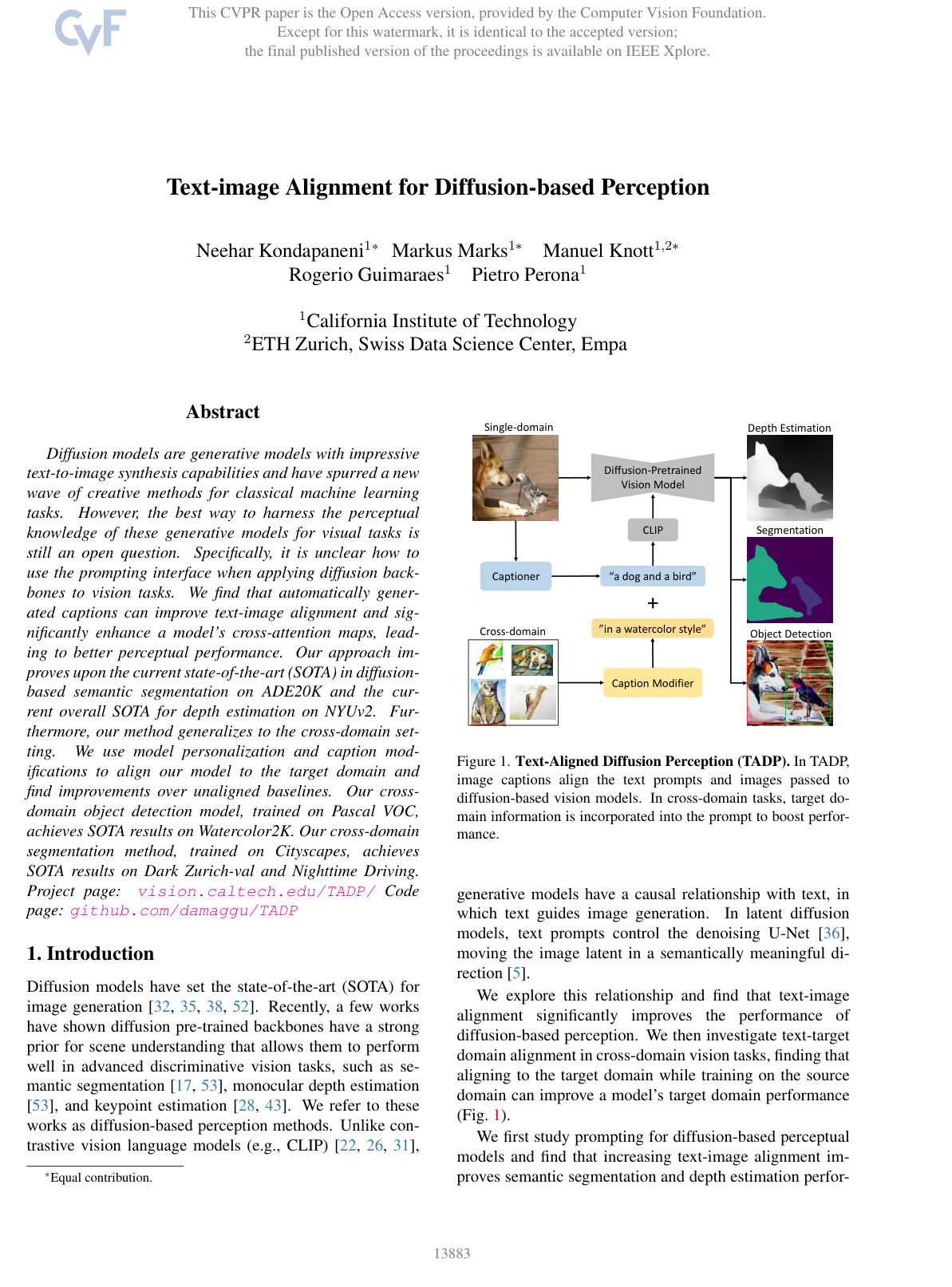
Text-Image Alignment for Diffusion-Based Perception
Neehar Kondapaneni, Markus Marks, Manuel Knott, Rogério Guimarães, Pietro Perona
Why you should read this
Proposes an automated image-captioning prompting framework that improves text-image alignment in pretrained diffusion backbones to achieve state-of-the-art performance across semantic segmentation, depth estimation, and cross-domain visual tasks.
Diffusion models are generative models with impressive text-to-image synthesis capabilities and have spurred a new wave of creative methods for classical machine learning tasks. However, the best way to harness the perceptual knowledge of these generative models for visual tasks is still an open question. Specifically, it is unclear how to use the prompting interface when applying diffusion backbones to vision tasks. We find that automatically generated captions can improve text-image alignment and significantly enhance a model's cross-attention maps, leading to better perceptual performance. Our approach improves upon the current state-of-the-art (SOTA) in diffusion-based semantic segmentation on ADE20K and the current overall SOTA for depth estimation on NYUv2. Furthermore, our method generalizes to the cross-domain setting. We use model personalization and caption modifications to align our model to the target domain and find improvements over unaligned baselines. Our cross-domain object detection model, trained on Pascal VOC, achieves SOTA results on Watercolor2K. Our cross-domain segmentation method, trained on Cityscapes, achieves SOTA results on Dark Zurich-val and Nighttime Driving. Project page: vision.caltech.edu/TADP/ Code page: github.com/damaggu/TADP
Added
2026-09-26