
keyword
text classification
Text classification is a natural language processing and machine learning task that involves automatically assigning one or more predefined categories or labels to unstructured text documents, sentences, or queries based on their content. The process converts raw text into numerical representations, which can range from traditional statistical features and word vectors to dense representations derived from deep neural networks and pre-trained transformer language models. Algorithms then analyze these features to identify patterns and predict the appropriate classes, supporting diverse real-world applications such as sentiment analysis, spam detection, news topic categorization, user intent recognition, and content moderation.
43 items
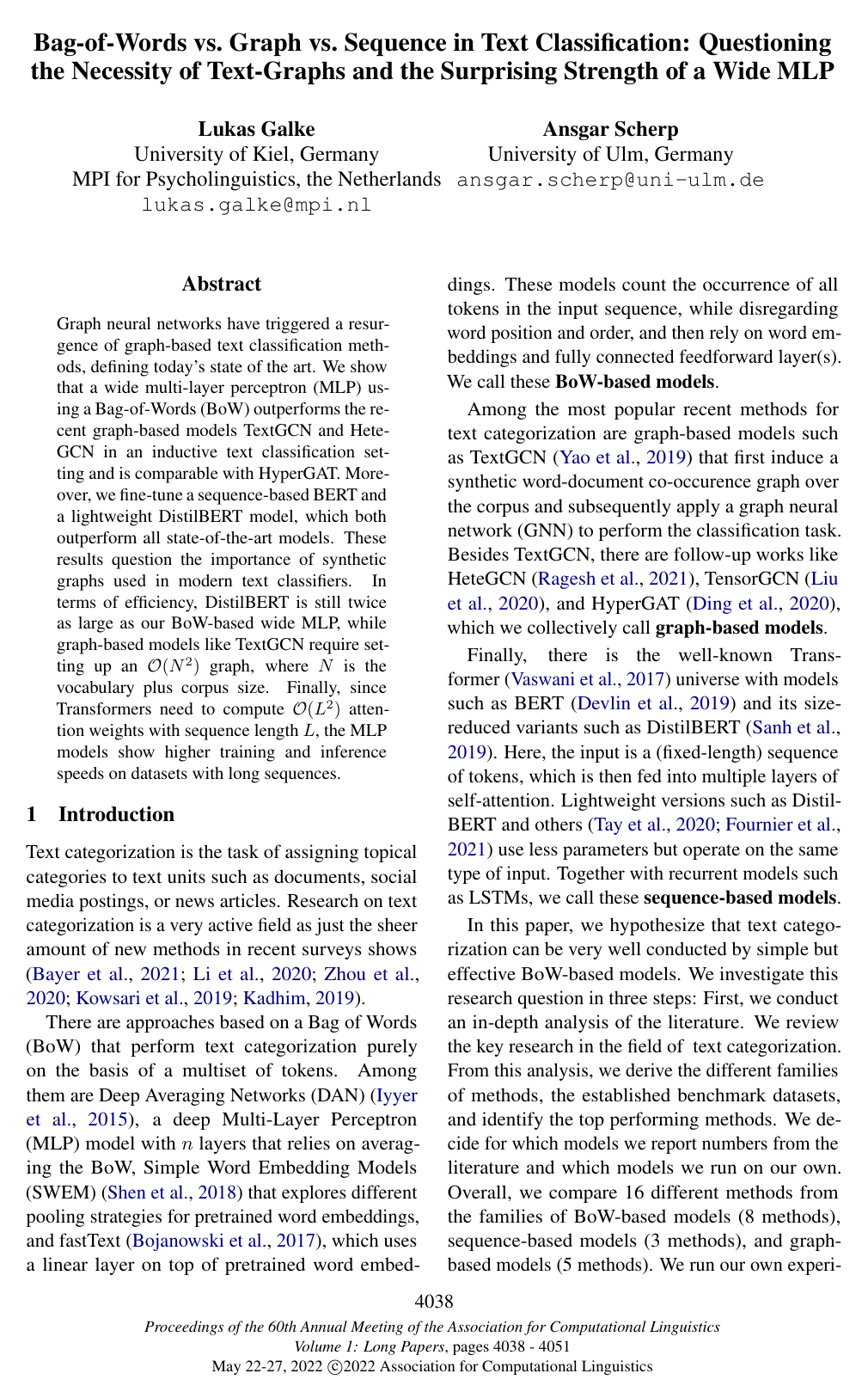
Bag-of-Words vs. Graph vs. Sequence in Text Classification: Questioning the Necessity of Text-Graphs and the Surprising Strength of a Wide MLP
Lukas Galke, Ansgar Scherp
Why you should read this
Demonstrates that a simple, wide bag-of-words multi-layer perceptron outperforms complex graph neural networks like TextGCN in inductive text classification while offering significantly faster training and inference than Transformer models on long sequences.
Graph neural networks have triggered a resurgence of graph-based text classification methods, defining today’s state of the art. We show that a wide multi-layer perceptron (MLP) using a Bag-of-Words (BoW) outperforms the recent graph-based models TextGCN and HeteGCN in an inductive text classification setting and is comparable with HyperGAT. Moreover, we fine-tune a sequence-based BERT and a lightweight DistilBERT model, which both outperform all state-of-the-art models. These results question the importance of synthetic graphs used in modern text classifiers. In terms of efficiency, DistilBERT is still twice as large as our BoW-based wide MLP, while graph-based models like TextGCN require setting up an O(N²) graph, where N is the vocabulary plus corpus size. Finally, since Transformers need to compute O(L²) attention weights with sequence length L, the MLP models show higher training and inference speeds on datasets with long sequences.
Added
2026-10-03
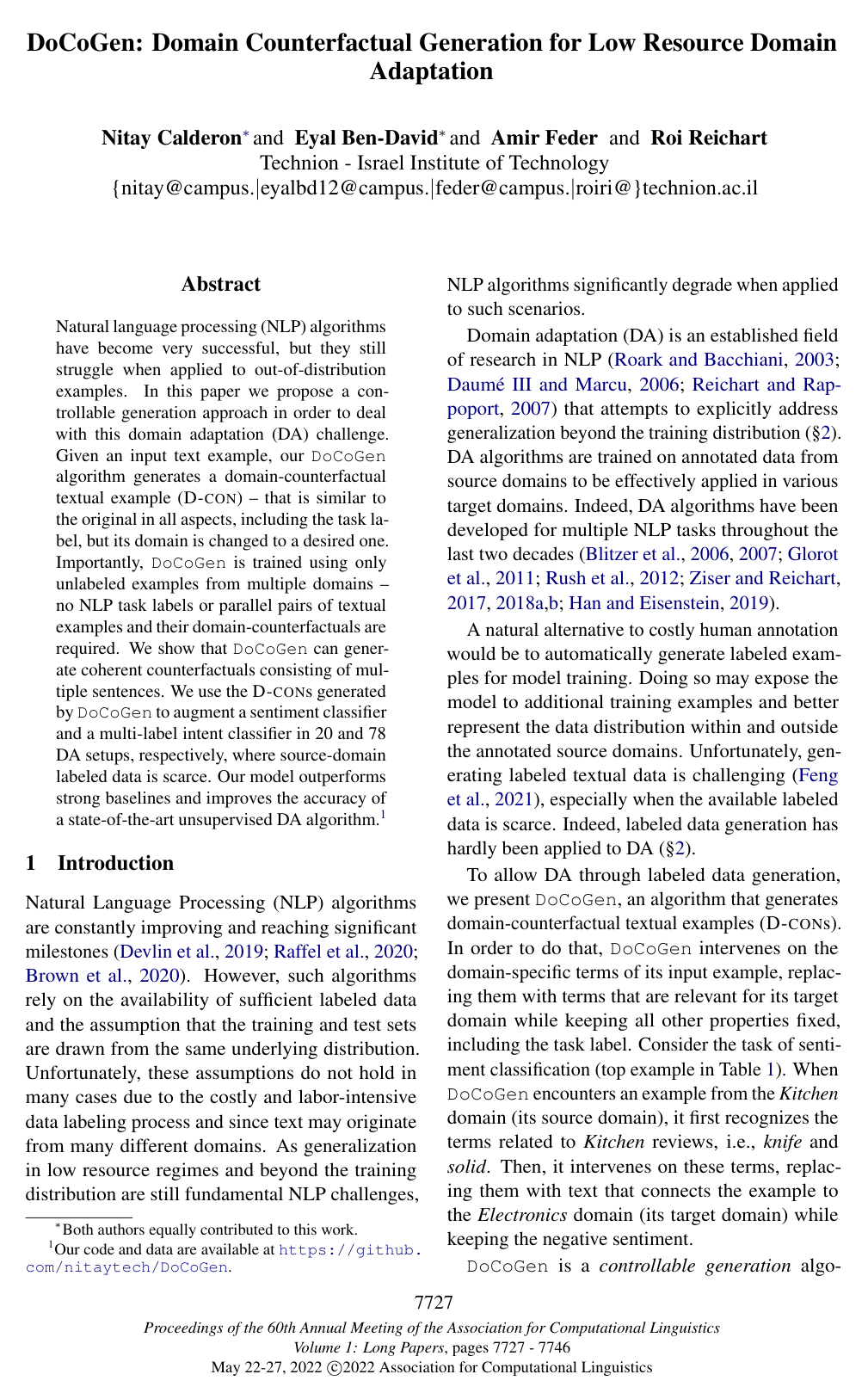
DoCoGen: Domain Counterfactual Generation for Low Resource Domain Adaptation
Nitay Calderon, Eyal Ben-David, Amir Feder, Roi Reichart
Why you should read this
Proposes DoCoGen, an unsupervised controllable generation framework that transforms multi-sentence texts across domains while preserving their task labels, enabling effective data augmentation for low-resource domain adaptation without requiring parallel text or target task annotations.
Natural language processing (NLP) algorithms have become very successful, but they still struggle when applied to out-of-distribution examples. In this paper we propose a controllable generation approach in order to deal with this domain adaptation (DA) challenge. Given an input text example, our DoCoGen algorithm generates a domain-counterfactual textual example (D-CON) – that is similar to the original in all aspects, including the task label, but its domain is changed to a desired one. Importantly, DoCoGen is trained using only unlabeled examples from multiple domains – no NLP task labels or parallel pairs of textual examples and their domain-counterfactuals are required. We show that DoCoGen can generate coherent counterfactuals consisting of multiple sentences. We use the D-CONs generated by DoCoGen to augment a sentiment classifier and a multi-label intent classifier in 20 and 78 DA setups, respectively, where source-domain labeled data is scarce. Our model outperforms strong baselines and improves the accuracy of a state-of-the-art unsupervised DA algorithm.
Added
2026-10-03
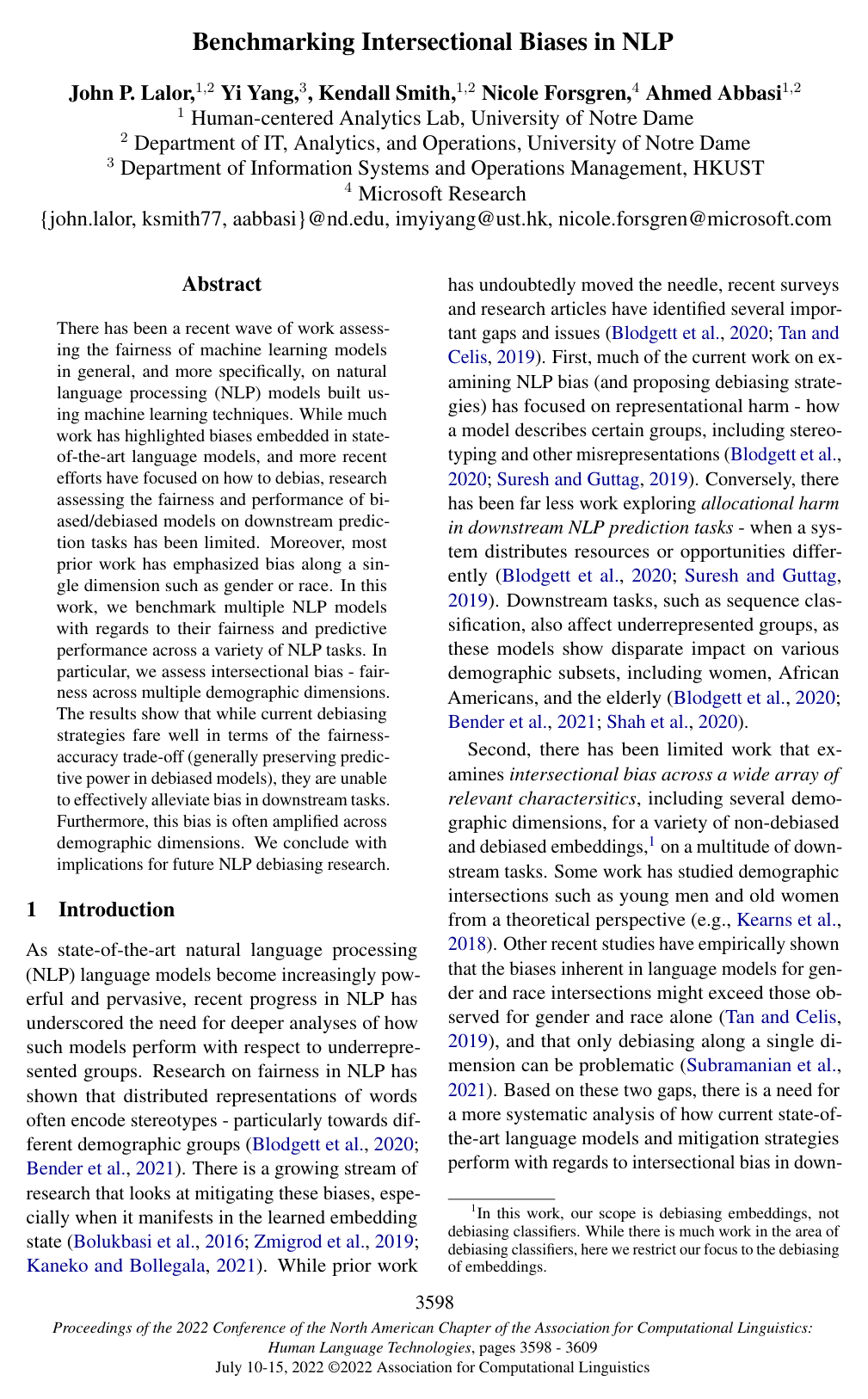
Benchmarking Intersectional Biases in NLP
John Lalor, Yi Yang, Kendall Smith, Nicole Forsgren, Ahmed Abbasi
Why you should read this
Reveals that standard debiasing techniques fail to prevent amplified allocational harms across intersecting demographic dimensions in downstream natural language processing tasks despite preserving predictive accuracy.
Added
2026-10-03
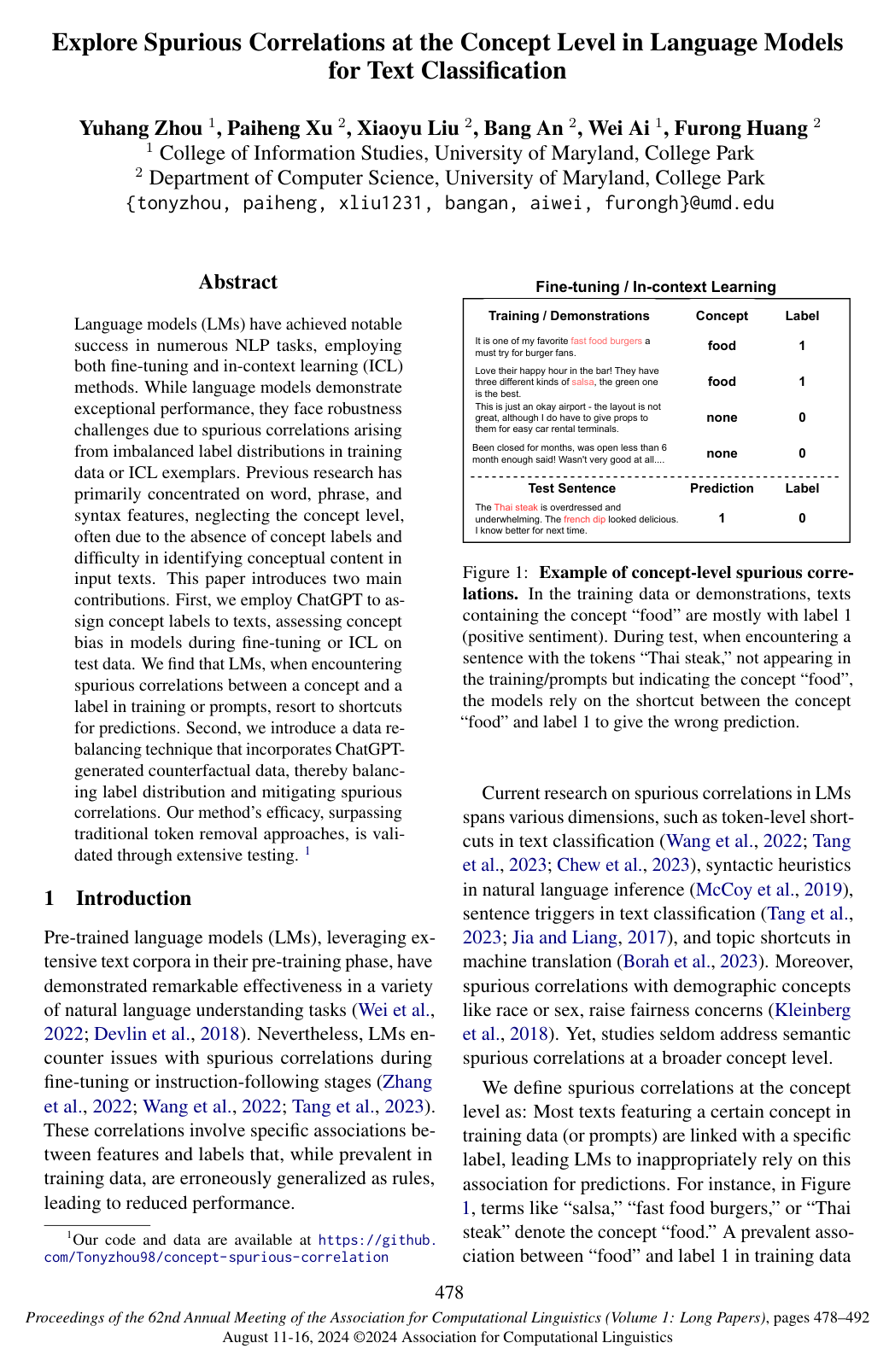
Explore Spurious Correlations at the Concept Level in Language Models for Text Classification
Yuhang Zhou, Paiheng Xu, Xiaoyu Liu, Bang An, Wei Ai, Furong Huang
Why you should read this
Reveals how language models learn shortcut predictions from broader concept-level biases in both fine-tuning and in-context learning, and presents a counterfactual data rebalancing method to eliminate these errors while preserving classification accuracy.
Language models (LMs) have achieved notable success in numerous NLP tasks, employing both fine-tuning and in-context learning (ICL) methods. While language models demonstrate exceptional performance, they face robustness challenges due to spurious correlations arising from imbalanced label distributions in training data or ICL exemplars. Previous research has primarily concentrated on word, phrase, and syntax features, neglecting the concept level, often due to the absence of concept labels and difficulty in identifying conceptual content in input texts. This paper introduces two main contributions. First, we employ ChatGPT to assign concept labels to texts, assessing concept bias in models during fine-tuning or ICL on test data. We find that LMs, when encountering spurious correlations between a concept and a label in training or prompts, resort to shortcuts for predictions. Second, we introduce a data re-balancing technique that incorporates ChatGPT-generated counterfactual data, thereby balancing label distribution and mitigating spurious correlations. Our method’s efficacy, surpassing traditional token removal approaches, is validated through extensive testing.
Added
2026-10-03
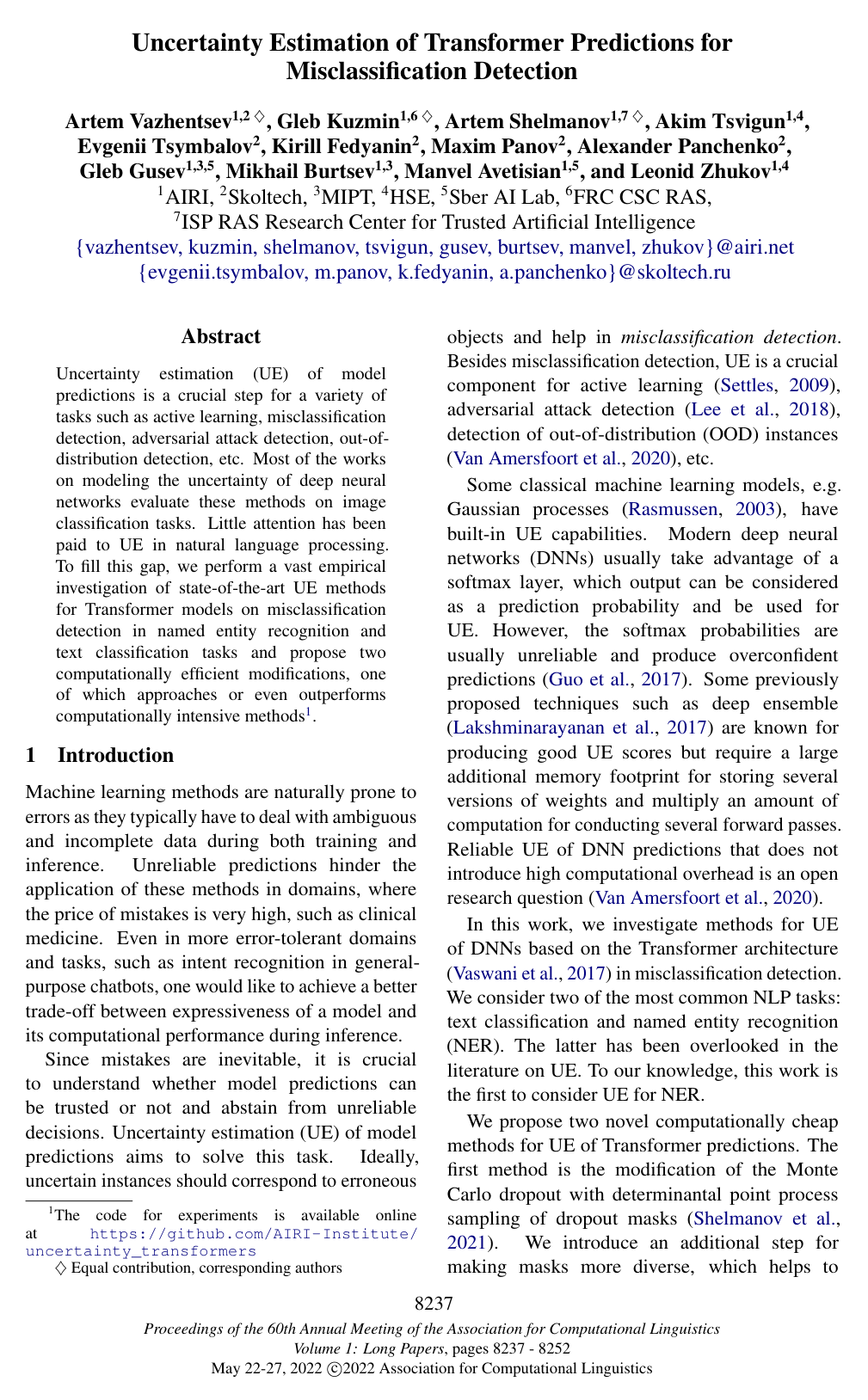
Uncertainty Estimation of Transformer Predictions for Misclassification Detection
Artem Vazhentsev, Gleb Kuzmin, Artem Shelmanov, Akim Tsvigun, Evgenii Tsymbalov, Kirill Fedyanin, Maxim Panov, Alexander Panchenko, Gleb Gusev, Mikhail Burtsev, Manvel Avetisian, Leonid Zhukov
Why you should read this
Develops computationally efficient uncertainty estimation methods for Transformer models in text classification and named entity recognition, demonstrating that a spectral-normalized Mahalanobis distance approach can rival or exceed heavy deep ensembles at detecting misclassifications.
Uncertainty estimation (UE) of model predictions is a crucial step for a variety of tasks such as active learning, misclassification detection, adversarial attack detection, out-of-distribution detection, etc. Most of the works on modeling the uncertainty of deep neural networks evaluate these methods on image classification tasks. Little attention has been paid to UE in natural language processing. To fill this gap, we perform a vast empirical investigation of state-of-the-art UE methods for Transformer models on misclassification detection in named entity recognition and text classification tasks and propose two computationally efficient modifications, one of which approaches or even outperforms computationally intensive methods1.
Added
2026-10-03
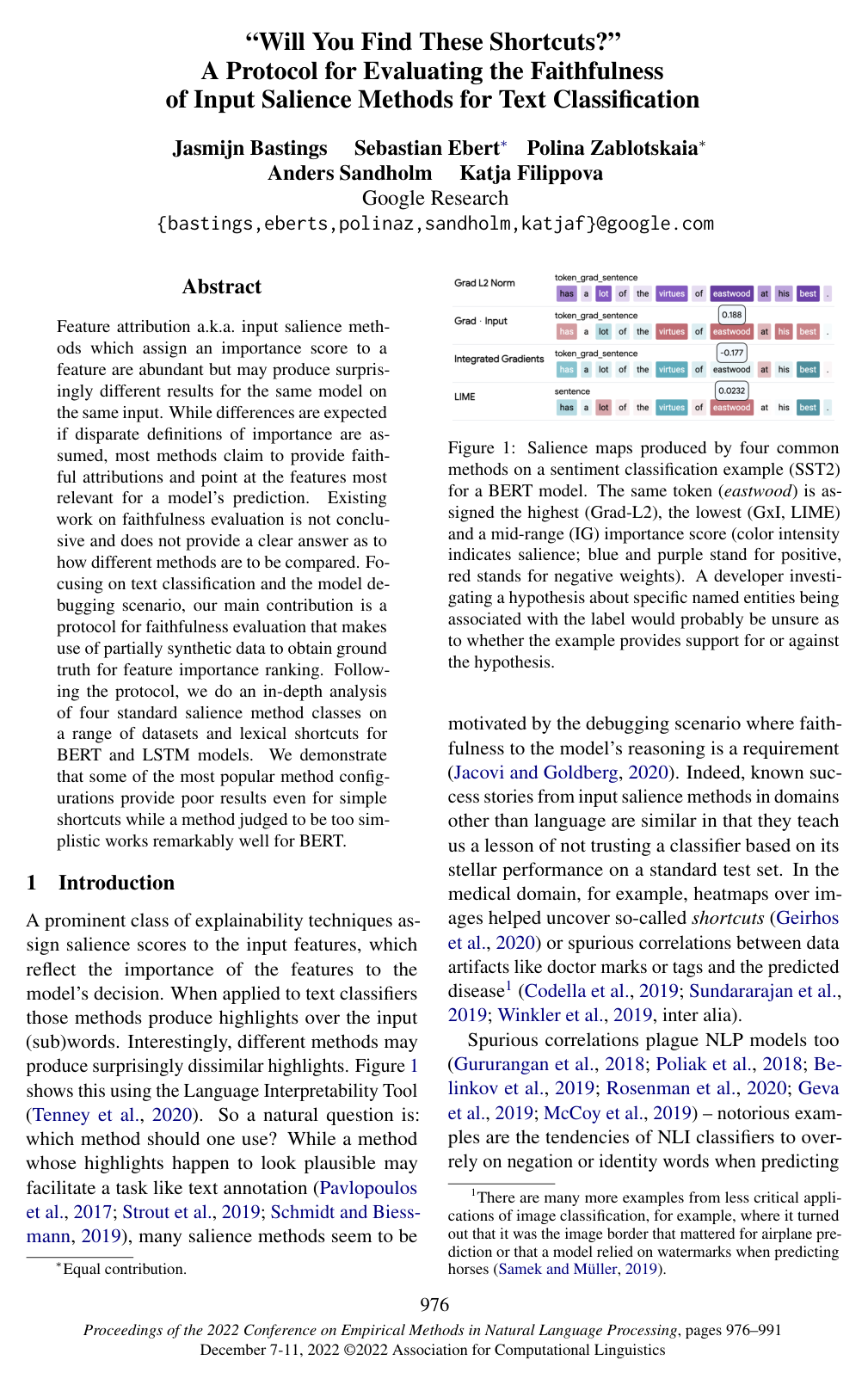
"Will You Find These Shortcuts?" A Protocol for Evaluating the Faithfulness of Input Salience Methods for Text Classification
Jasmijn Bastings, Sebastian Ebert, Polina Zablotskaia, Anders Sandholm, Katja Filippova
Why you should read this
Establishes a rigorous evaluation protocol using synthetic shortcut injection to benchmark the faithfulness of input salience methods, revealing that popular explanation techniques often fail to detect even simple lexical patterns used by text classifiers.
A common approach for explaining predictions made by neural networks is to identify salient features using gradients or attention. In natural language processing specifically, there have been several approaches proposed to compute gradient-based token importance scores; yet their faithfulness remains unclear: e.g., do they agree where important tokens occur? different formulations may yield completely different explanations, making comparisons across papers ambiguous. Existing evaluation practice often relies solely on intuition—both when designing new explanation techniques and reporting results.We propose experiments called “shortcut” tasks specially crafted such that we know which spurious patterns could exist in data and how easily models would pick them up instead of meaningful signals.Empirically, neither commonly used variants of input salience methods nor attention pass our tests consistently.This calls into question prior work based entirely on automatic metrics.Finally, we suggest simple practical recommendations relating design choices in evaluating model behavior to obtainmore faithful attributions.The code base supporting all analyses reported here hasbeen released alongwith an interactive online tool accompanyingthis paper.Both links accessibleat https://github.com/google-research/ \allowbreak google-research/tree/master/saliency\_faith fulness .Thus,in summary,the contributionsofourpaperare( )a setoffive shortcuttasksincontrolledsettingsofdifferentcomplexities;(ii) asystematicstudyofgradientbasedsaliencymethodsacrossthese five settings,w.r.t.multipletextclassifiersincludingstateoftheartmodelsfine tunedonfourlanguage datasets,and(iii)a concrete proposaltoaugmentexistingbenchmarksingle-taskmetricsbyadditionalmulti taskediagnosticsdrivenbyeitheroftheshortcutdatasetsintroducedorrealisticdomainspecificpatternsaswe exemplifyfortoxicitydetection.Wenotethatexplanationsamplersemustbecausally relatedtothedecisionprocess,butalsomusto beclearly communicatedtothestakeholder,i.e.acontentprovideroranend-user-inthatsenseouremphasisisonanalyzingthemethodratherthanjustperformance.Hence,intheabsenceofaformalframeworkforevaluatingex planation qualityweproposeaprotocolthatisolatesbehavioraldifferenceswhile encouragingtheadoptionofcommonscoresfordistinctclasses ofexplanation methods
Added
2026-10-02
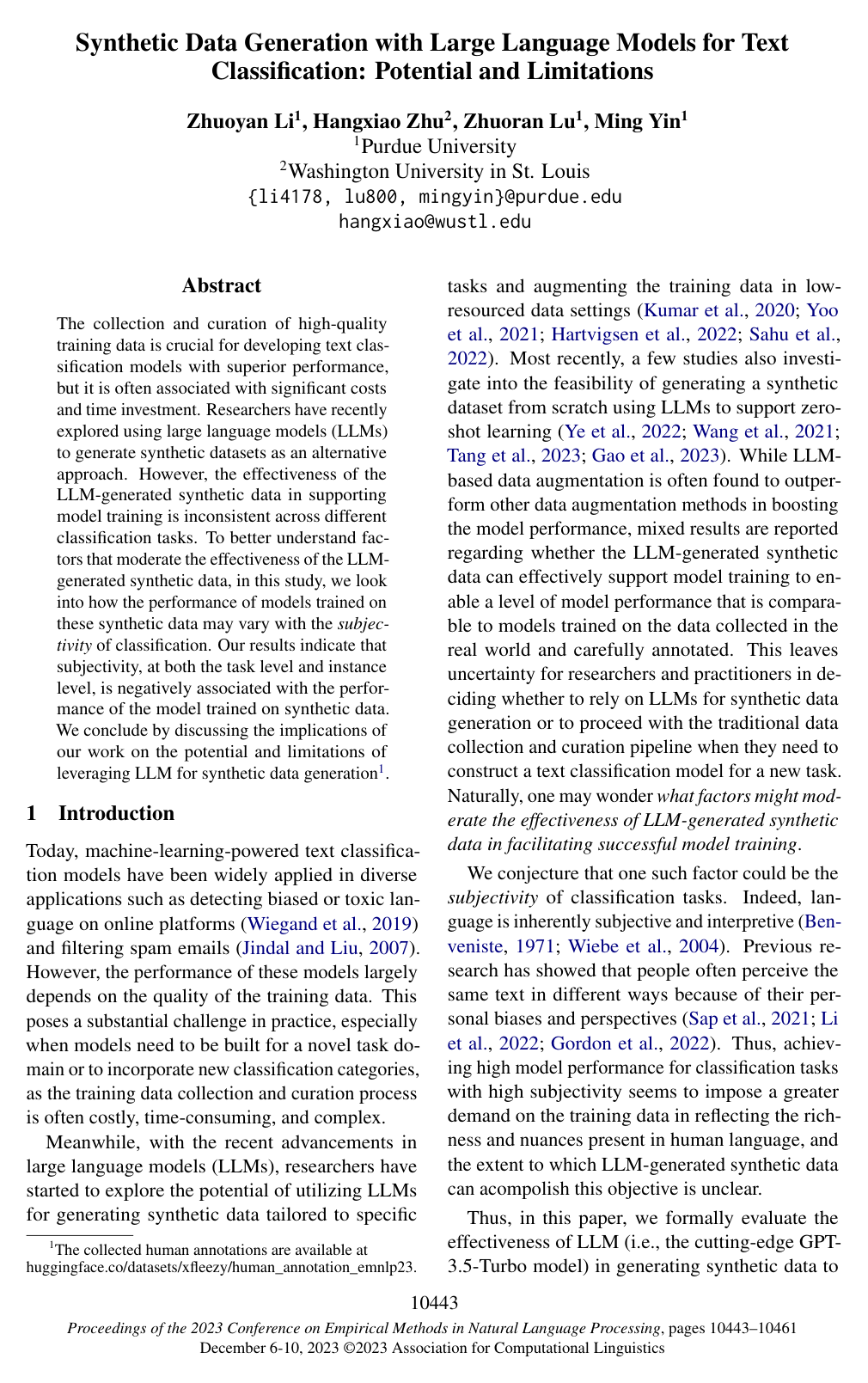
Synthetic Data Generation with Large Language Models for Text Classification: Potential and Limitations
Zhuoyan Li, Hangxiao Zhu, Zhuoran Lu, Ming Yin
Why you should read this
Demonstrates through empirical evaluation across ten datasets that the effectiveness of LLM-generated synthetic training data for text classifiers degrades significantly as task and instance subjectivity increase.
The collection and curation of high-quality training data is crucial for developing text classification models with superior performance, but it is often associated with significant costs and time investment. Researchers have recently explored using large language models (LLMs) to generate synthetic datasets as an alternative approach. However, the effectiveness of the LLM-generated synthetic data in supporting model training is inconsistent across different classification tasks. To better understand factors that moderate the effectiveness of the LLM-generated synthetic data, in this study, we look into how the performance of models trained on these synthetic data may vary with the subjectivity of classification. Our results indicate that subjectivity, at both the task level and instance level, is negatively associated with the performance of the model trained on synthetic data. We conclude by discussing the implications of our work on the potential and limitations of leveraging LLM for synthetic data generation¹.
Added
2026-10-01
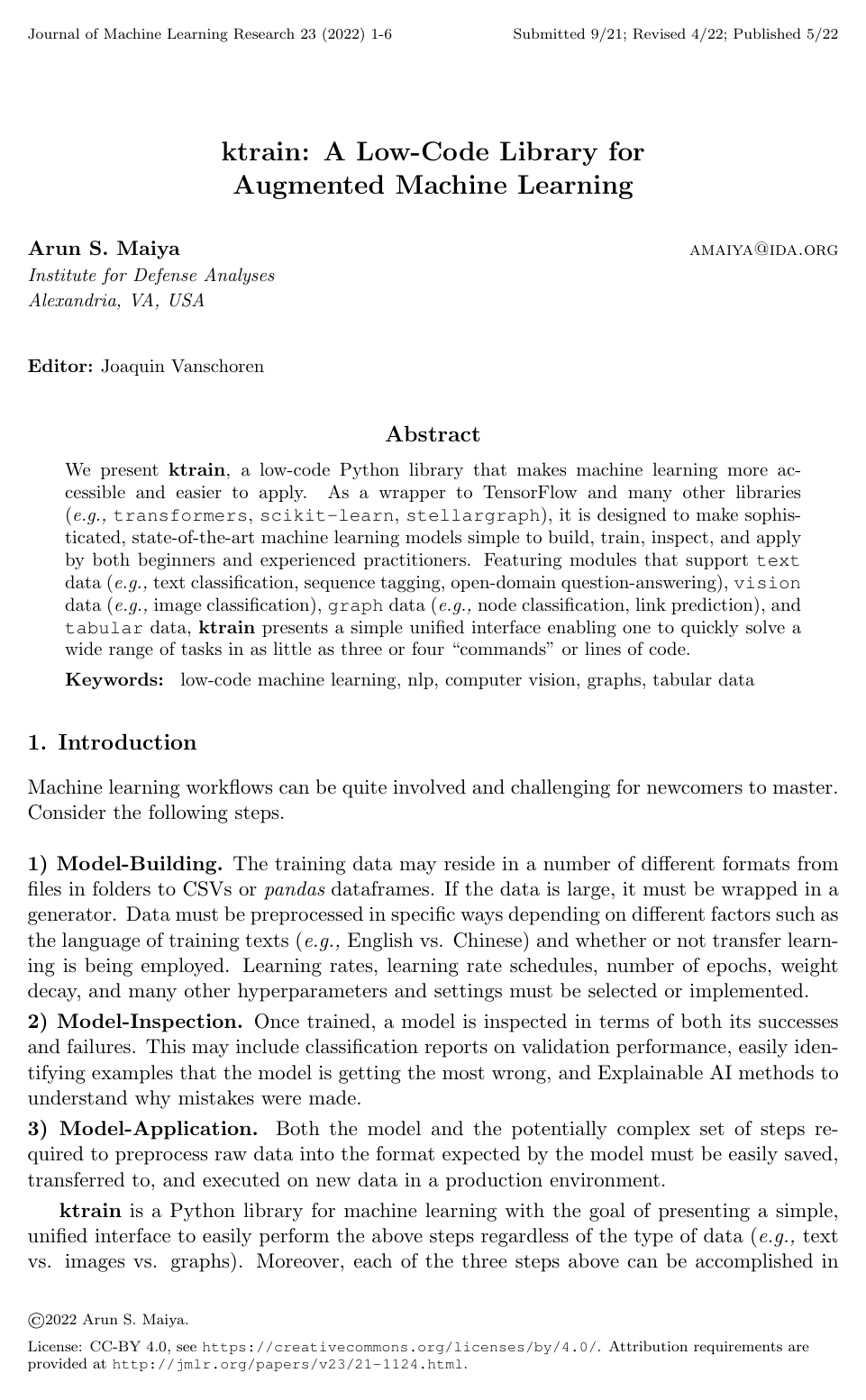
ktrain: A Low-Code Library for Augmented Machine Learning
Arun S. Maiya
Why you should read this
Presents an open-source Python library that wraps TensorFlow and Hugging Face Transformers to train, inspect, and deploy state-of-the-art machine learning models across text, vision, graph, and tabular domains using only a few lines of code.
We present ktrain, a low-code Python library that makes machine learning more accessible and easier to apply. As a wrapper to TensorFlow and many other libraries (e.g., transformers, scikit-learn, stellargraph), it is designed to make sophisticated, state-of-the-art machine learning models simple to build, train, inspect, and apply by both beginners and experienced practitioners. Featuring modules that support text data (e.g., text classification, sequence tagging, open-domain question-answering), vision data (e.g., image classification), graph data (e.g., node classification, link prediction), and tabular data, ktrain presents a simple unified interface enabling one to quickly solve a wide range of tasks in as little as three or four “commands” or lines of code.
Added
2026-09-30
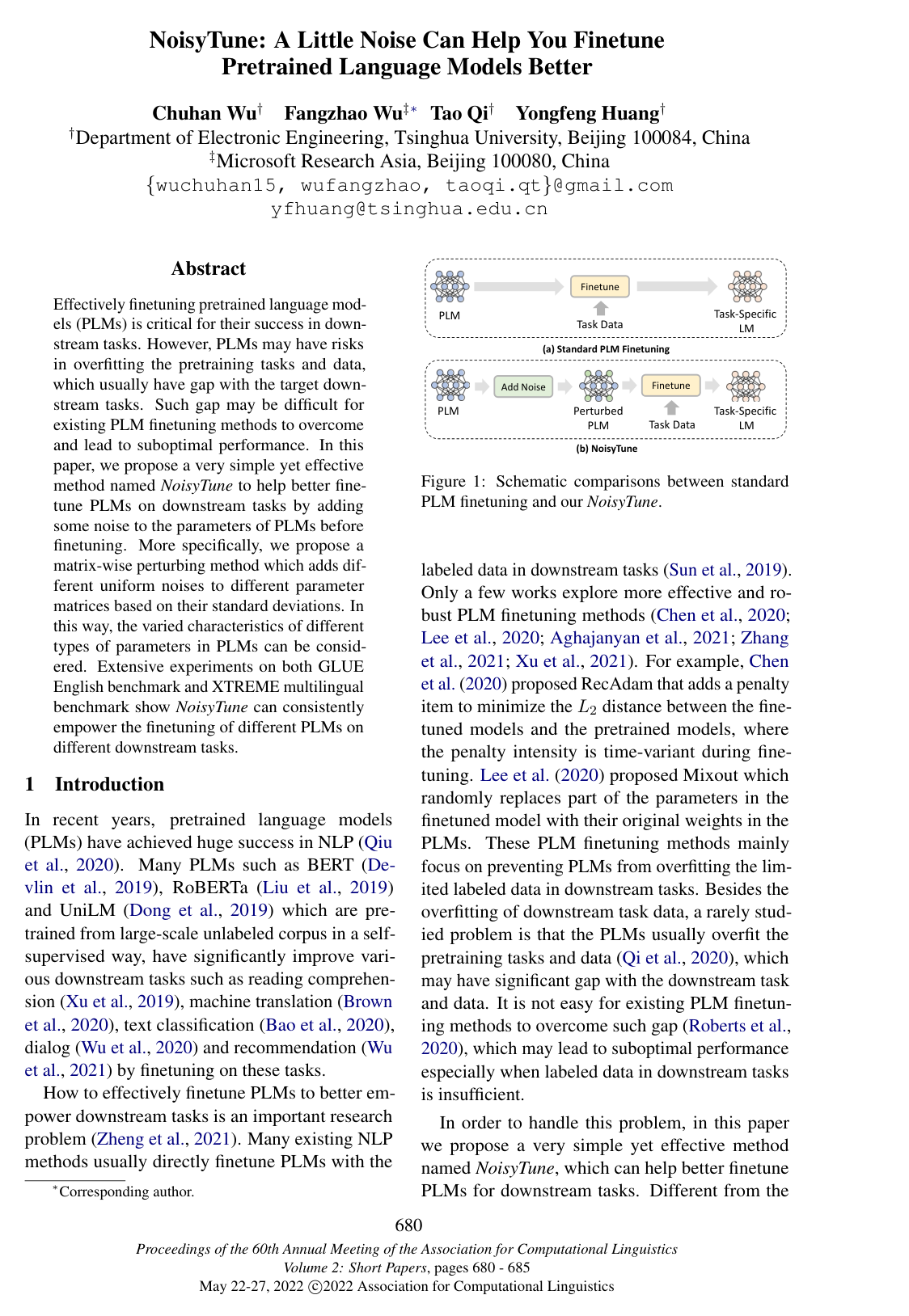
NoisyTune: A Little Noise Can Help You Finetune Pretrained Language Models Better
Chuhan Wu, Fangzhao Wu, Tao Qi, Yongfeng Huang
Why you should read this
Proposes NoisyTune, a lightweight and easily implementable method that improves downstream fine-tuning by adding matrix-wise uniform noise scaled by parameter standard deviations to prevent pretrained language models from overfitting their pretraining tasks.
Effectively finetuning pretrained language models (PLMs) is critical for their success in downstream tasks. However, PLMs may have risks in overfitting the pretraining tasks and data, which usually have gap with the target downstream tasks. Such gap may be difficult for existing PLM finetuning methods to overcome and lead to suboptimal performance. In this paper, we propose a very simple yet effective method named NoisyTune to help better finetune PLMs on downstream tasks by adding some noise to the parameters of PLMs before finetuning. More specifically, we propose a matrix-wise perturbing method which adds different uniform noises to different parameter matrices based on their standard deviations. In this way, the varied characteristics of different types of parameters in PLMs can be considered. Extensive experiments on both GLUE English benchmark and XTREME multilingual benchmark show NoisyTune can consistently empower the finetuning of different PLMs on different downstream tasks.
Added
2026-09-26
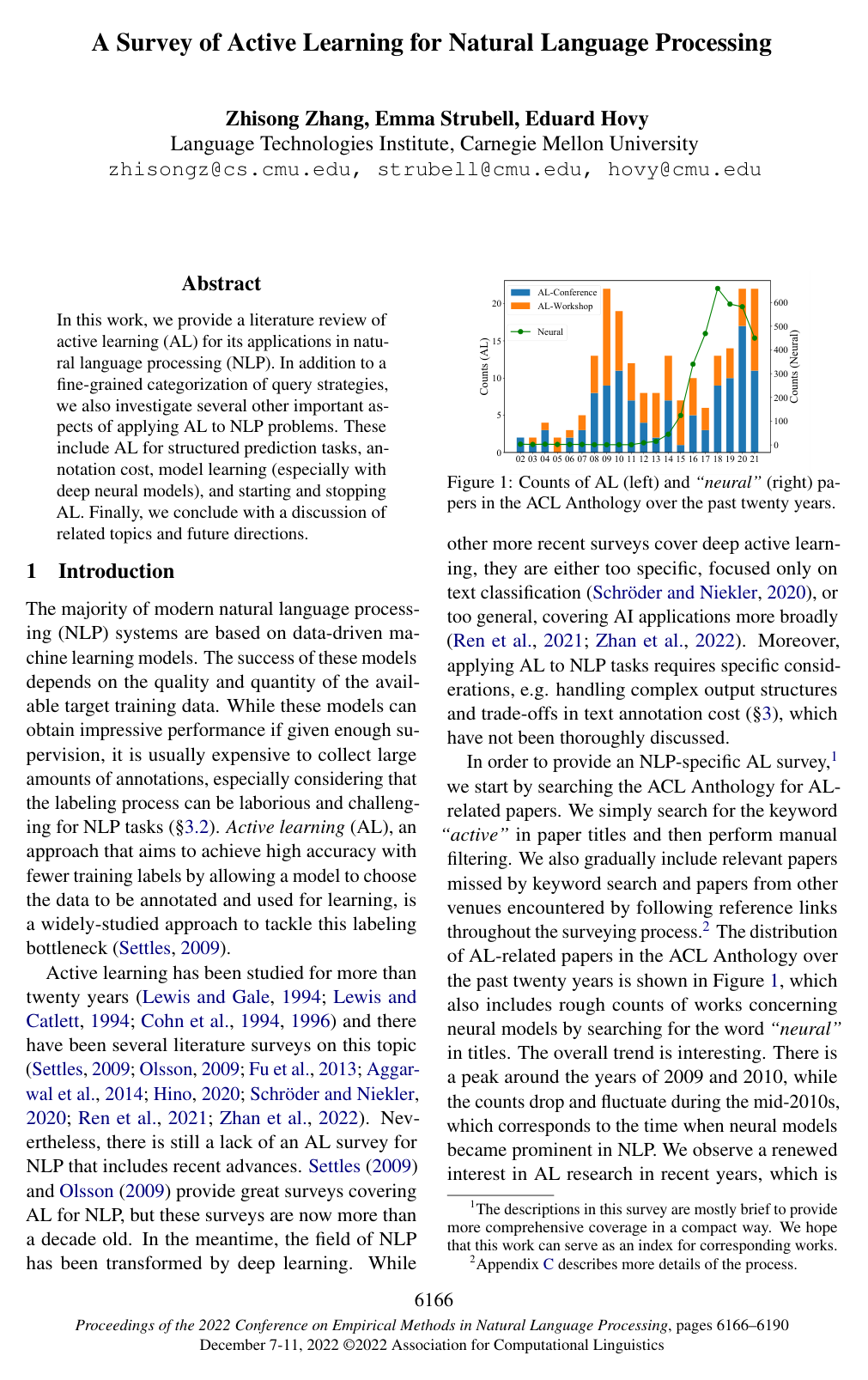
A Survey of Active Learning for Natural Language Processing
Zhisong Zhang, Emma Strubell, Eduard H. Hovy
Why you should read this
Presents a structured overview of active learning query strategies and practical challenges specific to natural language processing, offering essential guidance on handling deep neural architectures, structured prediction, and annotation costs.
In this work, we provide a literature review of active learning (AL) for its applications in natural language processing (NLP). In addition to a fine-grained categorization of query strategies, we also investigate several other important aspects of applying AL to NLP problems. These include AL for structured prediction tasks, annotation cost, model learning (especially with deep neural models), and starting and stopping AL. Finally, we conclude with a discussion of related topics and future directions.
Added
2026-09-26
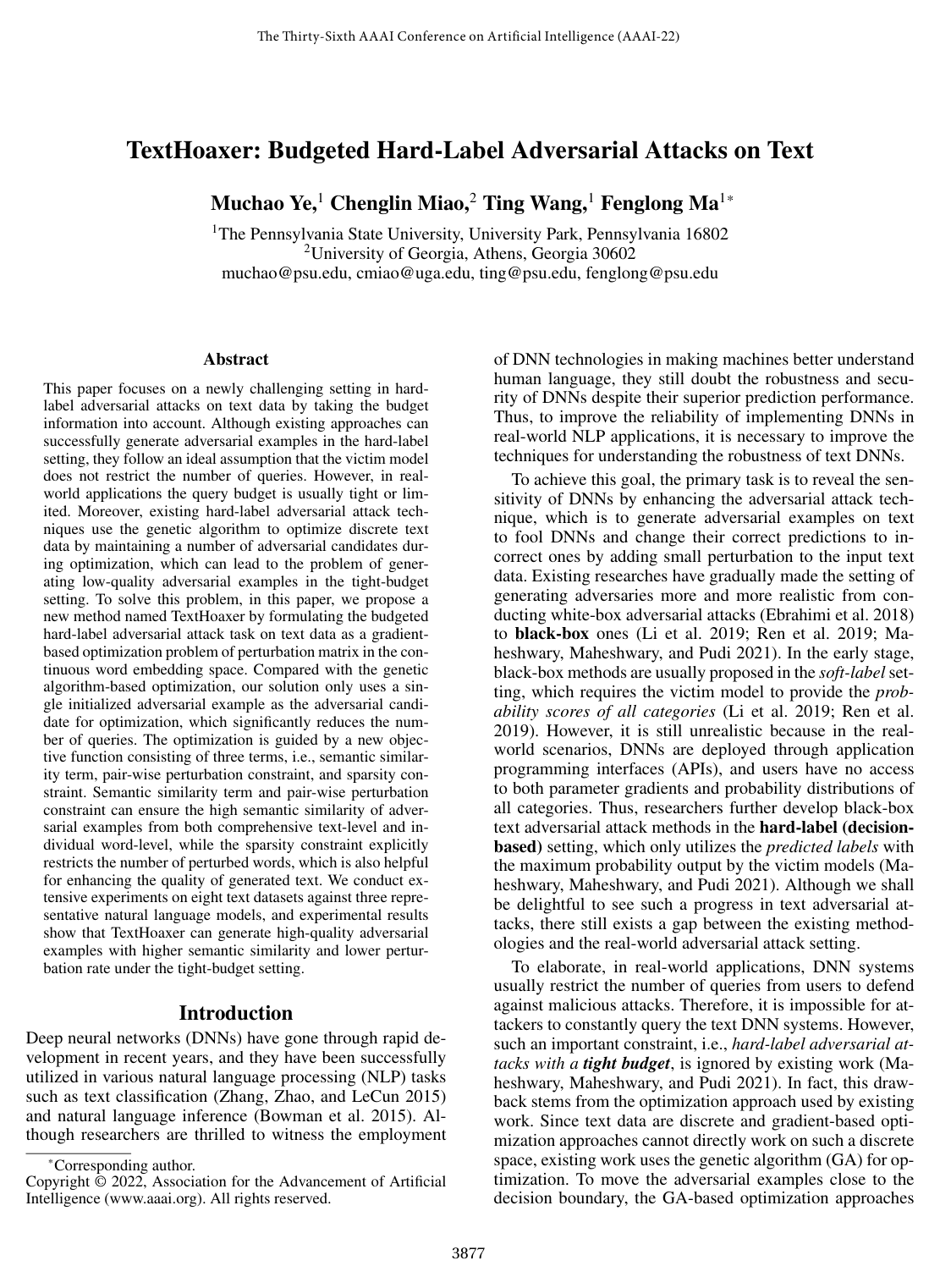
TextHoaxer: Budgeted Hard-Label Adversarial Attacks on Text
Muchao Ye, Chenglin Miao, Ting Wang, Fenglong Ma
Why you should read this
Proposes TextHoaxer, a gradient-based framework that formulates hard-label text adversarial attacks in continuous word embedding space to generate high-similarity adversarial examples under strict query budgets without relying on query-expensive genetic algorithms.
This paper focuses on a newly challenging setting in hard-label adversarial attacks on text data by taking the budget information into account. Although existing approaches can successfully generate adversarial examples in the hard-label setting, they follow an ideal assumption that the victim model does not restrict the number of queries. However, in real-world applications the query budget is usually tight or limited. Moreover, existing hard-label adversarial attack techniques use the genetic algorithm to optimize discrete text data by maintaining a number of adversarial candidates during optimization, which can lead to the problem of generating low-quality adversarial examples in the tight-budget setting. To solve this problem, in this paper, we propose a new method named TextHoaxer by formulating the budgeted hard-label adversarial attack task on text data as a gradient-based optimization problem of perturbation matrix in the continuous word embedding space. Compared with the genetic algorithm-based optimization, our solution only uses a single initialized adversarial example as the adversarial candidate for optimization, which significantly reduces the number of queries. The optimization is guided by a new objective function consisting of three terms, i.e., semantic similarity term, pair-wise perturbation constraint, and sparsity constraint. Semantic similarity term and pair-wise perturbation constraint can ensure the high semantic similarity of adversarial examples from both comprehensive text-level and individual word-level, while the sparsity constraint explicitly restricts the number of perturbed words, which is also helpful for enhancing the quality of generated text. We conduct extensive experiments on eight text datasets against three representative natural language models, and experimental results show that TextHoaxer can generate high-quality adversarial examples with higher semantic similarity and lower perturbation rate under the tight-budget setting.
Added
2026-09-26
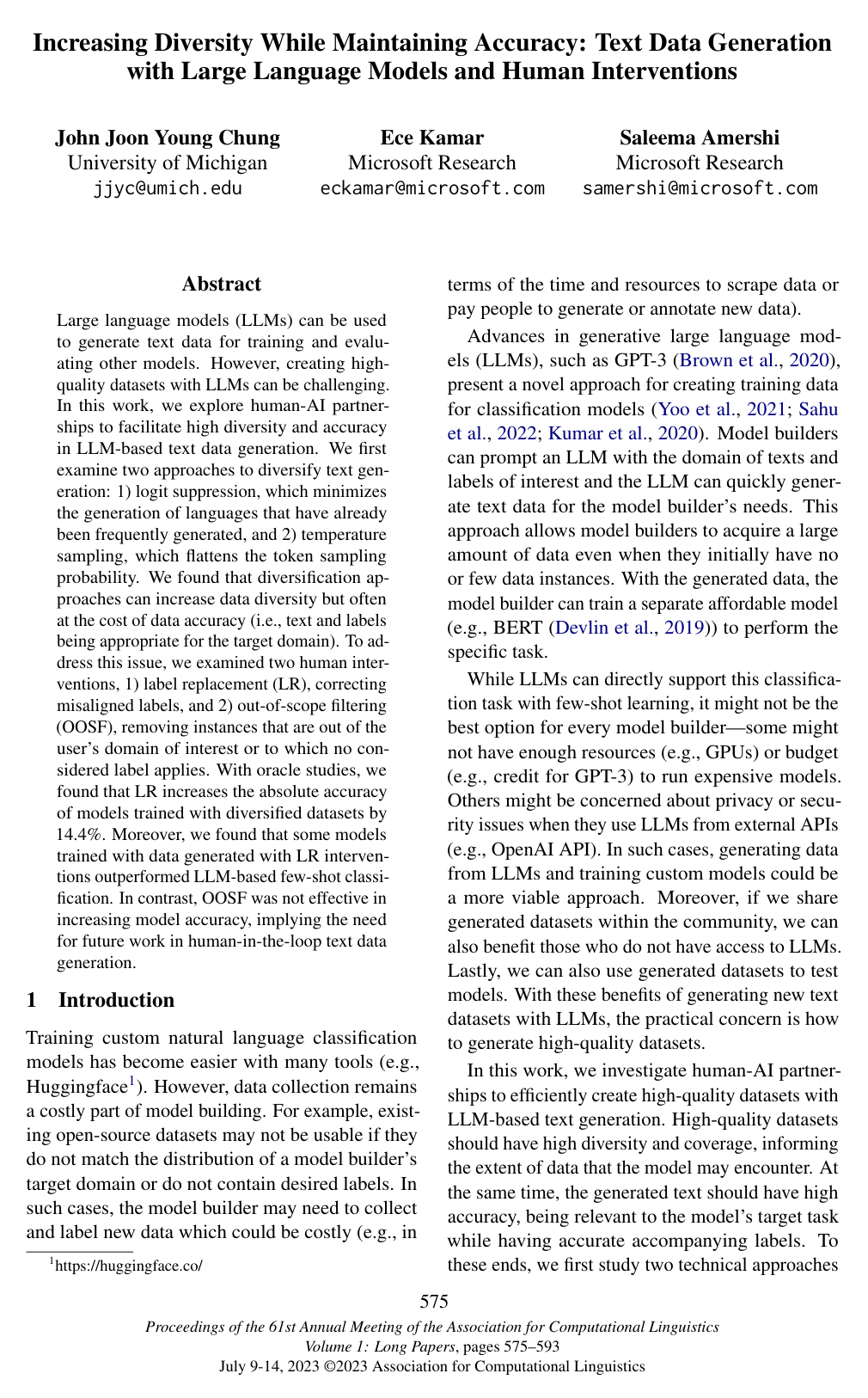
Increasing Diversity While Maintaining Accuracy: Text Data Generation with Large Language Models and Human Interventions
John Joon Young Chung, Ece Kamar, Saleema Amershi
Why you should read this
Demonstrates how combining large language model diversification techniques with targeted human label replacement allows smaller downstream classifiers to outperform few-shot large language models by balancing synthetic text variety and annotation accuracy.
Large language models (LLMs) can be used to generate text data for training and evaluating other models. However, creating high-quality datasets with LLMs can be challenging. In this work, we explore human-AI partnerships to facilitate high diversity and accuracy in LLM-based text data generation. We first examine two approaches to diversify text generation: 1) logit suppression, which minimizes the generation of languages that have already been frequently generated, and 2) temperature sampling, which flattens the token sampling probability. We found that diversification approaches can increase data diversity but often at the cost of data accuracy (i.e., text and labels being appropriate for the target domain). To address this issue, we examined two human interventions, 1) label replacement (LR), correcting misaligned labels, and 2) out-of-scope filtering (OOSF), removing instances that are out of the user’s domain of interest or to which no considered label applies. With oracle studies, we found that LR increases the absolute accuracy of models trained with diversified datasets by 14.4%. Moreover, we found that some models trained with data generated with LR interventions outperformed LLM-based few-shot classification. In contrast, OOSF was not effective in increasing model accuracy, implying the need for future work in human-in-the-loop text data generation.
Added
2026-09-26
A Sensitivity Analysis of (and Practitioners’ Guide to) Convolutional Neural Networks for Sentence Classification
Ye Zhang, Byron C. Wallace
Why you should read this
Establishes practical guidelines for configuring convolutional neural networks in sentence classification by isolating which hyperparameter choices critically influence model accuracy and which can be safely neglected.
Convolutional Neural Networks (CNNs) have recently achieved remarkably strong performance on the practically important task of sentence classification (kim 2014, kalchbrenner 2014, johnson 2014). However, these models require practitioners to specify an exact model architecture and set accompanying hyperparameters, including the filter region size, regularization parameters, and so on. It is currently unknown how sensitive model performance is to changes in these configurations for the task of sentence classification. We thus conduct a sensitivity analysis of one-layer CNNs to explore the effect of architecture components on model performance; our aim is to distinguish between important and comparatively inconsequential design decisions for sentence classification. We focus on one-layer CNNs (to the exclusion of more complex models) due to their comparative simplicity and strong empirical performance, which makes it a modern standard baseline method akin to Support Vector Machine (SVMs) and logistic regression. We derive practical advice from our extensive empirical results for those interested in getting the most out of CNNs for sentence classification in real world settings.
Added
2026-09-25
Recurrent Neural Network for Text Classification with Multi-Task Learning
Pengfei Liu, Xipeng Qiu, Xuanjing Huang
Why you should read this
Proposes three multi-task recurrent neural network architectures that share text representations across related tasks to improve classification accuracy when training data is limited.
Neural network based methods have obtained great progress on a variety of natural language processing tasks. However, in most previous works, the models are learned based on single-task supervised objectives, which often suffer from insufficient training data. In this paper, we use the multi-task learning framework to jointly learn across multiple related tasks. Based on recurrent neural network, we propose three different mechanisms of sharing information to model text with task-specific and shared layers. The entire network is trained jointly on all these tasks. Experiments on four benchmark text classification tasks show that our proposed models can improve the performance of a task with the help of other related tasks.
Added
2026-09-25
Is BERT Really Robust? A Strong Baseline for Natural Language Attack on Text Classification and Entailment
Di Jin, Zhijing Jin, Joey Tianyi Zhou, Peter Szolovits
Why you should read this
Proposes TextFooler, a simple and computationally efficient attack framework that systematically deceives pre-trained models like BERT by generating natural, semantics-preserving adversarial examples for classification and textual entailment.
Machine learning algorithms are often vulnerable to adversarial examples that have imperceptible alterations from the original counterparts but can fool the state-of-the-art models. It is helpful to evaluate or even improve the robustness of these models by exposing the maliciously crafted adversarial examples. In this paper, we present TextFooler, a simple but strong baseline to generate natural adversarial text. By applying it to two fundamental natural language tasks, text classification and textual entailment, we successfully attacked three target models, including the powerful pre-trained BERT, and the widely used convolutional and recurrent neural networks. We demonstrate the advantages of this framework in three ways: (1) effective---it outperforms state-of-the-art attacks in terms of success rate and perturbation rate, (2) utility-preserving---it preserves semantic content and grammaticality, and remains correctly classified by humans, and (3) efficient---it generates adversarial text with computational complexity linear to the text length. *The code, pre-trained target models, and test examples are available at this https URL.
Added
2026-09-25
Text Classification using String Kernels
H. Lodhi, C. Saunders, J. Shawe-Taylor, N. Cristianini, Christopher J. C. H. Watkins
Why you should read this
Proposes a string subsequence kernel for text categorization that captures non-contiguous character sequences via dynamic programming and outperforms traditional bag-of-words representations on benchmark corpora.
We propose a novel approach for categorizing text documents based on the use of a special kernel. The kernel is an inner product in the feature space generated by all subsequences of length k. A subsequence is any ordered sequence of k characters occurring in the text though not necessarily contiguously. The subsequences are weighted by an exponentially decaying factor of their full length in the text, hence emphasising those occurrences that are close to contiguous. A direct computation of this feature vector would involve a prohibitive amount of computation even for modest values of k, since the dimension of the feature space grows exponentially with k. The paper describes how despite this fact the inner product can be efficiently evaluated by a dynamic programming technique. Experimental comparisons of the performance of the kernel compared with a standard word feature space kernel (Joachims, 1998) show positive results on modestly sized datasets. The case of contiguous subsequences is also considered for comparison with the subsequences kernel with different decay factors. For larger documents and datasets the paper introduces an approximation technique that is shown to deliver good approximations efficiently for large datasets.
Added
2026-09-25
Natural language processing: state of the art, current trends and challenges
Diksha Khurana, Aditya C Koli, Kiran Khatter, Sukhdev Singh
Why you should read this
Presents a comprehensive historical and technical overview of natural language processing by breaking down its architectural levels, natural language generation components, modern real-world applications, and open research challenges.
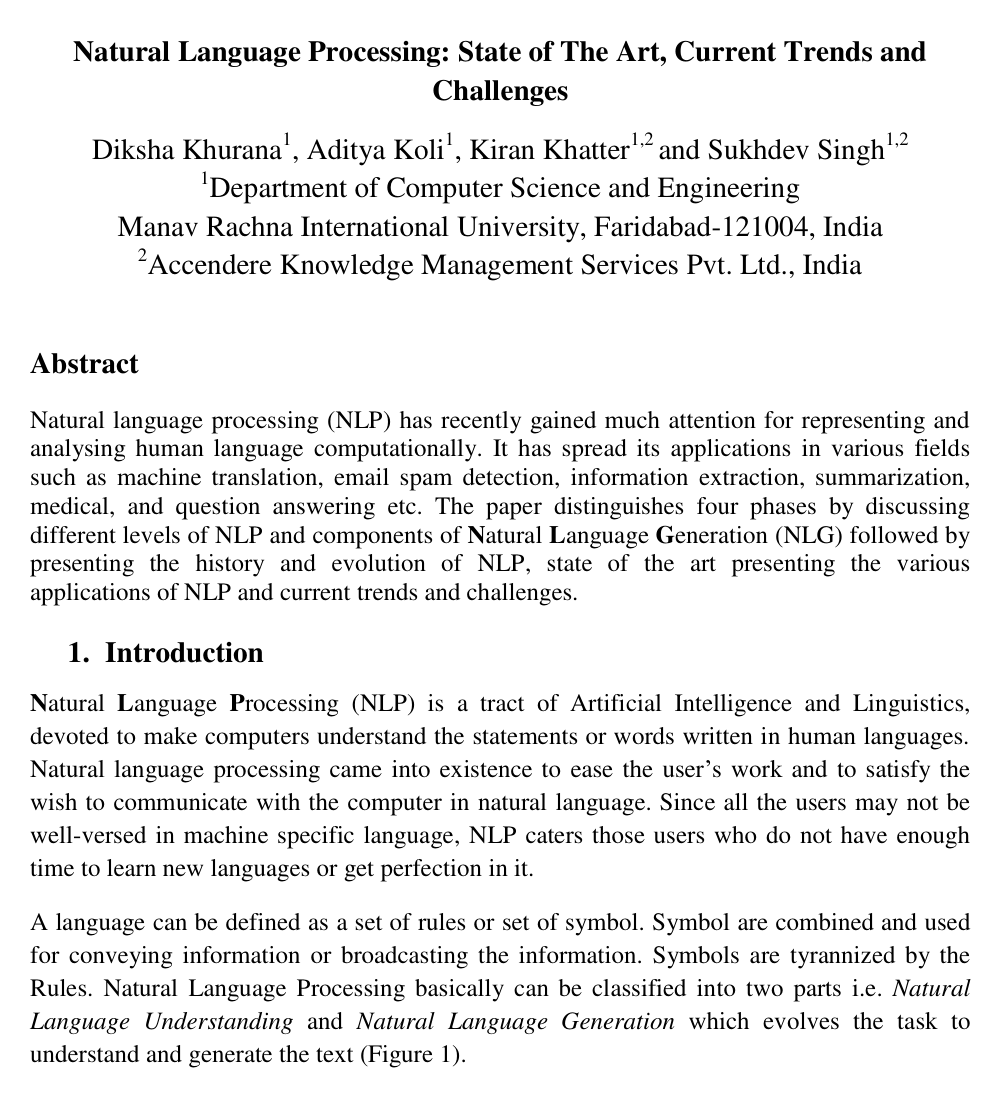
Natural language processing (NLP) has recently gained much attention for representing and analysing human language computationally. It has spread its applications in various fields such as machine translation, email spam detection, information extraction, summarization, medical, and question answering etc. The paper distinguishes four phases by discussing different levels of NLP and components of Natural Language Generation (NLG) followed by presenting the history and evolution of NLP, state of the art presenting the various applications of NLP and current trends and challenges.
Added
2026-09-24
“Liar, Liar Pants on Fire”: A New Benchmark Dataset for Fake News Detection
William Yang Wang
Why you should read this
Introduces the LIAR benchmark dataset of 12,800 fact-checked statements from PolitiFact alongside a hybrid neural network architecture that integrates contextual metadata with text to improve automated fake news detection.
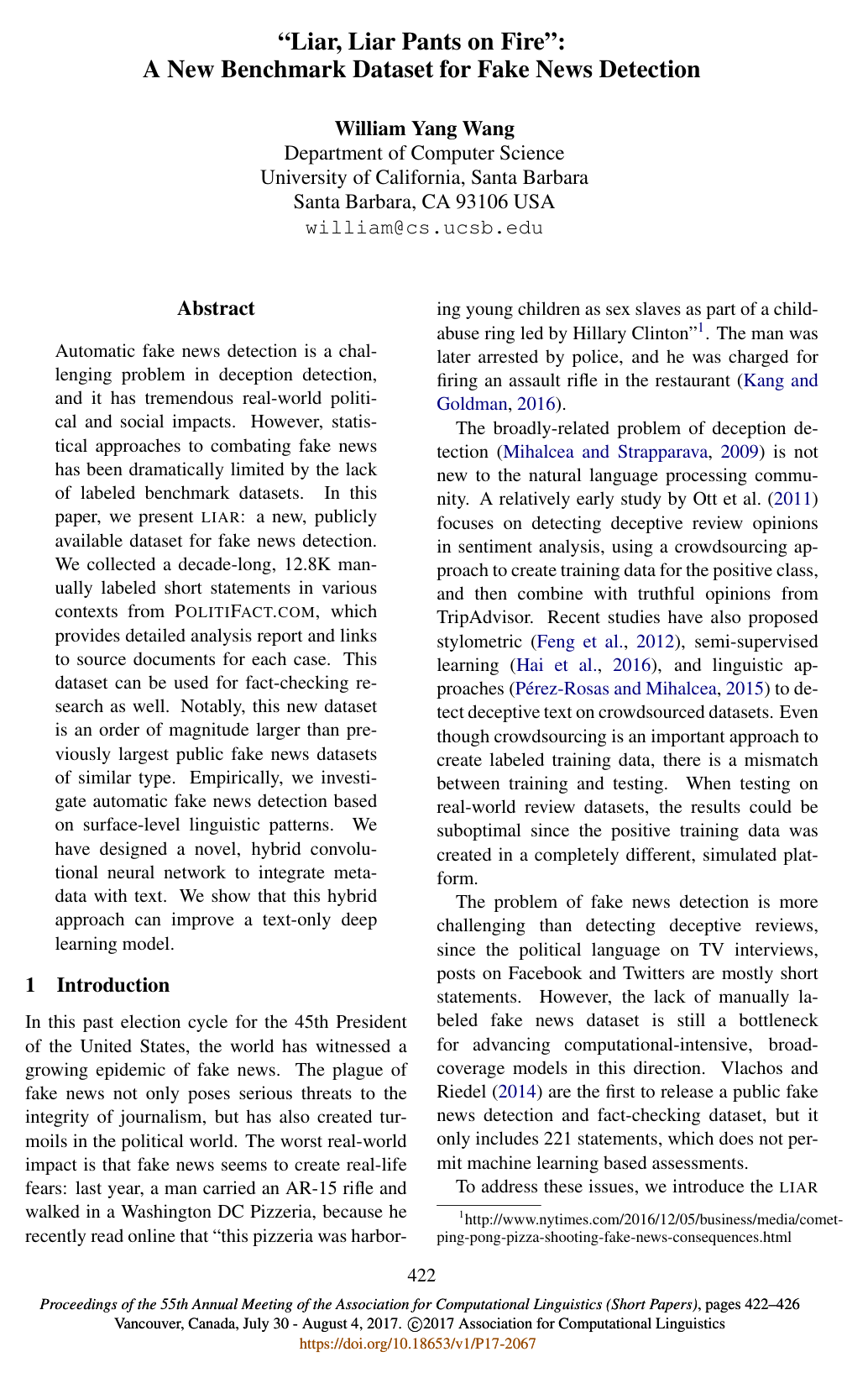
Automatic fake news detection is a challenging problem in deception detection, and it has tremendous real-world political and social impacts. However, statistical approaches to combating fake news has been dramatically limited by the lack of labeled benchmark datasets. In this paper, we present liar: a new, publicly available dataset for fake news detection. We collected a decade-long, 12.8K manually labeled short statements in various contexts from this http URL, which provides detailed analysis report and links to source documents for each case. This dataset can be used for fact-checking research as well. Notably, this new dataset is an order of magnitude larger than previously largest public fake news datasets of similar type. Empirically, we investigate automatic fake news detection based on surface-level linguistic patterns. We have designed a novel, hybrid convolutional neural network to integrate meta-data with text. We show that this hybrid approach can improve a text-only deep learning model.
Added
2026-09-24
Measuring praise and criticism: Inference of semantic orientation from association
Peter D. Turney, Michael L. Littman
Why you should read this
Proposes a method for automatically determining the positive or negative semantic orientation of words across diverse parts of speech by measuring their statistical association with paradigm seed words using pointwise mutual information and latent semantic analysis.
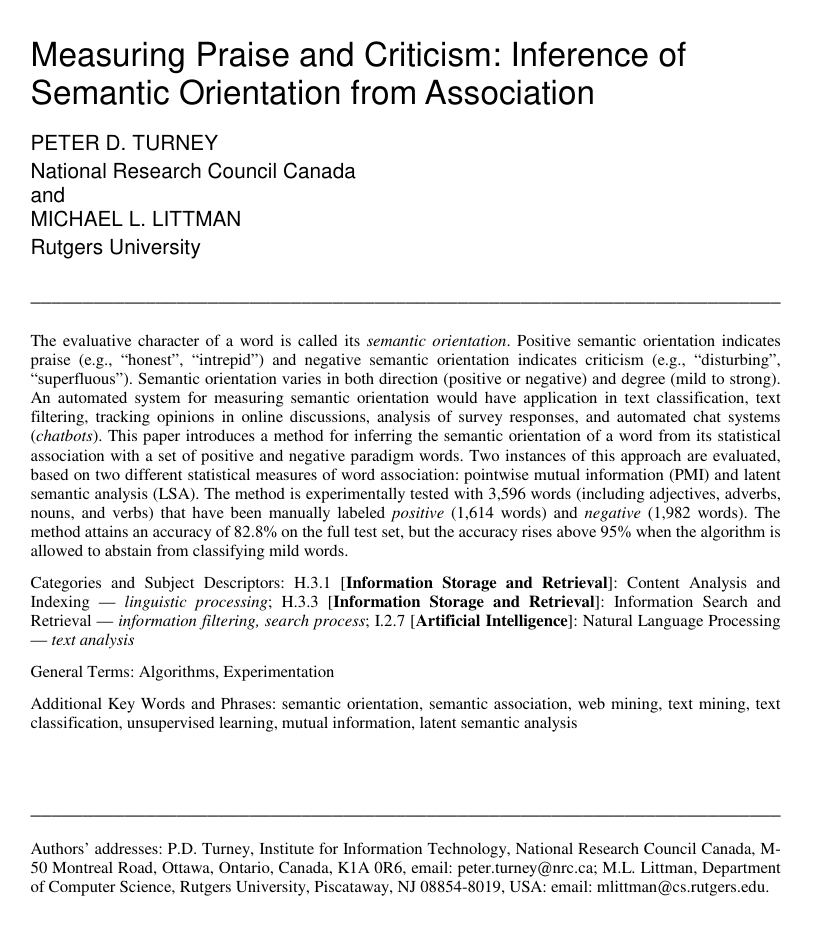
The evaluative character of a word is called its semantic orientation. Positive semantic orientation indicates praise (e.g., "honest", "intrepid") and negative semantic orientation indicates criticism (e.g., "disturbing", "superfluous"). Semantic orientation varies in both direction (positive or negative) and degree (mild to strong). An automated system for measuring semantic orientation would have application in text classification, text filtering, tracking opinions in online discussions, analysis of survey responses, and automated chat systems (chatbots). This paper introduces a method for inferring the semantic orientation of a word from its statistical association with a set of positive and negative paradigm words. Two instances of this approach are evaluated, based on two different statistical measures of word association: pointwise mutual information (PMI) and latent semantic analysis (LSA). The method is experimentally tested with 3,596 words (including adjectives, adverbs, nouns, and verbs) that have been manually labeled positive (1,614 words) and negative (1,982 words). The method attains an accuracy of 82.8% on the full test set, but the accuracy rises above 95% when the algorithm is allowed to abstain from classifying mild words.
Added
2026-09-24
How to Fine-Tune BERT for Text Classification?
Chi Sun, Xipeng Qiu, Yige Xu, Xuanjing Huang
Why you should read this
Establishes a practical, empirical guide for fine-tuning BERT on text classification by identifying optimal training strategies that achieve state-of-the-art performance across eight benchmark datasets.
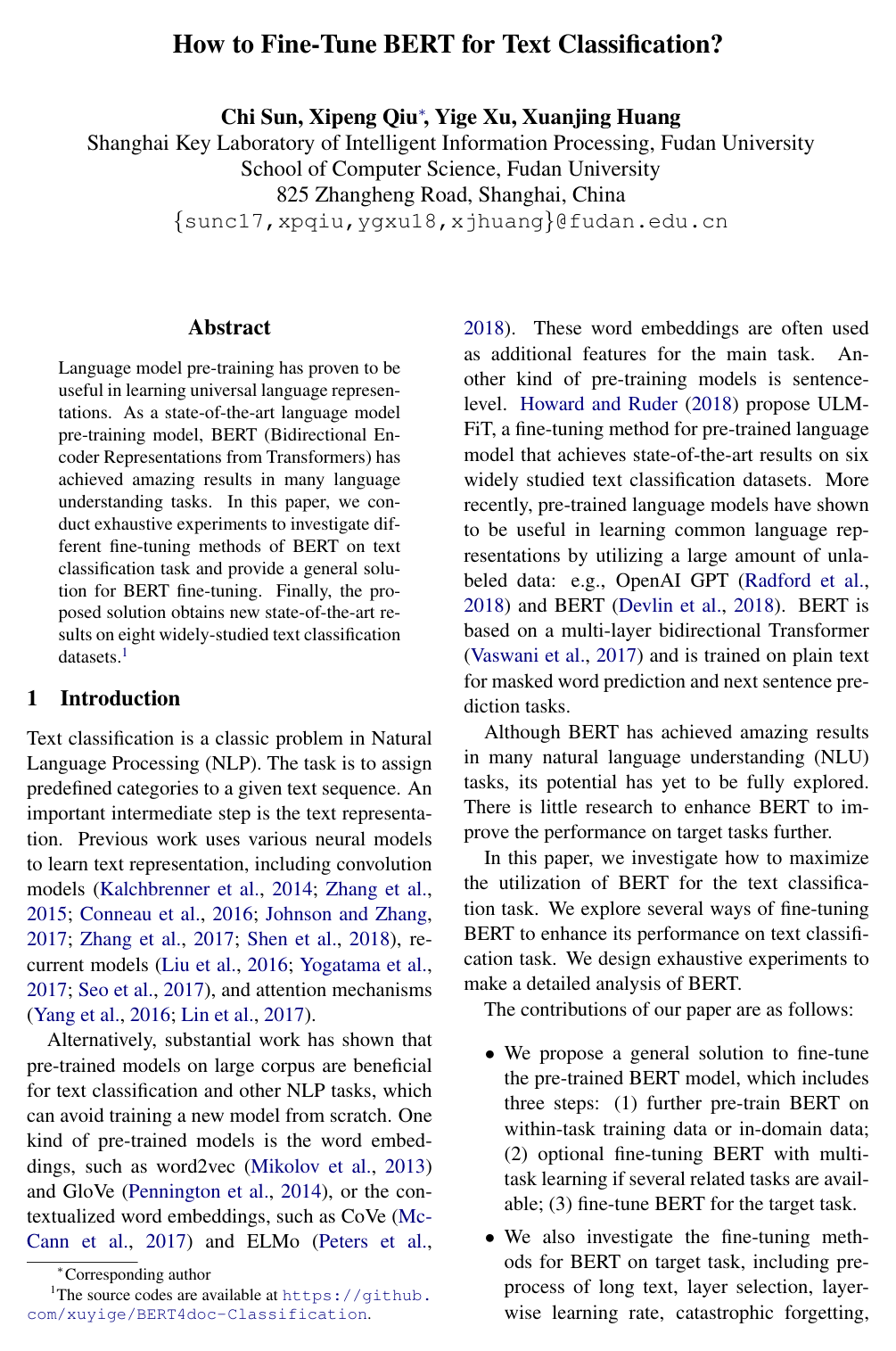
Language model pre-training has proven to be useful in learning universal language representations. As a state-of-the-art language model pre-training model, BERT (Bidirectional Encoder Representations from Transformers) has achieved amazing results in many language understanding tasks. In this paper, we conduct exhaustive experiments to investigate different fine-tuning methods of BERT on text classification task and provide a general solution for BERT fine-tuning. Finally, the proposed solution obtains new state-of-the-art results on eight widely-studied text classification datasets.
Added
2026-09-18