
keyword
temporal shift module
A temporal shift module is a neural network operator designed for video understanding that enables temporal modeling in two-dimensional convolutional neural networks without introducing extra parameters or computational overhead. It functions by shifting a portion of feature channels along the time dimension, transferring selected channel data from adjacent past and future frames to facilitate information exchange across neighboring time steps. By allowing subsequent standard spatial convolutions to process features containing temporal context from nearby frames, the module achieves spatiotemporal modeling capability comparable to three-dimensional convolutions while preserving the low computational complexity and inference speed of two-dimensional architectures. It can be configured for both bidirectional offline video analysis and uni-directional online video processing for real-time, low-latency applications.
2 items
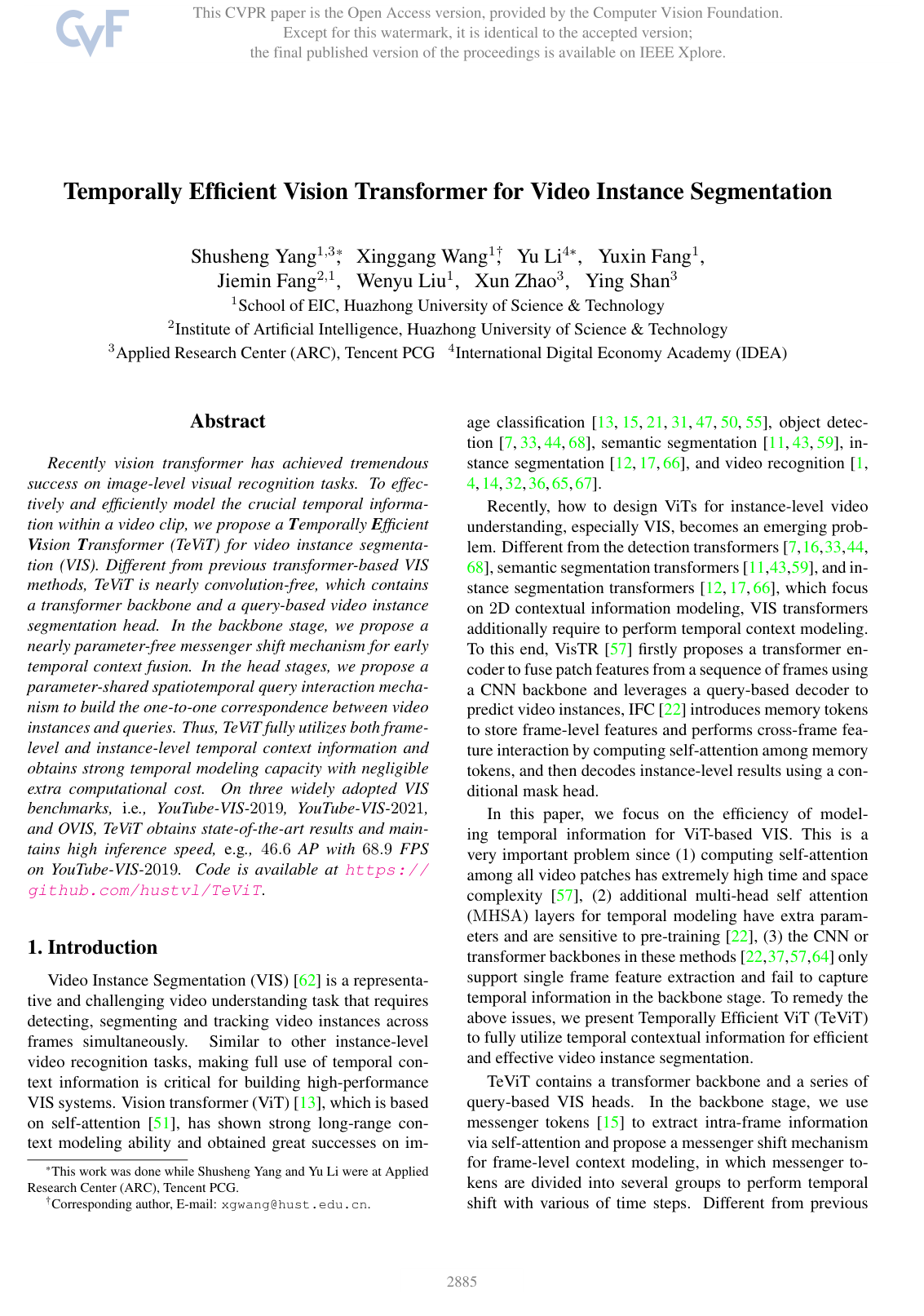
Temporally Efficient Vision Transformer for Video Instance Segmentation
Shusheng Yang, Xinggang Wang, Yu Li, Yuxin Fang, Jiemin Fang, Wenyu Liu, Xun Zhao, Ying Shan
Why you should read this
Presents an efficient, nearly convolution-free vision transformer architecture that models frame- and instance-level temporal contexts through a lightweight messenger shift mechanism and spatiotemporal query interactions to achieve state-of-the-art video instance segmentation at real-time speeds.
Recently, vision transformer has achieved tremendous success on image-level visual recognition tasks. To effectively and efficiently model the crucial temporal information within a video clip, we propose a Temporally Efficient Vision Transformer (TeViT) for video instance segmentation (VIS). Different from previous transformer-based VIS methods, TeViT is nearly convolution-free, which contains a transformer backbone and a query-based video instance segmentation head. In the backbone stage, we propose a nearly parameter-free messenger shift mechanism for early temporal context fusion. In the head stages, we propose a parameter-shared spatiotemporal query interaction mechanism to build the one-to-one correspondence between video instances and queries. Thus, TeViT fully utilizes both frame-level and instance-level temporal context information and obtains strong temporal modeling capacity with negligible extra computational cost. On three widely adopted VIS benchmarks, i.e., YouTube-VIS-2019, YouTube-VIS-2021, and OVIS, TeViT obtains state-of-the-art results and maintains high inference speed, e.g., 46.6 AP with 68.9 FPS on YouTube-VIS-2019. Code is available at https://github.com/hustvl/TeViT.
Added
2026-09-26
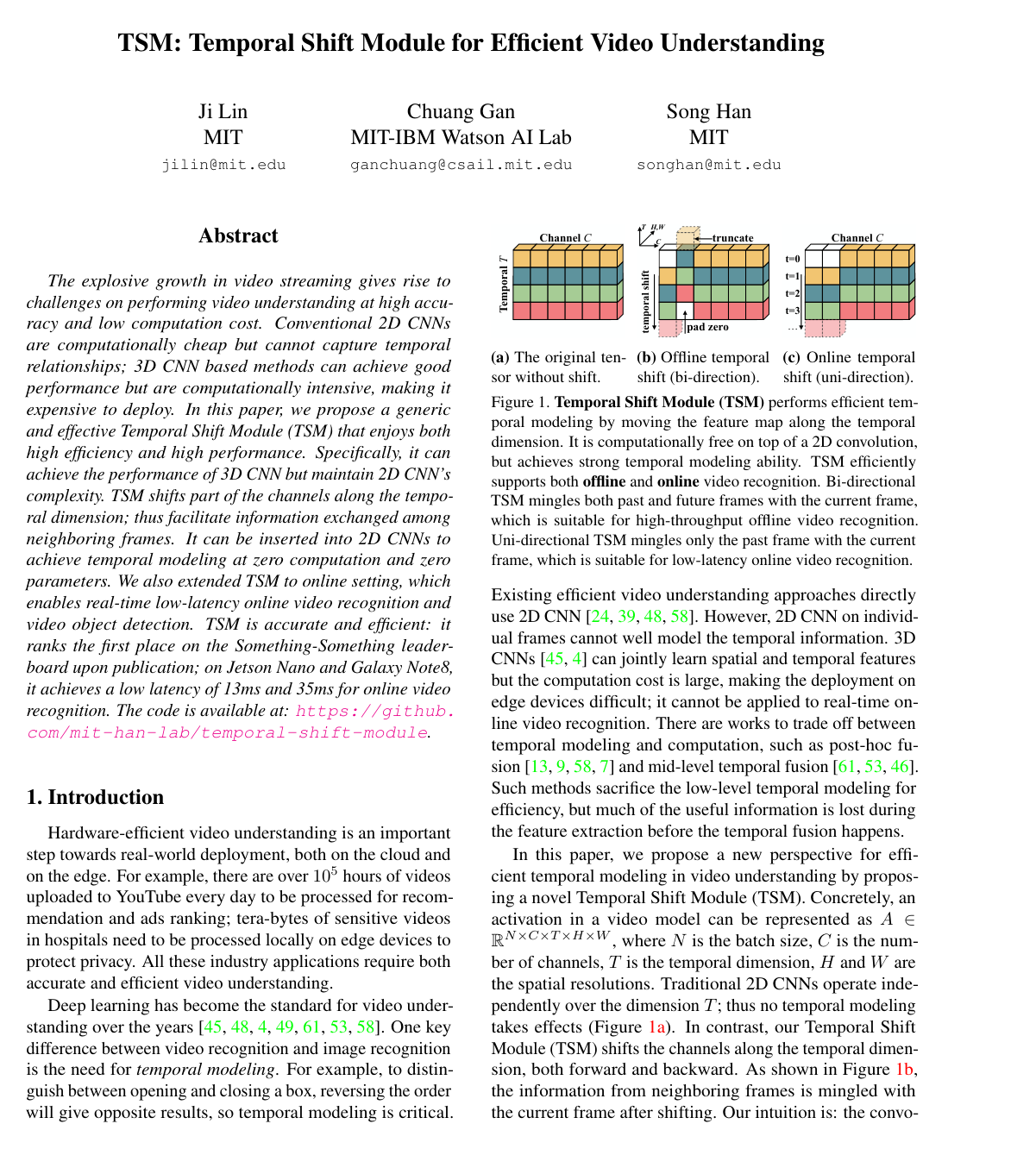
TSM: Temporal Shift Module for Efficient Video Understanding
Ji Lin, Chuang Gan, Song Han
Why you should read this
Introduces the Temporal Shift Module, an approach that shifts feature channels across neighboring frames to equip standard 2D CNNs with 3D-level temporal modeling at zero extra parameters and computational cost, making real-time video recognition feasible on edge devices.
The explosive growth in video streaming gives rise to challenges on performing video understanding at high accuracy and low computation cost. Conventional 2D CNNs are computationally cheap but cannot capture temporal relationships; 3D CNN based methods can achieve good performance but are computationally intensive, making it expensive to deploy. In this paper, we propose a generic and effective Temporal Shift Module (TSM) that enjoys both high efficiency and high performance. Specifically, it can achieve the performance of 3D CNN but maintain 2D CNN's complexity. TSM shifts part of the channels along the temporal dimension; thus facilitate information exchanged among neighboring frames. It can be inserted into 2D CNNs to achieve temporal modeling at zero computation and zero parameters. We also extended TSM to online setting, which enables real-time low-latency online video recognition and video object detection. TSM is accurate and efficient: it ranks the first place on the Something-Something leaderboard upon publication; on Jetson Nano and Galaxy Note8, it achieves a low latency of 13ms and 35ms for online video recognition. The code is available at: this https URL.
Added
2026-09-16