
keyword
temporal localization
Temporal localization is the computer vision and video analysis task of identifying the precise starting and ending timestamps of specific actions, events, or semantic moments within an untrimmed video. Unlike standard video classification, which assigns a single label to an entire clip, temporal localization determines both the boundary intervals of relevant segments and their corresponding categories or alignments with natural language queries. Accomplishing this requires models to distinguish target activities from background content, evaluate sequential visual changes, and reason across temporal dependencies and causal relationships over time. This capability is fundamental to video understanding applications such as video search and retrieval, event summarization, automated surveillance, and multimodal video reasoning.
4 items
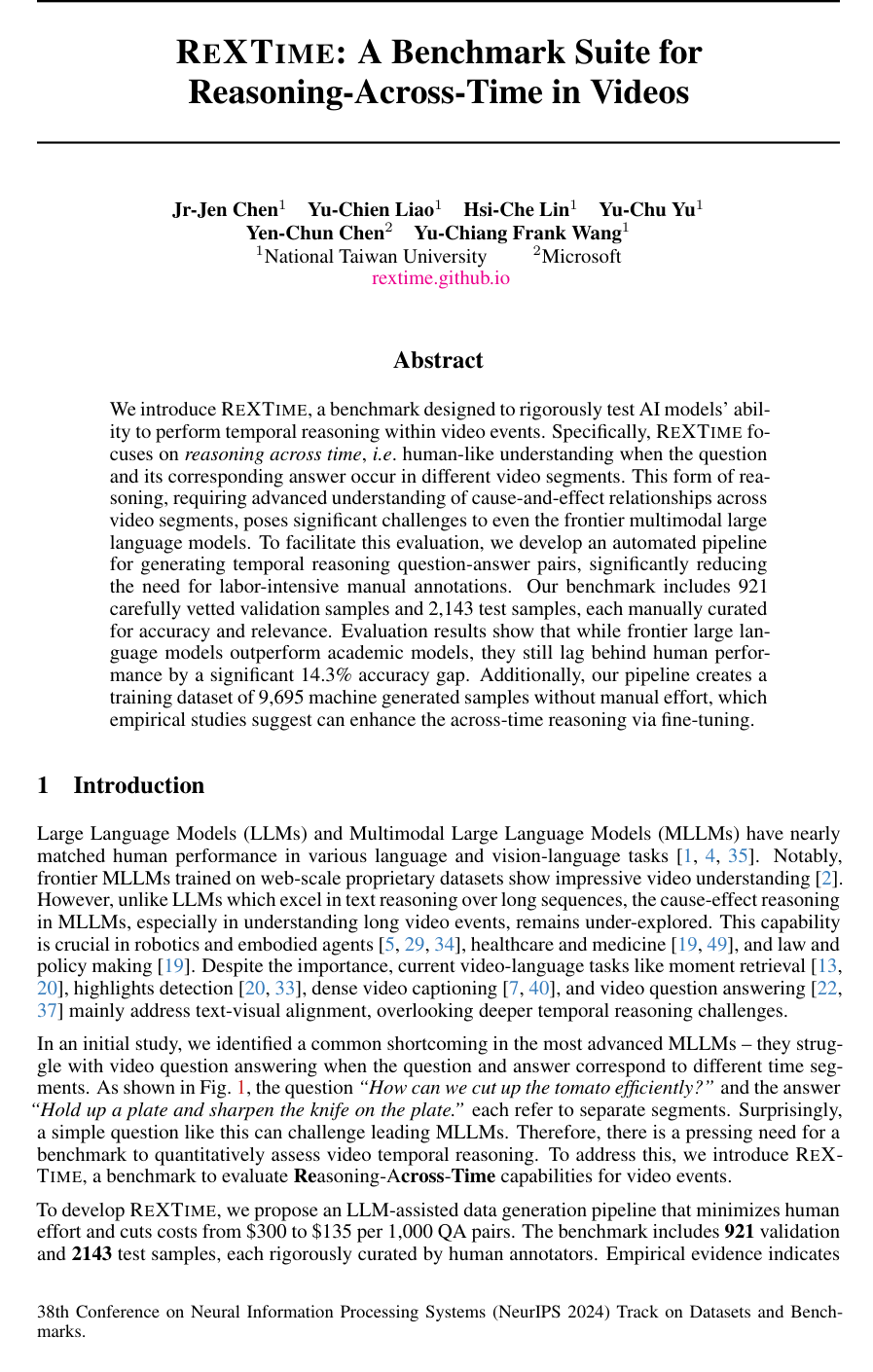
ReXTime: A Benchmark Suite for Reasoning-Across-Time in Videos
Jr-Jen Chen, Yu-Chien Liao, Hsi-Che Lin, Yu-Chu Yu, Yen-Chun Chen, Yu-Chiang Frank Wang
Why you should read this
Presents a benchmark and cost-effective data generation pipeline to evaluate and improve multimodal language models on complex cause-and-effect temporal reasoning where questions and answers span non-overlapping video segments.
We introduce REXTIME, a benchmark designed to rigorously test AI models’ ability to perform temporal reasoning within video events. Specifically, REXTIME focuses on reasoning across time, i.e. human-like understanding when the question and its corresponding answer occur in different video segments. This form of reasoning, requiring advanced understanding of cause-and-effect relationships across video segments, poses significant challenges to even the frontier multimodal large language models. To facilitate this evaluation, we develop an automated pipeline for generating temporal reasoning question-answer pairs, significantly reducing the need for labor-intensive manual annotations. Our benchmark includes 921 carefully vetted validation samples and 2,143 test samples, each manually curated for accuracy and relevance. Evaluation results show that while frontier large language models outperform academic models, they still lag behind human performance by a significant 14.3% accuracy gap. Additionally, our pipeline creates a training dataset of 9,695 machine generated samples without manual effort, which empirical studies suggest can enhance the across-time reasoning via fine-tuning.
Added
2026-09-26
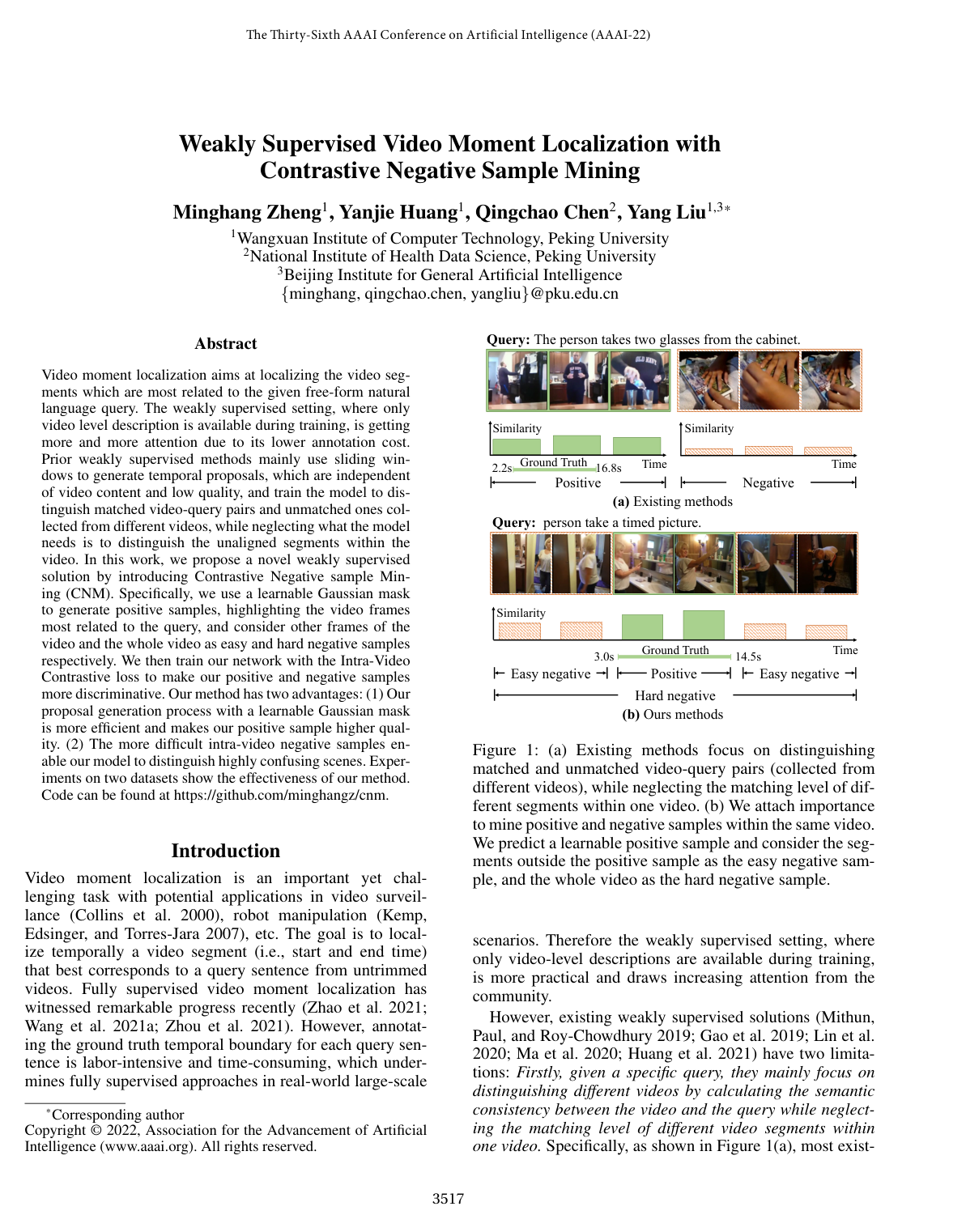
Weakly Supervised Video Moment Localization with Contrastive Negative Sample Mining
Minghang Zheng, Yanjie Huang, Qingchao Chen, Yang Liu
Why you should read this
Proposes a weakly supervised video moment localization framework that replaces rigid sliding windows with learnable Gaussian masks and mines hard intra-video negatives to better distinguish confusing segments without frame-level annotations.
Video moment localization aims at localizing the video segments which are most related to the given free-form natural language query. The weakly supervised setting, where only video level description is available during training, is getting more and more attention due to its lower annotation cost. Prior weakly supervised methods mainly use sliding windows to generate temporal proposals, which are independent of video content and low quality, and train the model to distinguish matched video-query pairs and unmatched ones collected from different videos, while neglecting what the model needs is to distinguish the unaligned segments within the video. In this work, we propose a novel weakly supervised solution by introducing Contrastive Negative sample Mining (CNM). Specifically, we use a learnable Gaussian mask to generate positive samples, highlighting the video frames most related to the query, and consider other frames of the video and the whole video as easy and hard negative samples respectively. We then train our network with the Intra-Video Contrastive loss to make our positive and negative samples more discriminative. Our method has two advantages: (1) Our proposal generation process with a learnable Gaussian mask is more efficient and makes our positive sample higher quality. (2) The more difficult intra-video negative samples enable our model to distinguish highly confusing scenes. Experiments on two datasets show the effectiveness of our method. Code can be found at https://github.com/minghangz/cnm.
Added
2026-09-26
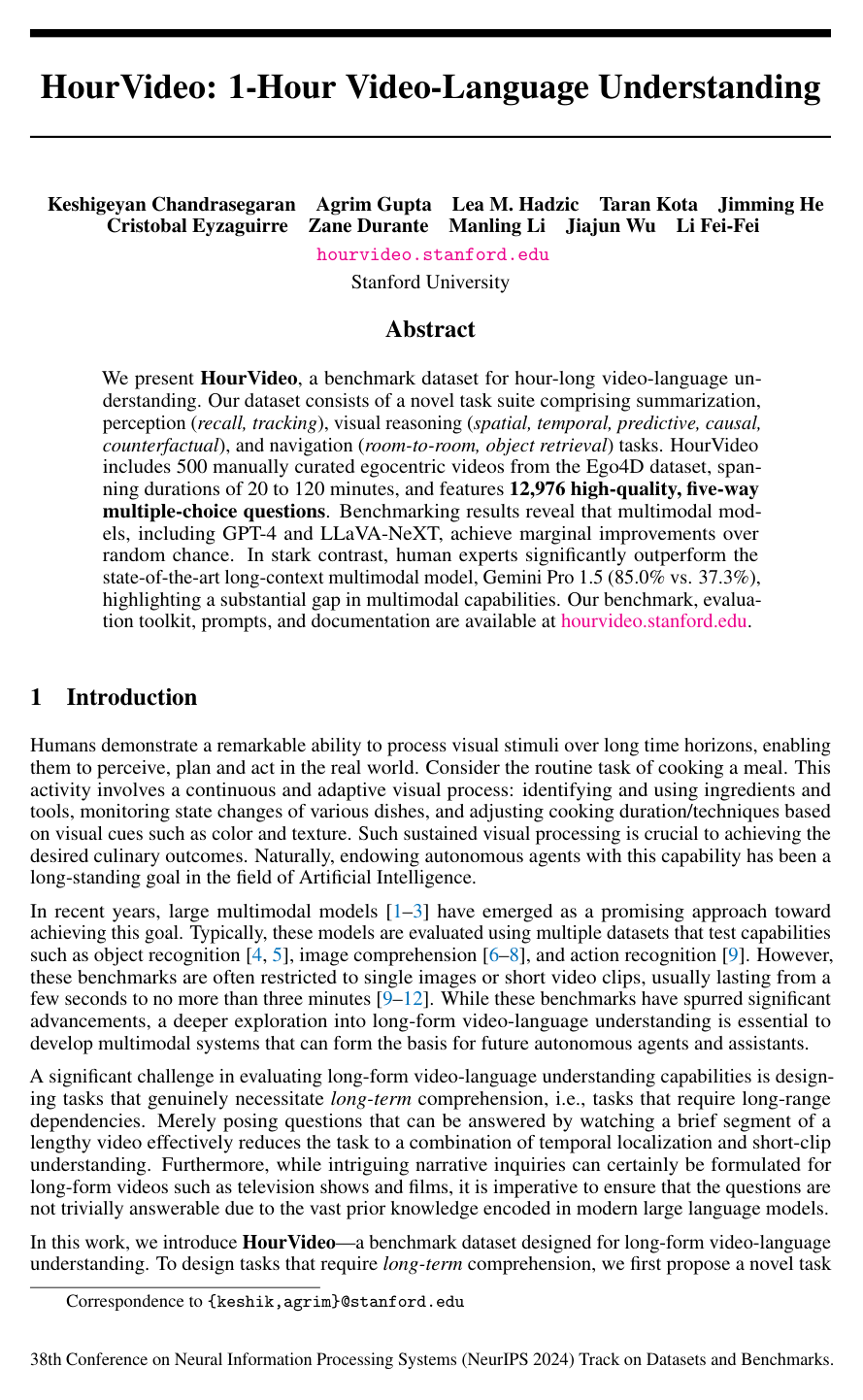
HourVideo: 1-Hour Video-Language Understanding
Keshigeyan Chandrasegaran, Agrim Gupta, Lea M. Hadzic, Taran Kota, Jimming He, Cristóbal Eyzaguirre, Zane Durante, Manling Li, Jiajun Wu, Li Fei-Fei
Why you should read this
Presents a benchmark of nearly thirteen thousand questions across five hundred hour-long egocentric videos to expose the critical performance gap between state-of-the-art multimodal models and human-level long-form video comprehension.
We present HourVideo, a benchmark dataset for hour-long video-language understanding. Our dataset consists of a novel task suite comprising summarization, perception (recall, tracking), visual reasoning (spatial, temporal, predictive, causal, counterfactual), and navigation (room-to-room, object retrieval) tasks. HourVideo includes 500 manually curated egocentric videos from the Ego4D dataset, spanning durations of 20 to 120 minutes, and features 12,976 high-quality, five-way multiple-choice questions. Benchmarking results reveal that multimodal models, including GPT-4 and LLaVA-NeXT, achieve marginal improvements over random chance. In stark contrast, human experts significantly outperform the state-of-the-art long-context multimodal model, Gemini Pro 1.5 (85.0% vs. 37.3%), highlighting a substantial gap in multimodal capabilities. Our benchmark, evaluation toolkit, prompts, and documentation are available at hourvideo.stanford.edu.
Added
2026-09-26
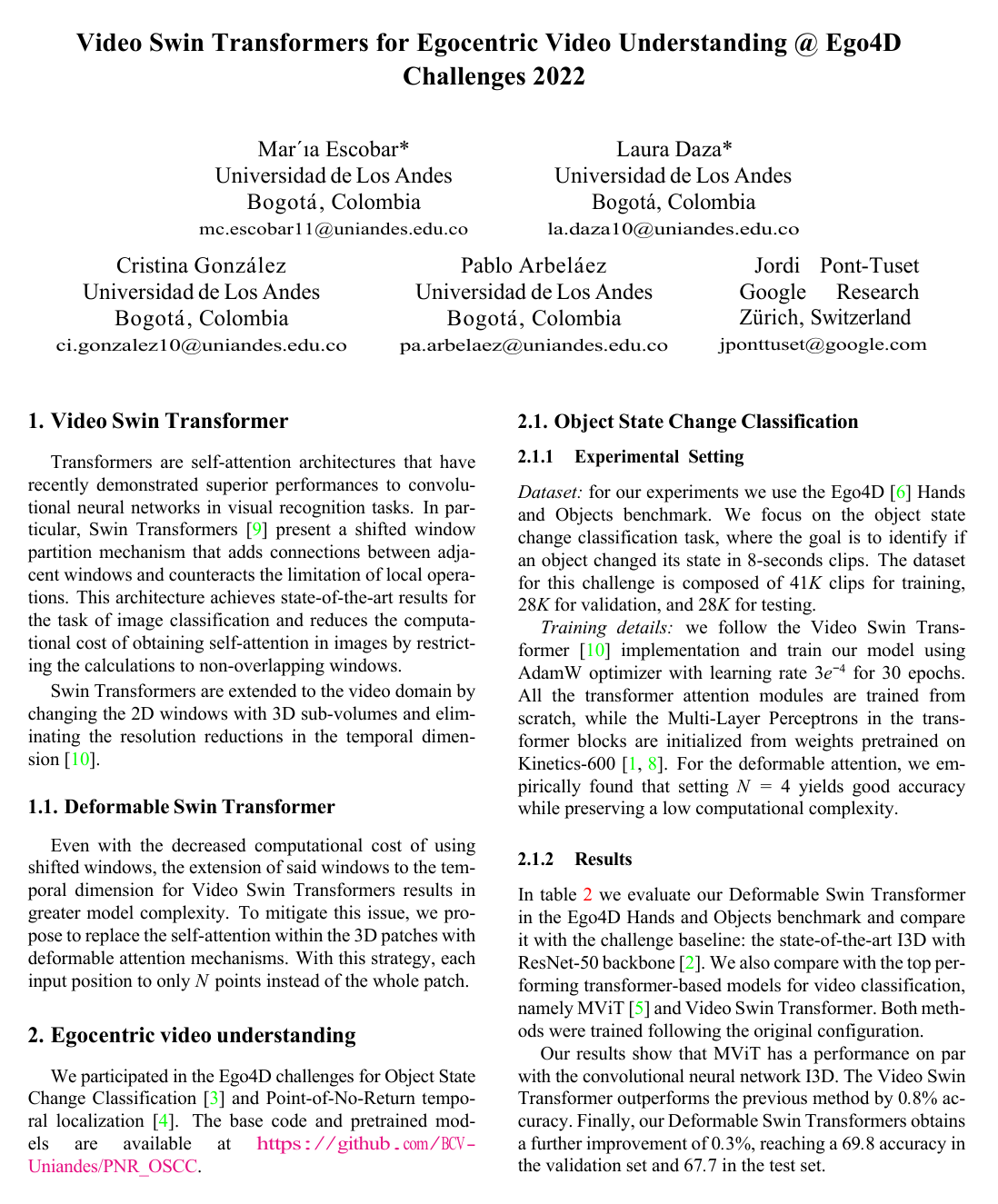
Video Swin Transformer
Ze Liu, Jia Ning, Yue Cao, Yixuan Wei, Zheng Zhang, Stephen Lin, Han Hu
Why you should read this
Extends the Swin Transformer architecture to video recognition via localized 3D spatio-temporal attention, establishing state-of-the-art accuracy on action recognition benchmarks with vastly superior parameter and data efficiency compared to global transformer models.
The vision community is witnessing a modeling shift from CNNs to Transformers, where pure Transformer architectures have attained top accuracy on the major video recognition benchmarks. These video models are all built on Transformer layers that globally connect patches across the spatial and temporal dimensions. In this paper, we instead advocate an inductive bias of locality in video Transformers, which leads to a better speed-accuracy trade-off compared to previous approaches which compute self-attention globally even with spatial-temporal factorization. The locality of the proposed video architecture is realized by adapting the Swin Transformer designed for the image domain, while continuing to leverage the power of pre-trained image models. Our approach achieves state-of-the-art accuracy on a broad range of video recognition benchmarks, including on action recognition (84.9 top-1 accuracy on Kinetics-400 and 86.1 top-1 accuracy on Kinetics-600 with ~20x less pre-training data and ~3x smaller model size) and temporal modeling (69.6 top-1 accuracy on Something-Something v2). The code and models will be made publicly available at this https URL.
Added
2026-09-16