
Built independently by an author, for readers. Read the story and support ChapterPal

keyword

task-level uncertainty

Task-level uncertainty refers to an aggregate measure in machine learning that quantifies the degree of inconsistency, ambiguity, or lack of confidence a model exhibits across an entire task or problem type rather than on a single isolated input. Unlike instance-level or token-level uncertainty, which evaluates a model on individual data points, task-level uncertainty assesses performance and stability across representative collections of examples or diverse task formulations. In natural language processing and instruction tuning, it is often measured by analyzing the variation or disagreement in model outputs when an objective is presented through alternative or perturbed prompt phrasings. By capturing a model sensitivity to changes in prompt formatting and identifying tasks where the system lacks robust understanding, task-level uncertainty serves as a criterion for prioritizing the most informative data to improve cross-task generalization and training efficiency.

1 item
Active Instruction Tuning: Improving Cross-Task Generalization by Training on Prompt Sensitive Tasks

Active Instruction Tuning: Improving Cross-Task Generalization by Training on Prompt Sensitive Tasks

Po-Nien Kung, Fan Yin, Di Wu, Kai-Wei Chang, Nanyun Peng

OrganizationsUniversity of California, Los Angeles

Why you should read this

Proposes an active instruction tuning framework that quantifies prompt uncertainty to identify and train on the most informative tasks, achieving superior cross-task generalization with substantially fewer training datasets.

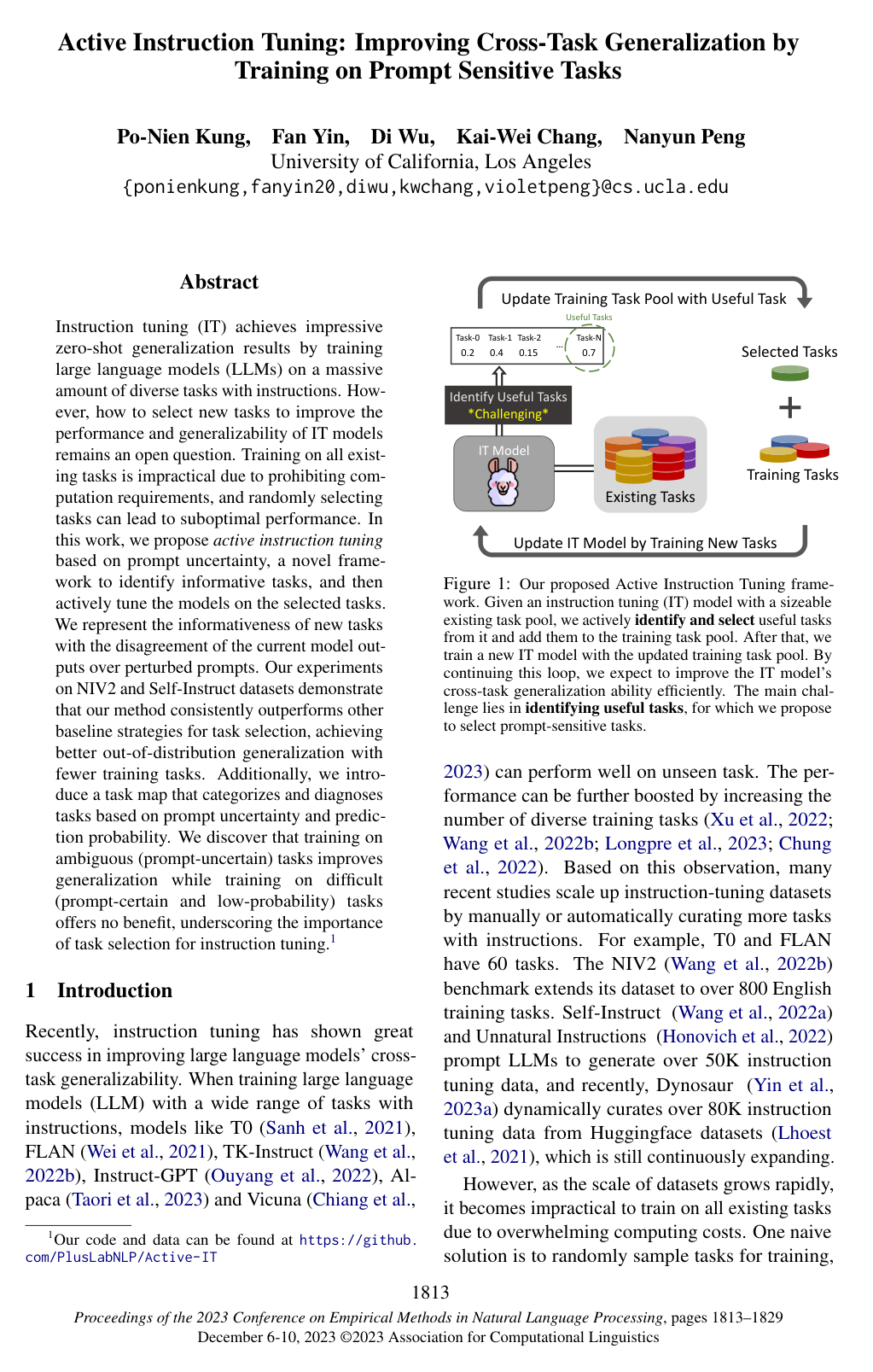
Instruction tuning (IT) achieves impressive zero-shot generalization results by training large language models (LLMs) on a massive amount of diverse tasks with instructions. However, how to select new tasks to improve the performance and generalizability of IT models remains an open question. Training on all existing tasks is impractical due to prohibiting computation requirements, and randomly selecting tasks can lead to suboptimal performance. In this work, we propose active instruction tuning based on prompt uncertainty, a novel framework to identify informative tasks, and then actively tune the models on the selected tasks. We represent the informativeness of new tasks with the disagreement of the current model outputs over perturbed prompts. Our experiments on NIV2 and Self-Instruct datasets demonstrate that our method consistently outperforms other baseline strategies for task selection, achieving better out-of-distribution generalization with fewer training tasks. Additionally, we introduce a task map that categorizes and diagnoses tasks based on prompt uncertainty and prediction probability. We discover that training on ambiguous (prompt-uncertain) tasks improves generalization while training on difficult (prompt-certain and low-probability) tasks offers no benefit, underscoring the importance of task selection for instruction tuning.¹

Added

2026-09-26