
keyword
Synaptic Intelligence
Synaptic Intelligence is a regularization-based continual learning method in artificial neural networks designed to mitigate catastrophic forgetting when learning sequential tasks. Inspired by biological mechanisms where individual synapses accumulate task-relevant information, this approach computes an importance score for each parameter based on its contribution to reducing the loss along its optimization trajectory during training. When the network encounters subsequent tasks, it applies a quadratic penalty that resists large modifications to weights identified as critical for past performance, enabling the model to retain previously acquired knowledge while maintaining the plasticity needed to learn new data efficiently without storing raw examples from prior tasks.
5 items
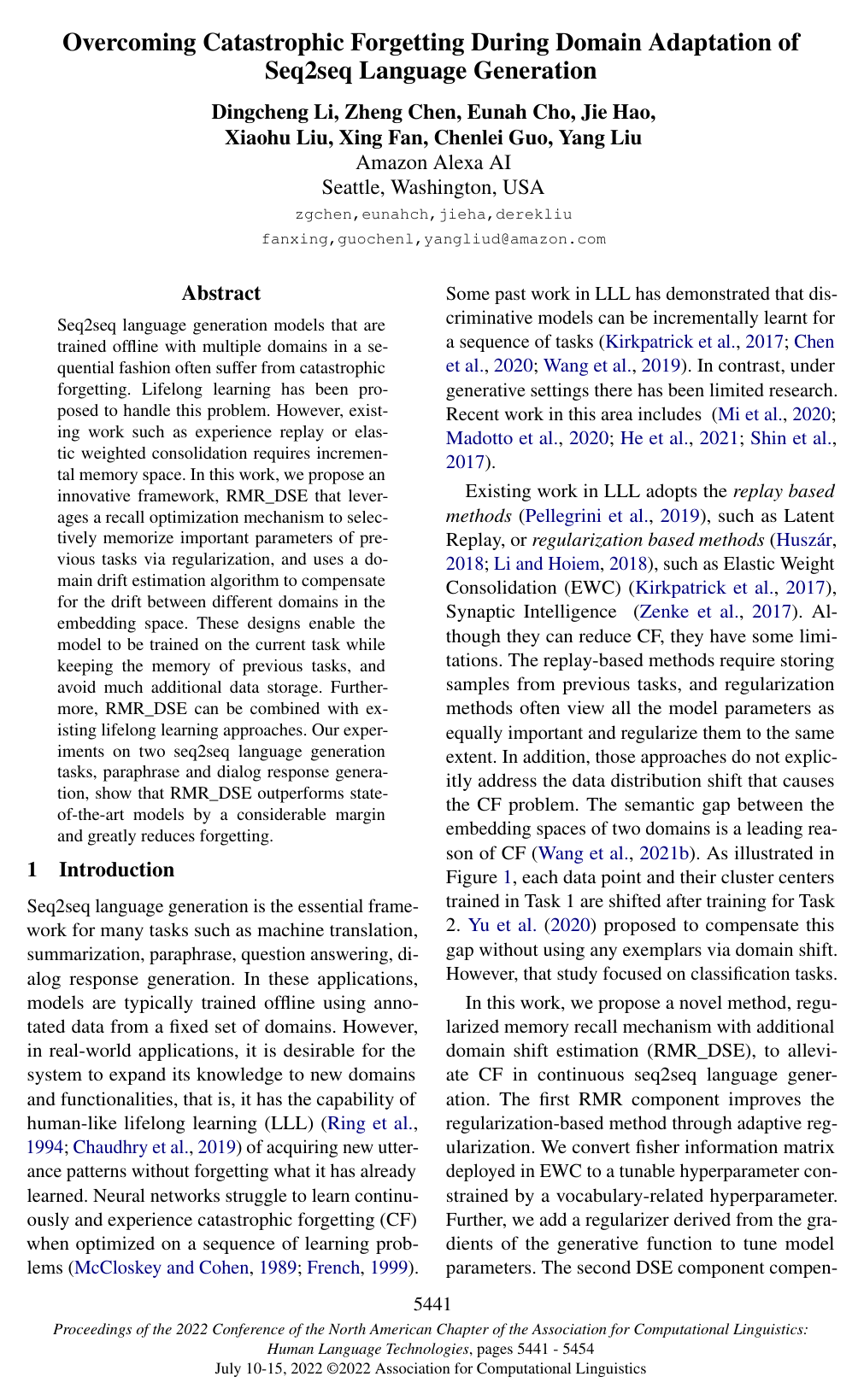
Overcoming Catastrophic Forgetting During Domain Adaptation of Seq2seq Language Generation
Dingcheng Li, Zheng Chen, Eunah Cho, Jie Hao, Xiaohu Liu, Fan Xing, Chenlei Guo, Yang Liu
Why you should read this
Proposes a framework combining adaptive parameter regularization with embedding-space domain drift estimation to prevent catastrophic forgetting in sequential sequence-to-sequence language generation without storing past task data.
Seq2seq language generation models that are trained offline with multiple domains in a sequential fashion often suffer from catastrophic forgetting. Lifelong learning has been proposed to handle this problem. However, existing work such as experience replay or elastic weighted consolidation requires incremental memory space. In this work, we propose an innovative framework, RMR_DSE that leverages a recall optimization mechanism to selectively memorize important parameters of previous tasks via regularization, and uses a domain drift estimation algorithm to compensate for the drift between different domains in the embedding space. These designs enable the model to be trained on the current task while keeping the memory of previous tasks, and avoid much additional data storage. Furthermore, RMR_DSE can be combined with existing lifelong learning approaches. Our experiments on two seq2seq language generation tasks, paraphrase and dialog response generation, show that RMR_DSE outperforms state-of-the-art models by a considerable margin and greatly reduces forgetting.
Added
2026-10-03
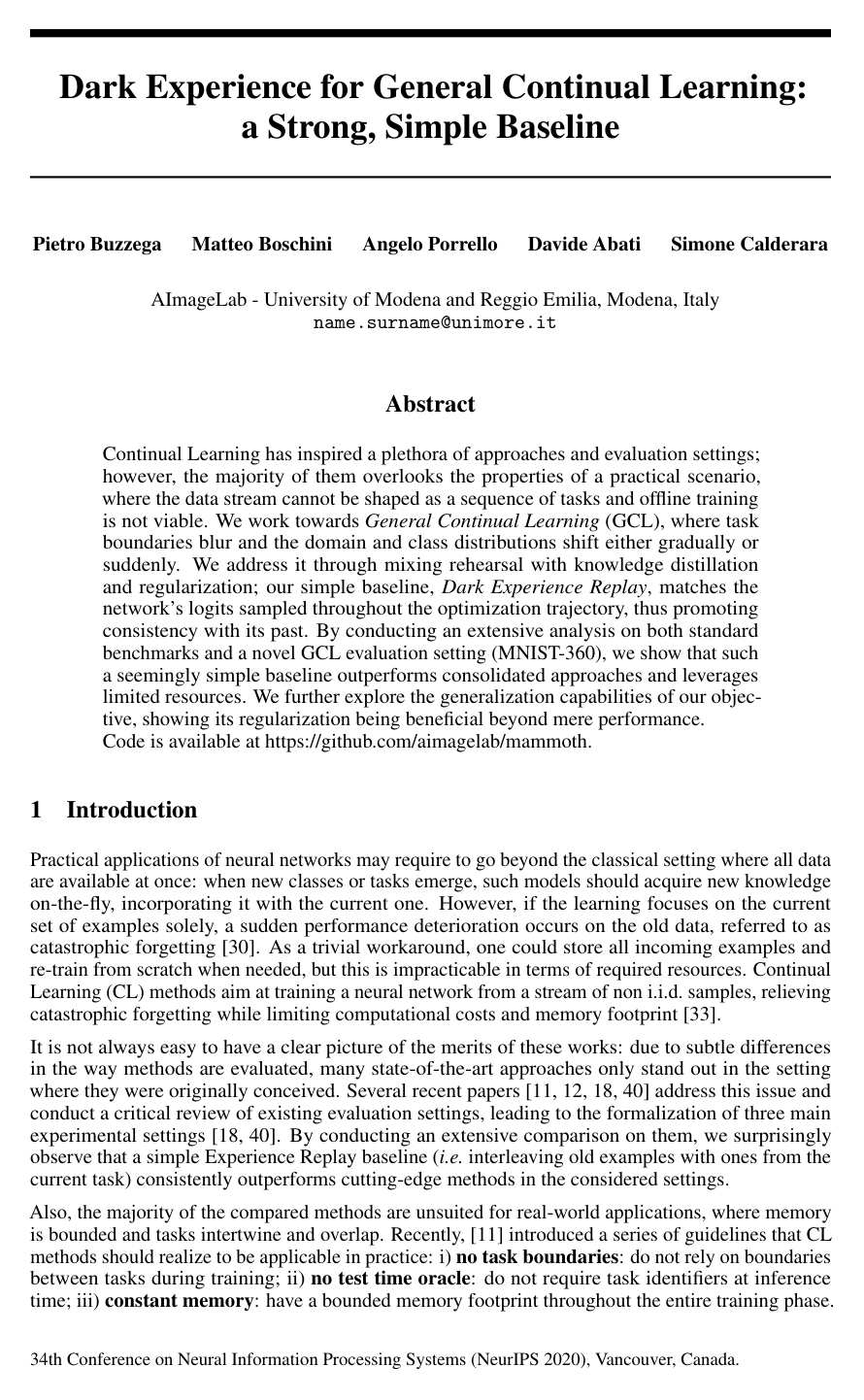
Dark Experience for General Continual Learning: a Strong, Simple Baseline
Pietro Buzzega, Matteo Boschini, Angelo Porrello, Davide Abati, Simone Calderara
Why you should read this
Proposes Dark Experience Replay, a simple baseline that matches past network logits during replay to outperform complex state-of-the-art methods in realistic continual learning settings without explicit task boundaries.
Continual Learning has inspired a plethora of approaches and evaluation settings; however, the majority of them overlooks the properties of a practical scenario, where the data stream cannot be shaped as a sequence of tasks and offline training is not viable. We work towards General Continual Learning (GCL), where task boundaries blur and the domain and class distributions shift either gradually or suddenly. We address it through mixing rehearsal with knowledge distillation and regularization; our simple baseline, Dark Experience Replay, matches the network's logits sampled throughout the optimization trajectory, thus promoting consistency with its past. By conducting an extensive analysis on both standard benchmarks and a novel GCL evaluation setting (MNIST-360), we show that such a seemingly simple baseline outperforms consolidated approaches and leverages limited resources. We further explore the generalization capabilities of our objective, showing its regularization being beneficial beyond mere performance.
Added
2026-09-25
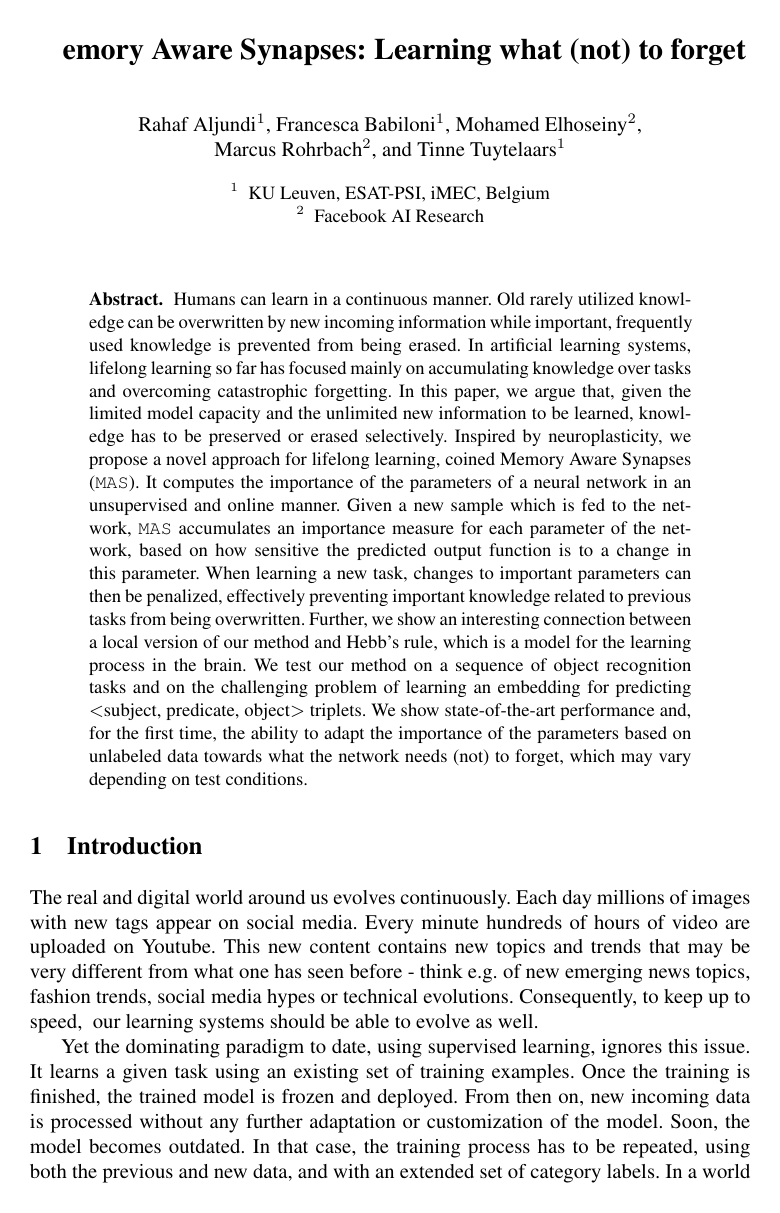
Memory Aware Synapses: Learning what (not) to forget
Rahaf Aljundi, Francesca Babiloni, Mohamed Elhoseiny, Marcus Rohrbach, Tinne Tuytelaars
Why you should read this
Proposes Memory Aware Synapses, an unsupervised continual learning approach that calculates parameter importance based on output sensitivity, allowing neural networks to prevent catastrophic forgetting across sequential tasks using unlabeled data.
Humans can learn in a continuous manner. Old rarely utilized knowledge can be overwritten by new incoming information while important, frequently used knowledge is prevented from being erased. In artificial learning systems, lifelong learning so far has focused mainly on accumulating knowledge over tasks and overcoming catastrophic forgetting. In this paper, we argue that, given the limited model capacity and the unlimited new information to be learned, knowledge has to be preserved or erased selectively. Inspired by neuroplasticity, we propose a novel approach for lifelong learning, coined Memory Aware Synapses (MAS). It computes the importance of the parameters of a neural network in an unsupervised and online manner. Given a new sample which is fed to the network, MAS accumulates an importance measure for each parameter of the network, based on how sensitive the predicted output function is to a change in this parameter. When learning a new task, changes to important parameters can then be penalized, effectively preventing important knowledge related to previous tasks from being overwritten. Further, we show an interesting connection between a local version of our method and Hebb's rule,which is a model for the learning process in the brain. We test our method on a sequence of object recognition tasks and on the challenging problem of learning an embedding for predicting subject, predicate, object triplets. We show state-of-the-art performance and, for the first time, the ability to adapt the importance of the parameters based on unlabeled data towards what the network needs (not) to forget, which may vary depending on test conditions.
Added
2026-09-16
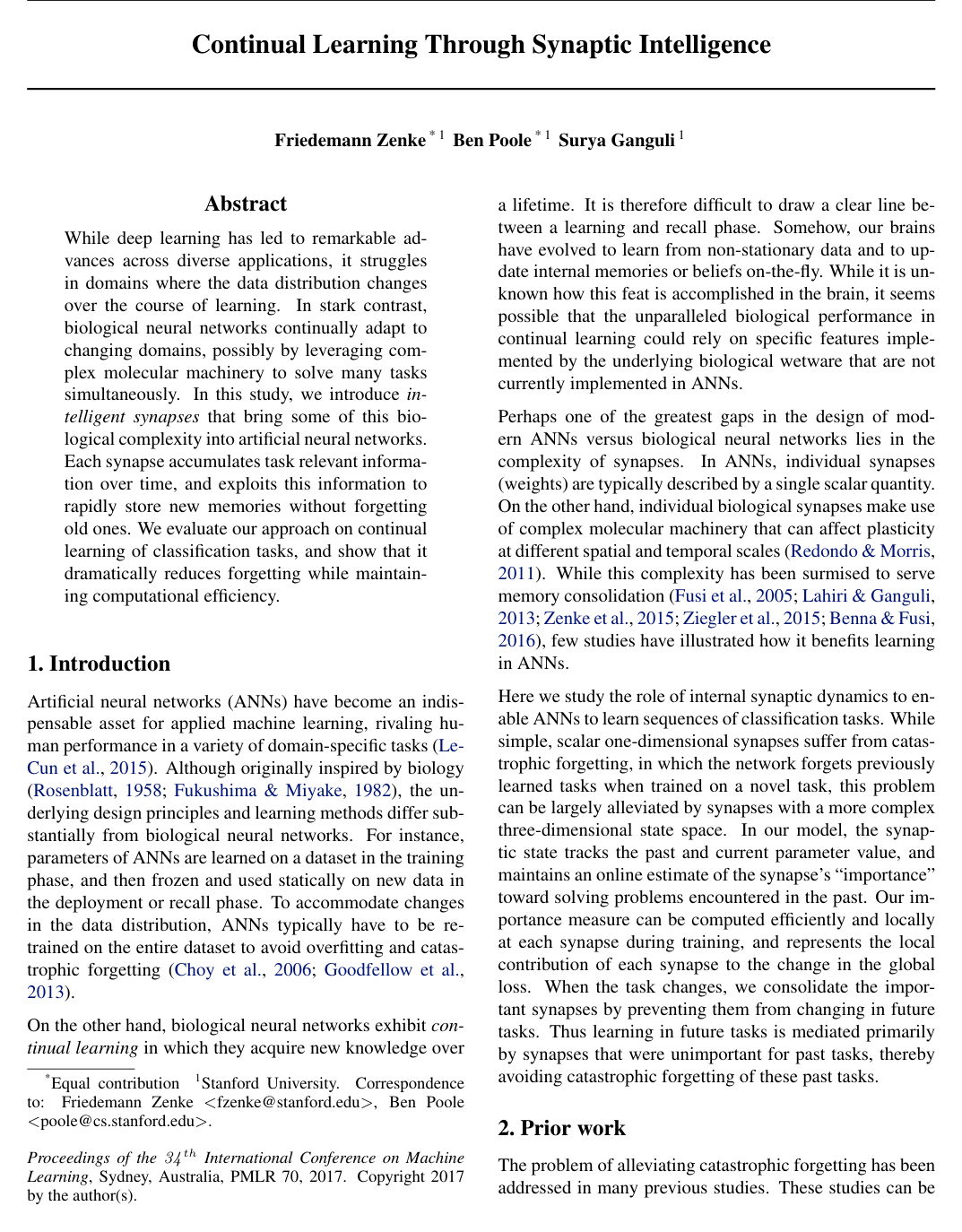
Continual Learning Through Synaptic Intelligence
Friedemann Zenke, Ben Poole, Surya Ganguli
Why you should read this
Proposes Synaptic Intelligence, a biologically inspired continual learning method that tracks parameter importance online to prevent catastrophic forgetting across sequential tasks with minimal computational overhead.
While deep learning has led to remarkable advances across diverse applications, it struggles in domains where the data distribution changes over the course of learning. In stark contrast, biological neural networks continually adapt to changing domains, possibly by leveraging complex molecular machinery to solve many tasks simultaneously. In this study, we introduce intelligent synapses that bring some of this biological complexity into artificial neural networks. Each synapse accumulates task relevant information over time, and exploits this information to rapidly store new memories without forgetting old ones. We evaluate our approach on continual learning of classification tasks, and show that it dramatically reduces forgetting while maintaining computational efficiency.
Added
2026-09-11
Continual Learning Mechanisms Compose for Long-Horizon Memorization
Zheyuan Zhang, Alvin Zhang, Daniel Khashabi, Tianmin Shu
Why you should read this
Demonstrates that composing complementary continual learning mechanisms—combining data, function, and weight anchors with merged low-rank adaptation—substantially mitigates catastrophic forgetting across 100 sequential tasks, yielding a 28-fold increase in long-horizon knowledge retention.
Language models may need to internalize information that arrives over time and retain it through many subsequent updates. To study this challenge, we introduce long-horizon memorization, a setting in which a model learns 100 query-answer tasks through continual supervised fine-tuning without retaining earlier training examples or receiving task identifiers at inference. Sequential updates cause catastrophic forgetting, and no single continual learning mechanism we evaluate maintains strong retention at this horizon. We hypothesize that mechanisms addressing complementary sources of forgetting will be more effective when composed. We organize these compositions along two design dimensions. Data, function, and weight anchors specify what prior information each update should preserve, while low-rank allocation rules determine where successive updates are retained. To test this hypothesis systematically, we construct three distinct 100-task memorization datasets. We introduce task-level successive halving to search the combinatorial design space and use a factorial experiment to measure individual and interaction effects. Our best method combines all three anchors with merged LoRA, ranks among the top 3 methods in all datasets, and raises average final retention from 1.2% under naive sequential fine-tuning to 34.9%, a 28-fold improvement. The data anchor and merged LoRA provide the largest average gains and interact super-additively on all three datasets. Together, these results show that composing complementary mechanisms substantially improves long-horizon memorization beyond what any individual mechanism achieves.
Added
2026-09-10
