
keyword
surface registration
Surface registration is the computational process of aligning two or more three-dimensional geometric surfaces into a shared coordinate system by determining the optimal spatial transformation between them. Widely used in computer vision, computer graphics, robotics, and medical imaging, this process establishes geometric correspondences between representations such as point clouds or polygon meshes to merge partial scans, track motion, or analyze structural variations. Registration methods generally operate through rigid transformations, which account strictly for translation and rotation, or non-rigid transformations, which accommodate complex deformations, scaling, and local morphing to match shapes that vary in geometry or pose.
2 items
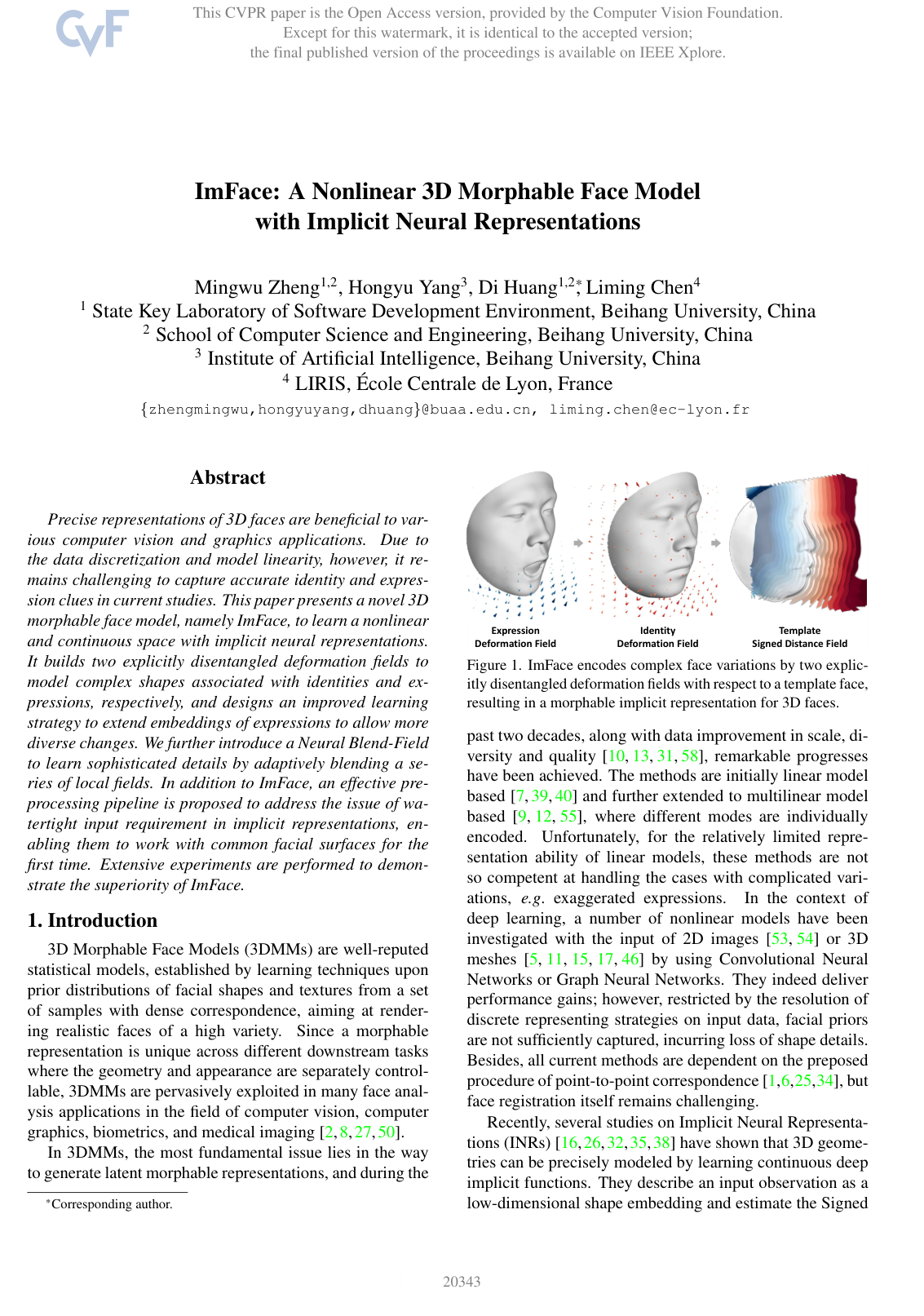
ImFace: A Nonlinear 3D Morphable Face Model with Implicit Neural Representations
Mingwu Zheng, Hongyu Yang, Di Huang, Liming Chen
Why you should read this
Proposes a nonlinear 3D morphable face model based on implicit neural representations that explicitly disentangles identity and expression deformation fields, enabling high-fidelity face reconstruction and synthesis directly from non-watertight surfaces.
Precise representations of 3D faces are beneficial to various computer vision and graphics applications. Due to the data discretization and model linearity, however, it remains challenging to capture accurate identity and expression clues in current studies. This paper presents a novel 3D morphable face model, namely ImFace, to learn a nonlinear and continuous space with implicit neural representations. It builds two explicitly disentangled deformation fields to model complex shapes associated with identities and expressions, respectively, and designs an improved learning strategy to extend embeddings of expressions to allow more diverse changes. We further introduce a Neural Blend-Field to learn sophisticated details by adaptively blending a series of local fields. In addition to ImFace, an effective preprocessing pipeline is proposed to address the issue of watertight input requirement in implicit representations, enabling them to work with common facial surfaces for the first time. Extensive experiments are performed to demonstrate the superiority of ImFace.
Added
2026-09-26

Using Spin Images for Efficient Object Recognition in Cluttered 3D Scenes
Andrew E. Johnson, M. Hebert
Why you should read this
Presents the spin image representation, a 2D local shape descriptor combined with PCA compression and efficient nearest-neighbor search, enabling simultaneous recognition and pose estimation of multiple 3D objects in heavily cluttered and occluded scenes without prior segmentation.
We present a 3D shape-based object recognition system for simultaneous recognition of multiple objects in scenes containing clutter and occlusion. Recognition is based on matching surfaces by matching points using the spin image representation. The spin image is a data level shape descriptor that is used to match surfaces represented as surface meshes. We present a compression scheme for spin images that results in efficient multiple object recognition which we verify with results showing the simultaneous recognition of multiple objects from a library of 20 models. Furthermore, we demonstrate the robust performance of recognition in the presence of clutter and occlusion through analysis of recognition trials on 100 scenes.
Added
2026-09-14