
keyword
subspace representation
A subspace representation is a method of encoding data, features, or concepts by embedding or projecting them into a lower-dimensional linear subspace within a higher-dimensional vector space. In this framework, complex information is characterized by specific directions or coordinate systems spanned by a subset of basis vectors rather than the full ambient space. By capturing the underlying geometric structure of the data, subspace representations facilitate dimensionality reduction, clustering, and pattern analysis while enabling computational models to isolate distinct semantic properties, invariant patterns, or shared relationships along well-defined linear dimensions.
2 items
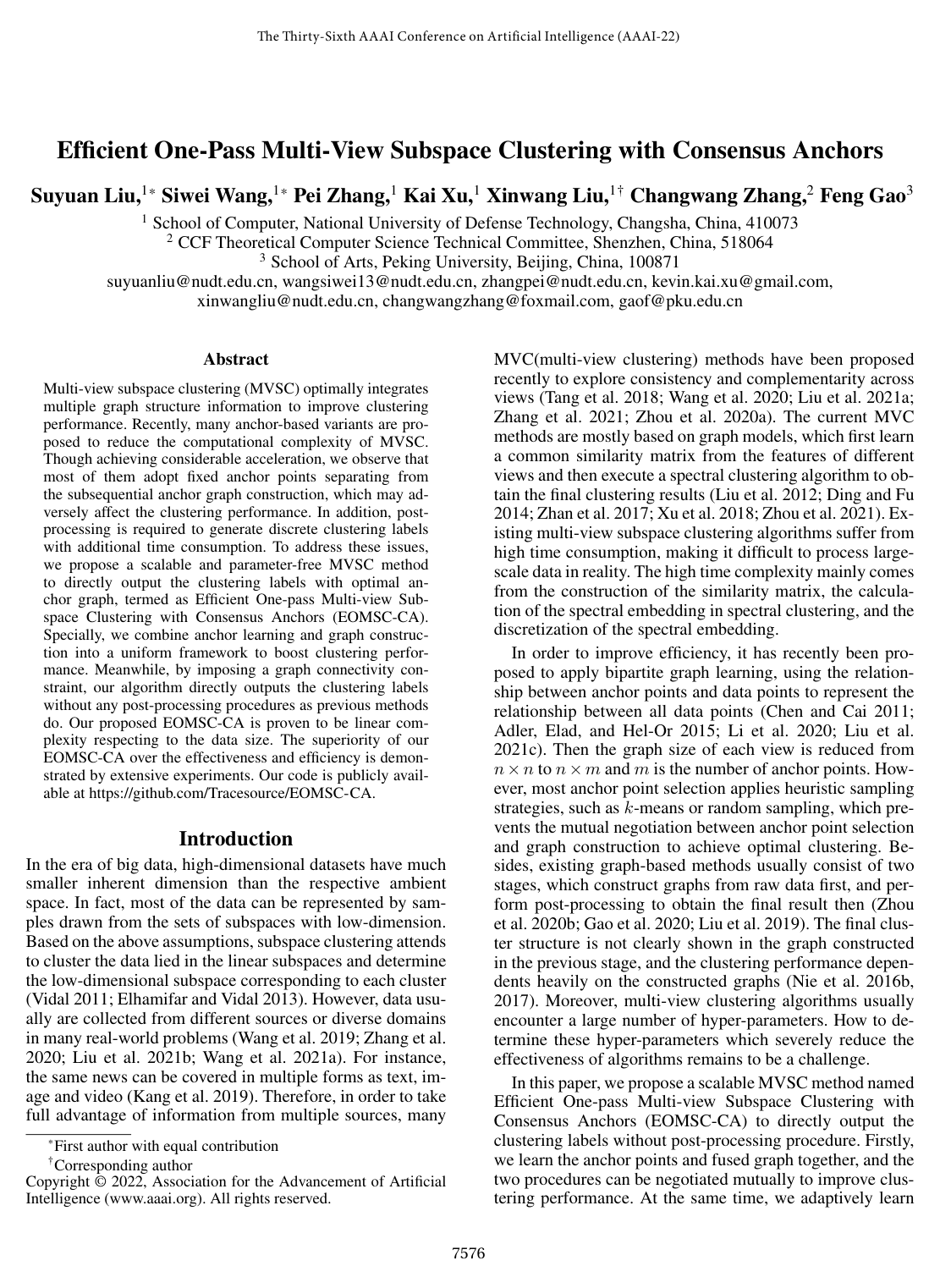
Efficient One-Pass Multi-View Subspace Clustering with Consensus Anchors
Suyuan Liu, Siwei Wang, Pei Zhang, Kai Xu, Xinwang Liu, Changwang Zhang, Feng Gao
Why you should read this
Proposes a scalable multi-view subspace clustering method that jointly learns consensus anchors and a fused graph with exact connected components, achieving linear time complexity and directly generating cluster labels without heuristic anchor sampling or post-processing steps.
Multi-view subspace clustering (MVSC) optimally integrates multiple graph structure information to improve clustering performance. Recently, many anchor-based variants are proposed to reduce the computational complexity of MVSC. Though achieving considerable acceleration, we observe that most of them adopt fixed anchor points separating from the sub-sequential anchor graph construction, which may adversely affect the clustering performance. In addition, post-processing is required to generate discrete clustering labels with additional time consumption. To address these issues, we propose a scalable and parameter-free MVSC method to directly output the clustering labels with optimal anchor graph, termed as Efficient One-pass Multi-view Subspace Clustering with Consensus Anchors (EOMSC-CA). Specially, we combine anchor learning and graph construction into a uniform framework to boost clustering performance. Meanwhile, by imposing a graph connectivity constraint, our algorithm directly outputs the clustering labels without any post-processing procedures as previous methods do. Our proposed EOMSC-CA is proven to be linear complexity respecting to the data size. The superiority of our EOMSC-CA over the effectiveness and efficiency is demonstrated by extensive experiments. Our code is publicly available at https://github.com/Tracesource/EOMSC-CA.
Added
2026-09-26
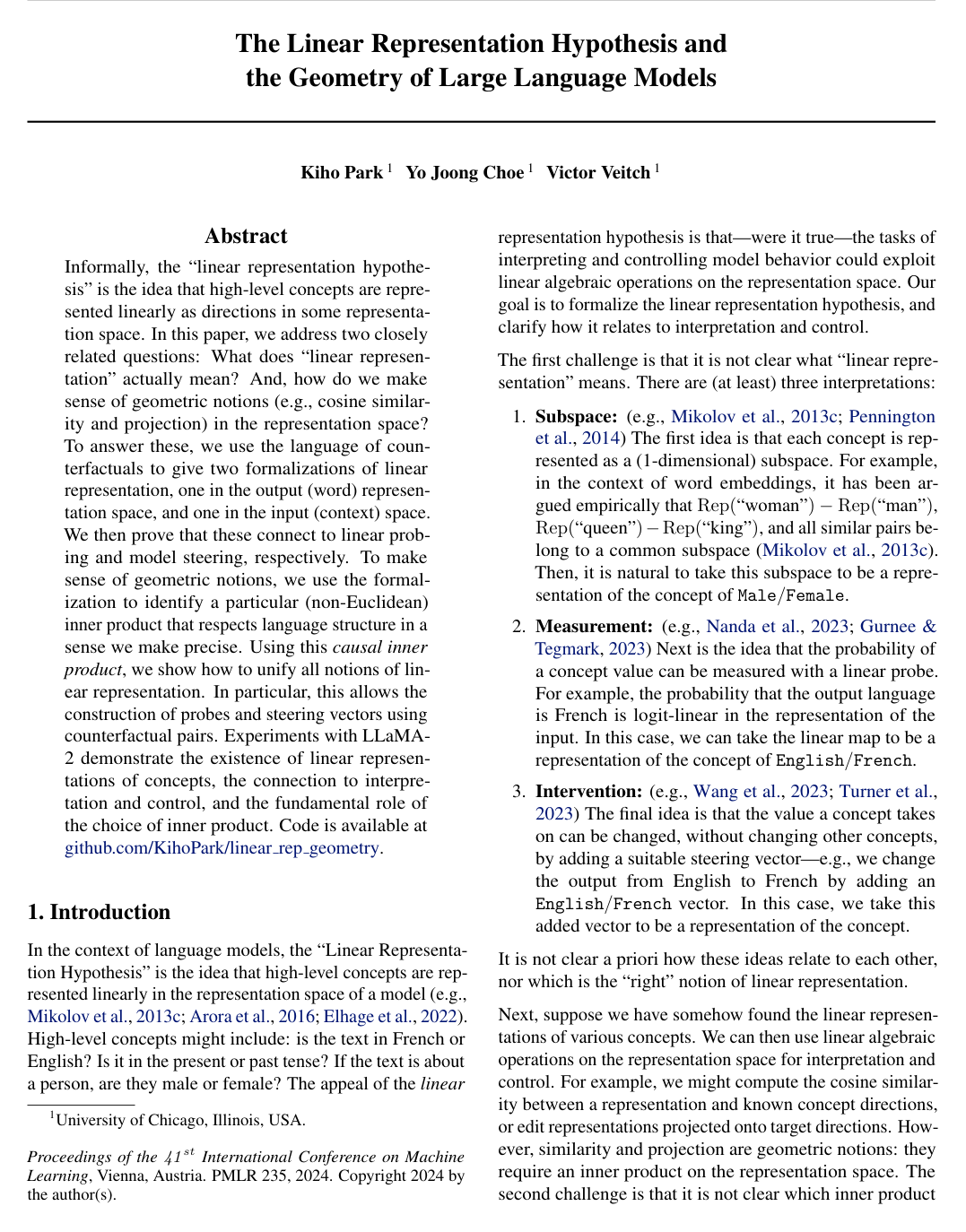
The Linear Representation Hypothesis and the Geometry of Large Language Models
Kiho Park, Yo Joong Choe, Victor Veitch
Why you should read this
Formalizes the linear representation hypothesis using counterfactual pairs to unify linear probing and steering under a causally grounded inner product for large language model representations.
Informally, the "linear representation hypothesis" is the idea that high-level concepts are represented linearly as directions in some representation space. In this paper, we address two closely related questions: What does "linear representation" actually mean? And, how do we make sense of geometric notions (e.g., cosine similarity and projection) in the representation space? To answer these, we use the language of counterfactuals to give two formalizations of linear representation, one in the output (word) representation space, and one in the input (context) space. We then prove that these connect to linear probing and model steering, respectively. To make sense of geometric notions, we use the formalization to identify a particular (non-Euclidean) inner product that respects language structure in a sense we make precise. Using this causal inner product, we show how to unify all notions of linear representation. In particular, this allows the construction of probes and steering vectors using counterfactual pairs. Experiments with LLaMA-2 demonstrate the existence of linear representations of concepts, the connection to interpretation and control, and the fundamental role of the choice of inner product. Code is available at github.com/KihoPark/linear_rep_geometry.
Added
2026-09-26