
keyword
structural pruning
Structural pruning is a model compression technique in deep learning that reduces the size and computational demands of neural networks by systematically removing entire coherent components, such as neurons, channels, attention heads, matrix rows and columns, or whole layers, rather than zeroing out individual weights. By eliminating structurally coupled groups of parameters, this process physically alters the network architecture into a smaller, dense model. As a result, structural pruning achieves direct reductions in memory usage and inference latency on standard computing hardware without requiring specialized sparse computation libraries or dedicated acceleration frameworks, distinguishing it from unstructured weight pruning.
4 items
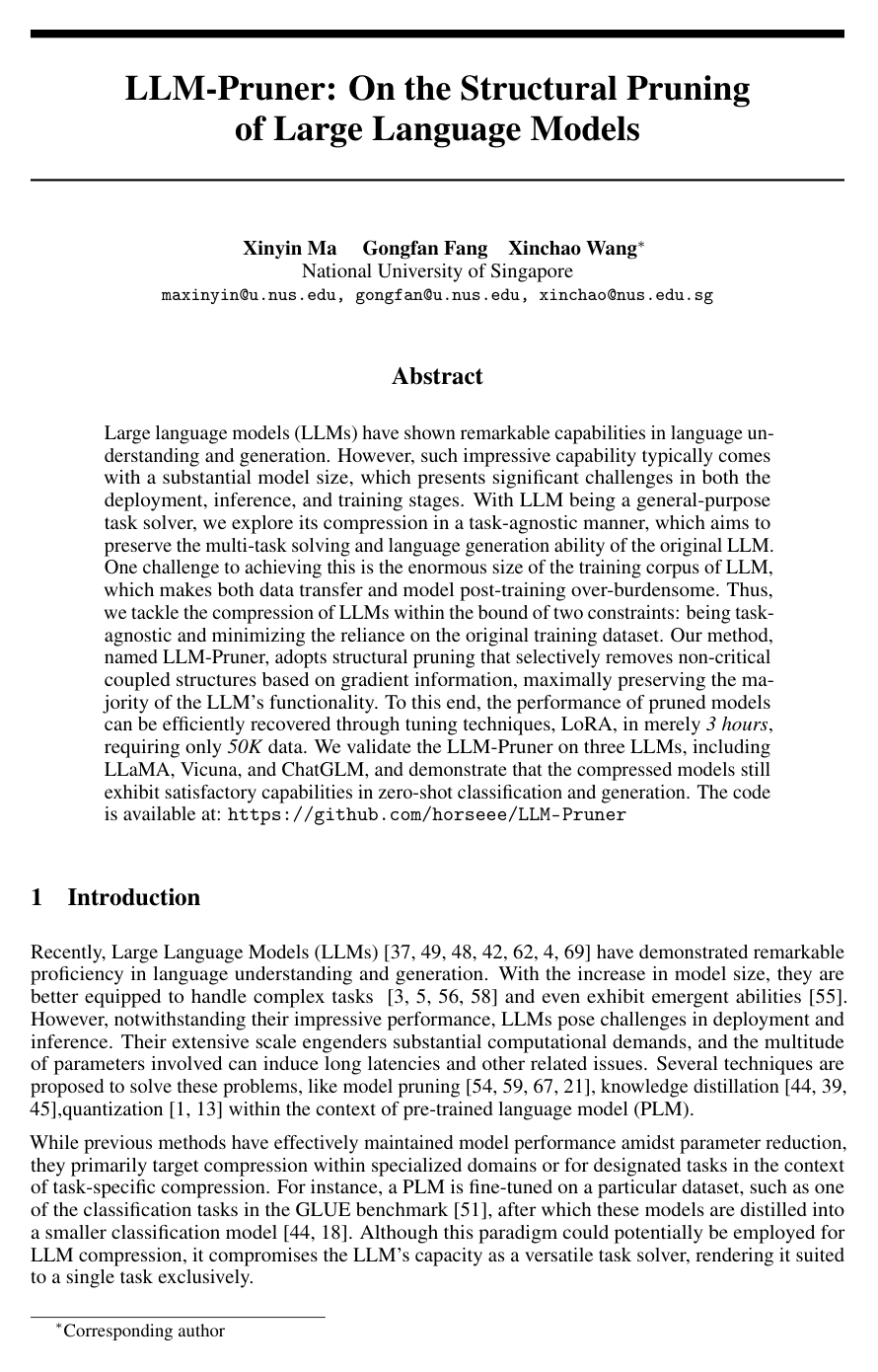
LLM-Pruner: On the Structural Pruning of Large Language Models
Xinyin Ma, Gongfan Fang, Xinchao Wang
Why you should read this
Presents LLM-Pruner, a task-agnostic structural pruning method that efficiently compresses large language models by removing non-critical coupled structures and recovers their multi-task generation performance in just three hours using 50,000 data samples.
Large language models (LLMs) have shown remarkable capabilities in language understanding and generation. However, such impressive capability typically comes with a substantial model size, which presents significant challenges in both the deployment, inference, and training stages. With LLM being a general-purpose task solver, we explore its compression in a task-agnostic manner, which aims to preserve the multi-task solving and language generation ability of the original LLM. One challenge to achieving this is the enormous size of the training corpus of LLM, which makes both data transfer and model post-training over-burdensome. Thus, we tackle the compression of LLMs within the bound of two constraints: being task-agnostic and minimizing the reliance on the original training dataset. Our method, named LLM-Pruner, adopts structural pruning that selectively removes non-critical coupled structures based on gradient information, maximally preserving the majority of the LLM's functionality. To this end, the performance of pruned models can be efficiently recovered through tuning techniques, LoRA, in merely 3 hours, requiring only 50K data. We validate the LLM-Pruner on three LLMs, including LLaMA, Vicuna, and ChatGLM, and demonstrate that the compressed models still exhibit satisfactory capabilities in zero-shot classification and generation. The code is available at: this https URL
Added
2026-10-05
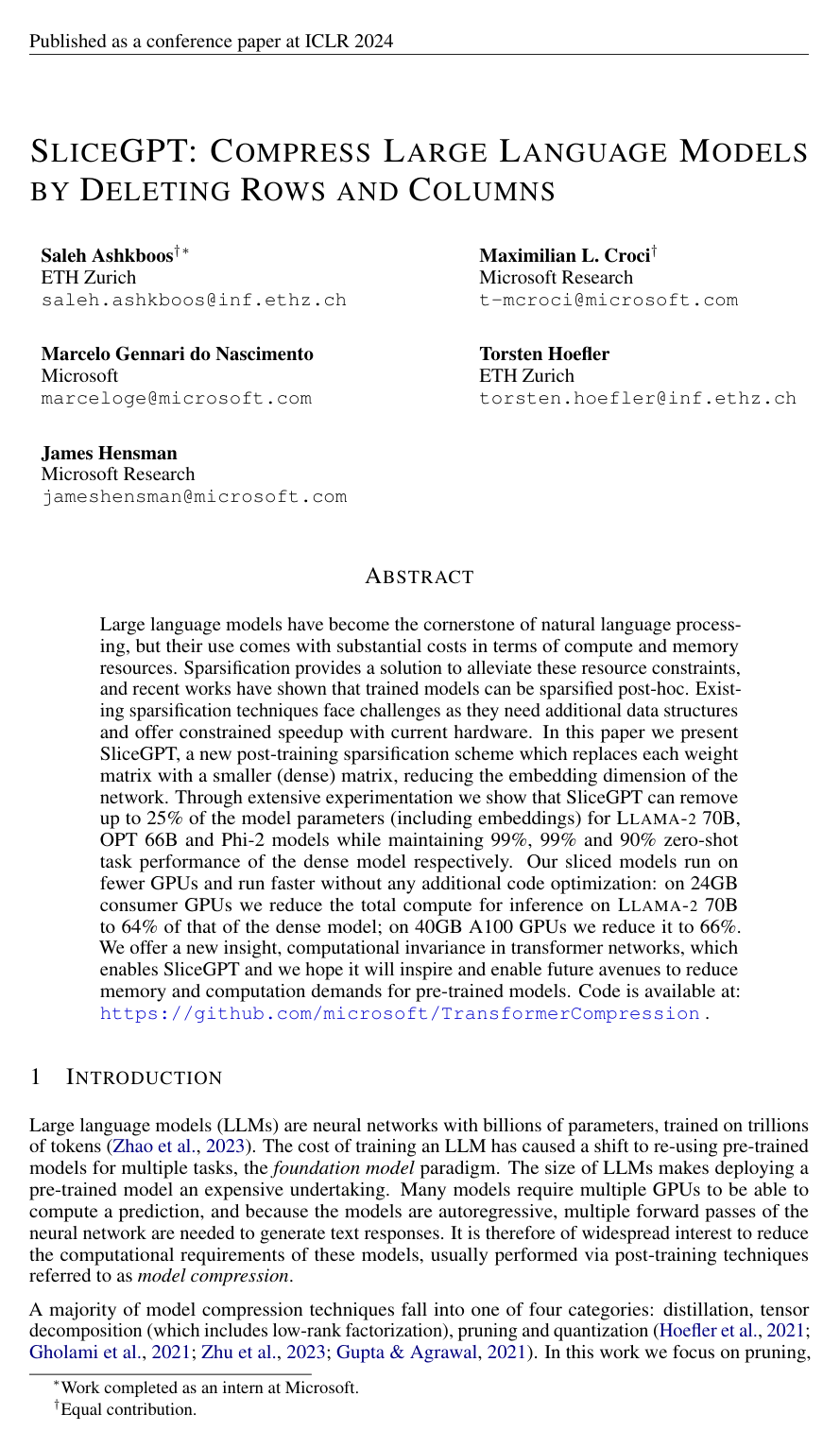
SliceGPT: Compress Large Language Models by Deleting Rows and Columns
Saleh Ashkboos, Maximilian L. Croci, Marcelo Gennari Do Nascimento, Torsten Hoefler, James Hensman
Why you should read this
Introduces SliceGPT, a post-training compression method that exploits computational invariance to slice transformer weight matrices into smaller dense arrays, cutting parameters by up to 25% and accelerating inference on standard GPUs with minimal loss in zero-shot accuracy.
Large language models have become the cornerstone of natural language processing, but their use comes with substantial costs in terms of compute and memory resources. Sparsification provides a solution to alleviate these resource constraints, and recent works have shown that trained models can be sparsified post-hoc. Existing sparsification techniques face challenges as they need additional data structures and offer constrained speedup with current hardware. In this paper we present SliceGPT, a new post-training sparsification scheme which replaces each weight matrix with a smaller (dense) matrix, reducing the embedding dimension of the network. Through extensive experimentation, we show that SliceGPT can remove up to 25% of the model parameters (including embeddings) for LLAMA2-70B, OPT 66B and Phi-2 models while maintaining 99%, 99% and 90% zero-shot task performance of the dense model respectively. Our sliced models run on fewer GPUs and run faster without any additional code optimization: on 24GB consumer GPUs we reduce the total compute for inference on LLAMA2-70B to 64% of that of the dense model; on 40GB A100 GPUs we reduce it to 66%. We offer a new insight, computational invariance in transformer networks, which enables SliceGPT and we hope it will inspire and enable future avenues to reduce memory and computation demands for pre-trained models. Code is available at: this https URL
Added
2026-09-26
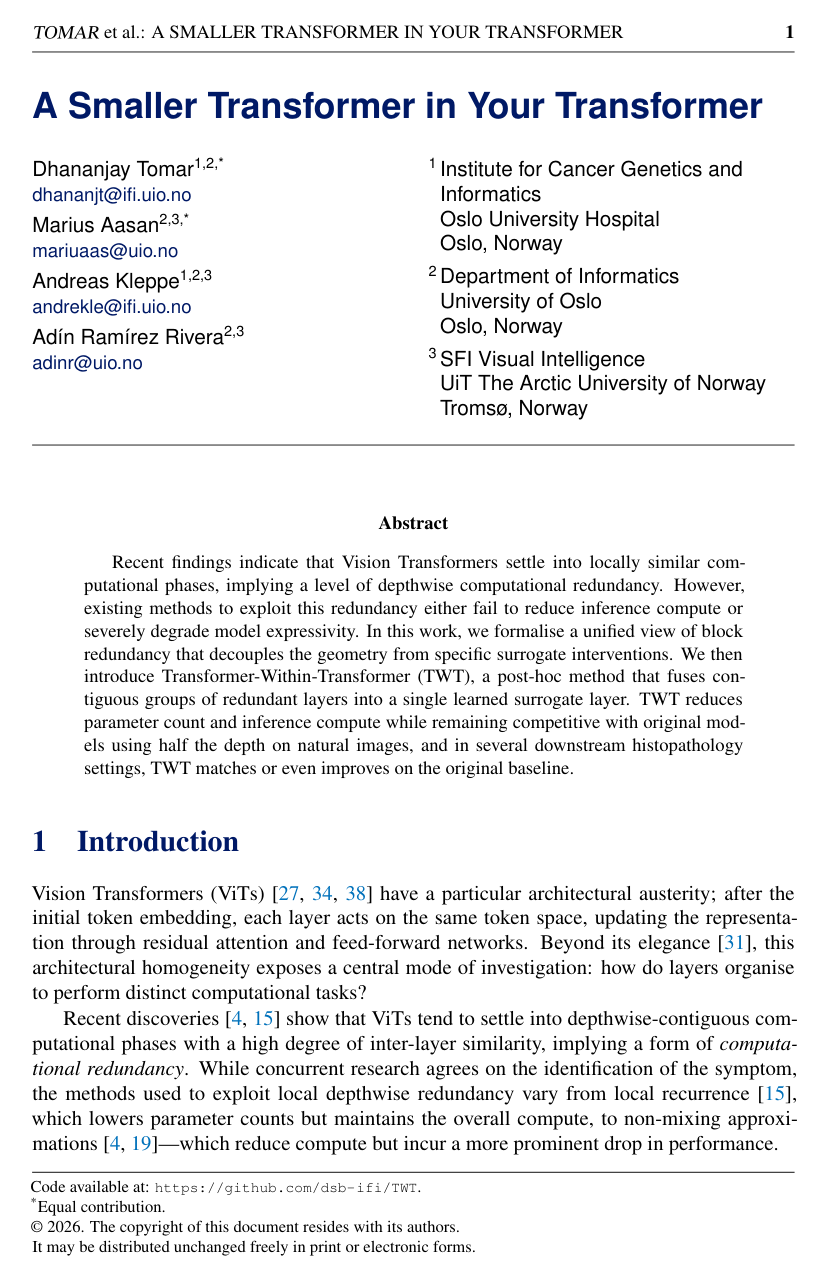
A Smaller Transformer in Your Transformer
Dhananjay Tomar, Marius Aasan, Andreas Kleppe, Adín Ramírez Rivera
Why you should read this
Proposes Transformer-Within-Transformer, a post-hoc compression technique that fuses contiguous redundant Vision Transformer layers into single learned surrogate blocks, halving model depth and inference computation while matching or exceeding baseline accuracy across natural image and histopathology domains.
Recent findings indicate that Vision Transformers settle into locally similar computational phases, implying a level of depthwise computational redundancy. However, existing methods to exploit this redundancy either fail to reduce inference compute or severely degrade model expressivity. In this work, we formalise a unified view of block redundancy that decouples the geometry from specific surrogate interventions. We then introduce Transformer-Within-Transformer (TWT), a post-hoc method that fuses contiguous groups of redundant layers into a single learned surrogate layer. TWT reduces parameter count and inference compute while remaining competitive with original models using half the depth on natural images, and in several downstream histopathology settings, TWT matches or even improves on the original baseline.
Added
2026-09-20

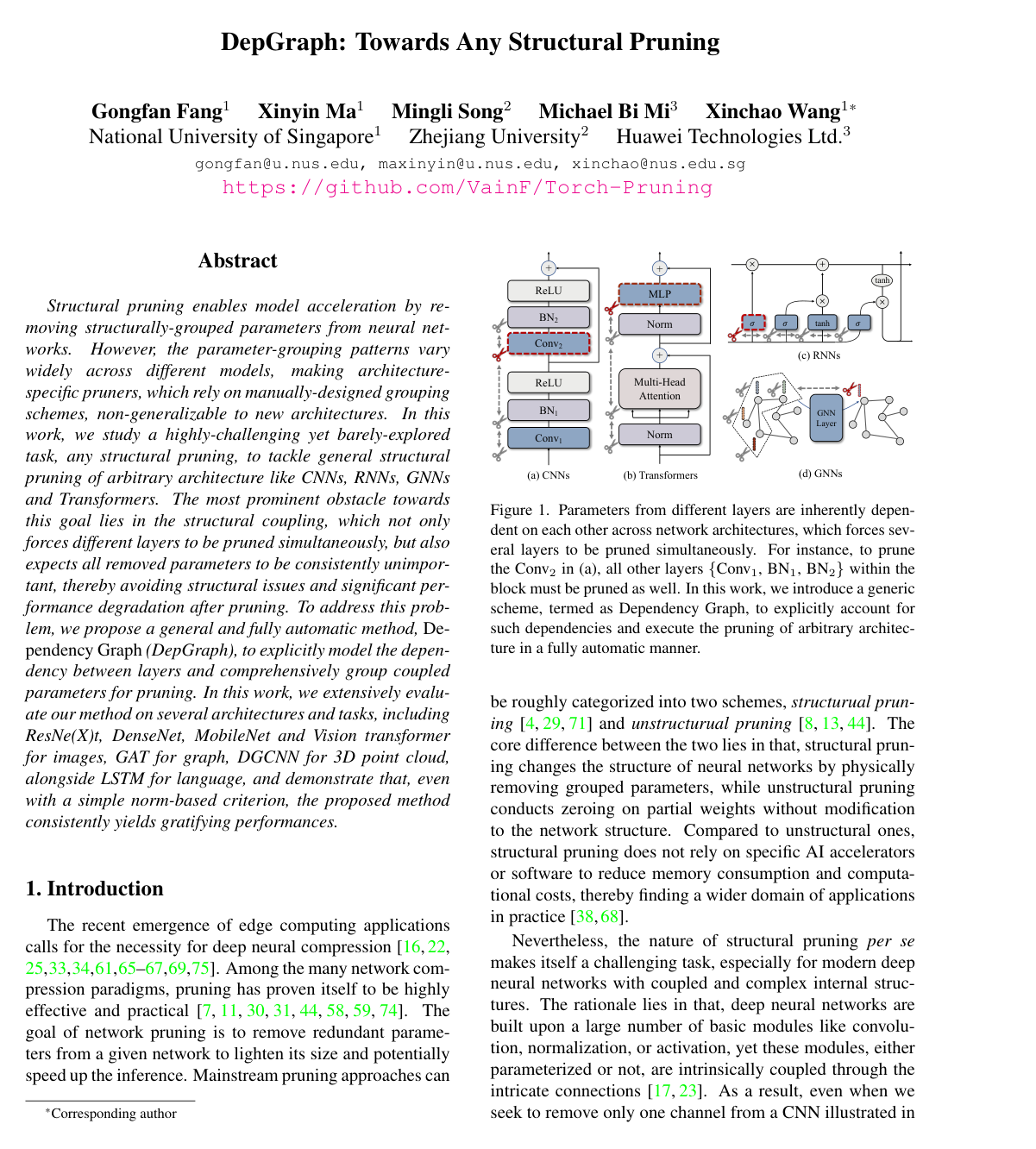
DepGraph: Towards Any Structural Pruning
Gongfan Fang, Xinyin Ma, Mingli Song, Michael Bi Mi, Xinchao Wang
Why you should read this
Establishes a generalized dependency graph framework that automatically handles the complex structural constraints of modern architectures (like residuals and transformers) to enable one-click structured pruning.
Structural pruning enables model acceleration by removing structurally-grouped parameters from neural networks. However, the parameter-grouping patterns vary widely across different models, making architecture-specific pruners, which rely on manually-designed grouping schemes, non-generalizable to new architectures. In this work, we study a highly-challenging yet barely-explored task, any structural pruning, to tackle general structural pruning of arbitrary architecture like CNNs, RNNs, GNNs and Transformers. The most prominent obstacle towards this goal lies in the structural coupling, which not only forces different layers to be pruned simultaneously, but also expects all removed parameters to be consistently unimportant, thereby avoiding structural issues and significant performance degradation after pruning. To address this problem, we propose a general and fully automatic method, Dependency Graph (DepGraph), to explicitly model the dependency between layers and comprehensively group coupled parameters for pruning. In this work, we extensively evaluate our method on several architectures and tasks, including ResNe(X)t, DenseNet, MobileNet and Vision transformer for images, GAT for graph, DGCNN for 3D point cloud, alongside LSTM for language, and demonstrate that, even with a simple norm-based criterion, the proposed method consistently yields gratifying performances.
Added
2026-02-26