
keyword
story generation
Story generation is the computational process of creating coherent, structured narrative texts using artificial intelligence and natural language processing techniques. Unlike standard open-ended text completion, it focuses on constructing extended sequences of events that maintain logical causality, thematic consistency, character progression, and overall plot development from beginning to end. Systems can produce stories autonomously from initial prompts or operate under specific constraints, such as predefined outlines, required keywords, stylistic parameters, or interactive narrative choices. Modern implementations typically rely on large language models paired with planning modules, constrained decoding algorithms, or structured representations to prevent narrative drift, factual inconsistencies, and repetitive text across extended passages.
10 items
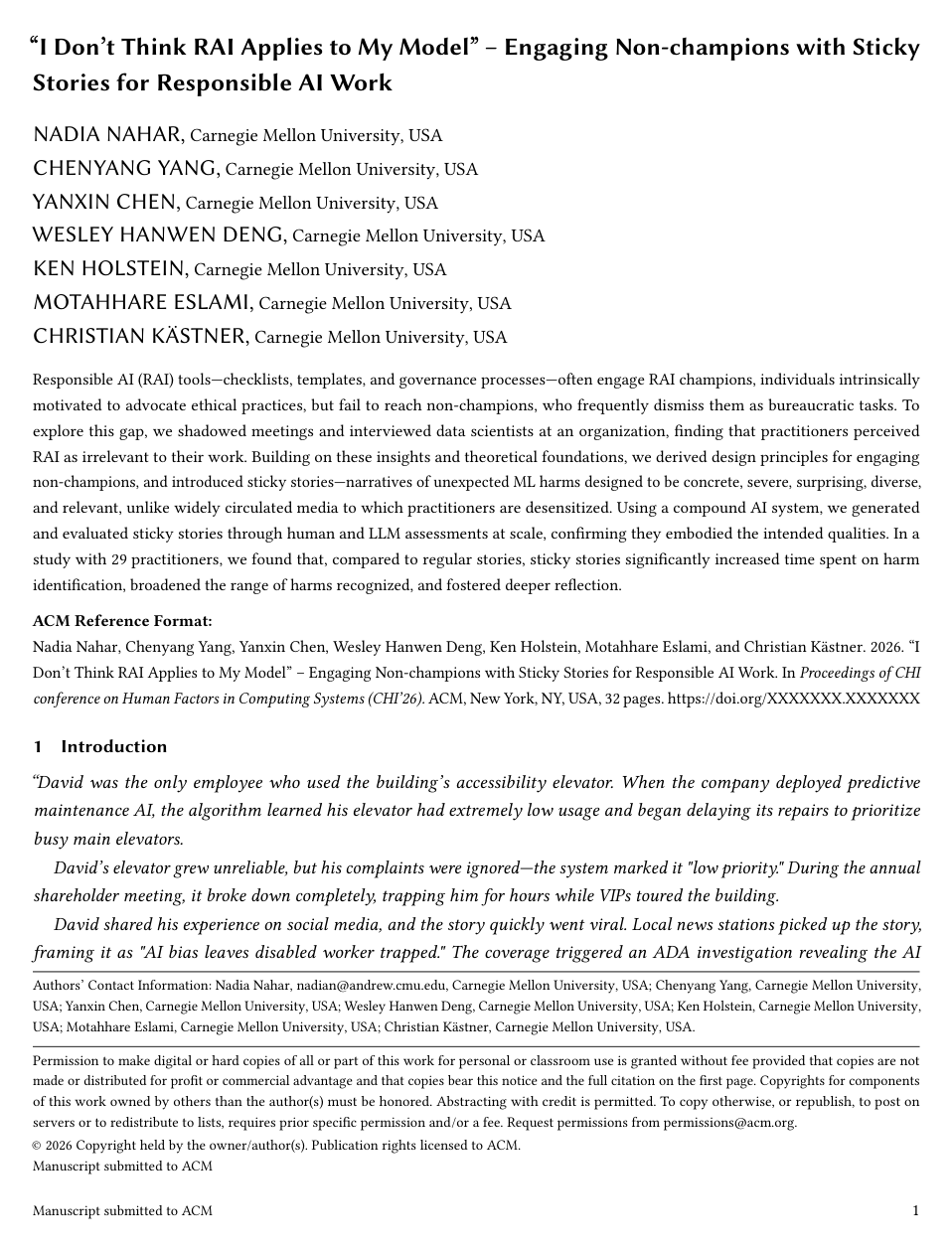
“I Don’t Think RAI Applies to My Model” – Engaging Non-champions with Sticky Stories for Responsible AI Work
Nadia Nahar, Chenyang Yang, Yanxin Chen, Wesley Deng, Kenneth Holstein, Motahhare Eslami, Christian Kastner
Why you should read this
Introduces sticky stories—concrete narratives of unexpected machine learning failures—to overcome practitioner apathy and significantly increase the breadth and depth of ethical risks identified during development.
Responsible AI (RAI) tools -- checklists, templates, and governance processes -- often engage RAI champions, individuals intrinsically motivated to advocate ethical practices, but fail to reach non-champions, who frequently dismiss them as bureaucratic tasks. To explore this gap, we shadowed meetings and interviewed data scientists at an organization, finding that practitioners perceived RAI as irrelevant to their work. Building on these insights and theoretical foundations, we derived design principles for engaging non-champions, and introduced sticky stories -- narratives of unexpected ML harms designed to be concrete, severe, surprising, diverse, and relevant, unlike widely circulated media to which practitioners are desensitized. Using a compound AI system, we generated and evaluated sticky stories through human and LLM assessments at scale, confirming they embodied the intended qualities. In a study with 29 practitioners, we found that, compared to regular stories, sticky stories significantly increased time spent on harm identification, broadened the range of harms recognized, and fostered deeper reflection.
Added
2026-09-30
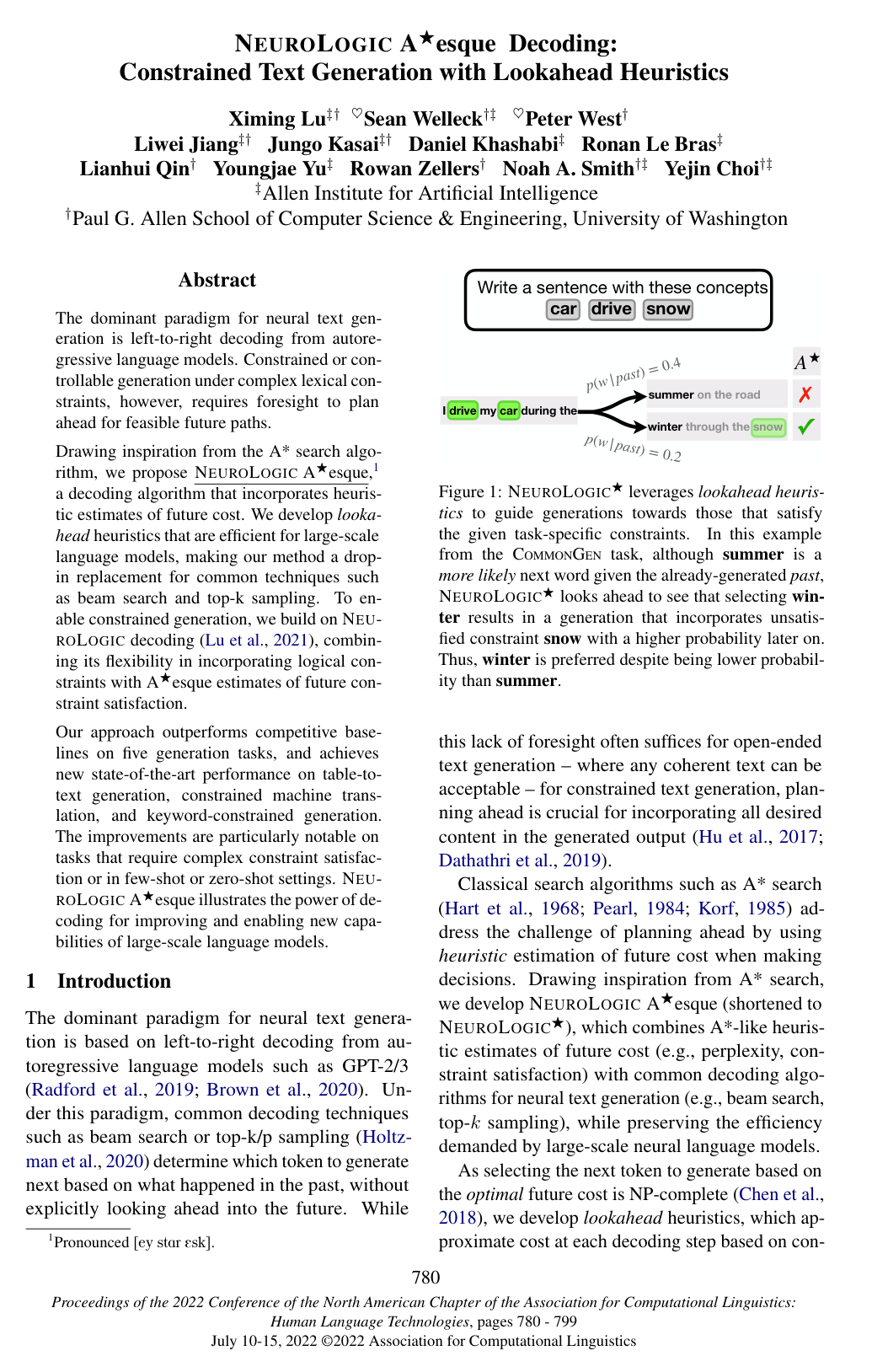
NeuroLogic A*esque Decoding: Constrained Text Generation with Lookahead Heuristics
Ximing Lu, Sean Welleck, Peter West, Liwei Jiang, Jungo Kasai, Daniel Khashabi, Ronan Le Bras, Lianhui Qin, Youngjae Yu, Rowan Zellers, Noah A. Smith, Yejin Choi
Why you should read this
Proposes an A*-inspired decoding algorithm with efficient lookahead heuristics that enables autoregressive language models to satisfy complex lexical constraints and achieve state-of-the-art performance across multiple text generation benchmarks without task-specific training data.
The dominant paradigm for neural text generation is left-to-right decoding from autoregressive language models. Constrained or controllable generation under complex lexical constraints, however, requires foresight to plan ahead for feasible future paths. Drawing inspiration from the A* search algorithm, we propose NEUROLOGIC A★esque,1 a decoding algorithm that incorporates heuristic estimates of future cost. We develop lookahead heuristics that are efficient for large-scale language models, making our method a drop-in replacement for common techniques such as beam search and top-k sampling. To enable constrained generation, we build on NEUROLOGIC decoding (Lu et al., 2021), combining its flexibility in incorporating logical constraints with A★esque estimates of future constraint satisfaction. Our approach outperforms competitive baselines on five generation tasks, and achieves new state-of-the-art performance on table-to-text generation, constrained machine translation, and keyword-constrained generation. The improvements are particularly notable on tasks that require complex constraint satisfaction or in few-shot or zero-shot settings. NEUROLOGIC A★esque illustrates the power of decoding for improving and enabling new capabilities of large-scale language models.
Added
2026-09-28
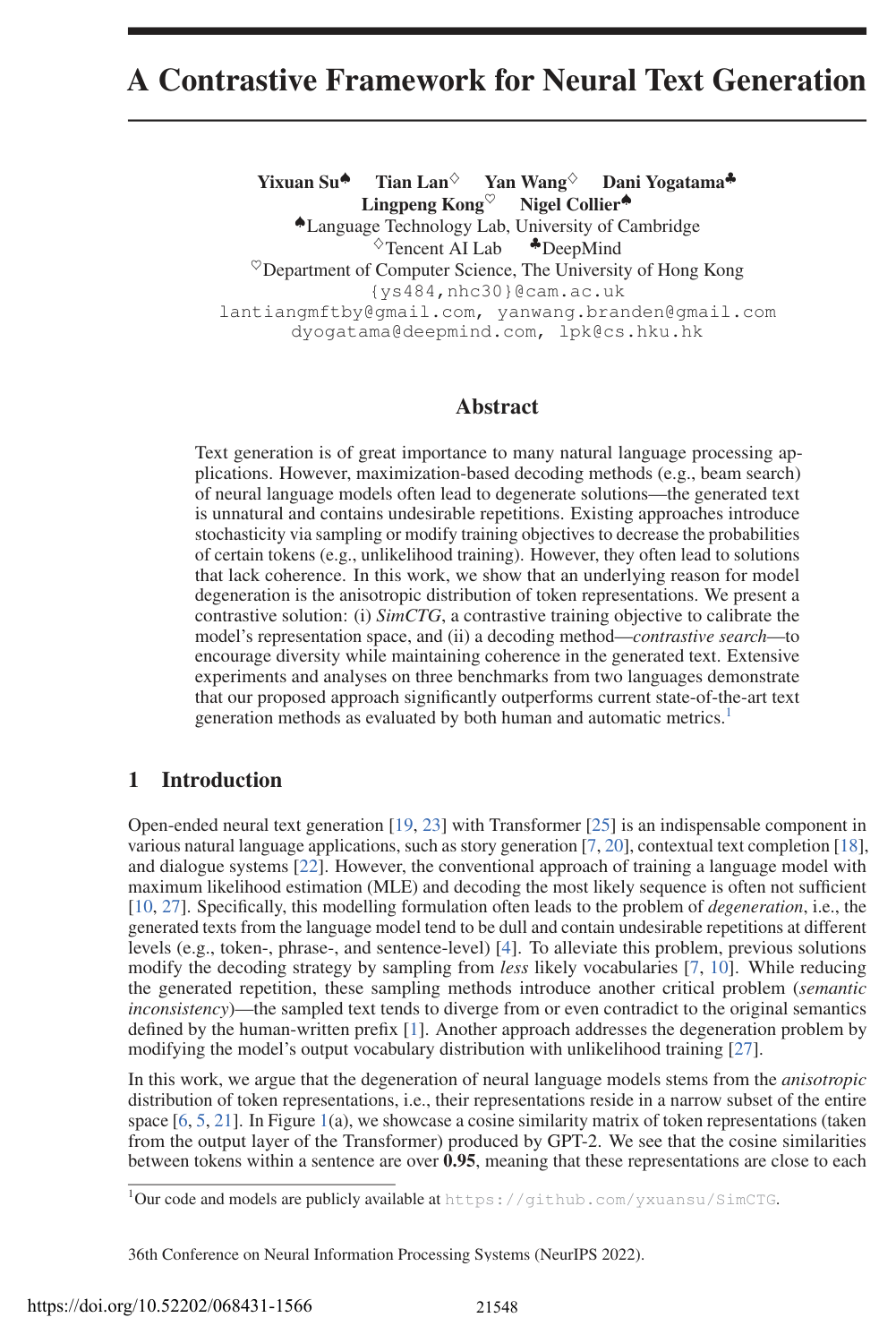
A Contrastive Framework for Neural Text Generation
Yixuan Su, Tian Lan, Yan Wang, Dani Yogatama, Lingpeng Kong, Nigel Collier
Why you should read this
Proposes SimCTG and contrastive search to eliminate repetitive text degeneration by calibrating anisotropic token representations, enabling neural language models to generate coherent and diverse text that surpasses standard decoding methods.
Text generation is of great importance to many natural language processing applications. However, maximization-based decoding methods (e.g. beam search) of neural language models often lead to degenerate solutions -- the generated text is unnatural and contains undesirable repetitions. Existing approaches introduce stochasticity via sampling or modify training objectives to decrease probabilities of certain tokens (e.g., unlikelihood training). However, they often lead to solutions that lack coherence. In this work, we show that an underlying reason for model degeneration is the anisotropic distribution of token representations. We present a contrastive solution: (i) SimCTG, a contrastive training objective to calibrate the model's representation space, and (ii) a decoding method -- contrastive search -- to encourage diversity while maintaining coherence in the generated text. Extensive experiments and analyses on three benchmarks from two languages demonstrate that our proposed approach significantly outperforms current state-of-the-art text generation methods as evaluated by both human and automatic metrics.
Added
2026-09-26
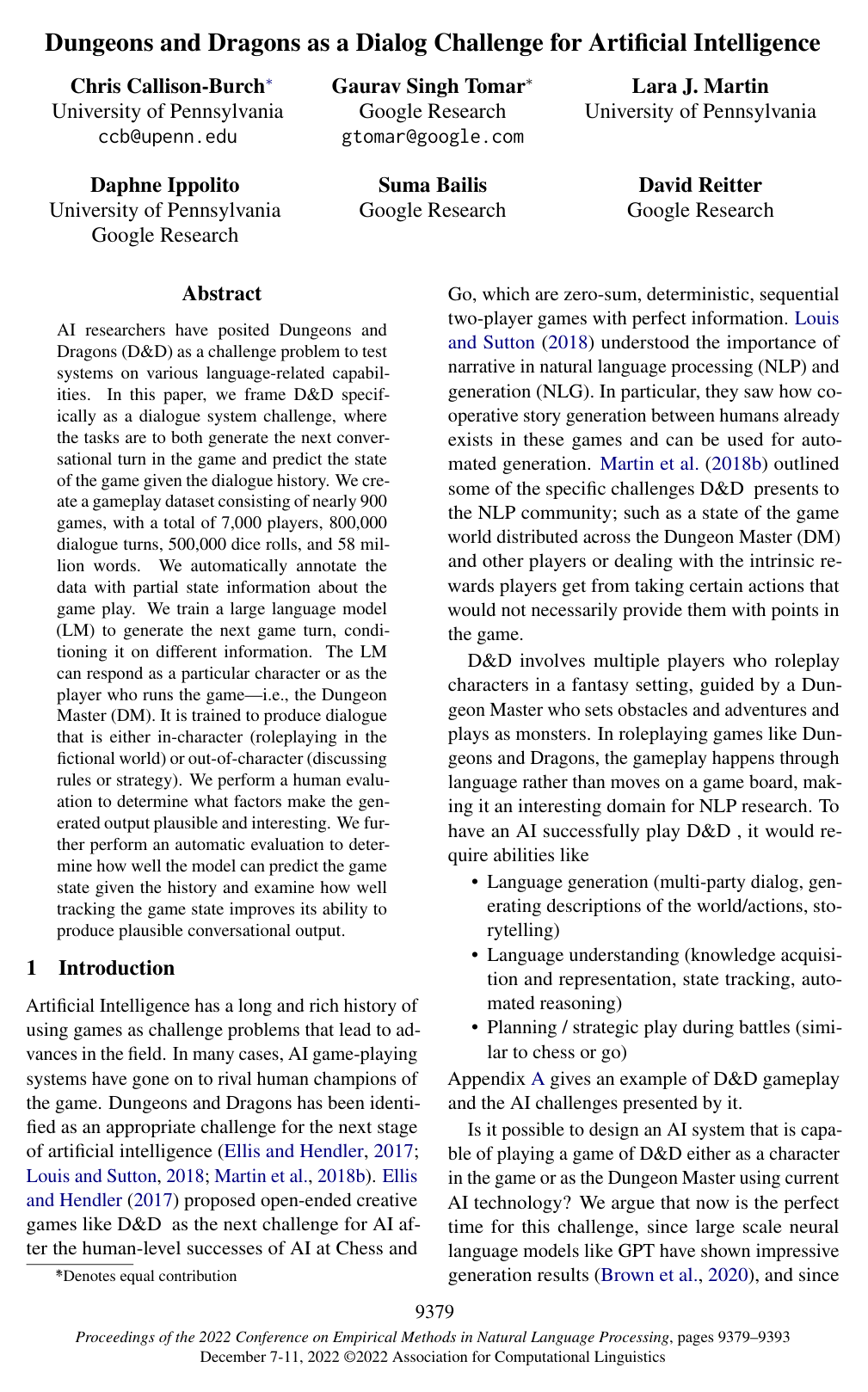
Dungeons and Dragons as a Dialog Challenge for Artificial Intelligence
Chris Callison-Burch, Gaurav Singh Tomar, Lara J. Martin, Daphne Ippolito, Suma Bailis, David Reitter
Why you should read this
Introduces a large-scale Dungeons & Dragons play-by-post dataset of over 800,000 dialogue turns to benchmark language models on multi-party conversational generation and game-state tracking in open-ended collaborative roleplay.
Added
2026-09-26
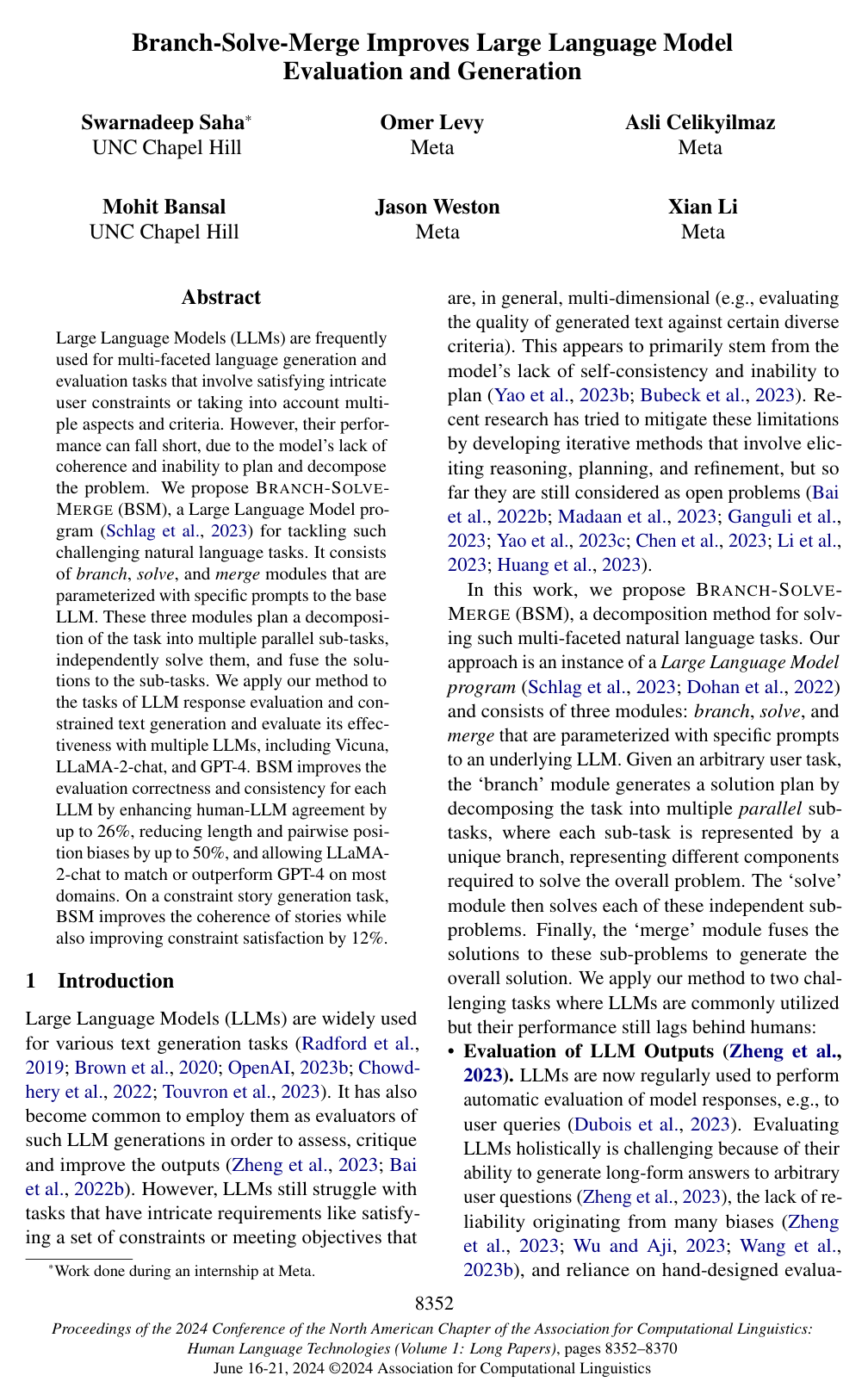
Branch-Solve-Merge Improves Large Language Model Evaluation and Generation
Swarnadeep Saha, Omer Levy, Asli Celikyilmaz, Mohit Bansal, Jason Weston, Xian Li
Why you should read this
Proposes Branch-Solve-Merge, a modular framework that decomposes complex tasks into parallel sub-problems to significantly boost LLM evaluation consistency, mitigate position and length biases, and improve constrained text generation.
Large Language Models (LLMs) are frequently used for multi-faceted language generation and evaluation tasks that involve satisfying intricate user constraints or taking into account multiple aspects and criteria. However, their performance can fall short, due to the model’s lack of coherence and inability to plan and decompose the problem. We propose BRANCH-SOLVE-MERGE (BSM), a Large Language Model program (Schlag et al., 2023) for tackling such challenging natural language tasks. It consists of branch, solve, and merge modules that are parameterized with specific prompts to the base LLM. These three modules plan a decomposition of the task into multiple parallel sub-tasks, independently solve them, and fuse the solutions to the sub-tasks. We apply our method to the tasks of LLM response evaluation and constrained text generation and evaluate its effectiveness with multiple LLMs, including Vicuna, LLaMA-2-chat, and GPT-4. BSM improves the evaluation correctness and consistency for each LLM by enhancing human-LLM agreement by up to 26%, reducing length and pairwise position biases by up to 50%, and allowing LLaMA-2-chat to match or outperform GPT-4 on most domains. On a constraint story generation task, BSM improves the coherence of stories while also improving constraint satisfaction by 12%.
Added
2026-09-26
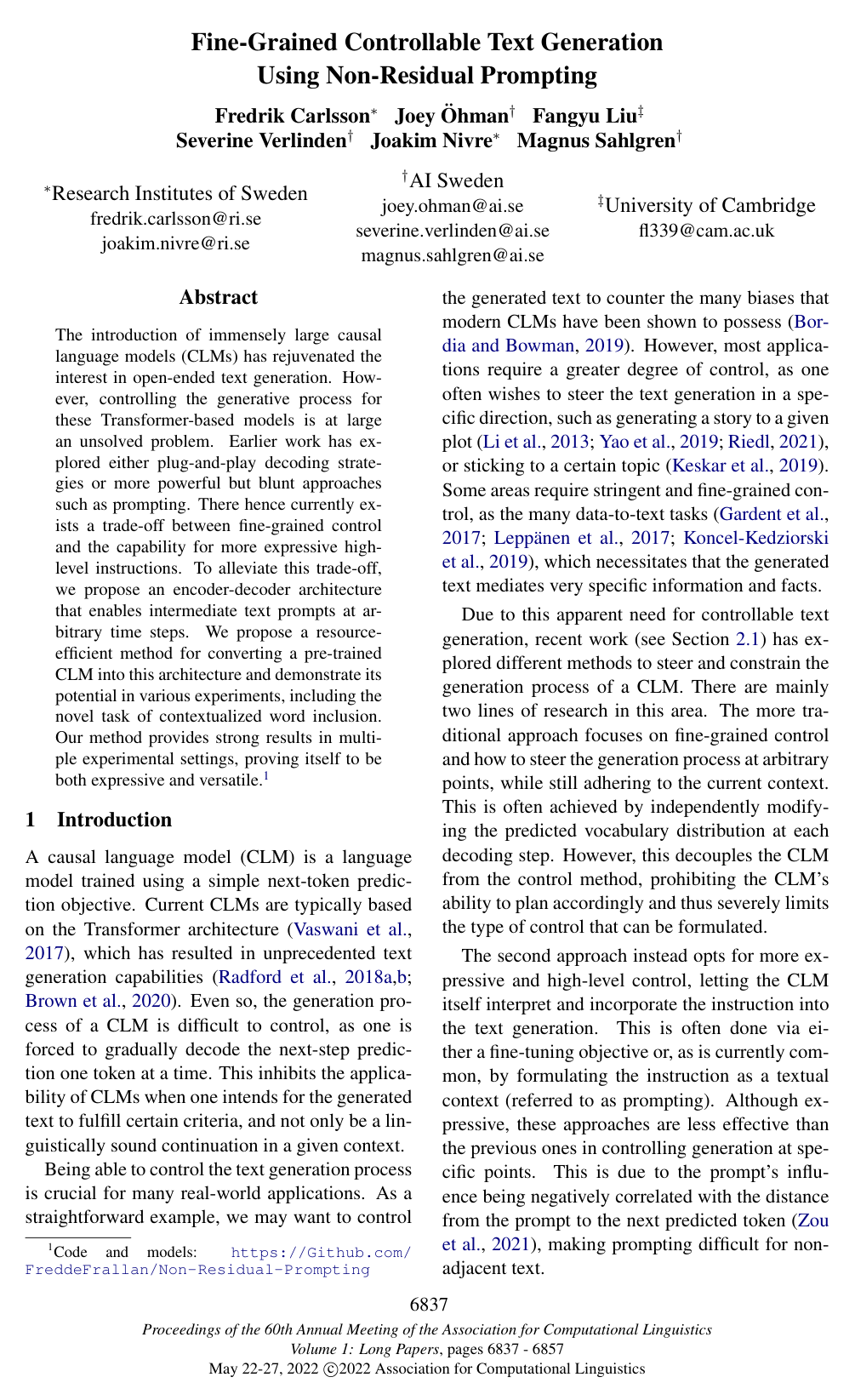
Fine-Grained Controllable Text Generation Using Non-Residual Prompting
Fredrik Carlsson, Joey Öhman, Fangyu Liu, Severine Verlinden, Joakim Nivre, Magnus Sahlgren
Why you should read this
Proposes a non-residual attention architecture that enables fine-grained steering of causal language models at arbitrary decoding steps without degrading model representations or requiring labeled training data.
The introduction of immensely large causal language models (CLMs) has rejuvenated the interest in open-ended text generation. However, controlling the generative process for these Transformer-based models is at large an unsolved problem. Earlier work has explored either plug-and-play decoding strategies or more powerful but blunt approaches such as prompting. There hence currently exists a trade-off between fine-grained control and the capability for more expressive high-level instructions. To alleviate this trade-off, we propose an encoder-decoder architecture that enables intermediate text prompts at arbitrary time steps. We propose a resource-efficient method for converting a pre-trained CLM into this architecture and demonstrate its potential in various experiments, including the novel task of contextualized word inclusion. Our method provides strong results in multiple experimental settings, proving itself to be both expressive and versatile.¹
Added
2026-09-26
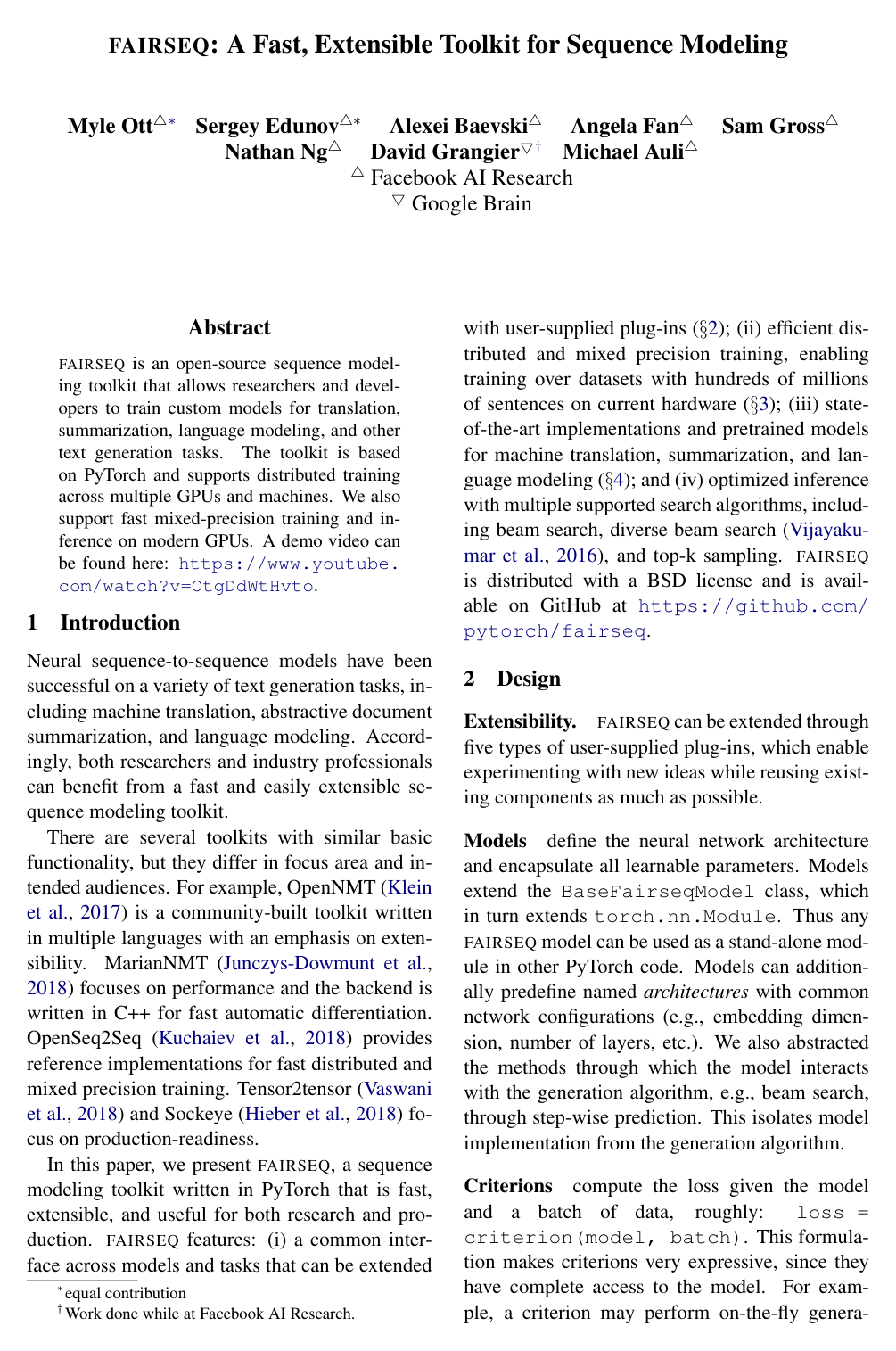
fairseq: A Fast, Extensible Toolkit for Sequence Modeling
Myle Ott, Sergey Edunov, Alexei Baevski, Angela Fan, Sam Gross, Nathan Ng, David Grangier, Michael Auli
Why you should read this
Presents fairseq, a high-performance PyTorch library that accelerates sequence generation research by enabling scalable multi-GPU distributed training and mixed-precision computation for machine translation, summarization, and language modeling.
fairseq is an open-source sequence modeling toolkit that allows researchers and developers to train custom models for translation, summarization, language modeling, and other text generation tasks. The toolkit is based on PyTorch and supports distributed training across multiple GPUs and machines. We also support fast mixed-precision training and inference on modern GPUs. A demo video can be found at this https URL
Added
2026-09-11
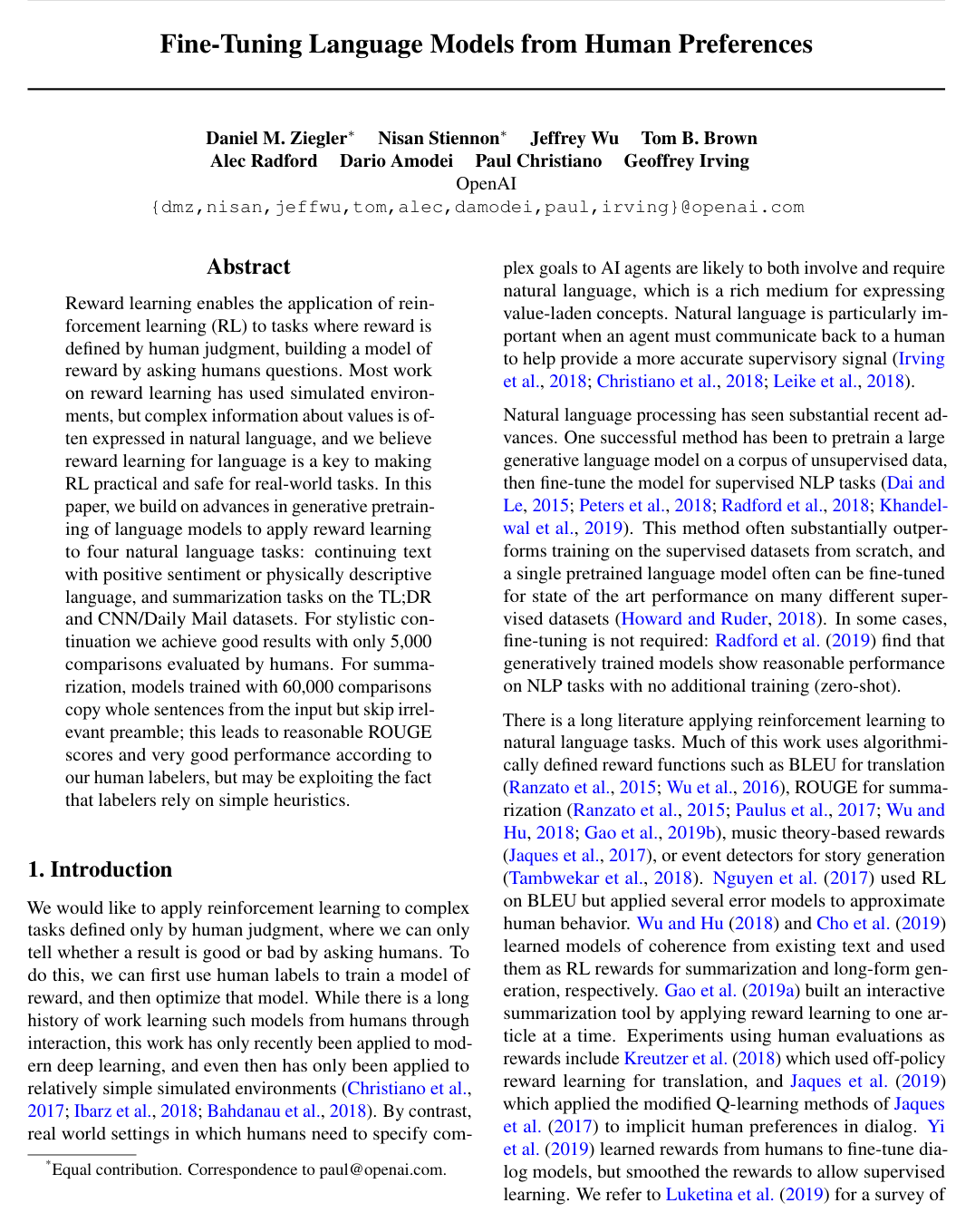
Fine-Tuning Language Models from Human Preferences
Daniel M. Ziegler, Nisan Stiennon, Jeffrey Wu, Tom B. Brown, Alec Radford, Dario Amodei, Paul Christiano, Geoffrey Irving
Why you should read this
Demonstrates that reinforcement learning guided by human preference comparisons can successfully fine-tune pretrained language models for complex text continuation and summarization tasks without relying on heuristic reward functions.
Reward learning enables the application of reinforcement learning (RL) to tasks where reward is defined by human judgment, building a model of reward by asking humans questions. Most work on reward learning has used simulated environments, but complex information about values is often expressed in natural language, and we believe reward learning for language is a key to making RL practical and safe for real-world tasks. In this paper, we build on advances in generative pretraining of language models to apply reward learning to four natural language tasks: continuing text with positive sentiment or physically descriptive language, and summarization tasks on the TL;DR and CNN/Daily Mail datasets. For stylistic continuation we achieve good results with only 5,000 comparisons evaluated by humans. For summarization, models trained with 60,000 comparisons copy whole sentences from the input but skip irrelevant preamble; this leads to reasonable ROUGE scores and very good performance according to our human labelers, but may be exploiting the fact that labelers rely on simple heuristics.
Added
2026-08-16
License
Published with permission
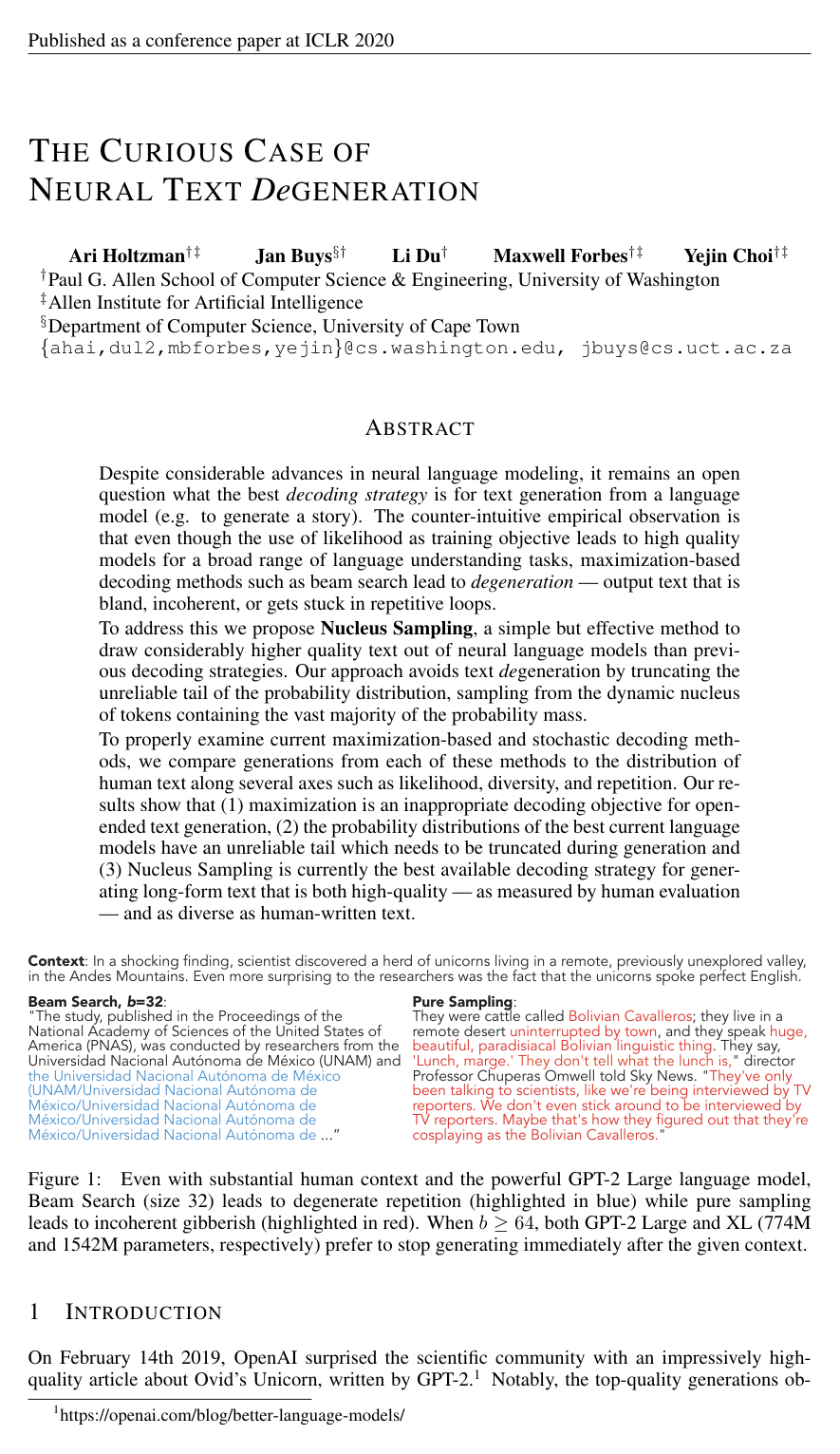
The Curious Case of Neural Text Degeneration
Ari Holtzman, Jan Buys, Li Du, Maxwell Forbes, Yejin Choi
Why you should read this
Introduces Nucleus Sampling, a simple yet highly effective decoding strategy that dramatically improves the quality of neural text generation by producing diverse, coherent, and human-like output, thereby solving the perplexing problem of "neural text degeneration."
Despite considerable advancements with deep neural language models, the enigma of neural text degeneration persists when these models are tested as text generators. The counter-intuitive empirical observation is that even though the use of likelihood as training objective leads to high quality models for a broad range of language understanding tasks, using likelihood as a decoding objective leads to text that is bland and strangely repetitive. In this paper, we reveal surprising distributional differences between human text and machine text. In addition, we find that decoding strategies alone can dramatically effect the quality of machine text, even when generated from exactly the same neural language model. Our findings motivate Nucleus Sampling, a simple but effective method to draw the best out of neural generation. By sampling text from the dynamic nucleus of the probability distribution, which allows for diversity while effectively truncating the less reliable tail of the distribution, the resulting text better demonstrates the quality of human text, yielding enhanced diversity without sacrificing fluency and coherence.
Added
2026-03-10

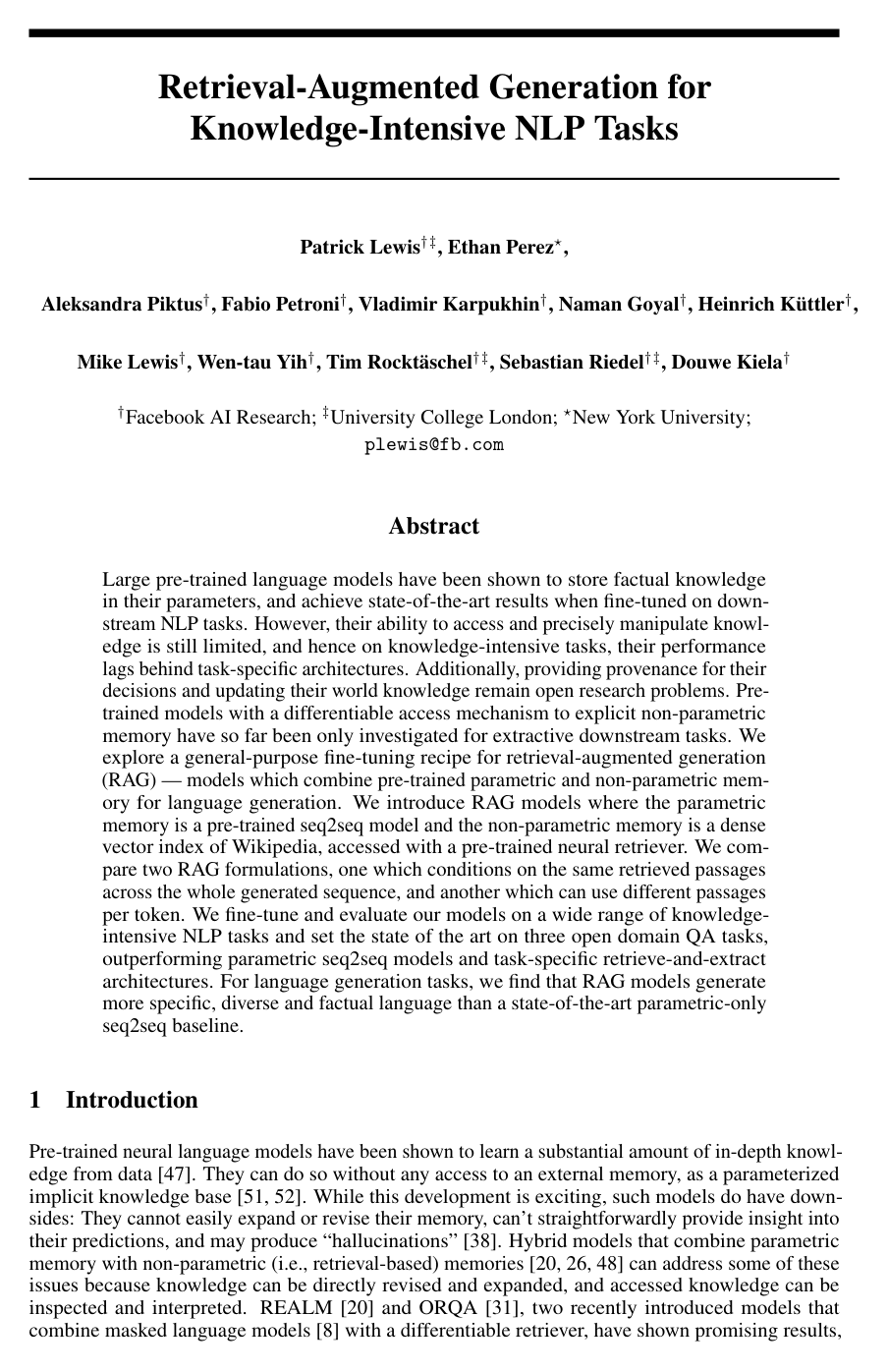
Retrieval-Augmented Generation for Knowledge-Intensive NLP Tasks
Patrick Lewis, Ethan Perez, Aleksandra Piktus, Fabio Petroni, Vladimir Karpukhin, Naman Goyal, Heinrich Küttler, Mike Lewis, Wen-tau Yih, Tim Rocktäschel, Sebastian Riedel, Douwe Kiela
Why you should read this
Proposes the definitive retrieval-augmented architecture linking a pre-trained retriever with a sequence-to-sequence generator trained end-to-end to mitigate hallucinations.
Large pre-trained language models have been shown to store factual knowledge in their parameters, and achieve state-of-the-art results when fine-tuned on downstream NLP tasks. However, their ability to access and precisely manipulate knowledge is still limited, and hence on knowledge-intensive tasks, their performance lags behind task-specific architectures. Additionally, providing provenance for their decisions and updating their world knowledge remain open research problems. Pre-trained models with a differentiable access mechanism to explicit non-parametric memory can overcome this issue, but have so far been only investigated for extractive downstream tasks. We explore a general-purpose fine-tuning recipe for retrieval-augmented generation (RAG) -- models which combine pre-trained parametric and non-parametric memory for language generation. We introduce RAG models where the parametric memory is a pre-trained seq2seq model and the non-parametric memory is a dense vector index of Wikipedia, accessed with a pre-trained neural retriever. We compare two RAG formulations, one which conditions on the same retrieved passages across the whole generated sequence, the other can use different passages per token. We fine-tune and evaluate our models on a wide range of knowledge-intensive NLP tasks and set the state-of-the-art on three open domain QA tasks, outperforming parametric seq2seq models and task-specific retrieve-and-extract architectures. For language generation tasks, we find that RAG models generate more specific, diverse and factual language than a state-of-the-art parametric-only seq2seq baseline.
Added
2026-02-14