
keyword
stochastic gradient descent
Stochastic gradient descent is an iterative optimization algorithm widely used in machine learning to minimize an objective or loss function by adjusting model parameters. Unlike standard gradient descent, which calculates the exact gradient of the loss function across an entire dataset before making an update, stochastic gradient descent estimates the gradient using only a randomly chosen single data point or a small subset of data known as a mini-batch. This subsampling drastically reduces computational overhead and memory requirements per iteration, enabling efficient training on large-scale datasets and high-dimensional models such as deep neural networks. Furthermore, the inherent noise introduced by estimating gradients from random samples can help the optimization process escape poor local minima and saddle points, often facilitating better generalization on unseen data.
85 items
Stochastic Gradient Descent under Markovian Sampling Schemes
Mathieu Even
Why you should read this
Establishes theoretical lower bounds for stochastic gradient descent under Markovian sampling schemes and develops MC-SAG, a communication-efficient variance-reduced algorithm that converges under milder regularity assumptions with a rate governed strictly by the Markov chain's hitting time.
We study a variation of vanilla stochastic gradient descent where the optimizer only has access to a “Markovian sampling scheme”. These schemes encompass applications that range from decentralized optimization with a random walker (token algorithms), to RL and online system identification problems. We focus on obtaining rates of convergence under the least restrictive assumptions possible on the underlying Markov chain and on the functions optimized. We first unveil the theoretical lower bound for methods that sample stochastic gradients along the path of a Markov chain, making appear a dependency in the hitting time of the underlying Markov chain. We then study Markov chain SGD (MC-SGD) under much milder regularity assumptions than prior works. We finally introduce MC-SAG, an alternative to MC-SGD with variance reduction, that only depends on the hitting time of the Markov chain, therefore obtaining a communication-efficient token algorithm.
Added
2026-10-05
Beyond Spectral Gap: The Role of the Topology in Decentralized Learning
Thijs Vogels, Hadrien Hendrikx, Martin Jaggi
Why you should read this
Resolves the disconnect between standard spectral gap theory and empirical decentralized optimization by proving that sparse graph averaging enables larger learning rates and faster convergence across finite and infinite network topologies.
In data-parallel optimization of machine learning models, workers collaborate to improve their estimates of the model: more accurate gradients allow them to use larger learning rates and optimize faster. In the decentralized setting, in which workers communicate over a sparse graph, current theory fails to capture important aspects of real-world behavior. First, the ‘spectral gap’ of the communication graph is not predictive of its empirical performance in (deep) learning. Second, current theory does not explain that collaboration enables larger learning rates than training alone. In fact, it prescribes smaller learning rates, which further decrease as graphs become larger, failing to explain convergence dynamics in infinite graphs. This paper aims to paint an accurate picture of sparsely-connected distributed optimization. We quantify how the graph topology influences convergence in a quadratic toy problem and provide theoretical results for general smooth and (strongly) convex objectives. Our theory matches empirical observations in deep learning, and accurately describes the relative merits of different graph topologies. This paper is an extension of the conference paper by Vogels et al. (2022). Code: github.com/epfml/topology-in-decentralized-learning.
Added
2026-10-05
Cross-Entropy Loss Functions: Theoretical Analysis and Applications
Anqi Mao, Mehryar Mohri, Yutao Zhong
Why you should read this
Establishes the first tight non-asymptotic -consistency bounds for cross-entropy and general comp-sum loss functions, using these theoretical guarantees to develop new adversarial training objectives that improve defense against attacks without sacrificing standard accuracy.
Cross-entropy is a widely used loss function in applications. It coincides with the logistic loss applied to the outputs of a neural network, when the softmax is used. But, what guarantees can we rely on when using cross-entropy as a surrogate loss? We present a theoretical analysis of a broad family of loss functions, comp-sum losses, that includes cross-entropy (or logistic loss), generalized cross-entropy, the mean absolute error and other cross-entropy-like loss functions. We give the first -consistency bounds for these loss functions. These are non-asymptotic guarantees that upper bound the zero-one loss estimation error in terms of the estimation error of a surrogate loss, for the specific hypothesis set used. We further show that our bounds are tight. These bounds depend on quantities called minimizability gaps. To make them more explicit, we give a specific analysis of these gaps for comp-sum losses. We also introduce a new family of loss functions, smooth adversarial comp-sum losses, that are derived from their comp-sum counterparts by adding in a related smooth term. We show that these loss functions are beneficial in the adversarial setting by proving that they admit -consistency bounds. This leads to new adversarial robustness algorithms that consist of minimizing a regularized smooth adversarial comp-sum loss. While our main purpose is a theoretical analysis, we also present an extensive empirical analysis comparing comp-sum losses. We further report the results of a series of experiments demonstrating that our adversarial robustness algorithms outperform the current state-of-the-art, while also achieving a superior non-adversarial accuracy.
Added
2026-10-05
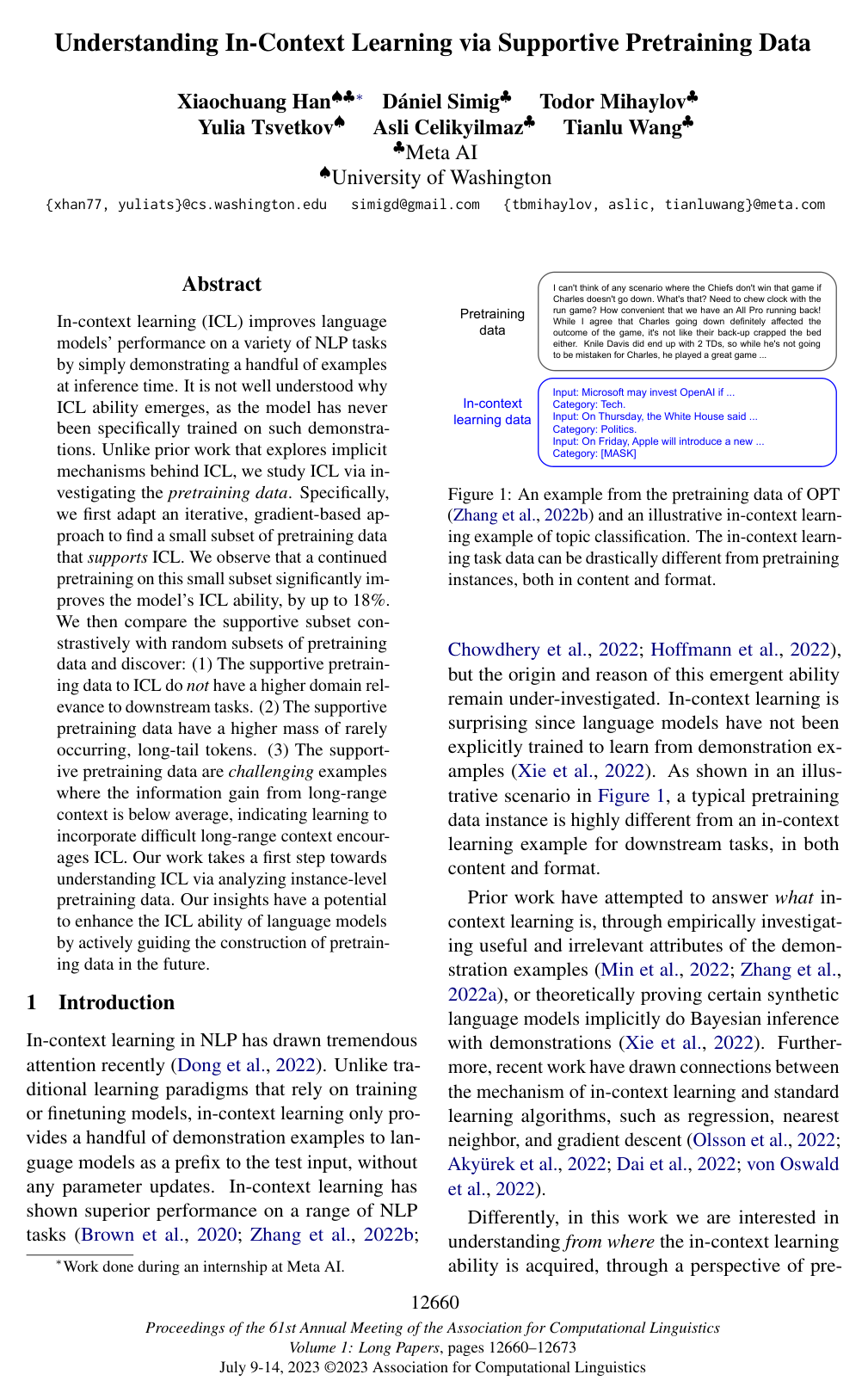
Understanding In-Context Learning via Supportive Pretraining Data
Xiaochuang Han, Daniel Simig, Todor Mihaylov, Yulia Tsvetkov, Asli Celikyilmaz, Tianlu Wang
Why you should read this
Reveals that in-context learning in large language models is driven by specific, challenging pretraining instances rich in long-tail tokens and difficult long-range contexts rather than domain-relevant text, providing actionable criteria to guide future pretraining data selection.
In-context learning (ICL) improves language models’ performance on a variety of NLP tasks by simply demonstrating a handful of examples at inference time. It is not well understood why ICL ability emerges, as the model has never been specifically trained on such demonstrations. Unlike prior work that explores implicit mechanisms behind ICL, we study ICL via investigating the pretraining data. Specifically, we first adapt an iterative, gradient-based approach to find a small subset of pretraining data that supports ICL. We observe that a continued pretraining on this small subset significantly improves the model’s ICL ability, by up to 18%. We then compare the supportive subset contrastively with random subsets of pretraining data and discover: (1) The supportive pretraining data to ICL do not have a higher domain relevance to downstream tasks. (2) The supportive pretraining data have a higher mass of rarely occurring, long-tail tokens. (3) The supportive pretraining data are challenging examples where the information gain from long-range context is below average, indicating learning to incorporate difficult long-range context encourages ICL. Our work takes a first step towards understanding ICL via analyzing instance-level pretraining data. Our insights have a potential to enhance the ICL ability of language models by actively guiding the construction of pretraining data in the future.
Added
2026-10-03
SWARM Parallelism: Training Large Models Can Be Surprisingly Communication-Efficient
Max Ryabinin, Tim Dettmers, Michael Diskin, Alexander Borzunov
Why you should read this
Proposes a fault-tolerant, decentralized model-parallel training algorithm that dynamically rebalances pipeline stages to train billion-scale language models across cheap, unreliable hardware over slow network connections.
Many deep learning applications benefit from using large models with billions of parameters. Training these models is notoriously expensive due to the need for specialized HPC clusters. In this work, we consider alternative setups for training large models: using cheap “preemptible” instances or pooling existing resources from multiple regions. We analyze the performance of existing model-parallel algorithms in these conditions and find configurations where training larger models becomes less communication-intensive. Based on these findings, we propose SWARM parallelism¹, a model-parallel training algorithm designed for poorly connected, heterogeneous and unreliable devices. SWARM creates temporary randomized pipelines between nodes that are rebalanced in case of failure. We empirically validate our findings and compare SWARM parallelism with existing large-scale training approaches. Finally, we combine our insights with compression strategies to train a large Transformer language model with 1B shared parameters (≈13B before sharing) on preemptible T4 GPUs with less than 200Mb/s network.
Added
2026-10-03
Accelerated Federated Learning with Decoupled Adaptive Optimization
Jiayin Jin, Jiaxiang Ren, Yang Zhou, Lingjuan Lyu, Ji Liu, Dejing Dou
Why you should read this
Proposes a principled ordinary differential equation decomposition framework and a decoupled adaptive optimization algorithm, FedDA, that accelerates federated learning convergence by accurately distributing centralized momentum updates across local client iterations.
The federated learning (FL) framework enables edge clients to collaboratively learn a shared inference model while keeping privacy of training data on clients. Recently, many heuristics efforts have been made to generalize centralized adaptive optimization methods, such as SGDM, Adam, AdaGrad, etc., to federated settings for improving convergence and accuracy. However, there is still a paucity of theoretical principles on where to and how to design and utilize adaptive optimization methods in federated settings. This work aims to develop novel adaptive optimization methods for FL from the perspective of dynamics of ordinary differential equations (ODEs). First, an analytic framework is established to build a connection between federated optimization methods and decompositions of ODEs of corresponding centralized optimizers. Second, based on this analytic framework, a momentum decoupling adaptive optimization method, FedDA, is developed to fully utilize the global momentum on each local iteration and accelerate the training convergence. Last but not least, full batch gradients are utilized to mimic centralized optimization in the end of the training process to ensure the convergence and overcome the possible inconsistency caused by adaptive optimization methods.
Added
2026-10-03
Adaptive Inertia: Disentangling the Effects of Adaptive Learning Rate and Momentum
Zeke Xie, Xinrui Wang, Huishuai Zhang, Issei Sato, Masashi Sugiyama
Why you should read this
Explains why Adam generalizes worse than SGD through diffusion theory and proposes Adaptive Inertia, a new optimizer that adapts momentum instead of learning rates to escape saddle points quickly while retaining SGD-like flat minima selection.
Adaptive Moment Estimation (Adam), which combines Adaptive Learning Rate and Momentum, would be the most popular stochastic optimizer for accelerating the training of deep neural networks. However, it is empirically known that Adam often generalizes worse than Stochastic Gradient Descent (SGD). The purpose of this paper is to unveil the mystery of this behavior in the diffusion theoretical framework. Specifically, we disentangle the effects of Adaptive Learning Rate and Momentum of the Adam dynamics on saddle-point escaping and flat minima selection. We prove that Adaptive Learning Rate can escape saddle points efficiently, but cannot select flat minima as SGD does. In contrast, Momentum provides a drift effect to help the training process pass through saddle points, and almost does not affect flat minima selection. This partly explains why SGD (with Momentum) generalizes better, while Adam generalizes worse but converges faster. Furthermore, motivated by the analysis, we design a novel adaptive optimization framework named Adaptive Inertia, which uses parameter-wise adaptive inertia to accelerate the training and provably favors flat minima as well as SGD. Our extensive experiments demonstrate that the proposed adaptive inertia method can generalize significantly better than SGD and conventional adaptive gradient methods.
Added
2026-10-02
Learning Rates as a Function of Batch Size: A Random Matrix Theory Approach to Neural Network Training
Diego Granziol, Stefan Zohren, Stephen Roberts
Why you should read this
Establishes theoretical scaling rules for neural network learning rates using random matrix theory to model mini-batch Hessian fluctuations, proving that optimal learning rates scale linearly with batch size for SGD and with the square root for adaptive optimizers like Adam.
We study the effect of mini-batching on the loss landscape of deep neural networks using spiked, field-dependent random matrix theory. We demonstrate that the magnitude of the extremal values of the batch Hessian are larger than those of the empirical Hessian. We also derive similar results for the Generalised Gauss-Newton matrix approximation of the Hessian. As a consequence of our theorems we derive an analytical expressions for the maximal learning rates as a function of batch size, informing practical training regimens for both stochastic gradient descent (linear scaling) and adaptive algorithms, such as Adam (square root scaling), for smooth, non-convex deep neural networks. Whilst the linear scaling for stochastic gradient descent has been derived under more restrictive conditions, which we generalise, the square root scaling rule for adaptive optimisers is, to our knowledge, completely novel. We validate our claims on the VGG/WideResNet architectures on the CIFAR-100 and ImageNet data sets. Based on our investigations of the sub-sampled Hessian we develop a stochastic Lanczos quadrature based on the fly learning rate and momentum learner, which avoids the need for expensive multiple evaluations for these key hyper-parameters and shows good preliminary results on the Pre-Residual Architecture for CIFAR-100. We further investigate the similarity between the Hessian spectrum of a multi-layer perceptron, trained on Gaussian mixture data, compared to that of deep neural networks trained on natural images. We find striking similarities, with both exhibiting rank degeneracy, a bulk spectrum and outliers to that spectrum. Furthermore, we show that ZCA whitening can remove such outliers early on in training before class separation occurs, but that outliers persist in later training.
Added
2026-10-02
SGD with Large Step Sizes Learns Sparse Features
Maksym Andriushchenko, Aditya Vardhan Varre, Loucas Pillaud-Vivien, Nicolas Flammarion
Why you should read this
Explains how large initial step sizes in stochastic gradient descent cause loss stabilization that amplifies gradient noise, implicitly biasing deep networks toward learning sparse features and improving generalization.
Deep neural networks trained with SGD learn features as data representations which form the basis of predictions made during test time. In over-parameterized models where sparse solutions exist, stochastic gradient descent (SGD) learns dense-to-sparse conversion that reliably identifies good sparse predictors whose performance matches original dense networks across several models to possibly ease interpretability. However, using large learning rates for (stochastic) gradient descent induces difficulty due to labels while also requiring at least two feature types through different training stages.
Added
2026-10-02
Secure Quantized Training for Deep Learning
Marcel Keller, Ke Sun
Why you should read this
Demonstrates practical deep neural network training within secure multi-party computation by introducing optimized protocols for exponentiation and inverse square roots that achieve near-plaintext accuracy on standard image benchmarks across various threat models.
We implement training of neural networks in secure multi-party computation (MPC) using quantization commonly used in said setting. We are the first to present an MNIST classifier purely trained in MPC that comes within 0.2 percent of the accuracy of the same convolutional neural network trained via plaintext computation. More concretely, we have trained a network with two convolutional and two dense layers to 99.2% accuracy in 3.5 hours (under one hour for 99% accuracy). We have also implemented AlexNet for CIFAR-10, which converges in a few hours. We develop novel protocols for exponentiation and inverse square root. Finally, we present experiments in a range of MPC security models for up to ten parties, both with honest and dishonest majority as well as semi-honest and malicious security.
Added
2026-10-02
Improving the Model Consistency of Decentralized Federated Learning
Yifan Shi, Li Shen, Kang Wei, Yan Sun, Bo Yuan, Xueqian Wang, Dacheng Tao
Why you should read this
Proposes two decentralized federated learning algorithms that combine Sharpness Aware Minimization with multiple gossip communication steps to reduce client model inconsistency, providing non-convex convergence guarantees and matching centralized performance on heterogeneous data.
To mitigate the privacy leakages and communication burdens of Federated Learning (FL), decentralized FL (DFL) discards the central server and each client only communicates with its neighbors in a decentralized communication network. However, existing DFL suffers from high inconsistency among local clients, which results in severe distribution shift and inferior performance compared with centralized FL (CFL), especially on heterogeneous data or sparse communication topologies. To alleviate this issue, we propose two DFL algorithms named DFedSAM and DFedSAM-MGS to improve the performance of DFL. Specifically, DFedSAM leverages gradient perturbation to generate local flat models via Sharpness Aware Minimization (SAM), which searches for models with uniformly low loss values. DFedSAM-MGS further boosts DFedSAM by adopting Multiple Gossip Steps (MGS) for better model consistency, which accelerates the aggregation of local flat models and better balances communication complexity and generalization. Theoretically, we present improved convergence rates and in non-convex setting for DFedSAM and DFedSAM-MGS, respectively, where is the spectral gap of gossip matrix and is the number of MGS. Empirically, our methods can achieve competitive performance compared with CFL methods and outperform existing DFL methods.
Added
2026-10-02
Communication-Efficient Adaptive Federated Learning
Yujia Wang, Lu Lin, Jinghui Chen
Why you should read this
Proposes FedCAMS, a communication-compressed adaptive federated learning algorithm that combines error-feedback compression with adaptive optimization to significantly reduce bandwidth overhead while maintaining the theoretical convergence rate of uncompressed methods.
Federated learning is a machine learning training paradigm that enables clients to jointly train models without sharing their own localized data. However, the implementation of federated learning in practice still faces numerous challenges, such as the large communication overhead due to the repetitive server-client synchronization and the lack of adaptivity by SGD-based model updates. Despite that various methods have been proposed for reducing the communication cost by gradient compression or quantization, and the federated versions of adaptive optimizers such as FedAdam are proposed to add more adaptivity, the current federated learning framework still cannot solve the aforementioned challenges all at once. In this paper, we propose a novel communication-efficient adaptive federated learning method (FedCAMS) with theoretical convergence guarantees. We show that in the nonconvex stochastic optimization setting, our proposed FedCAMS achieves the same convergence rate of O(1/(√(T K m))) as its non-compressed counterparts. Extensive experiments on various benchmarks verify our theoretical analysis.
Added
2026-10-01
On Biased Compression for Distributed Learning
Aleksandr Beznosikov, Samuel Horváth, Peter Richtárik, Mher Safaryan
Why you should read this
Establishes the first theoretical framework proving linear convergence for biased gradient compression operators in single-node and distributed optimization, showing both theoretically and empirically why biased methods like Top- sparsification consistently outperform unbiased alternatives when combined with error feedback.
In the last few years, various communication compression techniques have emerged as an indispensable tool helping to alleviate the communication bottleneck in distributed learning. However, despite the fact biased compressors often show superior performance in practice when compared to the much more studied and understood unbiased compressors, very little is known about them. In this work we study three classes of biased compression operators, two of which are new, and their performance when applied to (stochastic) gradient descent and distributed (stochastic) gradient descent. We show for the first time that biased compressors can lead to linear convergence rates both in the single node and distributed settings. We prove that distributed compressed SGD method, employed with error feedback mechanism, enjoys the ergodic rate O (δL exp [− μK / δL] + (C+δD) / (Kμ)), where δ ≥ 1 is a compression parameter which grows when more compression is applied, L and μ are the smoothness and strong convexity constants, C captures stochastic gradient noise (C = 0 if full gradients are
Added
2026-09-28
Adaptive Second Order Coresets for Data-efficient Machine Learning
Omead Pooladzandi, David Davini, Baharan Mirzasoleiman
Why you should read this
Proposes ADACORE, a data-selection method that dynamically approximates loss curvature through exponentially averaged Hessian estimates to construct weighted training subsets with provable convergence guarantees and over 2.9x training speedups across convex and deep learning models.
Training machine learning models on massive datasets incurs substantial computational costs. To alleviate such costs, there has been a sustained effort to develop data-efficient training methods that can carefully select subsets of the training examples that generalize on par with the full training data. However, existing methods are limited in providing theoretical guarantees for the quality of the models trained on the extracted subsets, and may perform poorly in practice. We propose ADACORE, a method that leverages the geometry of the data to extract subsets of the training examples for efficient machine learning. The key idea behind our method is to dynamically approximate the curvature of the loss function via an exponentially-averaged estimate of the Hessian to select weighted subsets (coresets) that provide a close approximation of the full gradient preconditioned with the Hessian. We prove rigorous guarantees for the convergence of various first and second-order methods applied to the subsets chosen by ADACORE. Our extensive experiments show that ADACORE extracts coresets with higher quality compared to baselines and speeds up training of convex and non-convex machine learning models, such as logistic regression and neural networks, by over 2.9x over the full data and 4.5x over random subsets1.
Added
2026-09-26
Stochastic Training is Not Necessary for Generalization
Jonas Geiping, Micah Goldblum, Phillip Pope, Michael Moeller, Tom Goldstein
Why you should read this
Demonstrates that full-batch training matches the generalization performance of stochastic gradient descent on modern neural networks, showing that explicit regularization can entirely replace the implicit regularization of optimization noise.
It is widely believed that the implicit regularization of SGD is fundamental to the impressive generalization behavior we observe in neural networks. In this work, we demonstrate that non-stochastic full-batch training can achieve comparably strong performance to SGD on CIFAR-10 using modern architectures. To this end, we show that the implicit regularization of SGD can be completely replaced with explicit regularization even when comparing against a strong and well-researched baseline. Our observations indicate that the perceived difficulty of full-batch training may be the result of its optimization properties and the disproportionate time and effort spent by the ML community tuning optimizers and hyperparameters for small-batch training.
Added
2026-09-26
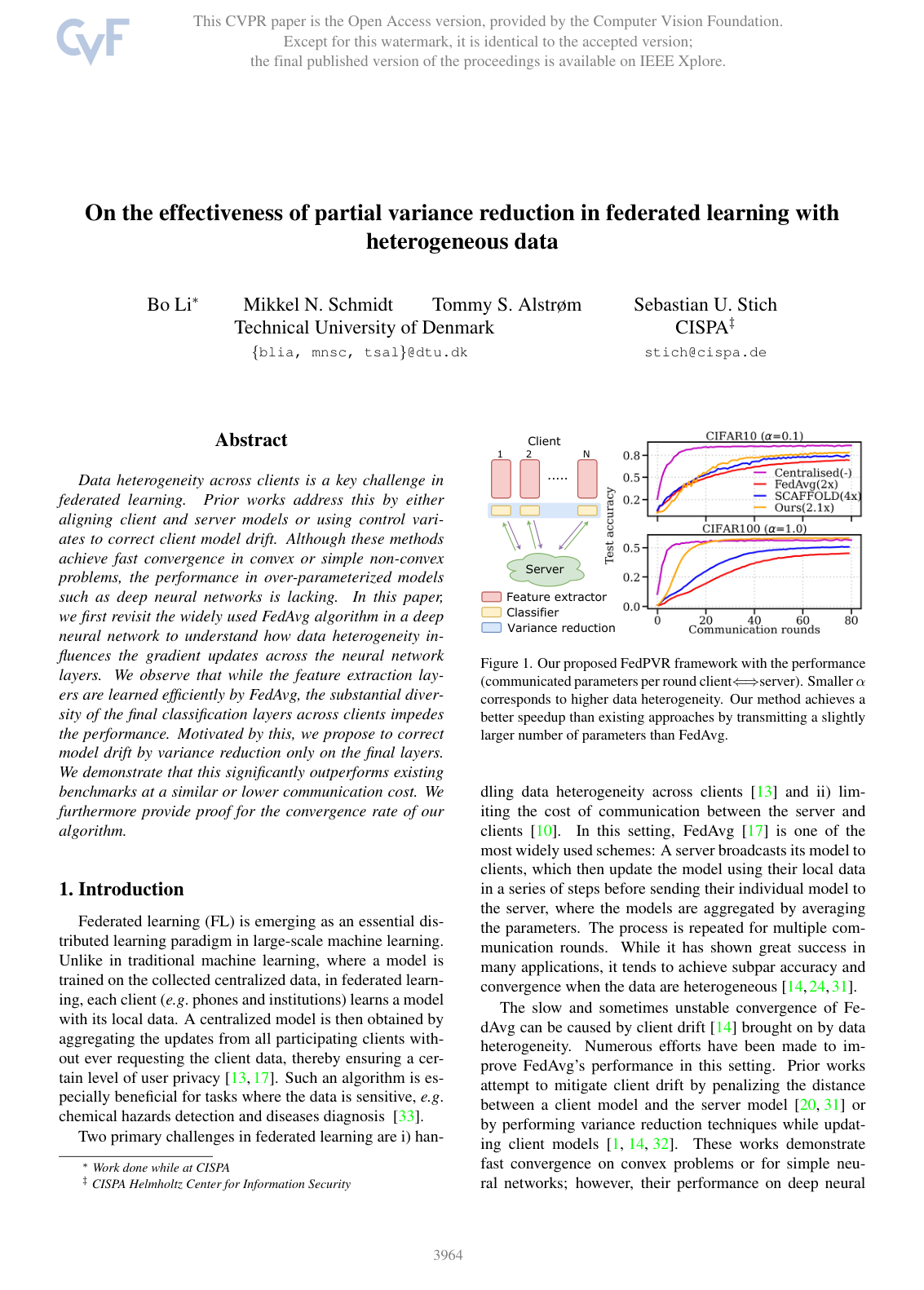
On the Effectiveness of Partial Variance Reduction in Federated Learning with Heterogeneous Data
Bo Li, Mikkel N. Schmidt, Tommy S. Alstrøm, Sebastian U. Stich
Why you should read this
Proposes FedPVR, a communication-efficient federated learning method that mitigates client drift on non-IID data by applying variance reduction exclusively to the final classification layers, achieving faster convergence and higher accuracy with minimal overhead compared to full-model variance reduction.
Data heterogeneity across clients is a key challenge in federated learning. Prior works address this by either aligning client and server models or using control variates to correct client model drift. Although these methods achieve fast convergence in convex or simple non-convex problems, the performance in over-parameterized models such as deep neural networks is lacking. In this paper, we first revisit the widely used FedAvg algorithm in a deep neural network to understand how data heterogeneity influences the gradient updates across the neural network layers. We observe that while the feature extraction layers are learned efficiently by FedAvg, the substantial diversity of the final classification layers across clients impedes the performance. Motivated by this, we propose to correct model drift by variance reduction only on the final layers. We demonstrate that this significantly outperforms existing benchmarks at a similar or lower communication cost. We furthermore provide proof for the convergence rate of our algorithm.
Added
2026-09-26
Byzantine Machine Learning Made Easy By Resilient Averaging of Momentums
Sadegh Farhadkhani, Rachid Guerraoui, Nirupam Gupta, Rafael Pinot, John Stephan
Why you should read this
Presents RESAM, a unified framework combining worker-side distributed momentum with server-side resilient averaging that proves optimal Byzantine resilience for distributed SGD using only standard optimization assumptions.
Byzantine resilience emerged as a prominent topic within the distributed machine learning community. Essentially, the goal is to enhance distributed optimization algorithms, such as distributed SGD, in a way that guarantees convergence despite the presence of some misbehaving (a.k.a., Byzantine) workers. Although a myriad of techniques addressing the problem have been proposed, the field arguably rests on fragile foundations. These techniques are hard to prove correct and rely on assumptions that are (a) quite unrealistic, i.e., often violated in practice, and (b) heterogeneous, i.e., making it difficult to compare approaches. We present RESAM (RESilient Averaging of Momentums), a unified framework that makes it simple to establish optimal Byzantine resilience, relying only on standard machine learning assumptions. Our framework is mainly composed of two operators: resilient averaging at the server and distributed momentum at the workers. We prove a general theorem stating the convergence of distributed SGD under RESAM. Interestingly, demonstrating and comparing the convergence of many existing techniques become direct corollaries of our theorem, without resorting to stringent assumptions. We also present an empirical evaluation of the practical relevance of RESAM.
Added
2026-09-26
Decentralized Gossip-Based Stochastic Bilevel Optimization over Communication Networks
Shuoguang Yang, Xuezhou Zhang, Mengdi Wang
Why you should read this
Proposes a single-timescale gossip-based algorithm for decentralized stochastic bilevel optimization that achieves optimal per-agent sample complexity and a linear speedup with network size for both nonconvex and Polyak-Łojasiewicz objectives.
Bilevel optimization have gained growing interests, with numerous applications being found in meta learning, minimax games, reinforcement learning, and nested composition optimization. This paper studies the problem of decentralized distributed stochastic bilevel optimization over a network where each agent can only communicate with its neighbors, and gives examples from multi-task, multi-agent learning and federated learning. In this paper, we propose a gossip-based decentralized bilevel learning algorithm that allows networked agents to solve both the inner and outer optimization problems in a single timescale and share information through network propagation. We show that our algorithm enjoys the Õ(1/(Kϵ₂)) per-agent sample complexity for general nonconvex bilevel optimization and Õ(1/(Kϵ)) for Polyak-Łojasiewicz objectives, achieving a speedup that scales linearly with the network size K. The sample complexities are optimal in both ϵ and K. We test our algorithm on the examples of hyperparameter tuning and decentralized reinforcement learning. Simulated experiments confirmed that our algorithm achieves the state-of-the-art training efficiency and test accuracy.
Added
2026-09-26
Optimal Stochastic Non-smooth Non-convex Optimization through Online-to-Non-convex Conversion
Ashok Cutkosky, Harsh Mehta, Francesco Orabona
Why you should read this
Establishes a reduction from non-smooth, non-convex stochastic optimization to online learning that achieves the optimal gradient complexity for finding -stationary points while unifying and recovering state-of-the-art rates across smooth and deterministic settings.
We present new algorithms for optimizing non-smooth, non-convex stochastic objectives based on a novel analysis technique. This improves the current best-known complexity for finding a (δ, ε)-stationary point from O(ε^{-4}δ^{-1}) stochastic gradient queries to O(ε^{-3}δ^{-1}), which we also show to be optimal. Our primary technique is a reduction from non-smooth non-convex optimization to online learning, after which our results follow from standard regret bounds in online learning. For deterministic and second-order smooth objectives, applying more advanced optimistic online learning techniques enables a new complexity of O(ε^{-1.5}δ^{-0.5}). Our improved non-smooth analysis also immediately recovers all optimal or best-known results for finding ε stationary points of smooth or second-order smooth objectives in both stochastic and deterministic settings.
Added
2026-09-26
The alignment property of SGD noise and how it helps select flat minima: A stability analysis
Lei Wu, Mingze Wang, Weijie Su
Why you should read this
Proves that SGD noise aligns with the Fisher information matrix to exponentially destabilize sharp minima, theoretically bounding the Hessian Frobenius norm of accessible solutions independently of model and sample size.
Added
2026-09-26