Built independently by an author, for readers. Read the story and support ChapterPal

keyword

spoof detection

Spoof detection is a security mechanism used by biometric authentication systems to determine whether an input sample originates from a genuine, living person or a fraudulent imitation. In biometric applications such as facial, fingerprint, or voice recognition, it identifies presentation attacks where an unauthorized individual attempts to deceive the system using synthetic or recorded artifacts, including printed photographs, video replays, silicone masks, or synthesized media. By analyzing distinguishing indicators such as liveness cues, surface textures, depth information, and dynamic biological responses, spoof detection prevents unauthorized access and ensures the integrity of automated identity verification.

1 item

Rethinking Domain Generalization for Face Anti-spoofing: Separability and Alignment

Rethinking Domain Generalization for Face Anti-spoofing: Separability and Alignment

Yiyou Sun, Yaojie Liu, Xiaoming Liu, Yixuan Li, Wen-Sheng Chu

OrganizationsGoogleMichigan State UniversityUniversity of Wisconsin Madison

Why you should read this

Proposes a face anti-spoofing framework that preserves domain-specific signals while aligning live-to-spoof transition directions through invariant risk minimization, outperforming conventional domain-invariant feature learning approaches on cross-domain benchmarks.

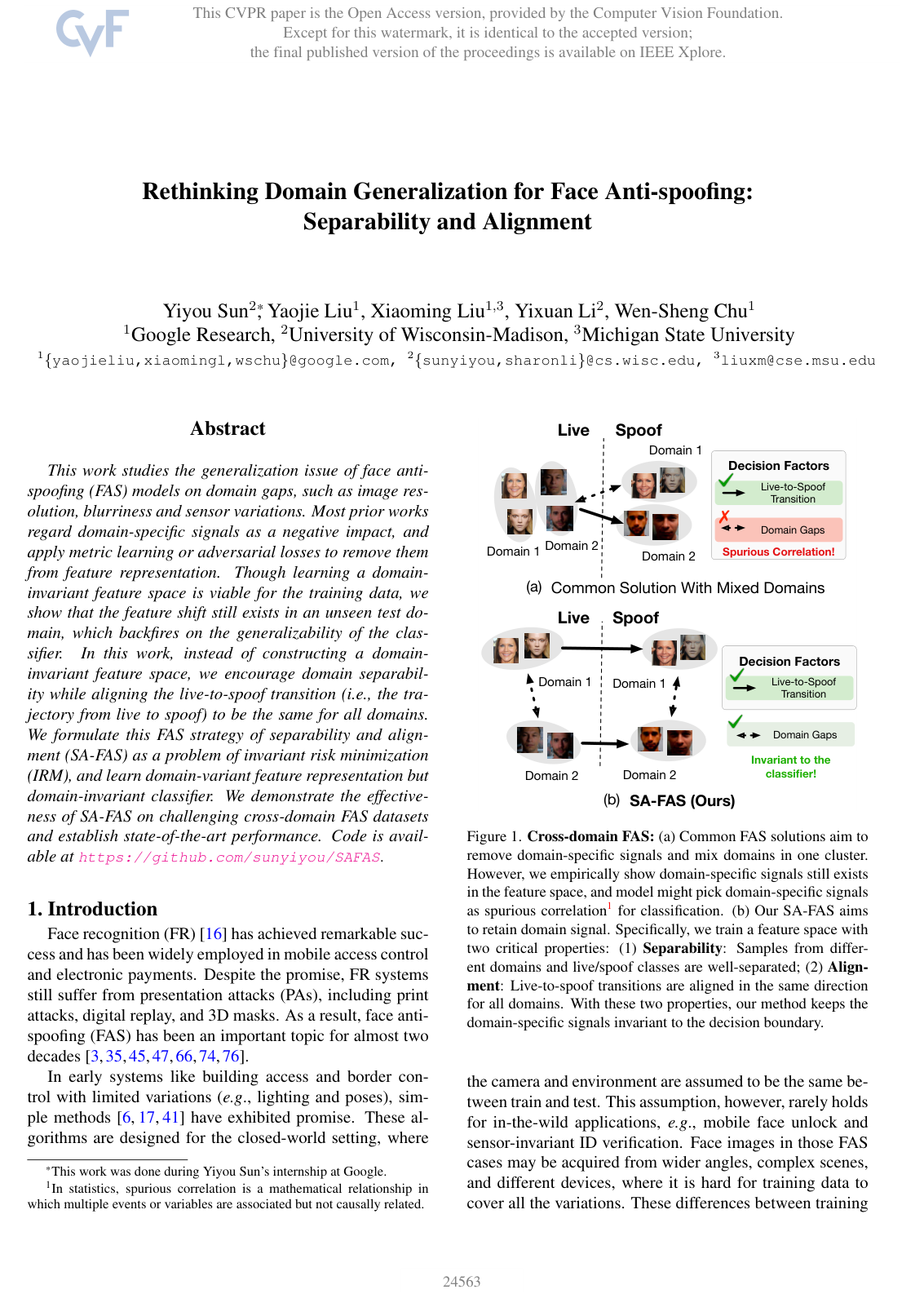
This work studies the generalization issue of face anti-spoofing (FAS) models on domain gaps, such as image resolution, blurriness and sensor variations. Most prior works regard domain-specific signals as a negative impact, and apply metric learning or adversarial losses to remove them from feature representation. Though learning a domain-invariant feature space is viable for the training data, we show that the feature shift still exists in an unseen test domain, which backfires on the generalizability of the classifier. In this work, instead of constructing a domain-invariant feature space, we encourage domain separability while aligning the live-to-spoof transition (i.e., the trajectory from live to spoof) to be the same for all domains. We formulate this FAS strategy of separability and alignment (SA-FAS) as a problem of invariant risk minimization (IRM), and learn domain-variant feature representation but domain-invariant classifier. We demonstrate the effectiveness of SA-FAS on challenging cross-domain FAS datasets and establish state-of-the-art performance. Code is available at https://github.com/sunyiyou/SAFAS.

Added

2026-09-26