
keyword
speech synthesis
Speech synthesis is the artificial production of human speech by computer software or hardware systems. Most commonly realized as text-to-speech technology, the process converts written text, phonetic transcriptions, or other symbolic inputs into intelligible and natural-sounding acoustic waveforms. Contemporary speech synthesis architectures predominantly utilize deep neural networks, often employing acoustic models to generate intermediate features like mel-spectrograms or discrete speech tokens alongside neural vocoders and generative models to reconstruct the final audio signal. Widely deployed across virtual assistants, accessibility tools, conversational artificial intelligence, and automated translation systems, modern synthesis methods are capable of modeling complex speech attributes such as pitch, timbre, emotion, and prosody to produce highly expressive, personalized, and multilingual spoken audio.
13 items
UnitY: Two-pass Direct Speech-to-speech Translation with Discrete Units
Hirofumi Inaguma, Sravya Popuri, Ilia Kulikov, Peng-Jen Chen, Changhan Wang, Yu-An Chung, Yun Tang, Ann Lee, Shinji Watanabe, Juan Pino
Why you should read this
Proposes UnitY, a two-pass direct speech-to-speech translation framework that first decodes text subwords and then predicts discrete acoustic units, achieving higher translation quality and nearly triple the decoding speed of single-pass speech-to-unit models.
Direct speech-to-speech translation (S2ST), in which all components can be optimized jointly, is advantageous over cascaded approaches to achieve fast inference with a simplified pipeline. We present a novel two-pass direct S2ST architecture, UnitY, which first generates textual representations and predicts discrete acoustic units subsequently. We enhance the model performance by subword prediction in the first-pass decoder, advanced two-pass decoder architecture design and search strategy, and better training regularization. To leverage large amounts of unlabeled text data, we pre-train the first-pass text decoder based on the self-supervised denoising auto-encoding task. Experimental evaluations on benchmark datasets at various data scales demonstrate that UnitY outperforms a single-pass speech-to-unit translation model by 2.5-4.2 ASR-BLEU with 2.83× decoding speed-up. We show that the proposed methods boost the performance even when predicting spectrogram in the second pass. However, predicting discrete units achieves 2.51× decoding speed-up compared to that case.
Added
2026-10-02
AudioLDM: Text-to-Audio Generation with Latent Diffusion Models
Haohe Liu, Zehua Chen, Yi Yuan, Xinhao Mei, Xubo Liu, Danilo P. Mandic, Wenwu Wang, Mark D. Plumbley
Why you should read this
Introduces AudioLDM, a latent diffusion framework that generates high-fidelity audio from text by leveraging contrastive language-audio representations, achieving state-of-the-art generation efficiency on a single GPU while enabling zero-shot text-guided audio manipulation.
Text-to-audio (TTA) system has recently gained attention for its ability to synthesize general audio based on text descriptions. However, previous studies in TTA have limited generation quality with high computational costs. In this study, we propose AudioLDM, a TTA system that is built on a latent space to learn the continuous audio representations from contrastive language-audio pretraining (CLAP) latents. The pretrained CLAP models enable us to train LDMs with audio embedding while providing text embedding as a condition during sampling. By learning the latent representations of audio signals and their compositions without modeling the cross-modal relationship, AudioLDM is advantageous in both generation quality and computational efficiency. Trained on AudioCaps with a single GPU, AudioLDM achieves state-of-the-art TTA performance measured by both objective and subjective metrics (e.g., frechet distance). Moreover, AudioLDM is the first TTA system that enables various text-guided audio manipulations (e.g., style transfer) in a zero-shot fashion. Our implementation and demos are available at this https URL.
Added
2026-09-28
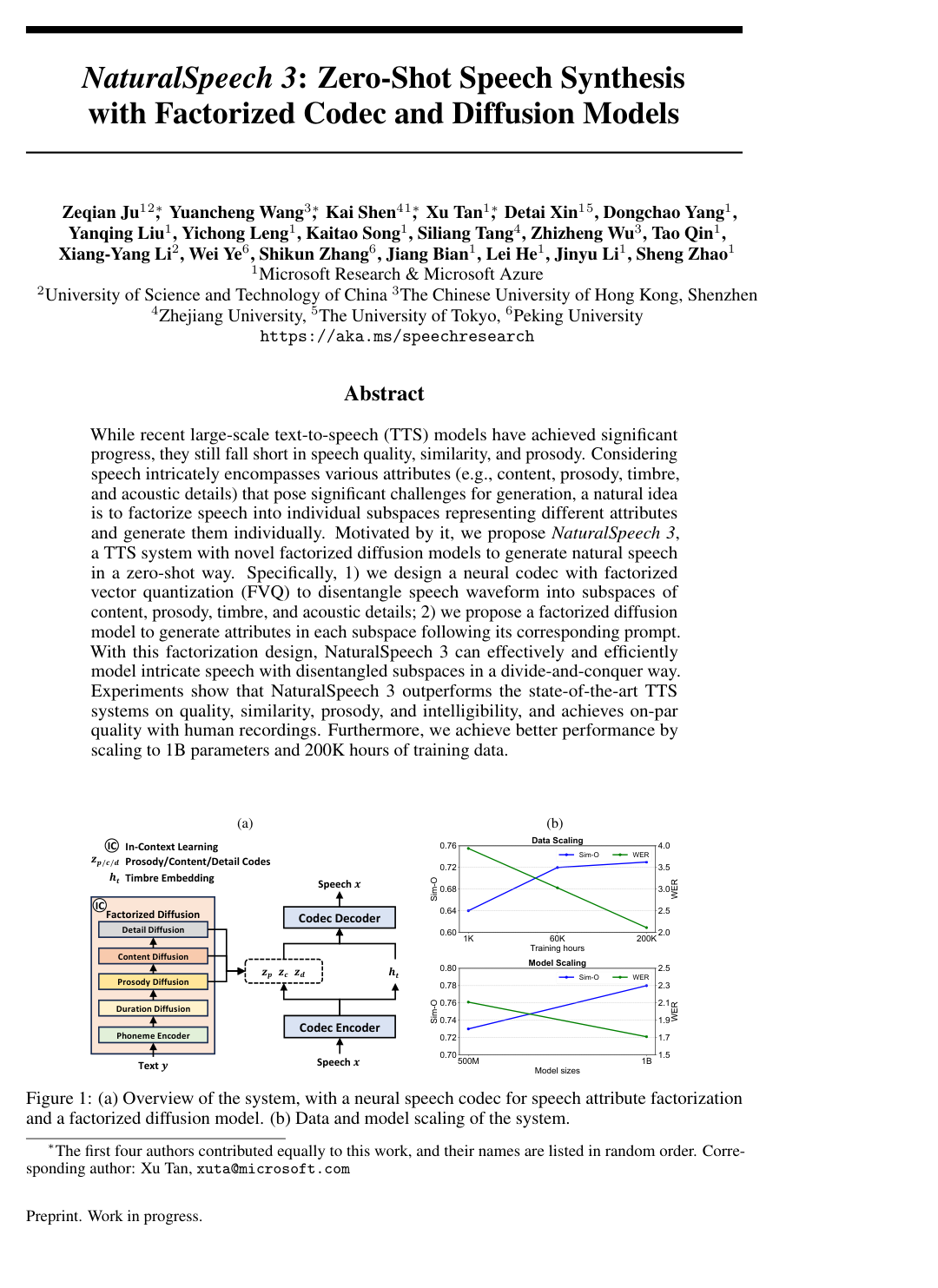
NaturalSpeech 3: Zero-Shot Speech Synthesis with Factorized Codec and Diffusion Models
Zeqian Ju, Yuancheng Wang, Kai Shen, Xu Tan, Detai Xin, Dongchao Yang, Eric Liu, Yichong Leng, Kaitao Song, Siliang Tang, Zhizheng Wu, Tao Qin, Xiangyang Li, Wei Ye, Shikun Zhang, Jiang Bian, Lei He, Jinyu Li, Sheng Zhao
Why you should read this
Presents NaturalSpeech 3, a zero-shot speech synthesis system that disentangles speech into content, prosody, timbre, and acoustic subspaces using factorized diffusion models, achieving audio quality and speaker similarity on par with human recordings.
While recent large-scale text-to-speech (TTS) models have achieved significant progress, they still fall short in speech quality, similarity, and prosody. Considering speech intricately encompasses various attributes (e.g., content, prosody, timbre, and acoustic details) that pose significant challenges for generation, a natural idea is to factorize speech into individual subspaces representing different attributes and generate them individually. Motivated by it, we propose NaturalSpeech 3, a TTS system with novel factorized diffusion models to generate natural speech in a zero-shot way. Specifically, 1) we design a neural codec with factorized vector quantization (FVQ) to disentangle speech waveform into subspaces of content, prosody, timbre, and acoustic details; 2) we propose a factorized diffusion model to generate attributes in each subspace following its corresponding prompt. With this factorization design, NaturalSpeech 3 can effectively and efficiently model intricate speech with disentangled subspaces in a divide-and-conquer way. Experiments show that NaturalSpeech 3 outperforms the state-of-the-art TTS systems on quality, similarity, prosody, and intelligibility, and achieves on-par quality with human recordings. Furthermore, we achieve better performance by scaling to 1B parameters and 200K hours of training data.
Added
2026-09-28
SUPERB-SG: Enhanced Speech processing Universal PERformance Benchmark for Semantic and Generative Capabilities
Hsiang-Sheng Tsai, Heng-Jui Chang, Wen-Chin Huang, Zili Huang, Kushal Lakhotia, Shu-Wen Yang, Shuyan Dong, Andy T. Liu, Cheng-I Lai, Jiatong Shi, Xuankai Chang, Phil Hall, Hsuan-Jui Chen, Shang-Wen Li, Shinji Watanabe, Abdelrahman Mohamed, Hung-yi Lee
Why you should read this
Presents SUPERB-SG, an expanded speech benchmark that adds challenging semantic and generative tasks to standard evaluation suites, providing a computationally efficient protocol to test how well frozen self-supervised models generalize across diverse speech processing applications.
Transfer learning has proven to be crucial in advancing the state of speech and natural language processing research in recent years. In speech, a model pre-trained by self-supervised learning transfers remarkably well on multiple tasks. However, the lack of a consistent evaluation methodology is limiting towards a holistic understanding of the efficacy of such models. SUPERB was a step towards introducing a common benchmark to evaluate pre-trained models across various speech tasks. In this paper, we introduce SUPERB-SG, a new benchmark focused on evaluating the semantic and generative capabilities of pre-trained models by increasing task diversity and difficulty over SUPERB. We use a lightweight methodology to test the robustness of representations learned by pre-trained models under shifts in data domain and quality across different types of tasks. It entails freezing pre-trained model parameters, only using simple task-specific trainable heads. The goal is to be inclusive of all researchers, and encourage efficient use of computational resources. We also show that the task diversity of SUPERB-SG coupled with limited task supervision is an effective recipe for evaluating the generalizability of model representation.
Added
2026-09-26
Towards Voice Reconstruction from EEG during Imagined Speech
Young-Eun Lee, Seo-Hyun Lee, Sang-Ho Kim, Seong-Whan Lee
Why you should read this
Presents NeuroTalk, a domain-adaptation framework that synthesizes an individual's own voice directly from non-invasive imagined speech EEG signals and enables phoneme-level reconstruction of unseen words.
Translating imagined speech from human brain activity into voice is a challenging and absorbing research issue that can provide new means of human communication via brain signals. Efforts to reconstruct speech from brain activity have shown their potential using invasive measures of spoken speech data, but have faced challenges in reconstructing imagined speech. In this paper, we propose NeuroTalk, which converts non-invasive brain signals of imagined speech into the user’s own voice. Our model was trained with spoken speech EEG which was generalized to adapt to the domain of imagined speech, thus allowing natural correspondence between the imagined speech and the voice as a ground truth. In our framework, an automatic speech recognition decoder contributed to decomposing the phonemes of the generated speech, demonstrating the potential of voice reconstruction from unseen words. Our results imply the potential of speech synthesis from human EEG signals, not only from spoken speech but also from the brain signals of imagined speech.
Added
2026-09-26
Open-Source Conversational AI with SpeechBrain 1.0
Mirco Ravanelli, Titouan Parcollet, Adel Moumen, Sylvain de Langen, Cem Subakan, Peter Plantinga, Yingzhi Wang, Pooneh Mousavi, Luca Della Libera, Artem Ploujnikov, Francesco Paissan, Davide Borra, Salah Zaiem, Zeyu Zhao, Shucong Zhang, Georgios Karakasidis, Sung-Lin Yeh, Pierre Champion, Aku Rouhe, Rudolf Braun, Florian Mai, Juan Zuluaga-Gomez, Seyed Mahed Mousavi, Andreas Nautsch, Ha Nguyen, Xuechen Liu, Sangeet Sagar, Jarod Duret, Salima Mdhaffar, Gaëlle Laperrière, Mickael Rouvier, Renato De Mori, Yannick Estève
Why you should read this
Presents SpeechBrain 1.0, an open-source PyTorch framework featuring over 200 reproducible training recipes, pre-trained models, and a unified benchmark suite supporting speech, audio, language model integration, and neurotechnology tasks.
SpeechBrain1 is an open-source Conversational AI toolkit based on PyTorch, focused particularly on speech processing tasks such as speech recognition, speech enhancement, speaker recognition, text-to-speech, and much more. It promotes transparency and replicability by releasing both the pre-trained models and the complete “recipes” of code and algorithms required for training them. This paper presents SpeechBrain 1.0, a significant milestone in the evolution of the toolkit, which now has over 200 recipes for speech, audio, and language processing tasks, and more than 100 models available on Hugging Face. SpeechBrain 1.0 introduces new technologies to support diverse learning modalities, Large Language Model (LLM) integration, and advanced decoding strategies, along with novel models, tasks, and modalities. It also includes a new benchmark repository, offering researchers a unified platform for evaluating models across diverse tasks.
Added
2026-09-26
Voicebox: Text-Guided Multilingual Universal Speech Generation at Scale
Matthew Le, Apoorv Vyas, Bowen Shi, Brian Karrer, Leda Sari, Rashel Moritz, Mary Williamson, Vimal Manohar, Yossi Adi, Jay Mahadeokar, Wei-Ning Hsu
Why you should read this
Introduces Voicebox, a non-autoregressive flow-matching speech model trained on 50,000 hours of audio that performs zero-shot text-to-speech, cross-lingual synthesis, and audio editing up to twenty times faster and with higher intelligibility than VALL-E.
Large-scale generative models such as GPT and DALL-E have revolutionized the research community. These models not only generate high fidelity outputs, but are also generalists which can solve tasks not explicitly taught. In contrast, speech generative models are still primitive in terms of scale and task generalization. In this paper, we present Voicebox, the most versatile text-guided generative model for speech at scale. Voicebox is a non-autoregressive flow-matching model trained to infill speech, given audio context and text, trained on over 50K hours of speech that are not filtered or enhanced. Similar to GPT, Voicebox can perform many different tasks through in-context learning, but is more flexible as it can also condition on future context. Voicebox can be used for mono or cross-lingual zero-shot text-to-speech synthesis, noise removal, content editing, style conversion, and diverse sample generation. In particular, Voicebox outperforms the state-of-the-art zero-shot TTS model VALL-E on both intelligibility (5.9% vs 1.9% word error rates) and audio similarity (0.580 vs 0.681) while being up to 20 times faster. Audio samples can be found in \url{this https URL}.
Added
2026-09-25
FastSpeech 2: Fast and High-Quality End-to-End Text to Speech
Yi Ren, Chenxu Hu, Xu Tan, Tao Qin, Sheng Zhao, Zhou Zhao, Tie-Yan Liu
Why you should read this
Introduces a non-autoregressive text-to-speech framework that trains directly on ground-truth acoustic targets conditioned on pitch, energy, and duration, eliminating complex distillation pipelines to achieve three times faster training and voice quality surpassing autoregressive models.
Non-autoregressive text to speech (TTS) models such as FastSpeech can synthesize speech significantly faster than previous autoregressive models with comparable quality. The training of FastSpeech model relies on an autoregressive teacher model for duration prediction (to provide more information as input) and knowledge distillation (to simplify the data distribution in output), which can ease the one-to-many mapping problem (i.e., multiple speech variations correspond to the same text) in TTS. However, FastSpeech has several disadvantages: 1) the teacher-student distillation pipeline is complicated and time-consuming, 2) the duration extracted from the teacher model is not accurate enough, and the target mel-spectrograms distilled from teacher model suffer from information loss due to data simplification, both of which limit the voice quality. In this paper, we propose FastSpeech 2, which addresses the issues in FastSpeech and better solves the one-to-many mapping problem in TTS by 1) directly training the model with ground-truth target instead of the simplified output from teacher, and 2) introducing more variation information of speech (e.g., pitch, energy and more accurate duration) as conditional inputs. Specifically, we extract duration, pitch and energy from speech waveform and directly take them as conditional inputs in training and use predicted values in inference. We further design FastSpeech 2s, which is the first attempt to directly generate speech waveform from text in parallel, enjoying the benefit of fully end-to-end inference. Experimental results show that 1) FastSpeech 2 achieves a 3x training speed-up over FastSpeech, and FastSpeech 2s enjoys even faster inference speed; 2) FastSpeech 2 and 2s outperform FastSpeech in voice quality, and FastSpeech 2 can even surpass autoregressive models. Audio samples are available at this https URL.
Added
2026-09-18
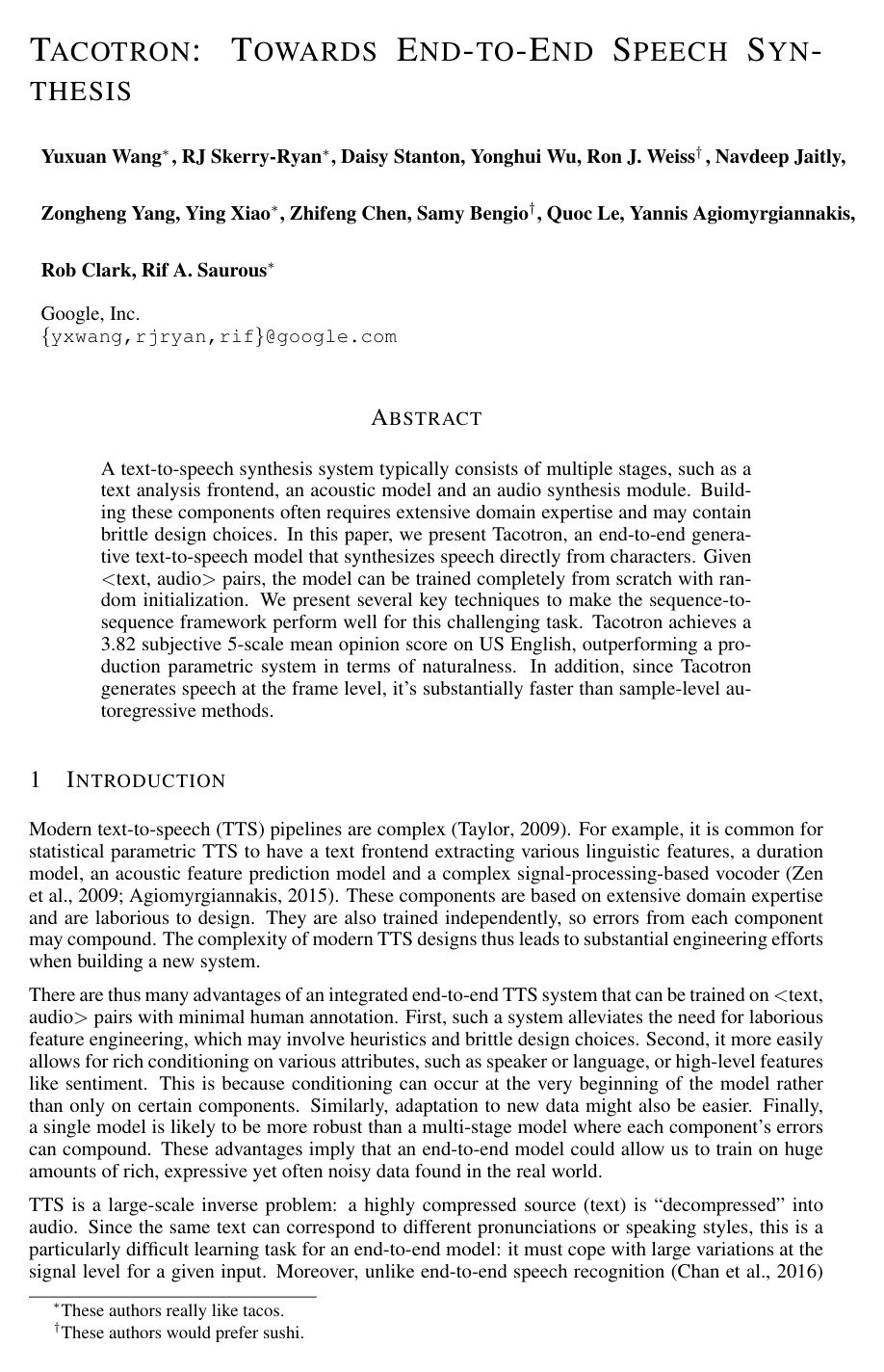
Tacotron: Towards End-to-End Speech Synthesis
Yuxuan Wang, RJ Skerry-Ryan, Daisy Stanton, Yonghui Wu, Ron J. Weiss, Navdeep Jaitly, Zongheng Yang, Ying Xiao, Zhifeng Chen, Samy Bengio, Quoc Le, Yannis Agiomyrgiannakis, Rob Clark, Rif A. Saurous
Why you should read this
Introduces an end-to-end sequence-to-sequence model that synthesizes speech directly from text characters, replacing complex multi-stage text-to-speech pipelines with a single neural network trained from scratch.
A text-to-speech synthesis system typically consists of multiple stages, such as a text analysis frontend, an acoustic model and an audio synthesis module. Building these components often requires extensive domain expertise and may contain brittle design choices. In this paper, we present Tacotron, an end-to-end generative text-to-speech model that synthesizes speech directly from characters. Given <text, audio> pairs, the model can be trained completely from scratch with random initialization. We present several key techniques to make the sequence-to-sequence framework perform well for this challenging task. Tacotron achieves a 3.82 subjective 5-scale mean opinion score on US English, outperforming a production parametric system in terms of naturalness. In addition, since Tacotron generates speech at the frame level, it's substantially faster than sample-level autoregressive methods.
Added
2026-09-16
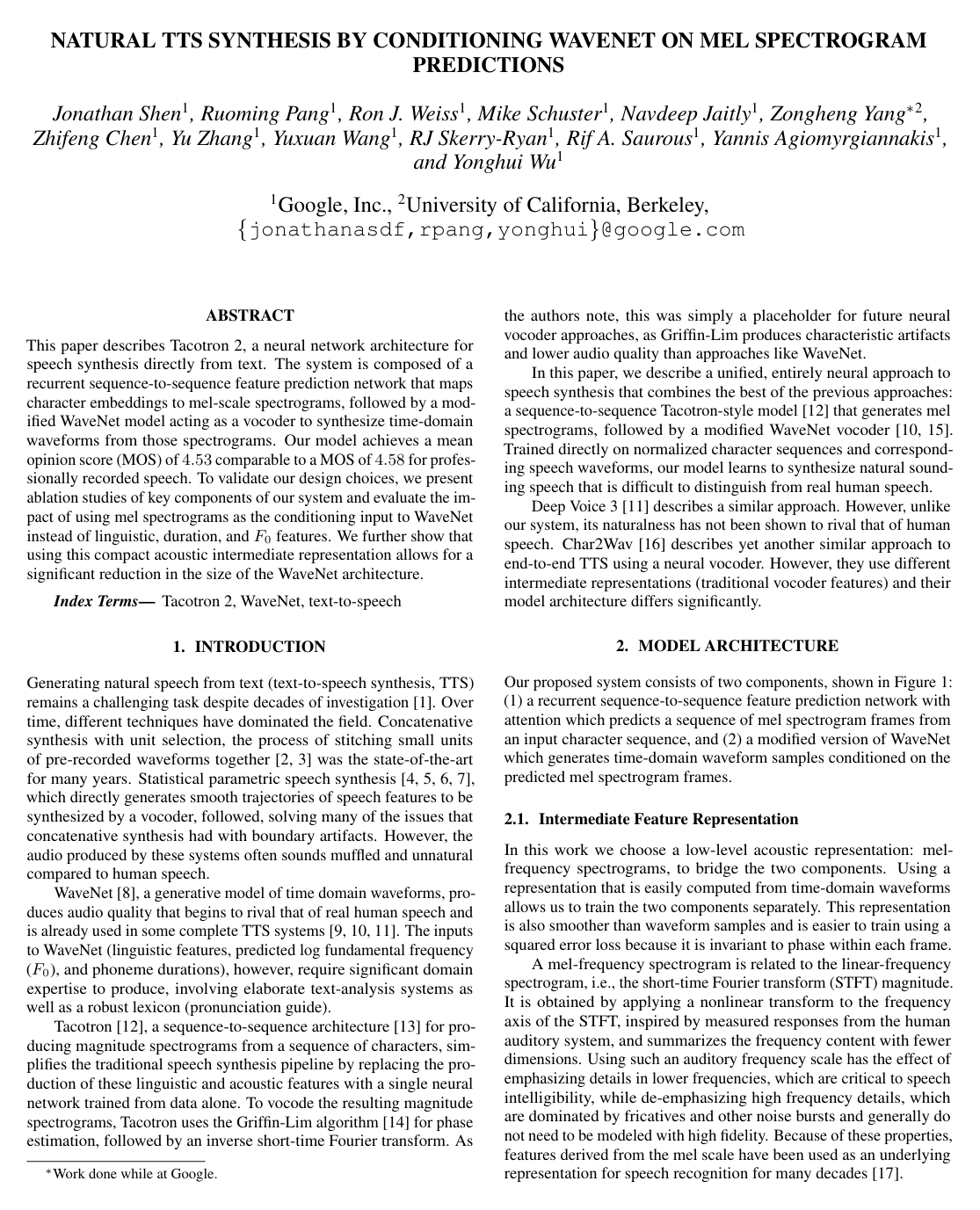
Natural TTS Synthesis by Conditioning Wavenet on MEL Spectrogram Predictions
Jonathan Shen, Ruoming Pang, Ron J. Weiss, Mike Schuster, Navdeep Jaitly, Zongheng Yang, Zhifeng Chen, Yu Zhang, Yuxuan Wang, RJ Skerry-Ryan, Rif A. Saurous, Yannis Agiomyrgiannakis, Yonghui Wu
Why you should read this
Introduces Tacotron 2, a neural text-to-speech architecture combining sequence-to-sequence mel-spectrogram prediction with a modified WaveNet vocoder to synthesize natural speech that rivals professional human recordings.
This paper describes Tacotron 2, a neural network architecture for speech synthesis directly from text. The system is composed of a recurrent sequence-to-sequence feature prediction network that maps character embeddings to mel-scale spectrograms, followed by a modified WaveNet model acting as a vocoder to synthesize timedomain waveforms from those spectrograms. Our model achieves a mean opinion score (MOS) of comparable to a MOS of for professionally recorded speech. To validate our design choices, we present ablation studies of key components of our system and evaluate the impact of using mel spectrograms as the input to WaveNet instead of linguistic, duration, and features. We further demonstrate that using a compact acoustic intermediate representation enables significant simplification of the WaveNet architecture.
Added
2026-09-12
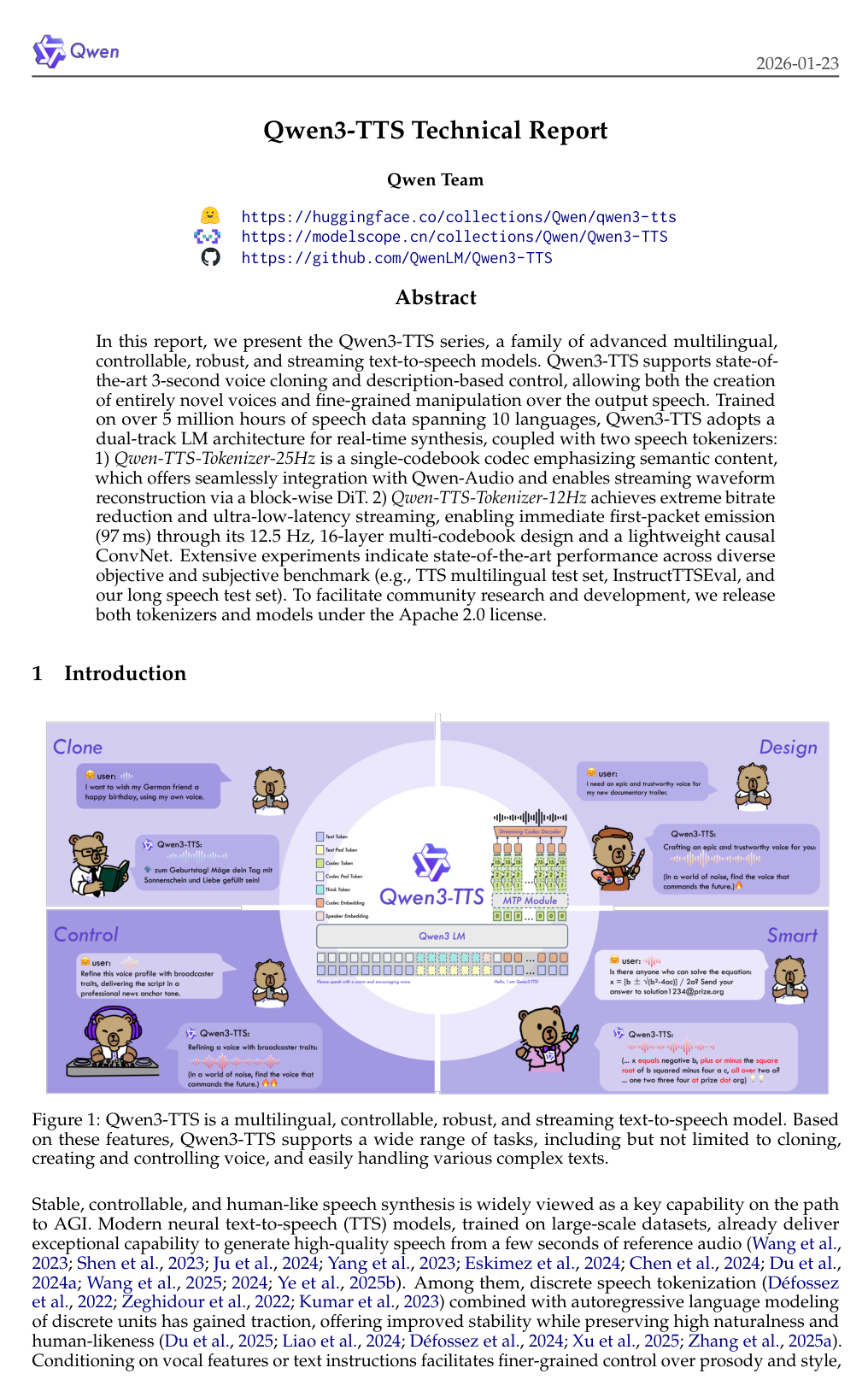
Qwen3-TTS Technical Report
Hangrui Hu, Xinfa Zhu, Ting He, Dake Guo, Bin Zhang, Xiong Wang, Zhifang Guo, Ziyue Jiang, Hongkun Hao, Zishan Guo, Xinyu Zhang, Pei Zhang, Baosong Yang, Jin Xu, Jingren Zhou, Junyang Lin
Why you should read this
Introduces the Qwen3-TTS series, a family of state-of-the-art multilingual, controllable, and streaming text-to-speech models that offer unprecedented 3-second voice cloning and ultra-low-latency real-time synthesis, transforming the landscape of human-like speech generation.
In this report, we present the Qwen3-TTS series, a family of advanced multilingual, controllable, robust, and streaming text-to-speech models. Qwen3-TTS supports state-of-the-art 3-second voice cloning and description-based control, allowing both the creation of entirely novel voices and fine-grained manipulation over the output speech. Trained on over 5 million hours of speech data spanning 10 languages, Qwen3-TTS adopts a dual-track LM architecture for real-time synthesis, coupled with two speech tokenizers: 1) Qwen-TTS-Tokenizer-25Hz is a single-codebook codec emphasizing semantic content, which offers seamlessly integration with Qwen-Audio and enables streaming waveform reconstruction via a block-wise DiT. 2) Qwen-TTS-Tokenizer-12Hz achieves extreme bitrate reduction and ultra-low-latency streaming, enabling immediate first-packet emission () through its 12.5 Hz, 16-layer multi-codebook design and a lightweight causal ConvNet. Extensive experiments indicate state-of-the-art performance across diverse objective and subjective benchmark (e.g., TTS multilingual test set, InstructTTSEval, and our long speech test set). To facilitate community research and development, we release both tokenizers and models under the Apache 2.0 license.
Added
2026-03-29

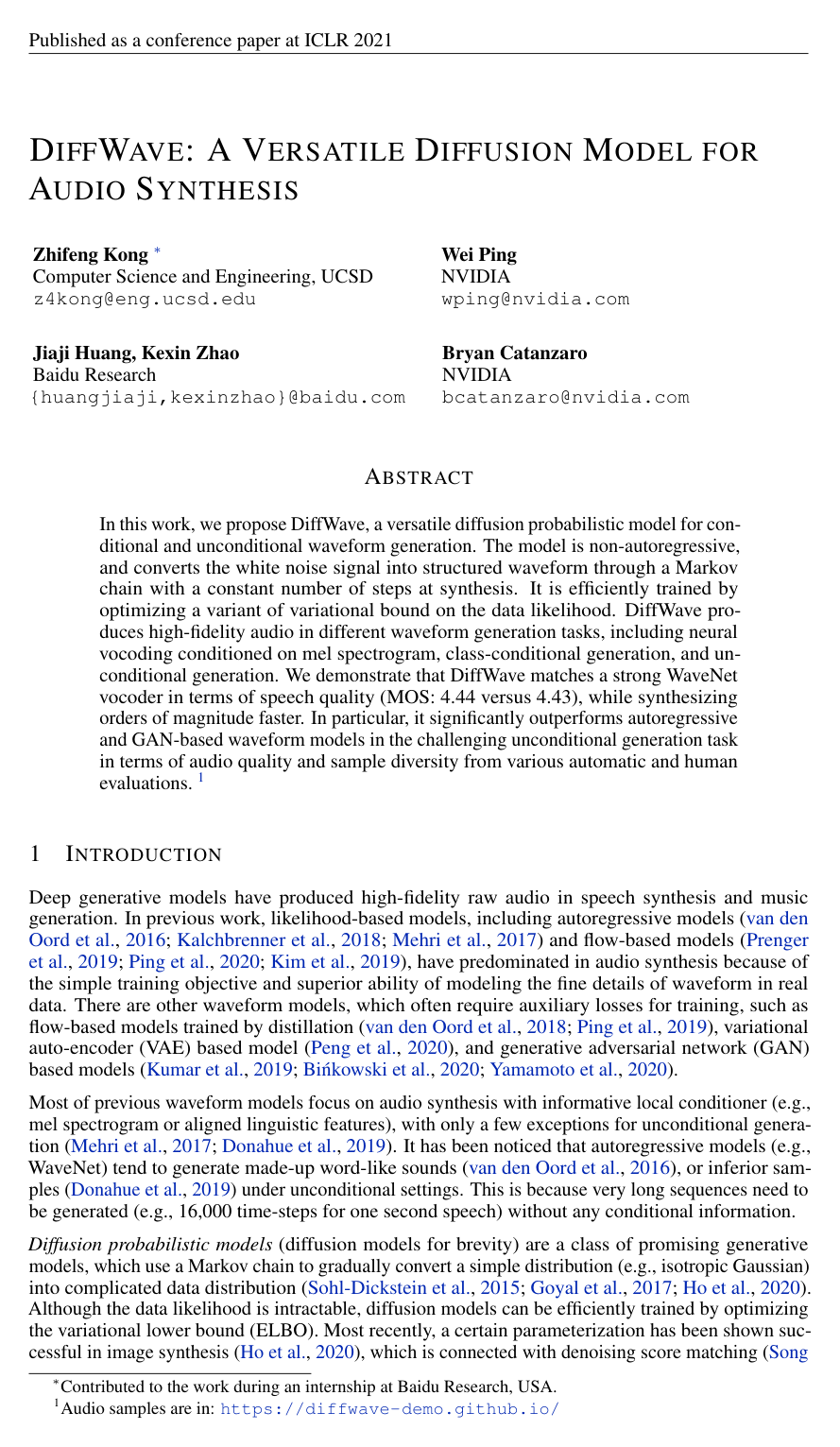
DiffWave: A Versatile Diffusion Model for Audio Synthesis
Zhifeng Kong, Wei Ping, Jiaji Huang, Kexin Zhao, Bryan Catanzaro
Why you should read this
Applies bidirectional diffusion to raw audio waveforms to match the quality of autoregressive vocoders with parallel sampling.
In this work, we propose DiffWave, a versatile diffusion probabilistic model for conditional and unconditional waveform generation. The model is non-autoregressive, and converts the white noise signal into structured waveform through a Markov chain with a constant number of steps at synthesis. It is efficiently trained by optimizing a variant of variational bound on the data likelihood. DiffWave produces high-fidelity audios in different waveform generation tasks, including neural vocoding conditioned on mel spectrogram, class-conditional generation, and unconditional generation. We demonstrate that DiffWave matches a strong WaveNet vocoder in terms of speech quality (MOS: 4.44 versus 4.43), while synthesizing orders of magnitude faster. In particular, it significantly outperforms autoregressive and GAN-based waveform models in the challenging unconditional generation task in terms of audio quality and sample diversity from various automatic and human evaluations.
Added
2026-02-25
WaveNet: A Generative Model for Raw Audio
Aäron van den Oord, Sander Dieleman, Heiga Zen, Karen Simonyan, Oriol Vinyals, Alexander Graves, Nal Kalchbrenner, Andrew Senior, Koray Kavukcuoglu
Why you should read this
Demonstrates that autoregressive principles extend perfectly to high-frequency continuous temporal data like raw audio through dilated causal convolutions.
This paper introduces WaveNet, a deep neural network for generating raw audio waveforms. The model is fully probabilistic and autoregressive, with the predictive distribution for each audio sample conditioned on all previous ones; nonetheless we show that it can be efficiently trained on data with tens of thousands of samples per second of audio. When applied to text-to-speech, it yields state-of-the-art performance, with human listeners rating it as significantly more natural sounding than the best parametric and concatenative systems for both English and Mandarin. A single WaveNet can capture the characteristics of many different speakers with equal fidelity, and can switch between them by conditioning on the speaker identity. When trained to model music, we find that it generates novel and often highly realistic musical fragments. We also show that it can be employed as a discriminative model, returning promising results for phoneme recognition.
Added
2026-02-21