
keyword
spectral hashing
Spectral hashing is an unsupervised algorithm designed for fast similarity search and approximate nearest neighbor retrieval in large datasets by mapping high-dimensional data points into compact binary codes. It formulates the objective of preserving pairwise data similarities as a graph-partitioning problem, ensuring that similar items produce binary codewords with a small Hamming distance between them. Because this discrete optimization problem is computationally intractable, spectral hashing applies a continuous relaxation to solve it using the thresholded eigenvectors of a graph Laplacian matrix. Under multidimensional distribution assumptions, these solutions can be computed analytically using eigenfunctions along principal component axes, enabling efficient out-of-sample encoding of new data points without explicitly constructing a pairwise graph.
3 items
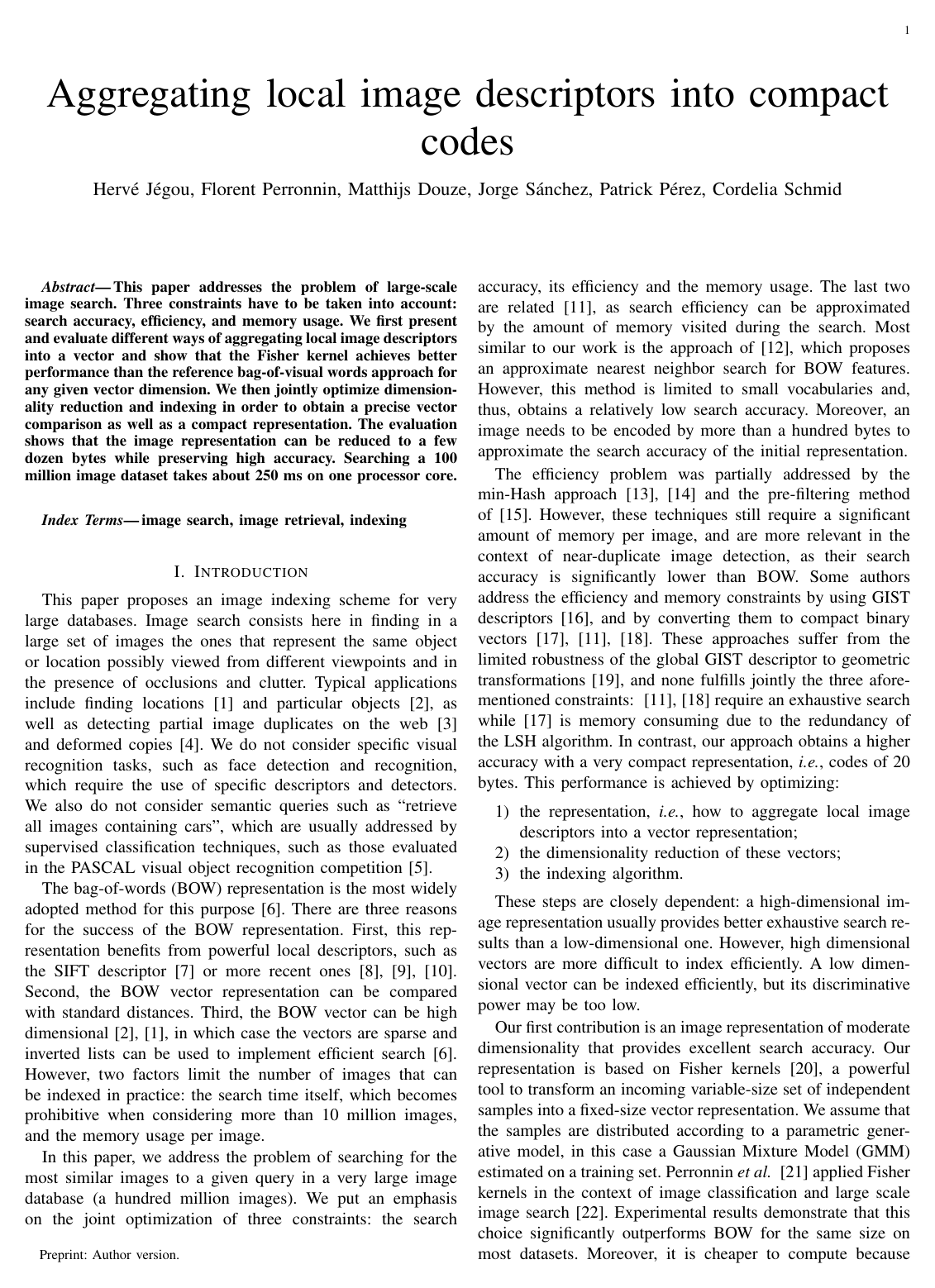
Aggregating Local Image Descriptors into Compact Codes
Hervé Jégou, Florent Perronnin, Matthijs Douze, Jorge Sánchez, P. Pérez, Cordelia Schmid
Why you should read this
Proposes an image indexing framework that aggregates local descriptors into compact codes of just a few dozen bytes, enabling accurate visual search across 100 million images in roughly 250 milliseconds on a single processor core.
This paper addresses the problem of large-scale image search. Three constraints have to be taken into account: search accuracy, efficiency, and memory usage. We first present and evaluate different ways of aggregating local image descriptors into a vector and show that the Fisher kernel achieves better performance than the reference bag-of-visual words approach for any given vector dimension. We then jointly optimize dimensionality reduction and indexing in order to obtain a precise vector comparison as well as a compact representation. The evaluation shows that the image representation can be reduced to a few dozen bytes while preserving high accuracy. Searching a 100 million image dataset takes about 250 ms on one processor core.
Added
2026-09-24
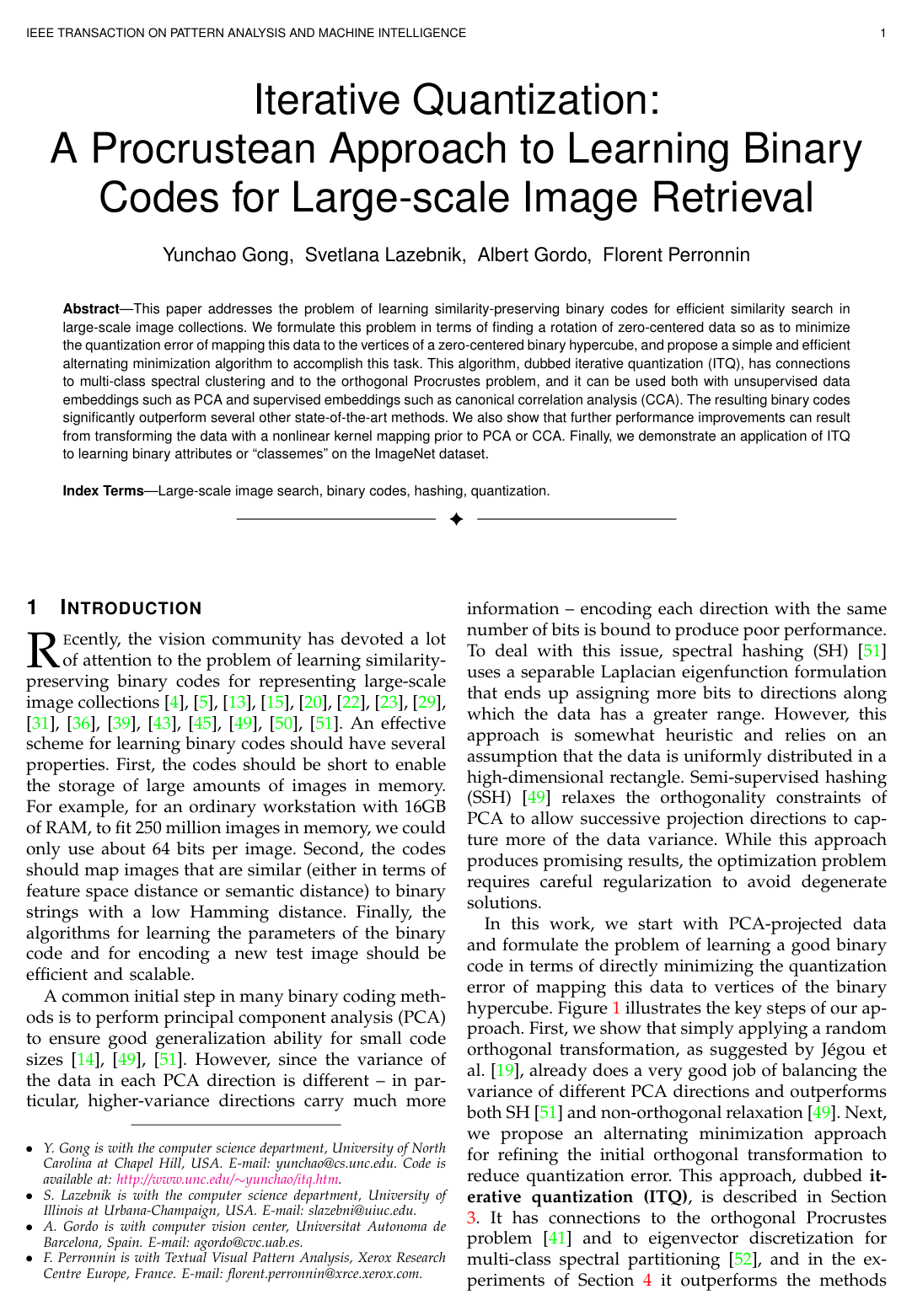
Iterative Quantization: A Procrustean Approach to Learning Binary Codes for Large-Scale Image Retrieval
Yunchao Gong, Svetlana Lazebnik, Albert Gordo, Florent Perronnin
Why you should read this
Proposes an alternating minimization method, Iterative Quantization, that finds an optimal orthogonal rotation to align dimensionally-reduced data with the vertices of a binary hypercube, significantly improving retrieval accuracy and scalability for large-scale image search.
This paper addresses the problem of learning similarity-preserving binary codes for efficient similarity search in large-scale image collections. We formulate this problem in terms of finding a rotation of zero-centered data so as to minimize the quantization error of mapping this data to the vertices of a zero-centered binary hypercube, and propose a simple and efficient alternating minimization algorithm to accomplish this task. This algorithm, dubbed iterative quantization (ITQ), has connections to multi-class spectral clustering and to the orthogonal Procrustes problem, and it can be used both with unsupervised data embeddings such as PCA and supervised embeddings such as canonical correlation analysis (CCA). The resulting binary codes significantly outperform several other state-of-the-art methods. We also show that further performance improvements can result from transforming the data with a nonlinear kernel mapping prior to PCA or CCA. Finally, we demonstrate an application of ITQ to learning binary attributes or “classemes” on the ImageNet dataset.
Added
2026-09-24
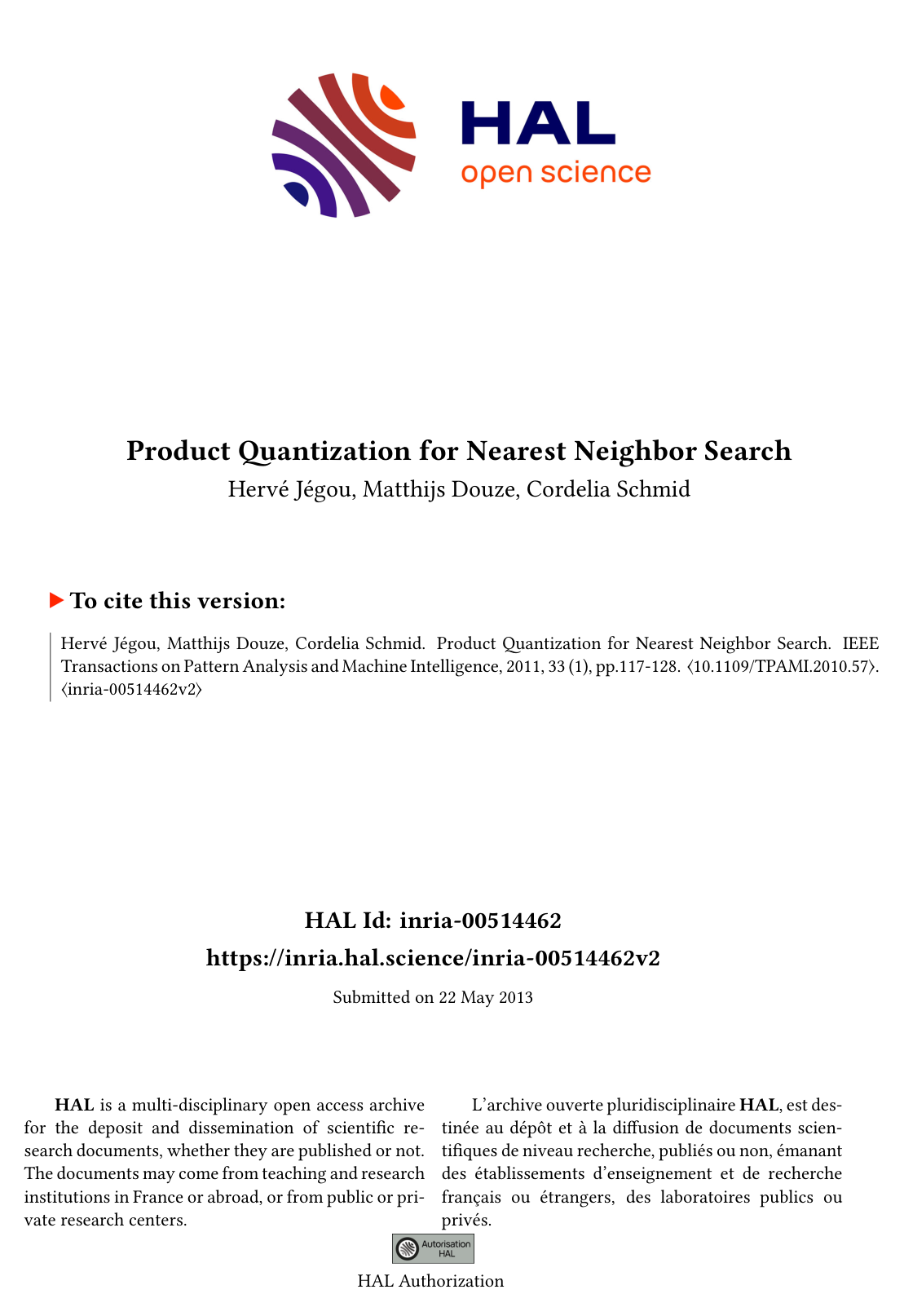
Product Quantization for Nearest Neighbor Search
Hervé Jégou, Matthijs Douze, Cordelia Schmid
Why you should read this
Formulates the mathematics of decomposing high-dimensional spaces into lower-dimensional Cartesian products to compress vectors and radically accelerate distance estimations.
This paper introduces a product quantization-based approach for approximate nearest neighbor search. The idea is to decompose the space into a Cartesian product of low-dimensional subspaces and to quantize each subspace separately. A vector is represented by a short code composed of its subspace quantization indices. The euclidean distance between two vectors can be efficiently estimated from their codes. An asymmetric version increases precision, as it computes the approximate distance between a vector and a code. Experimental results show that our approach searches for nearest neighbors efficiently, in particular in combination with an inverted file system. Results for SIFT and GIST image descriptors show excellent search accuracy, outperforming three state-of-the-art approaches. The scalability of our approach is validated on a data set of two billion vectors.
Added
2026-05-03