
keyword
spatio-temporal attention
Spatio-temporal attention is a deep learning mechanism that enables neural networks to dynamically focus on the most relevant features across both spatial locations and temporal sequences in data such as video. By calculating attention weights over pixels or token representations within individual frames as well as across consecutive frames over time, the mechanism captures visual structures, motion dynamics, and long-range temporal relationships. Implementations typically compute attention either jointly across space and time dimensions or factorize the operation into separate, alternating spatial and temporal modules to improve computational efficiency. This mechanism is widely used in video classification, action recognition, motion tracking, and video generation to maintain structural coherence and temporal consistency.
3 items
RAVE: Randomized Noise Shuffling for Fast and Consistent Video Editing with Diffusion Models
Ozgur Kara, Bariscan Kurtkaya, Hidir Yesiltepe, James M. Rehg, Pinar Yanardag
Why you should read this
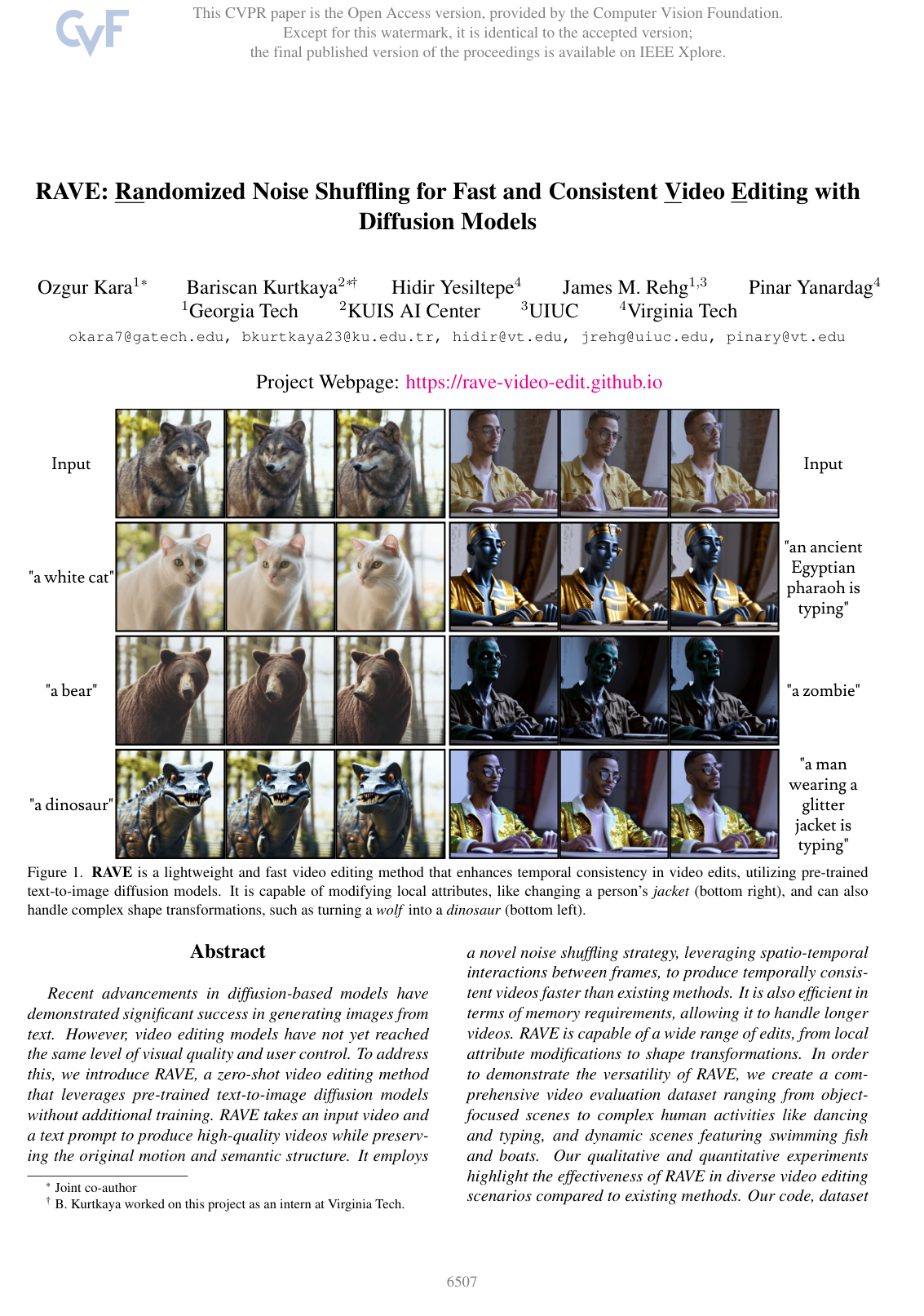
Proposes a training-free video editing framework that uses randomized noise shuffling across diffusion steps to achieve temporally consistent, full-sequence edits with lower memory overhead and faster inference than prior methods.
Recent advancements in diffusion-based models have demonstrated significant success in generating images from text. However, video editing models have not yet reached the same level of visual quality and user control. To address this, we introduce RAVE, a zero-shot video editing method that leverages pre-trained text-to-image diffusion models without additional training. RAVE takes an input video and a text prompt to produce high-quality videos while preserving the original motion and semantic structure. It employs a novel noise shuffling strategy, leveraging spatio-temporal interactions between frames, to produce temporally consistent videos faster than existing methods. It is also efficient in terms of memory requirements, allowing it to handle longer videos. RAVE is capable of a wide range of edits, from local attribute modifications to shape transformations. In order to demonstrate the versatility of RAVE, we create a comprehensive video evaluation dataset ranging from object-focused scenes to complex human activities like dancing and typing, and dynamic scenes featuring swimming fish and boats. Our qualitative and quantitative experiments highlight the effectiveness of RAVE in diverse video editing scenarios compared to existing methods. Our code, dataset
Added
2026-09-26
ST-Adapter: Parameter-Efficient Image-to-Video Transfer Learning
Junting Pan, Ziyi Lin, Xiatian Zhu, Jing Shao, Hongsheng Li
Why you should read this
Proposes a lightweight Spatio-Temporal Adapter that enables frozen pre-trained image vision transformers to perform video action recognition by updating only about eight percent of parameters while matching or exceeding full fine-tuning performance.
Capitalizing on large pre-trained models for various downstream tasks of interest have recently emerged with promising performance. Due to the ever-growing model size, the standard full fine-tuning based task adaptation strategy becomes prohibitively costly in terms of model training and storage. This has led to a new research direction in parameter-efficient transfer learning. However, existing attempts typically focus on downstream tasks from the same modality (e.g., image understanding) of the pre-trained model. This creates a limit because in some specific modalities, (e.g., video understanding) such a strong pre-trained model with sufficient knowledge is less or not available. In this work, we investigate such a novel cross-modality transfer learning setting, namely parameter-efficient image-to-video transfer learning. To solve this problem, we propose a new Spatio-Temporal Adapter (ST-Adapter) for parameter-efficient fine-tuning per video task. With a built-in spatio-temporal reasoning capability in a compact design, ST-Adapter enables a pre-trained image model without temporal knowledge to reason about dynamic video content at a small (~8%) per-task parameter cost, requiring approximately 20 times fewer updated parameters compared to previous work. Extensive experiments on video action recognition tasks show that our ST-Adapter can match or even outperform the strong full fine-tuning strategy and state-of-the-art video models, whilst enjoying the advantage of parameter efficiency. Code and model are available at https://github.com/linziyi96/st-adapter
Added
2026-09-26
ViViT: A Video Vision Transformer
Anurag Arnab, Mostafa Dehghani, Georg Heigold, Chen Sun, Mario Lučić, Cordelia Schmid
Why you should read this
Introduces ViViT, an efficient pure-transformer framework for video classification that factorizes spatio-temporal dimensions and leverages pretrained image models to surpass standard 3D convolutional networks across major benchmarks.
We present pure-transformer based models for video classification, drawing upon the recent success of such models in image classification. Our model extracts spatio-temporal tokens from the input video, which are then encoded by a series of transformer layers. In order to handle the long sequences of tokens encountered in video, we propose several, efficient variants of our model which factorise the spatial- and temporal-dimensions of the input. Although transformer-based models are known to only be effective when large training datasets are available, we show how we can effectively regularise the model during training and leverage pretrained image models to be able to train on comparatively small datasets. We conduct thorough ablation studies, and achieve state-of-the-art results on multiple video classification benchmarks including Kinetics 400 and 600, Epic Kitchens, Something-Something v2 and Moments in Time, outperforming prior methods based on deep 3D convolutional networks. To facilitate further research, we release code at this https URL
Added
2026-09-12