
keyword
spatial transformer
A spatial transformer is a neural network component based on the transformer architecture that applies self-attention across the spatial dimensions of visual data to model relationships among different regions of an image or video frame. Visual inputs are typically partitioned into a grid of spatial tokens or patches, which the spatial transformer processes to capture global context, geometric structures, and fine-grained visual features simultaneously. In broader visual architectures, such as video processing frameworks and generative image models, spatial transformers are frequently employed as dedicated modules factorized separately from temporal or codebook dimensions, allowing the system to efficiently encode spatial interactions while mitigating the computational cost associated with full joint attention across space and time.
3 items
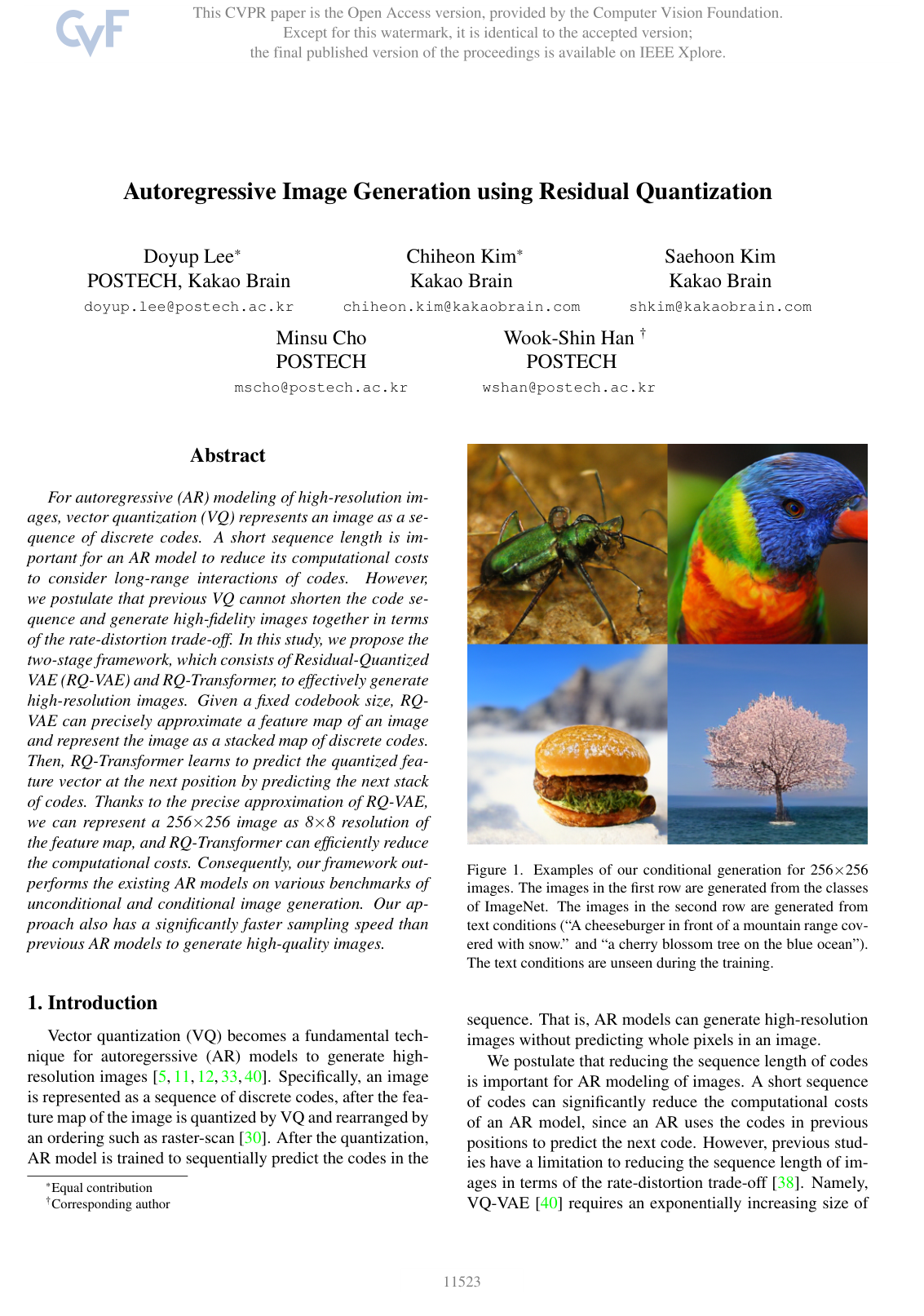
Autoregressive Image Generation using Residual Quantization
Doyup Lee, Chiheon Kim, Saehoon Kim, Minsu Cho, Wook-Shin Han
Why you should read this
Proposes a two-stage residual quantization framework, comprising RQ-VAE and RQ-Transformer, that drastically shortens discrete code sequences to achieve faster sampling and lower computational costs in high-resolution autoregressive image generation without sacrificing fidelity.
For autoregressive (AR) modeling of high-resolution images, vector quantization (VQ) represents an image as a sequence of discrete codes. A short sequence length is important for an AR model to reduce its computational costs to consider long-range interactions of codes. However, we postulate that previous VQ cannot shorten the code sequence and generate high-fidelity images together in terms of the rate-distortion trade-off. In this study, we propose the two-stage framework, which consists of Residual-Quantized VAE (RQ-VAE) and RQ-Transformer, to effectively generate high-resolution images. Given a fixed codebook size, RQ-VAE can precisely approximate a feature map of an image and represent the image as a stacked map of discrete codes. Then, RQ-Transformer learns to predict the quantized feature vector at the next position by predicting the next stack of codes. Thanks to the precise approximation of RQ-VAE, we can represent a 256256 image as 88 resolution of the feature map, and RQ-Transformer can efficiently reduce the computational costs. Consequently, our framework outperforms the existing AR models on various benchmarks of unconditional and conditional image generation. Our approach also has a significantly faster sampling speed than previous AR models to generate high-quality images.
Added
2026-10-05
Scaling Vision Transformers to 22 Billion Parameters
Mostafa Dehghani, Josip Djolonga, Basil Mustafa, Piotr Padlewski, Jonathan Heek, Justin Gilmer, Andreas Peter Steiner, Mathilde Caron, Robert Geirhos, Ibrahim Alabdulmohsin, Rodolphe Jenatton, Lucas Beyer, Michael Tschannen, Anurag Arnab, Xiao Wang, Carlos Riquelme Ruiz, Matthias Minderer, Joan Puigcerver, Utku Evci, Manoj Kumar, Sjoerd van Steenkiste, Gamaleldin Fathy Elsayed, Aravindh Mahendran, Fisher Yu, Avital Oliver, Fantine Huot, Jasmijn Bastings, Mark Collier, Alexey A. Gritsenko, Vighnesh Birodkar, Cristina Nader Vasconcelos, Yi Tay, Thomas Mensink, Alexander Kolesnikov, Filip Pavetic, Dustin Tran, Thomas Kipf, Mario Lucic, Xiaohua Zhai, Daniel Keysers, Jeremiah J. Harmsen, Neil Houlsby
Why you should read this
Introduces an efficient training recipe for a 22-billion-parameter Vision Transformer, demonstrating that language-model-scale vision architectures achieve strong downstream performance, improved fairness tradeoffs, and closer alignment with human visual perception.
The scaling of Transformers has driven breakthrough capabilities for language models. At present, the largest large language models (LLMs) contain upwards of 100B parameters. Vision Transformers (ViT) have introduced the same architecture to image and video modelling, but these have not yet been successfully scaled to nearly the same degree; the largest dense ViT contains 4B parameters (Chen et al., 2022). We present a recipe for highly efficient and stable training of a 22B-parameter ViT (ViT-22B) and perform a wide variety of experiments on the resulting model. When evaluated on downstream tasks (often with a lightweight linear model on frozen features), ViT-22B demonstrates increasing performance with scale. We further observe other interesting benefits of scale, including an improved tradeoff between fairness and performance, state-of-the-art alignment to human visual perception in terms of shape/texture bias, and improved robustness. ViT-22B demonstrates the potential for "LLM-like" scaling in vision, and provides key steps towards getting there.
Added
2026-09-28
ViViT: A Video Vision Transformer
Anurag Arnab, Mostafa Dehghani, Georg Heigold, Chen Sun, Mario Lučić, Cordelia Schmid
Why you should read this
Introduces ViViT, an efficient pure-transformer framework for video classification that factorizes spatio-temporal dimensions and leverages pretrained image models to surpass standard 3D convolutional networks across major benchmarks.
We present pure-transformer based models for video classification, drawing upon the recent success of such models in image classification. Our model extracts spatio-temporal tokens from the input video, which are then encoded by a series of transformer layers. In order to handle the long sequences of tokens encountered in video, we propose several, efficient variants of our model which factorise the spatial- and temporal-dimensions of the input. Although transformer-based models are known to only be effective when large training datasets are available, we show how we can effectively regularise the model during training and leverage pretrained image models to be able to train on comparatively small datasets. We conduct thorough ablation studies, and achieve state-of-the-art results on multiple video classification benchmarks including Kinetics 400 and 600, Epic Kitchens, Something-Something v2 and Moments in Time, outperforming prior methods based on deep 3D convolutional networks. To facilitate further research, we release code at this https URL
Added
2026-09-12