
keyword
Sparse Transformers
Sparse Transformers are a class of Transformer neural network architectures designed to process long sequences and large data structures more efficiently by replacing standard dense full self-attention or dense computation with sparse connectivity patterns. In conventional Transformers, every token attends to every other token, causing computational time and memory requirements to grow quadratically with sequence length. Sparse Transformers mitigate this bottleneck by restricting interactions to selected subsets of tokens, such as local neighborhoods, strided intervals, global memory tokens, or dynamically routed pathways. By reducing the computational and memory complexity from quadratic to sub-quadratic or linear while preserving representation quality, Sparse Transformers enable neural models to scale to much longer context windows, high-resolution multimedia inputs, and large graph datasets.
6 items
Exphormer: Sparse Transformers for Graphs
Hamed Shirzad, Ameya Velingker, Balaji Venkatachalam, Danica J. Sutherland, Ali Kemal Sinop
Why you should read this
Proposes a scalable graph transformer framework that uses expander graphs and virtual global nodes to achieve linear complexity while preserving the expressive power and theoretical guarantees of dense global attention.
Graph transformers have emerged as a promising architecture for a variety of graph learning and representation tasks. Despite their successes, though, it remains challenging to scale graph transformers to large graphs while maintaining accuracy competitive with message-passing networks. In this paper, we introduce EXPHORMER, a framework for building powerful and scalable graph transformers. EXPHORMER consists of a sparse attention mechanism based on two mechanisms: virtual global nodes and expander graphs, whose mathematical characteristics, such as spectral expansion, pseudorandomness, and sparsity, yield graph transformers with complexity only linear in the size of the graph, while allowing us to prove desirable theoretical properties of the resulting transformer models. We show that incorporating EXPHORMER into the recently-proposed GraphGPS framework produces models with competitive empirical results on a wide variety of graph datasets, including state-of-the-art results on three datasets. We also show that EXPHORMER can scale to datasets on larger graphs than shown in previous graph transformer architectures. Codes can be found at https://github.com/hamed1375/Exphormer.
Added
2026-09-28
Dynamic Context Pruning for Efficient and Interpretable Autoregressive Transformers
Sotiris Anagnostidis, Dario Pavllo, Luca Biggio, Lorenzo Noci, Aurélien Lucchi, Thomas Hofmann
Why you should read this
Proposes a learnable context-pruning mechanism for autoregressive language models that discards up to 80% of uninformative tokens during generation to cut inference memory and double throughput without hurting downstream accuracy.
Autoregressive Transformers adopted in Large Language Models (LLMs) are hard to scale to long sequences. Despite several works trying to reduce their computational cost, most of LLMs still adopt attention layers between all pairs of tokens in the sequence, thus incurring a quadratic cost. In this study, we present a novel approach that dynamically prunes contextual information while preserving the model’s expressiveness, resulting in reduced memory and computational requirements during inference. Our method employs a learnable mechanism that determines which uninformative tokens can be dropped from the context at any point across the generation process. By doing so, our approach not only addresses performance concerns but also enhances interpretability, providing valuable insight into the model’s decision-making process. Our technique can be applied to existing pre-trained models through a straightforward fine-tuning process, and the pruning strength can be specified by a sparsity parameter. Notably, our empirical findings demonstrate that we can effectively prune up to 80% of the context without significant performance degradation on downstream tasks, offering a valuable tool for mitigating inference costs. Our reference implementation achieves up to 2× increase in inference throughput and even greater memory savings.
Added
2026-09-26
Efficient Transformers: A Survey
Yi Tay, Mostafa Dehghani, Dara Bahri, Donald Metzler
Why you should read this
Systematizes dozens of efficient Transformer variants into a clear taxonomy of computational and memory trade-offs, helping researchers choose the optimal architecture for resource-constrained deep learning applications.
Transformer model architectures have garnered immense interest lately due to their effectiveness across a range of domains like language, vision and reinforcement learning. In the field of natural language processing for example, Transformers have become an indispensable staple in the modern deep learning stack. Recently, a dizzying number of "X-former" models have been proposed - Reformer, Linformer, Performer, Longformer, to name a few - which improve upon the original Transformer architecture, many of which make improvements around computational and memory efficiency. With the aim of helping the avid researcher navigate this flurry, this paper characterizes a large and thoughtful selection of recent efficiency-flavored "X-former" models, providing an organized and comprehensive overview of existing work and models across multiple domains.
Added
2026-09-24
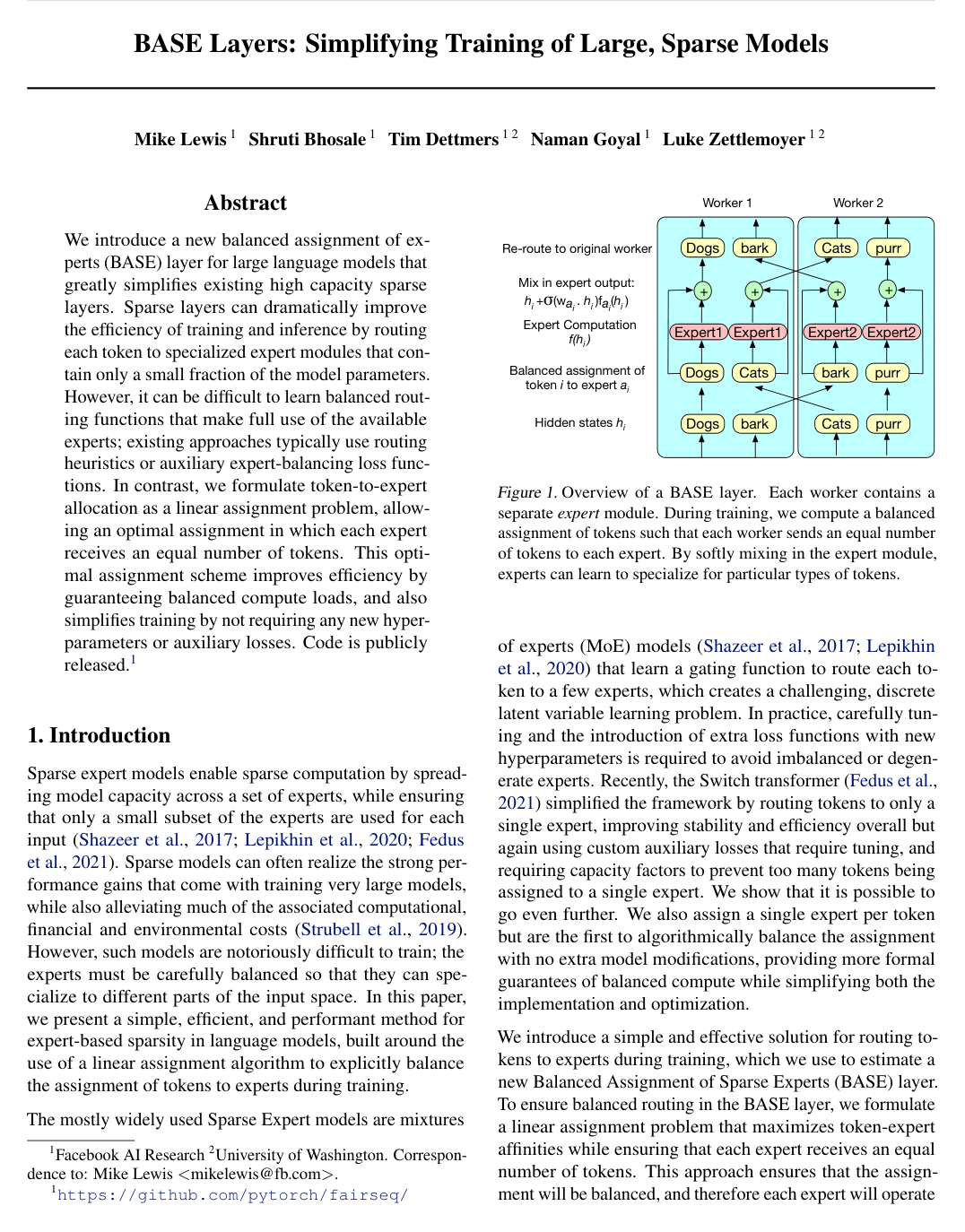
BASE Layers: Simplifying Training of Large, Sparse Models
Mike Lewis, Shruti Bhosale, Tim Dettmers, Naman Goyal, Luke Zettlemoyer
Why you should read this
Introduces a novel BASE layer that dramatically simplifies the training and improves the efficiency of large, sparse language models by optimally balancing token assignments to experts without new hyperparameters or auxiliary losses.
We introduce a new balanced assignment of experts (BASE) layer for large language models that greatly simplifies existing high capacity sparse layers. Sparse layers can dramatically improve the efficiency of training and inference by routing each token to specialized expert modules that contain only a small fraction of the model parameters. However, it can be difficult to learn balanced routing functions that make full use of the available experts; existing approaches typically use routing heuristics or auxiliary expert-balancing loss functions. In contrast, we formulate token-to-expert allocation as a linear assignment problem, allowing an optimal assignment in which each expert receives an equal number of tokens. This optimal assignment scheme improves efficiency by guaranteeing balanced compute loads, and also simplifies training by not requiring any new hyperparameters or auxiliary losses. Code is publicly released at this https URL
Added
2026-02-24

Big Bird: Transformers for Longer Sequences
Manzil Zaheer, Guru Guruganesh, Avinava Dubey, Joshua Ainslie, Chris Alberti, Santiago Ontañón, Philip Pham, Anirudh Ravula, Qifan Wang, Yang Li, Amr Ahmed
Why you should read this
Provides the theoretical proof that sparse attention involving random, window, and global connections is a universal approximator of sequence functions.
Transformers-based models, such as BERT, have been one of the most successful deep learning models for NLP. Unfortunately, one of their core limitations is the quadratic dependency (mainly in terms of memory) on the sequence length due to their full attention mechanism. To remedy this, we propose, BigBird, a sparse attention mechanism that reduces this quadratic dependency to linear. We show that BigBird is a universal approximator of sequence functions and is Turing complete, thereby preserving these properties of the quadratic, full attention model. Along the way, our theoretical analysis reveals some of the benefits of having global tokens (such as CLS), that attend to the entire sequence as part of the sparse attention mechanism. The proposed sparse attention can handle sequences of length up to 8x of what was previously possible using similar hardware. As a consequence of the capability to handle longer context, BigBird drastically improves performance on various NLP tasks such as question answering and summarization. We also propose novel applications to genomics data.
Added
2026-02-11
Generating Long Sequences with Sparse Transformers
Rewon Child, Scott Gray, Alec Radford, Ilya Sutskever
Why you should read this
Pioneers factorized attention patterns (strided and fixed), providing the first blueprint for reducing quadratic complexity to sub-quadratic.
Transformers are powerful sequence models, but require time and memory that grows quadratically with the sequence length. In this paper we introduce sparse factorizations of the attention matrix which reduce this to . We also introduce a) a variation on architecture and initialization to train deeper networks, b) the recomputation of attention matrices to save memory, and c) fast attention kernels for training. We call networks with these changes Sparse Transformers, and show they can model sequences tens of thousands of timesteps long using hundreds of layers. We use the same architecture to model images, audio, and text from raw bytes, setting a new state of the art for density modeling of Enwik8, CIFAR-10, and ImageNet-64. We generate unconditional samples that demonstrate global coherence and great diversity, and show it is possible in principle to use self-attention to model sequences of length one million or more.
Added
2026-02-11