
keyword
sparse representations
A sparse representation is a data encoding method in which an input signal, text, or feature vector is expressed such that most of its dimensions or constituent elements are zero, leaving only a small subset of components active or non-zero. In machine learning and signal processing, this is commonly achieved through sparse coding, where data is approximated as a linear combination of a few basis elements from a dictionary, or through neural networks using thresholding activation functions that produce exact zeros. In information retrieval and natural language processing, sparse representations typically take the form of high-dimensional lexical vectors where dimensions correspond to vocabulary terms, facilitating exact keyword matching and efficient search through inverted indexes. By preserving essential information with a minimal number of active features, sparse representations enhance computational and memory efficiency, improve interpretability, and provide robust models for naturally sparse real-world data.
7 items
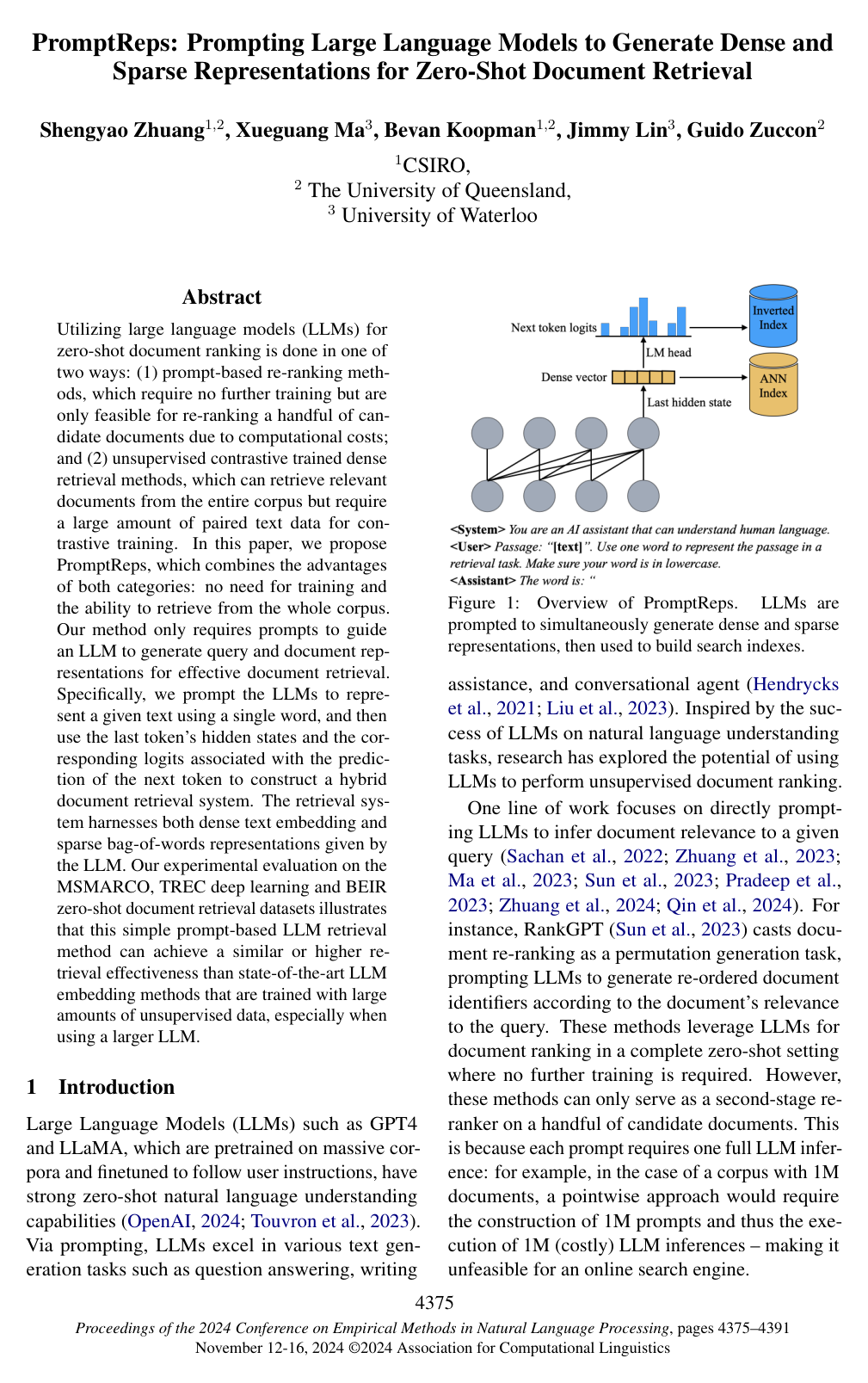
PromptReps: Prompting Large Language Models to Generate Dense and Sparse Representations for Zero-Shot Document Retrieval
Shengyao Zhuang, Xueguang Ma, Bevan Koopman, Jimmy Lin, Guido Zuccon
Why you should read this
Introduces a prompt-based approach that simultaneously extracts dense embeddings and sparse bag-of-words representations from large language models in a single forward pass, enabling zero-shot full-corpus document retrieval without expensive contrastive fine-tuning.
Utilizing large language models (LLMs) for zero-shot document ranking is done in one of two ways: (1) prompt-based re-ranking methods, which require no further training but are only feasible for re-ranking a handful of candidate documents due to computational costs; and (2) unsupervised contrastive trained dense retrieval methods, which can retrieve relevant documents from the entire corpus but require a large amount of paired text data for contrastive training. In this paper, we propose PromptReps, which combines the advantages of both categories: no need for training and the ability to retrieve from the whole corpus. Our method only requires prompts to guide an LLM to generate query and document representations for effective document retrieval. Specifically, we prompt the LLMs to represent a given text using a single word, and then use the last token’s hidden states and the corresponding logits associated with the prediction of the next token to construct a hybrid document retrieval system. The retrieval system harnesses both dense text embedding and sparse bag-of-words representations given by the LLM. Our experimental evaluation on the MSMARCO, TREC deep learning and BEIR zero-shot document retrieval datasets illustrates that this simple prompt-based LLM retrieval method can achieve a similar or higher retrieval effectiveness than state-of-the-art LLM embedding methods that are trained with large amounts of unsupervised data, especially when using a larger LLM.
Added
2026-09-26
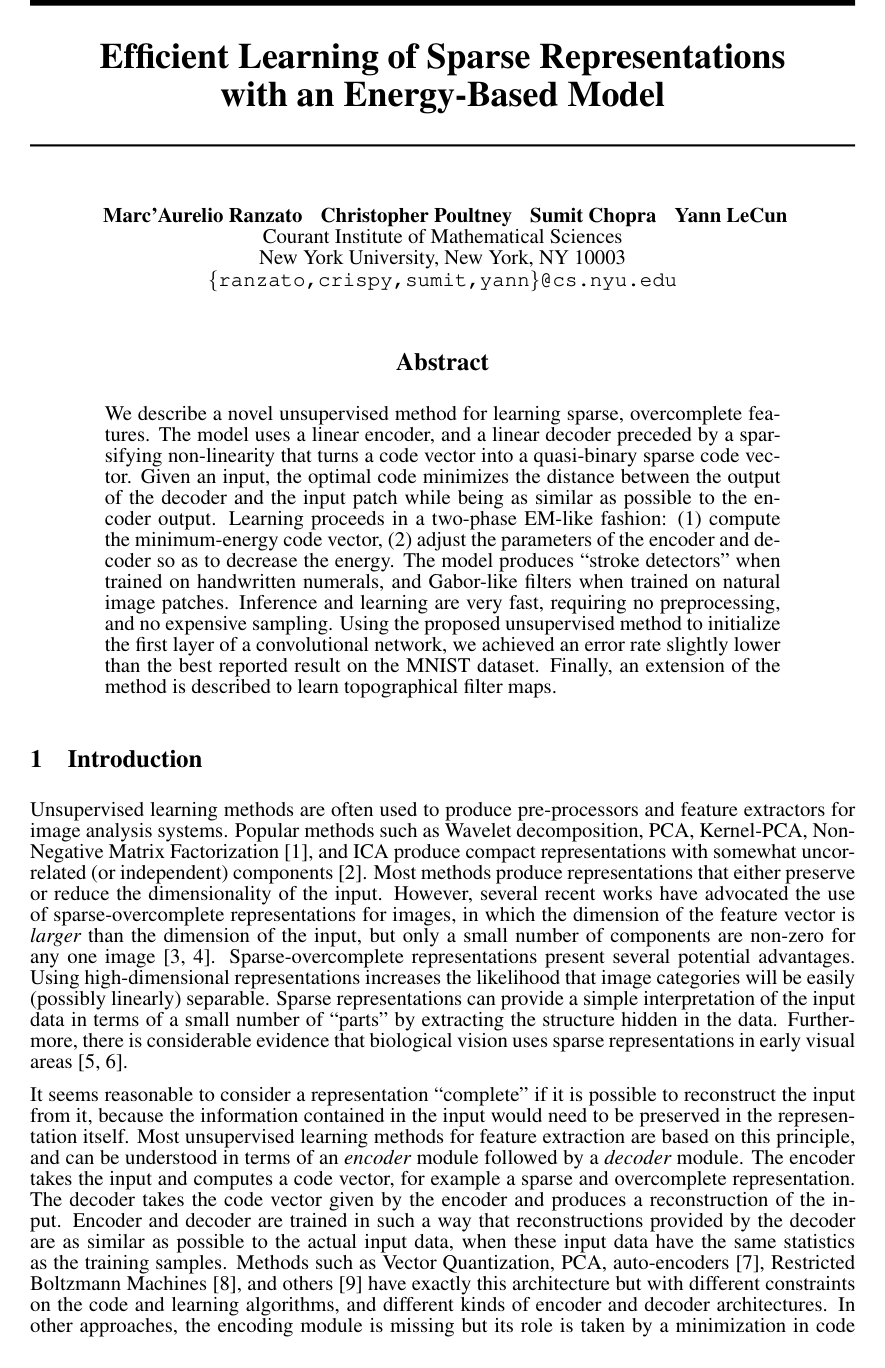
Efficient Learning of Sparse Representations with an Energy-Based Model
Marc'Aurelio Ranzato, Christopher S. Poultney, S. Chopra, Yann LeCun
Why you should read this
Proposes an energy-based unsupervised learning framework using a sparsifying logistic function to efficiently extract sparse, overcomplete visual features without expensive sampling, enabling state-of-the-art weight initialization for convolutional networks on MNIST.
We describe a novel unsupervised method for learning sparse, overcomplete features. The model uses a linear encoder, and a linear decoder preceded by a sparsifying non-linearity that turns a code vector into a quasi-binary sparse code vector. Given an input, the optimal code minimizes the distance between the output of the decoder and the input patch while being as similar as possible to the encoder output. Learning proceeds in a two-phase EM-like fashion: (1) compute the minimum-energy code vector, (2) adjust the parameters of the encoder and decoder so as to decrease the energy. The model produces “stroke detectors” when trained on handwritten numerals, and Gabor-like filters when trained on natural image patches. Inference and learning are very fast, requiring no preprocessing, and no expensive sampling. Using the proposed unsupervised method to initialize the first layer of a convolutional network, we achieved an error rate slightly lower than the best reported result on the MNIST dataset. Finally, an extension of the method is described to learn topographical filter maps.
Added
2026-09-25
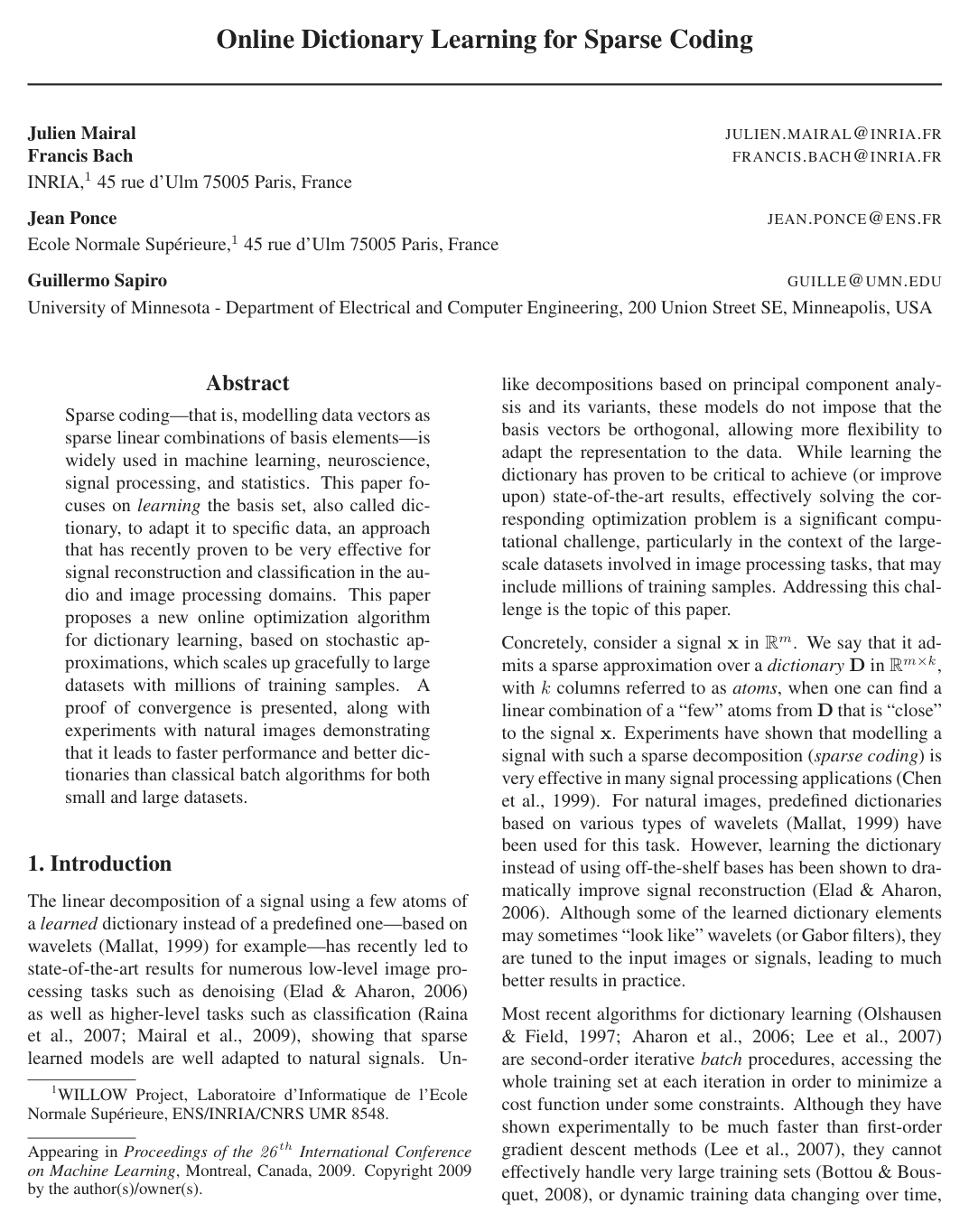
Online dictionary learning for sparse coding
Julien Mairal, Francis Bach, Jean Ponce, Guillermo Sapiro
Why you should read this
Develops an online dictionary learning algorithm based on stochastic approximations that efficiently scales to millions of training samples without requiring learning rate tuning, backed by convergence proofs and demonstrated on large-scale image restoration tasks.
Sparse coding—that is, modelling data vectors as sparse linear combinations of basis elements—is widely used in machine learning, neuroscience, signal processing, and statistics. This paper focuses on learning the basis set, also called dictionary, to adapt it to specific data, an approach that has recently proven to be very effective for signal reconstruction and classification in the audio and image processing domains. This paper proposes a new online optimization algorithm for dictionary learning, based on stochastic approximations, which scales up gracefully to large datasets with millions of training samples. A proof of convergence is presented, along with experiments with natural images demonstrating that it leads to faster performance and better dictionaries than classical batch algorithms for both small and large datasets. like decompositions based on principal component analysis and its variants, these models do not impose that the basis vectors be orthogonal, allowing more flexibility to adapt the representation to the data. While learning the dictionary has proven to be critical to achieve (or improve upon) state-of-the-art results, effectively solving the corresponding optimization problem is a significant computational challenge, particularly in the context of the large-scale datasets involved in image processing tasks, that may include millions of training samples. Addressing this challenge is the topic of this paper. Concretely, consider a signal x in R^m. We say that it admits a sparse approximation over a dictionary D in R^{m×k}, with k columns referred to as atoms, when one can find a linear combination of a “few” atoms from D that is “close” to the signal x. Experiments have shown that modelling a signal with such a sparse decomposition (sparse coding) is very effective in many signal processing applications (Chen et al., 1999). For natural images, predefined dictionaries based on various types of wavelets (Mallat, 1999) have been used for this task. However, learning the dictionary instead of using off-the-shelf bases has been shown to dramatically improve signal reconstruction (Elad & Aharon, 2006). Although some of the learned dictionary elements may sometimes “look like” wavelets (or Gabor filters), they are tuned to the input images or signals, leading to much better results in practice. Most recent algorithms for dictionary learning (Olshausen & Field, 1997; Aharon et al., 2006; Lee et al., 2007) are second-order iterative batch procedures, accessing the whole training set at each iteration in order to minimize a cost function under some constraints. Although they have shown experimentally to be much faster than first-order gradient descent methods (Lee et al., 2007), they cannot effectively handle very large training sets (Bottou & Bousquet, 2008), or dynamic training data changing over time,
Added
2026-09-14
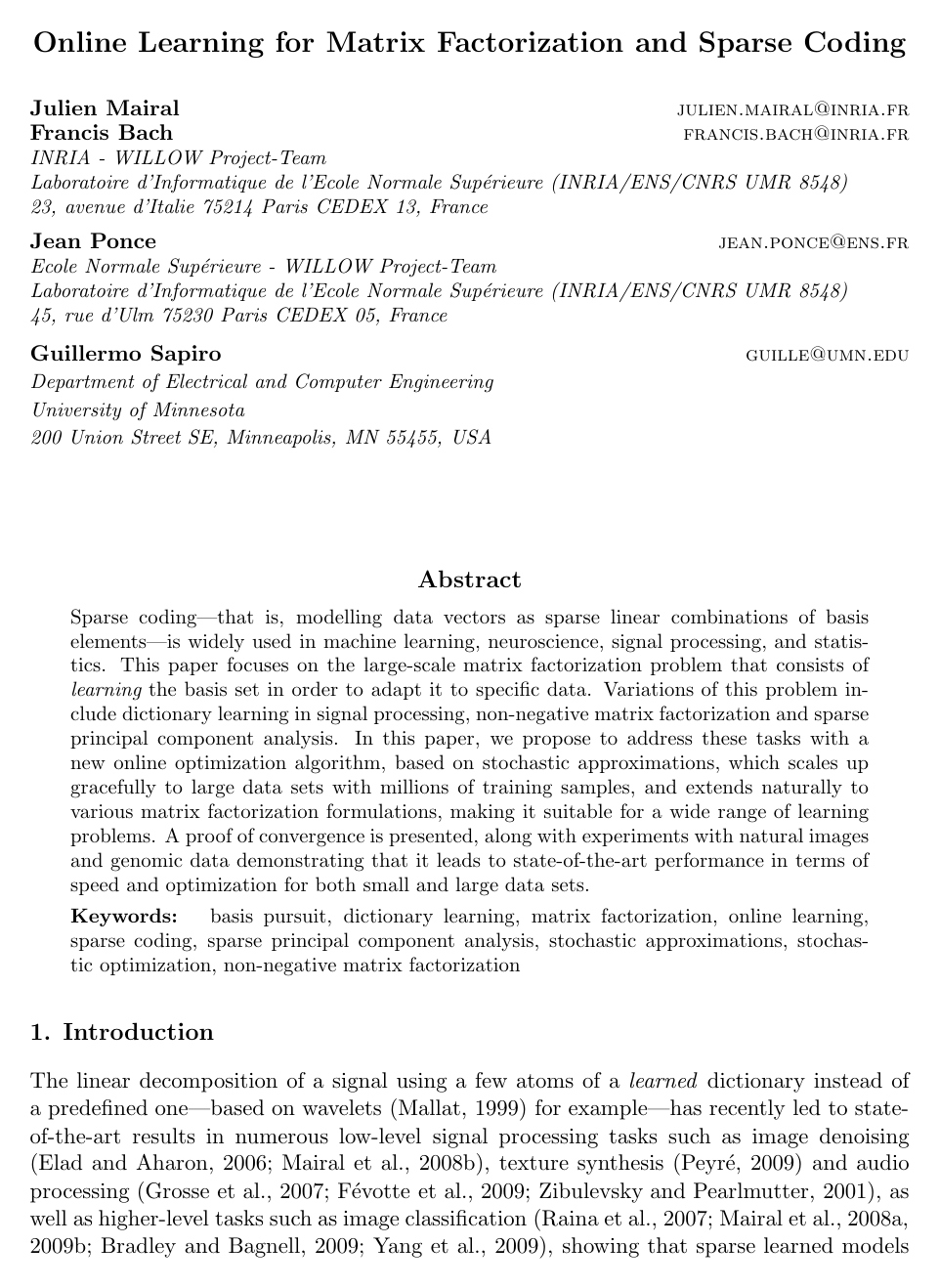
Online Learning for Matrix Factorization and Sparse Coding
Julien Mairal, Francis Bach, Jean Ponce, Guillermo Sapiro
Why you should read this
Introduces an online stochastic algorithm for sparse coding and dictionary learning that scales efficiently to millions of training samples with provable convergence guarantees across diverse matrix factorization tasks.
Sparse coding--that is, modelling data vectors as sparse linear combinations of basis elements--is widely used in machine learning, neuroscience, signal processing, and statistics. This paper focuses on the large-scale matrix factorization problem that consists of learning the basis set, adapting it to specific data. Variations of this problem include dictionary learning in signal processing, non-negative matrix factorization and sparse principal component analysis. In this paper, we propose to address these tasks with a new online optimization algorithm, based on stochastic approximations, which scales up gracefully to large datasets with millions of training samples, and extends naturally to various matrix factorization formulations, making it suitable for a wide range of learning problems. A proof of convergence is presented, along with experiments with natural images and genomic data demonstrating that it leads to state-of-the-art performance in terms of speed and optimization for both small and large datasets.
Added
2026-09-14
Deep Sparse Rectifier Neural Networks
Xavier Glorot, Antoine Bordes, Yoshua Bengio
Why you should read this
Demonstrates that rectifier activation functions induce sparse representations and enable deep neural networks to achieve top performance on purely supervised tasks without requiring unsupervised pre-training.
While logistic sigmoid neurons are more biologically plausible than hyperbolic tangent neurons, the latter work better for training multi-layer neural networks. This paper shows that rectifying neurons are an even better model of biological neurons and yield equal or better performance than hyperbolic tangent networks in spite of the hard non-linearity and non-differentiability at zero, creating sparse representations with true zeros, which seem remarkably suitable for naturally sparse data. Even though they can take advantage of semi-supervised setups with extra-unlabeled data, deep rectifier networks can reach their best performance without requiring any unsupervised pre-training on purely supervised tasks with large labeled datasets. Hence, these results can be seen as a new milestone in the attempts at under-standing the difficulty in training deep but purely supervised neural networks, and closing the performance gap between neural networks learnt with and without unsupervised pre-training.
Added
2026-09-09
License
Published with permission
Representation Learning: A Review and New Perspectives
Yoshua Bengio, Aaron C. Courville, P. Vincent
Why you should read this
Synthesizes the foundational principles and core algorithms of deep feature learning, explaining how models isolate underlying explanatory factors of variation to define what makes data representations effective for artificial intelligence.
The success of machine learning algorithms generally depends on data representation, and we hypothesize that this is because different representations can entangle and hide more or less the different explanatory factors of variation behind the data. Although specific domain knowledge can be used to help design representations, learning with generic priors can also be used, and the quest for AI is motivating the design of more powerful representation-learning algorithms implementing such priors. This paper reviews recent work in the area of unsupervised feature learning and deep learning, covering advances in probabilistic models, auto-encoders, manifold learning, and deep networks. This motivates longer-term unanswered questions about the appropriate objectives for learning good representations, for computing representations (i.e., inference), and the geometrical connections between representation learning, density estimation and manifold learning.
Added
2026-09-06
SPLADE: Sparse Lexical and Expansion Model for First Stage Ranking
Thibault Formal, Benjamin Piwowarski, Stéphane Clinchant
Why you should read this
Introduces SPLADE, a novel first-stage ranker that leverages explicit sparsity regularization and a log-saturation effect to achieve highly sparse representations and competitive results against state-of-the-art dense and sparse methods, while also exploring the effectiveness-efficiency trade-off.
In neural Information Retrieval, ongoing research is directed towards improving the first retriever in ranking pipelines. Learning dense embeddings to conduct retrieval using efficient approximate nearest neighbors methods has proven to work well. Meanwhile, there has been a growing interest in learning sparse representations for documents and queries, that could inherit from the desirable properties of bag-of-words models such as the exact matching of terms and the efficiency of inverted indexes. In this work, we present a new first-stage ranker based on explicit sparsity regularization and a log-saturation effect on term weights, leading to highly sparse representations and competitive results with respect to state-of-the-art dense and sparse methods. Our approach is simple, trained end-to-end in a single stage. We also explore the trade-off between effectiveness and efficiency, by controlling the contribution of the sparsity regularization.
Added
2026-05-26
License
Published with permission