
Built independently by an author, for readers. Read the story and support ChapterPal

keyword

space-partitioning methods

Space-partitioning methods are computational and indexing techniques that divide a multidimensional space into structured sub-regions to organize geometric objects or vector data efficiently. By decomposing the overall space hierarchically or into discrete cells, these methods allow algorithms to quickly locate data points, evaluate nearest-neighbor relationships, and execute range queries by pruning irrelevant spatial regions from consideration. Commonly realized through spatial data structures such as k-d trees, octrees, binary space partitioning trees, and bounding hierarchies like R-trees, they accelerate search operations over exhaustive linear scans in low to moderate dimensions, though their query efficiency often diminishes in higher-dimensional spaces as geometric distances and boundary overlaps increase.

1 item
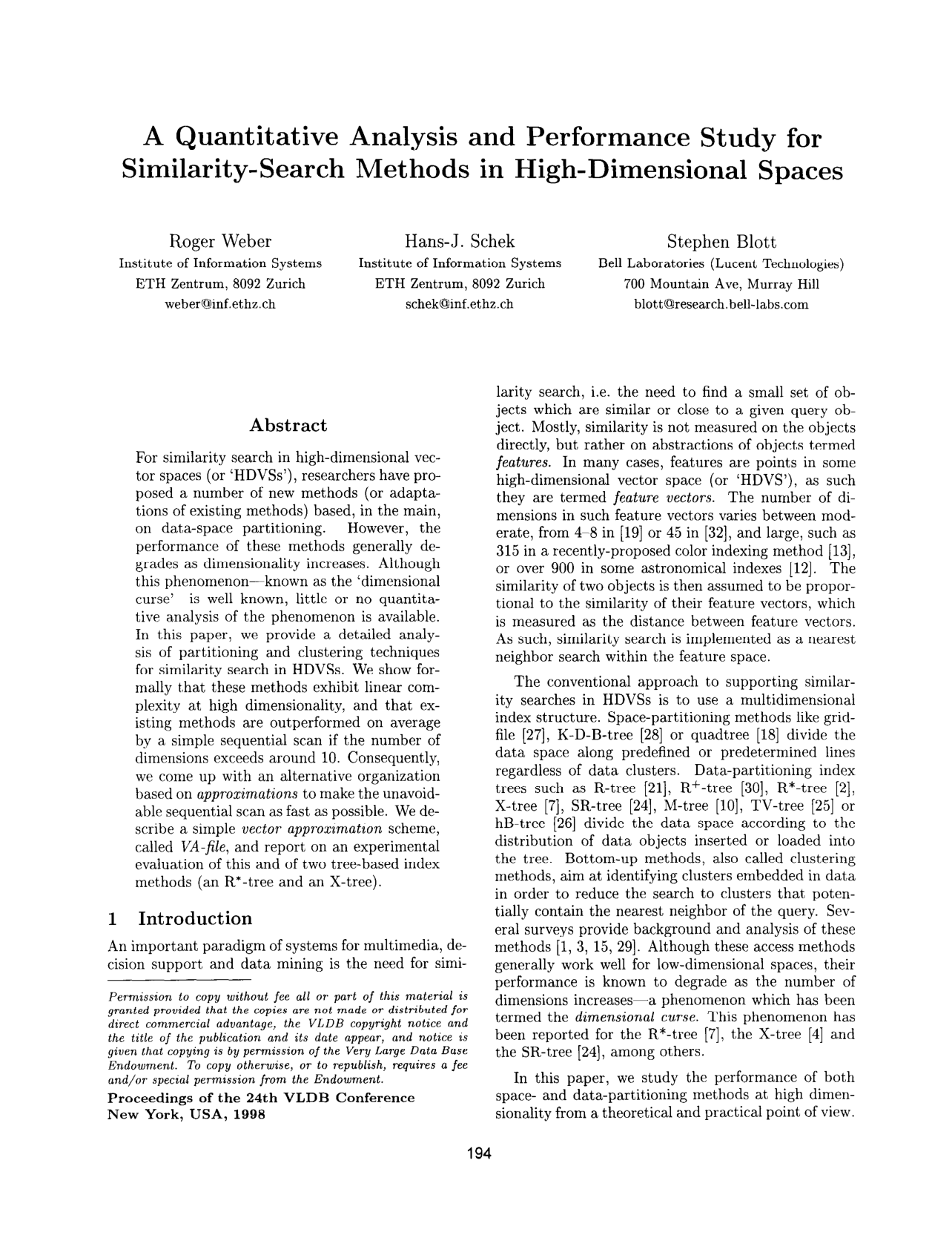
A Quantitative Analysis and Performance Study for Similarity-Search Methods in High-Dimensional Spaces

A Quantitative Analysis and Performance Study for Similarity-Search Methods in High-Dimensional Spaces

Roger Weber, Hans-J. Schek, Stephen Blott

OrganizationsBell LaboratoriesETH ZurichInstitute of Information Systems

Why you should read this

Proves that conventional tree-based indexing structures degenerate into linear scans beyond ten dimensions and introduces the Vector Approximation File to dramatically accelerate similarity search in high-dimensional vector spaces.

For similarity search in high-dimensional vector spaces (or ‘HDVSs’), researchers have proposed a number of new methods (or adaptations of existing methods) based, in the main, on data-space partitioning. However, the performance of these methods generally degrades as dimensionality increases. Although this phenomenon—known as the ‘dimensional curse’ is well known, little or no quantitative analysis of the phenomenon is available. In this paper, we provide a detailed analysis of partitioning and clustering techniques for similarity search in HDVSs. We show formally that these methods exhibit linear complexity at high dimensionality, and that existing methods are outperformed on average by a simple sequential scan if the number of dimensions exceeds around 10. Consequently, we come up with an alternative organization based on approximations to make the unavoidable sequential scan as fast as possible. We describe a simple vector approximation scheme, called VA-file, and report on an experimental evaluation of this and of two tree-based index methods (an R*-tree and an X-tree).

Added

2026-09-18