
keyword
space complexity
Space complexity is a measure of the total amount of computer memory or storage an algorithm requires to run to completion as a function of the size of its input. It encompasses both the auxiliary space utilized for temporary variables, call stacks, and intermediate computations, as well as the space required to hold the input data. In computational complexity theory and algorithm analysis, space complexity is typically expressed using asymptotic notation, such as Big O notation, to characterize how memory demands scale as the input size grows. This metric helps determine the practical feasibility of an algorithm on hardware with constrained memory resources and provides a standard method for comparing the memory efficiency of different computational methods.
2 items
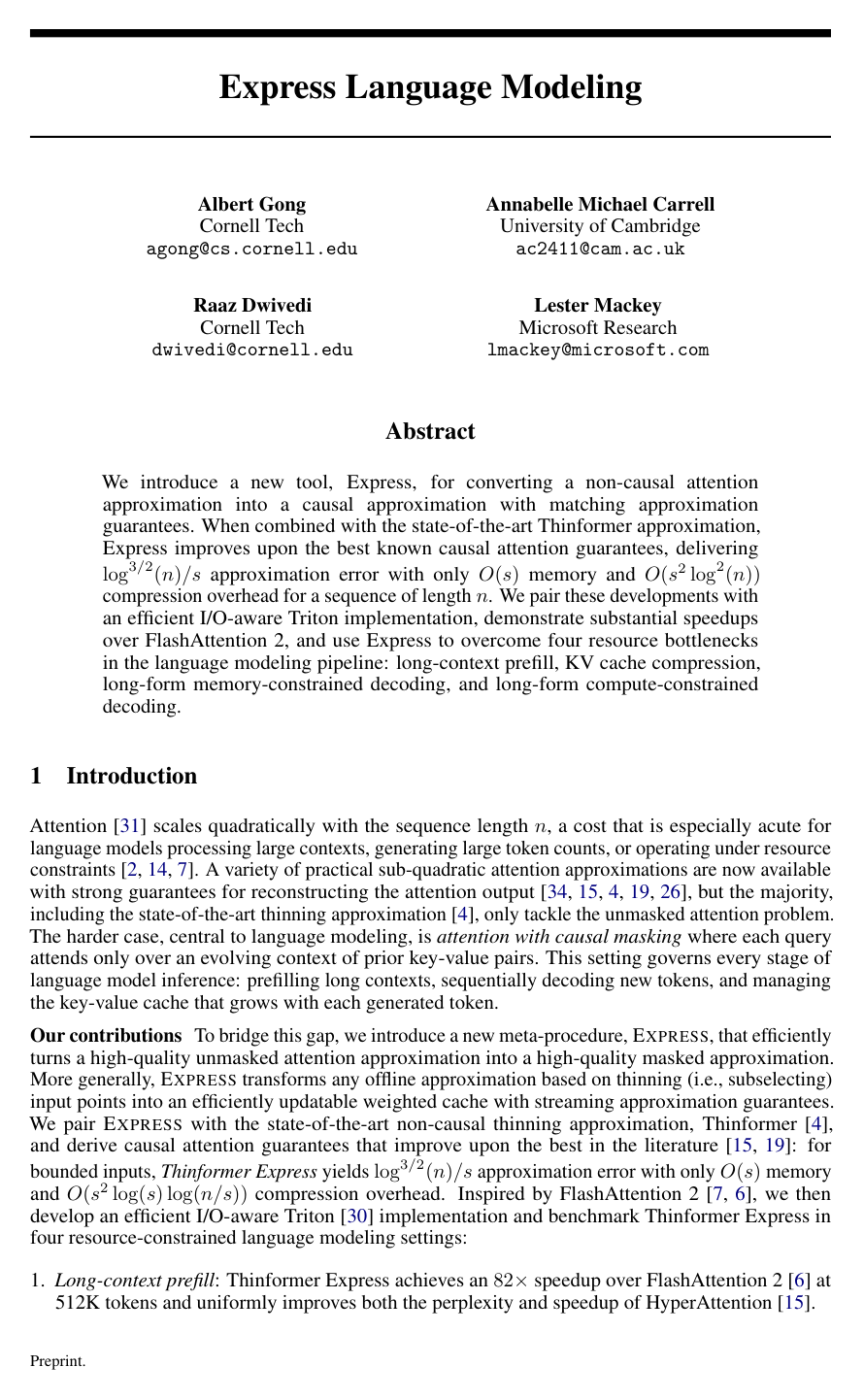
Express Language Modeling
Albert Gong, Annabelle Michael Carrell, Raaz Dwivedi, Lester Mackey
Why you should read this
Develops Express, a method for converting non-causal attention approximations into causal ones with provable theoretical guarantees, delivering faster execution speeds than FlashAttention 2 across key long-context prefill and decoding bottlenecks.
We introduce a new tool, Express, for converting a non-causal attention approximation into a causal approximation with matching approximation guarantees. When combined with the state-of-the-art Thinformer approximation, Express improves upon the best known causal attention guarantees, delivering approximation error with only memory and compression overhead for a sequence of length . We pair these developments with an efficient I/O-aware Triton implementation, demonstrate substantial speedups over FlashAttention 2, and use Express to overcome four resource bottlenecks in the language modeling pipeline: long-context prefill, KV cache compression, long-form memory-constrained decoding, and long-form compute-constrained decoding.
Added
2026-09-30
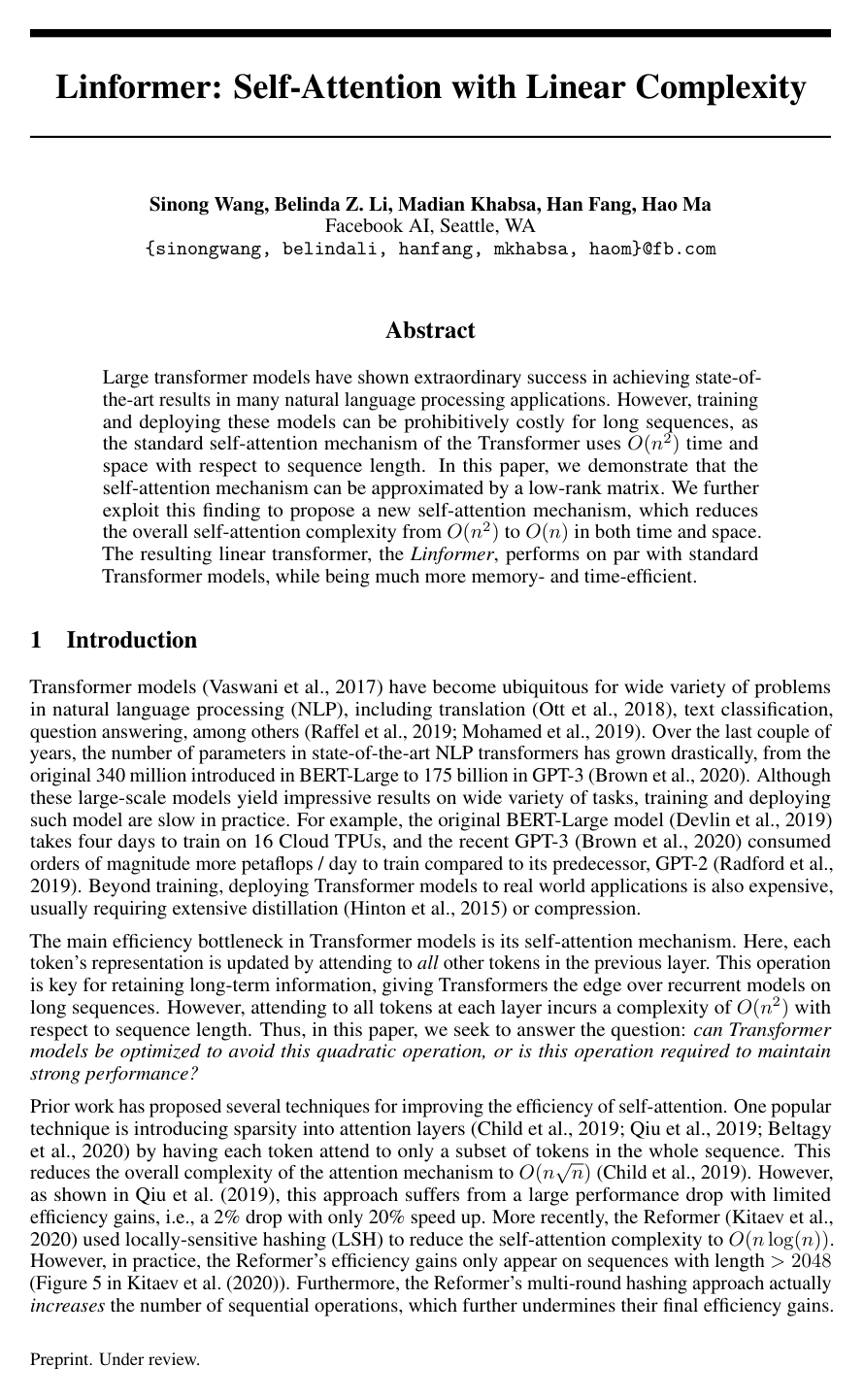
Linformer: Self-Attention with Linear Complexity
Sinong Wang, Belinda Z. Li, Madian Khabsa, Han Fang, Hao Ma
Why you should read this
Proposes Linformer, an attention architecture that reduces Transformer computational and memory complexity from quadratic to linear via low-rank matrix approximation without sacrificing accuracy.
Large transformer models have shown extraordinary success in achieving state-of-the-art results in many natural language processing applications. However, training and deploying these models can be prohibitively costly for long sequences, as the standard self-attention mechanism of the Transformer uses time and space with respect to sequence length. In this paper, we demonstrate that the self-attention mechanism can be approximated by a low-rank matrix. We further exploit this finding to propose a new self-attention mechanism, which reduces the overall self-attention complexity from to in both time and space. The resulting linear transformer, the \textit{Linformer}, performs on par with standard Transformer models, while being much more memory- and time-efficient.
Added
2026-09-14