
keyword
Slot Attention
Slot Attention is an architectural mechanism in machine learning designed to decompose perceptual inputs, such as images or video frames, into a set of discrete vector representations called slots. Unlike standard attention modules where queries attend to inputs independently, Slot Attention employs an iterative routing process in which slots compete with one another to explain parts of the input feature map by normalizing attention weights across the slot dimension. This competitive dynamic enables neural networks to bind visual elements to individual slots in a permutation-invariant manner, facilitating unsupervised object discovery, visual entity segmentation, relational reasoning, and compositional scene generation without requiring manual object-level annotations.
2 items
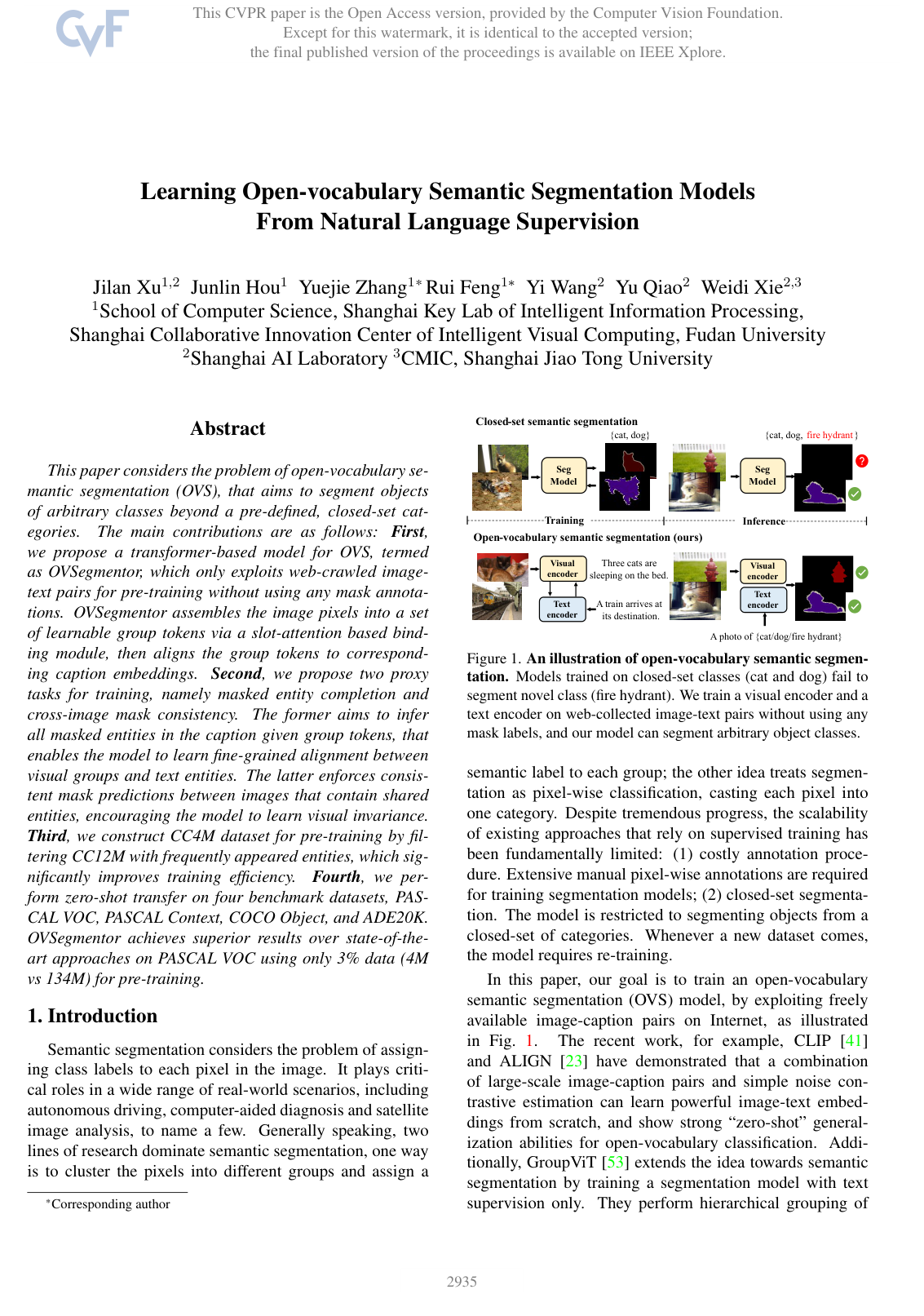
Learning Open-Vocabulary Semantic Segmentation Models From Natural Language Supervision
Jilan Xu, Junlin Hou, Yuejie Zhang, Rui Feng, Yi Wang, Yu Qiao, Weidi Xie
Why you should read this
Presents OVSegmentor, a vision-language framework that learns open-vocabulary semantic segmentation directly from web-scale image-caption pairs without manual mask annotations by using slot-attention group tokens and proxy tasks for masked entity completion and cross-image consistency.
This paper considers the problem of open-vocabulary semantic segmentation (OVS), that aims to segment objects of arbitrary classes beyond a pre-defined, closed-set categories. The main contributions are as follows: First, we propose a transformer-based model for OVS, termed as OVSegmentor, which only exploits web-crawled image-text pairs for pre-training without using any mask annotations. OVSegmentor assembles the image pixels into a set of learnable group tokens via a slot-attention based binding module, then aligns the group tokens to corresponding caption embeddings. Second, we propose two proxy tasks for training, namely masked entity completion and cross-image mask consistency. The former aims to infer all masked entities in the caption given group tokens, that enables the model to learn fine-grained alignment between visual groups and text entities. The latter enforces consistent mask predictions between images that contain shared entities, encouraging the model to learn visual invariance. Third, we construct CC4M dataset for pre-training by filtering CC12M with frequently appeared entities, which significantly improves training efficiency. Fourth, we perform zero-shot transfer on four benchmark datasets, PASCAL VOC, PASCAL Context, COCO Object, and ADE20K. OVSegmentor achieves superior results over state-of-the-art approaches on PASCAL VOC using only 3% data (4M vs 134M) for pre-training.
Added
2026-09-26
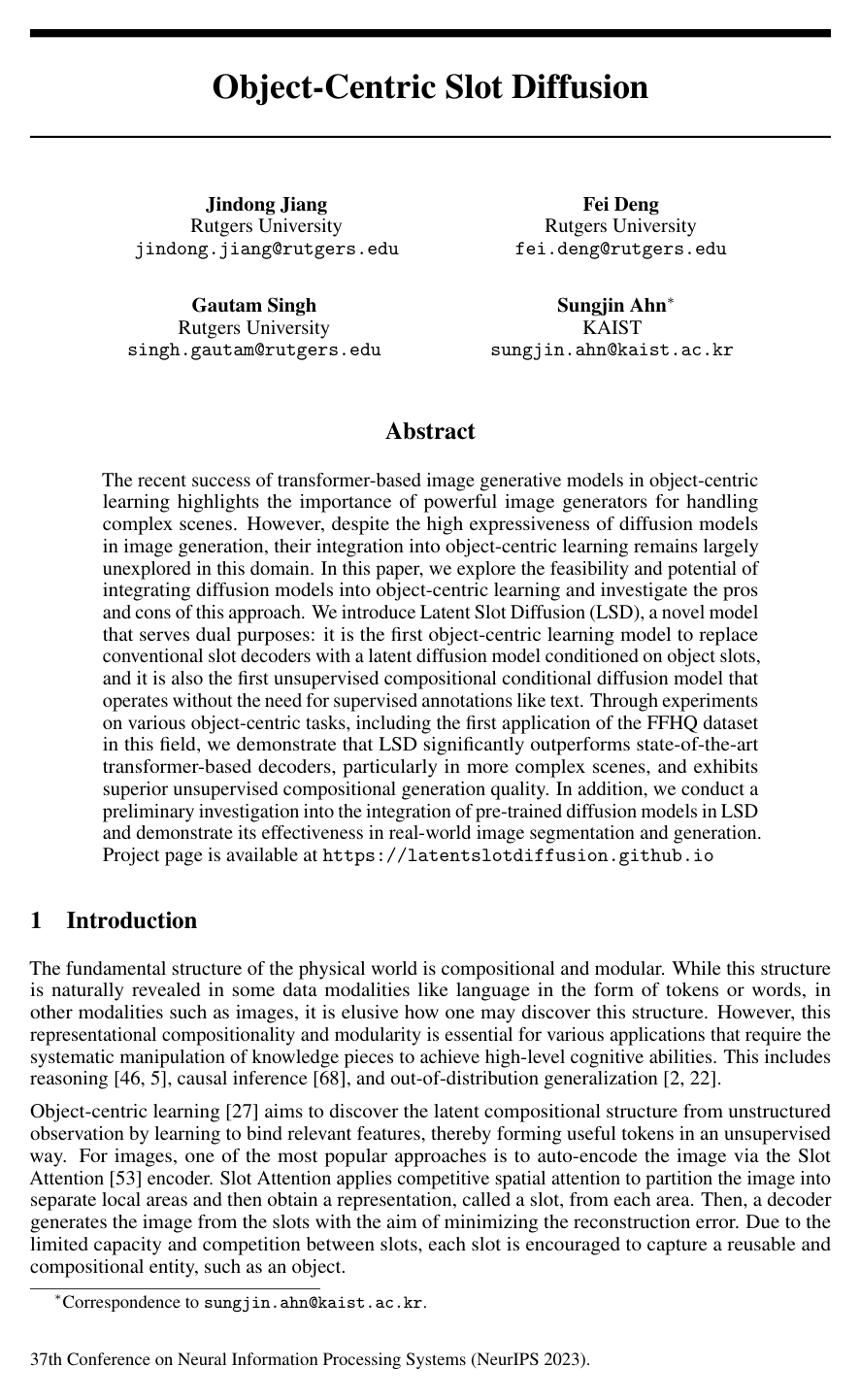
Object-Centric Slot Diffusion
Jindong Jiang, Fei Deng, Gautam Singh, Sungjin Ahn
Why you should read this
Proposes Latent Slot Diffusion to replace traditional decoders with a conditional latent diffusion model, enabling high-quality unsupervised compositional image generation and object segmentation in complex real-world scenes.
The recent success of transformer-based image generative models in object-centric learning highlights the importance of powerful image generators for handling complex scenes. However, despite the high expressiveness of diffusion models in image generation, their integration into object-centric learning remains largely unexplored in this domain. In this paper, we explore the feasibility and potential of integrating diffusion models into object-centric learning and investigate the pros and cons of this approach. We introduce Latent Slot Diffusion (LSD), a novel model that serves dual purposes: it is the first object-centric learning model to replace conventional slot decoders with a latent diffusion model conditioned on object slots, and it is also the first unsupervised compositional conditional diffusion model that operates without the need for supervised annotations like text. Through experiments on various object-centric tasks, including the first application of the FFHQ dataset in this field, we demonstrate that LSD significantly outperforms state-of-the-art transformer-based decoders, particularly in more complex scenes, and exhibits superior unsupervised compositional generation quality. In addition, we conduct a preliminary investigation into the integration of pre-trained diffusion models in LSD and demonstrate its effectiveness in real-world image segmentation and generation. Project page is available at https://latentslotdiffusion.github.io
Added
2026-09-26