
Built independently by an author, for readers. Read the story and support ChapterPal

keyword

single-source DG tasks

Single-source domain generalization tasks are machine learning problems where a model is trained exclusively on data from a single source domain and evaluated on one or more distinct, unseen target domains without access to target data during training. Unlike multi-source domain generalization, which leverages variations across multiple training distributions to identify domain-invariant features, single-source settings require learning robust representations without the benefit of cross-domain comparisons. Because models risk overfitting to the specific stylistic, environmental, or sensor biases of the lone source environment, these tasks typically rely on techniques such as adversarial data augmentation, feature perturbation, domain randomization, or test-time adaptation to overcome distribution shifts and generalize to novel test distributions.

1 item
Improved Test-Time Adaptation for Domain Generalization

Improved Test-Time Adaptation for Domain Generalization

Liang Chen, Yong Zhang, Yibing Song, Ying Shan, Lingqiao Liu

OrganizationsFudan UniversityTencentUniversity of Adelaide

Why you should read this

Proposes an improved test-time adaptation framework that optimizes a learnable consistency loss aligned with the primary prediction task and updates only dedicated adaptive parameters to prevent performance degradation on unseen domains.

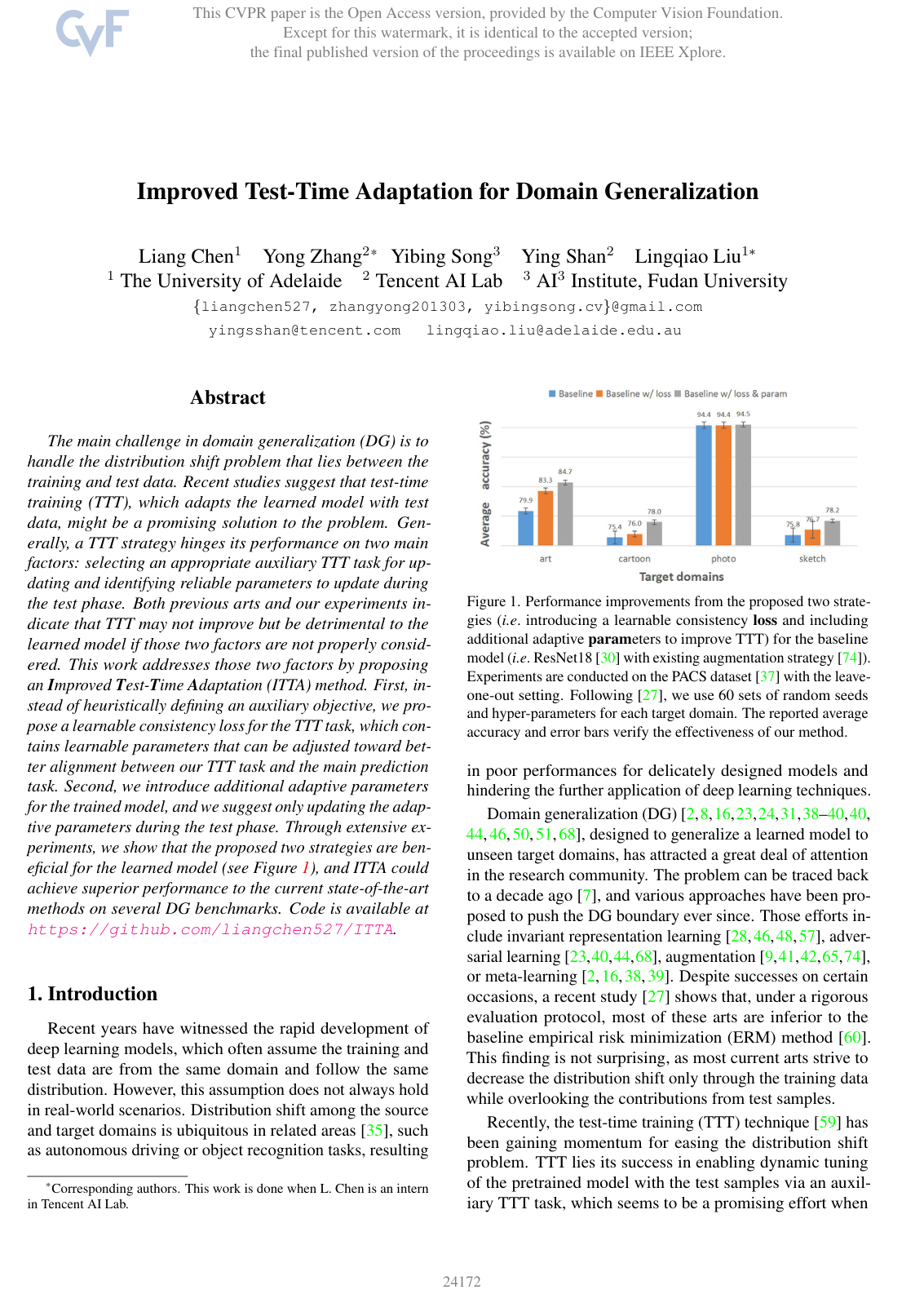
The main challenge in domain generalization (DG) is to handle the distribution shift problem that lies between the training and test data. Recent studies suggest that test-time training (TTT), which adapts the learned model with test data, might be a promising solution to the problem. Generally, a TTT strategy hinges its performance on two main factors: selecting an appropriate auxiliary TTT task for updating and identifying reliable parameters to update during the test phase. Both previous arts and our experiments indicate that TTT may not improve but be detrimental to the learned model if those two factors are not properly considered. This work addresses those two factors by proposing an Improved Test-Time Adaptation (ITTA) method. First, instead of heuristically defining an auxiliary objective, we propose a learnable consistency loss for the TTT task, which contains learnable parameters that can be adjusted toward better alignment between our TTT task and the main prediction task. Second, we introduce additional adaptive parameters for the trained model, and we suggest only updating the adaptive parameters during the test phase. Through extensive experiments, we show that the proposed two strategies are beneficial for the learned model (see Figure 1), and ITTA could achieve superior performance to the current state-of-the-art methods on several DG benchmarks. Code is available at https://github.com/liangchen527/ITTA.

Added

2026-09-26