
keyword
simulated annealing
Simulated annealing is a probabilistic metaheuristic optimization technique used to approximate the global optimum of a function within a large or complex search space. Inspired by the metallurgical process of annealing, in which a material is heated and gradually cooled to reduce structural defects and achieve a low-energy state, the algorithm models an optimization problem as a physical system seeking minimum energy. During execution, the algorithm iteratively explores neighboring solutions and accepts better states while also allowing suboptimal transitions based on a probability that decreases alongside a cooling temperature parameter. This controlled acceptance of worse solutions enables the method to escape local optima during early iterations and steadily converge toward a high-quality global optimum as the temperature decreases.
3 items
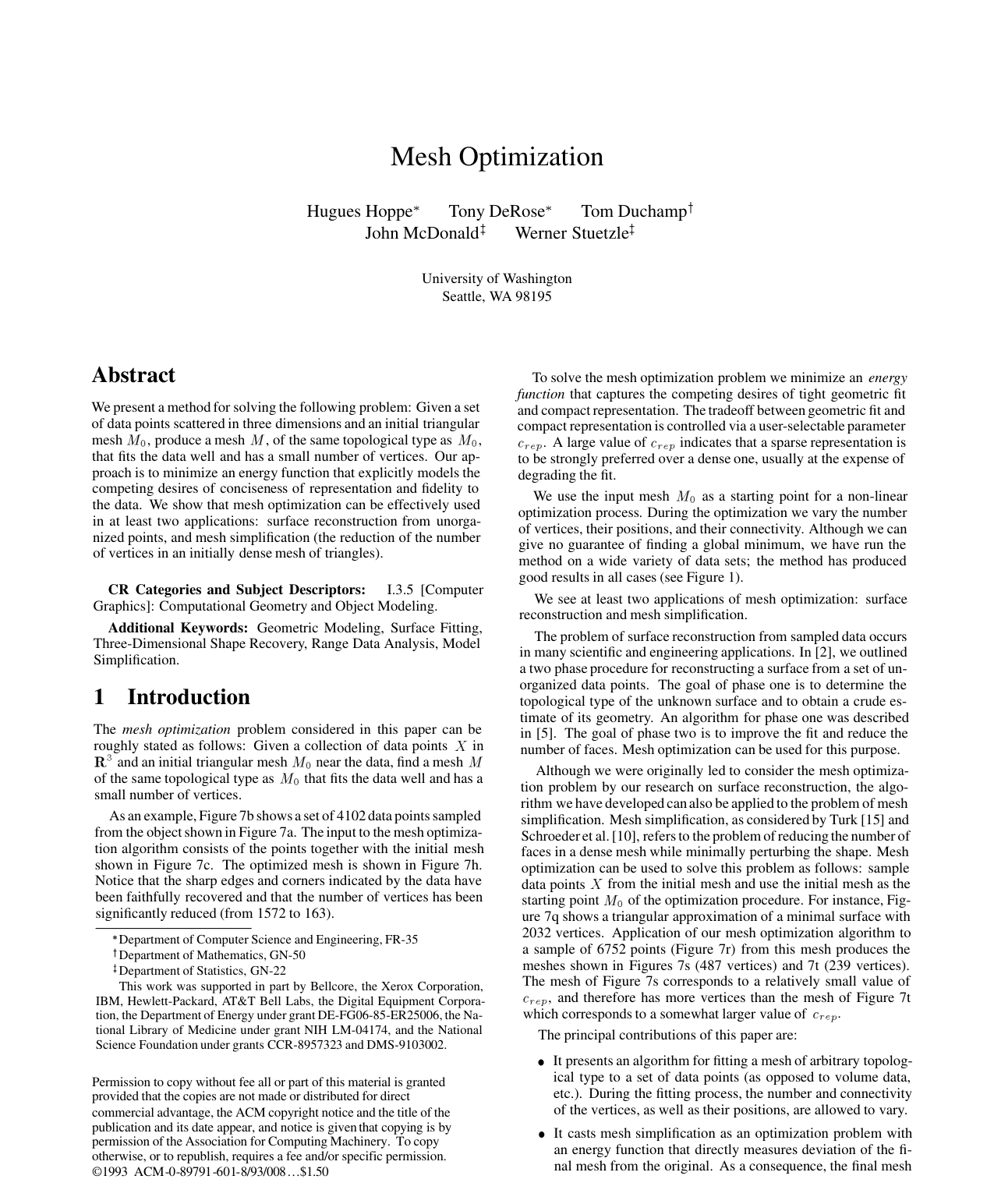
Mesh optimization
Hugues Hoppe, T. DeRose, T. Duchamp, J. McDonald, W. Stuetzle
Why you should read this
Develops an energy-minimization framework that jointly optimizes mesh connectivity and vertex positions to accurately fit 3D point sets while reducing geometric complexity, recovering sharp features for both surface reconstruction and mesh simplification.
We present a method for solving the following problem: Given a set of data points scattered in three dimensions and an initial triangular mesh M0, produce a mesh M, of the same topological type as M0, that fits the data well and has a small number of vertices. Our approach is to minimize an energy function that explicitly models the competing desires of conciseness of representation and fidelity to the data. We show that mesh optimization can be effectively used in at least two applications: surface reconstruction from unorganized points, and mesh simplification (the reduction of the number of vertices in an initially dense mesh of triangles).
Added
2026-09-24
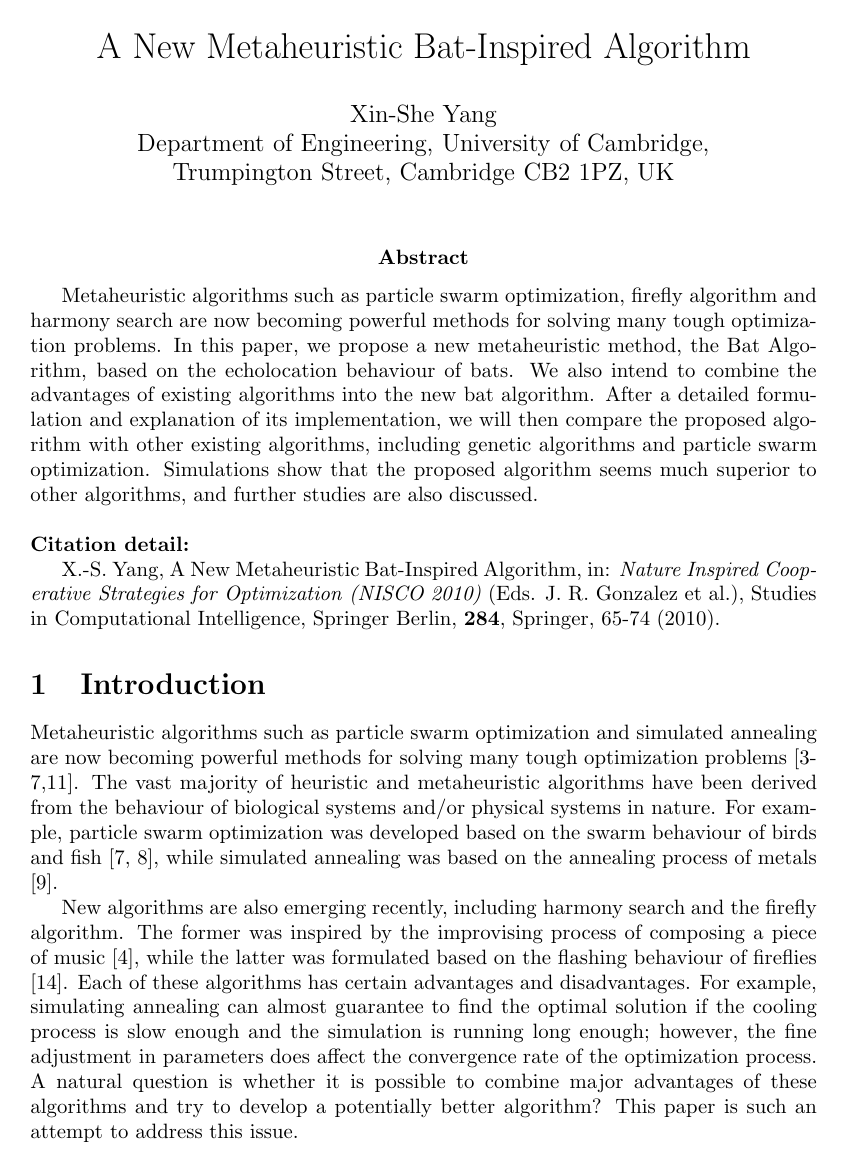
A New Metaheuristic Bat-Inspired Algorithm
Xin-She Yang
Why you should read this
Proposes the Bat Algorithm, a metaheuristic optimization method based on bat echolocation that combines the strengths of existing swarm techniques to outperform particle swarm optimization and genetic algorithms on complex benchmark problems.
Metaheuristic algorithms such as particle swarm optimization, firefly algorithm and harmony search are now becoming powerful methods for solving many tough optimization problems. In this paper, we propose a new metaheuristic method, the Bat Algorithm, based on the echolocation behaviour of bats. We also intend to combine the advantages of existing algorithms into the new bat algorithm. After a detailed formulation and explanation of its implementation, we will then compare the proposed algorithm with other existing algorithms, including genetic algorithms and particle swarm optimization. Simulations show that the proposed algorithm seems much superior to other algorithms, and further studies are also discussed.
Added
2026-09-10
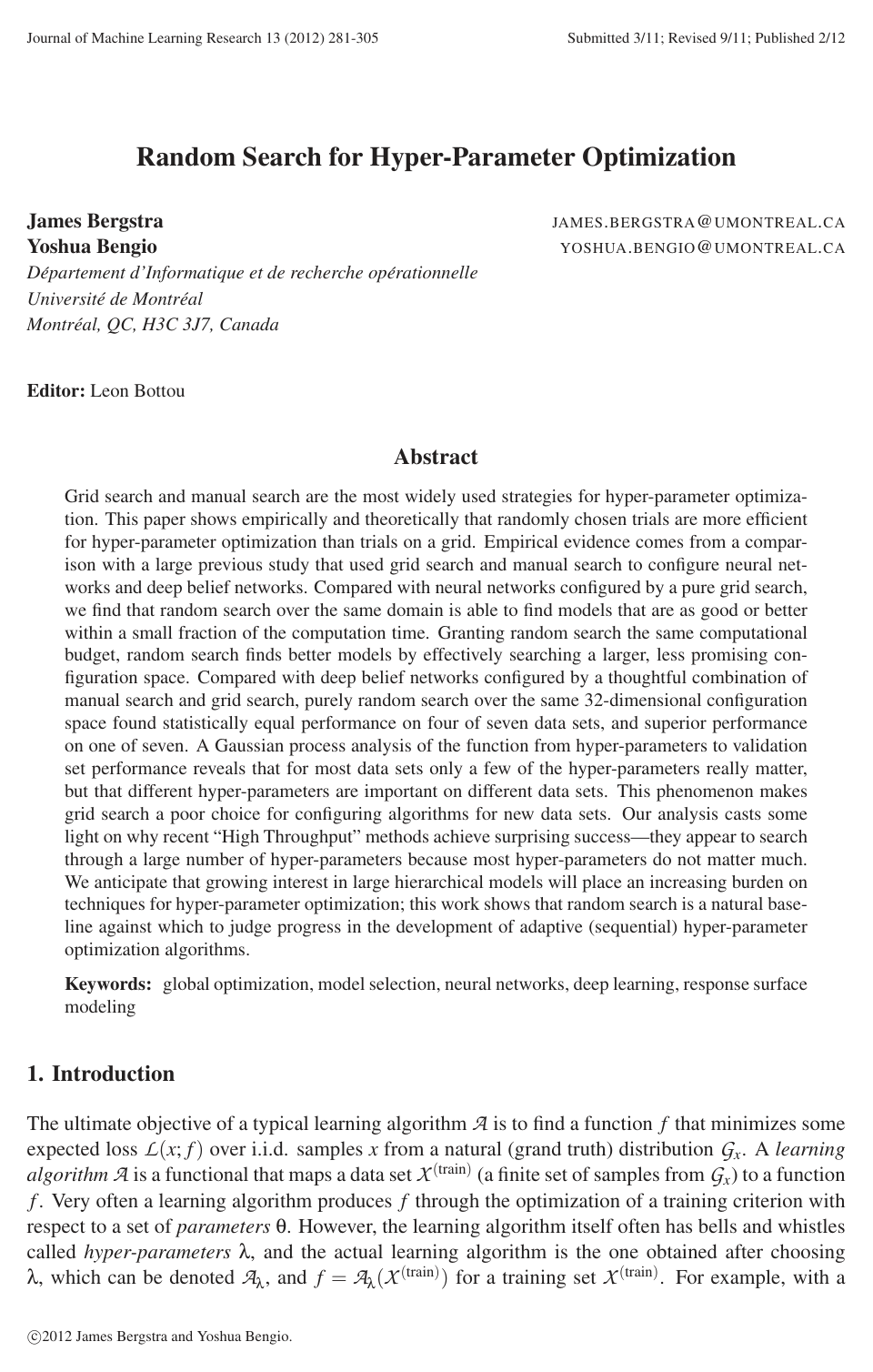
Random Search for Hyper-Parameter Optimization
James Bergstra, Yoshua Bengio
Why you should read this
Demonstrates that random search significantly outperforms grid search for hyperparameter tuning by exploiting the low effective dimensionality of configuration spaces, yielding equal or superior models at a fraction of the computational cost.
Grid search and manual search are the most widely used strategies for hyper-parameter optimization. This paper shows empirically and theoretically that randomly chosen trials are more efficient for hyper-parameter optimization than trials on a grid. Empirical evidence comes from a comparison with a large previous study that used grid search and manual search to configure neural networks and deep belief networks. Compared with neural networks configured by a pure grid search, we find that random search over the same domain is able to find models that are as good or better within a small fraction of the computation time. Granting random search the same computational budget, random search finds better models by effectively searching a larger, less promising configuration space. Compared with deep belief networks configured by a thoughtful combination of manual search and grid search, purely random search over the same 32-dimensional configuration space found statistically equal performance on four of seven data sets, and superior performance on one of seven. A Gaussian process analysis of the function from hyper-parameters to validation set performance reveals that for most data sets only a few of the hyper-parameters really matter, but that different hyper-parameters are important on different data sets. This phenomenon makes grid search a poor choice for configuring algorithms for new data sets. Our analysis casts some light on why recent “High Throughput” methods achieve surprising success—they appear to search through a large number of hyper-parameters because most hyper-parameters do not matter much. We anticipate that growing interest in large hierarchical models will place an increasing burden on techniques for hyper-parameter optimization; this work shows that random search is a natural base-line against which to judge progress in the development of adaptive (sequential) hyper-parameter optimization algorithms.
Added
2026-09-06
