
keyword
similarity graphs
A similarity graph is a graph-based data representation where individual data points are modeled as vertices, and the edges connecting them reflect the pairwise degree of similarity or relatedness between those points. The edge connections and their corresponding weights are constructed using a chosen similarity metric, such as cosine similarity or distance-based kernel functions. Depending on the construction method, a similarity graph can be fully connected with continuous weights, constrained by a distance or similarity threshold, or restricted to connections between nearest neighbors. By encoding the local geometric relationships and manifold structures among data elements, similarity graphs serve as a foundational structure in machine learning and data analysis for algorithms such as spectral clustering, graph-based ranking, and dimensionality reduction.
2 items
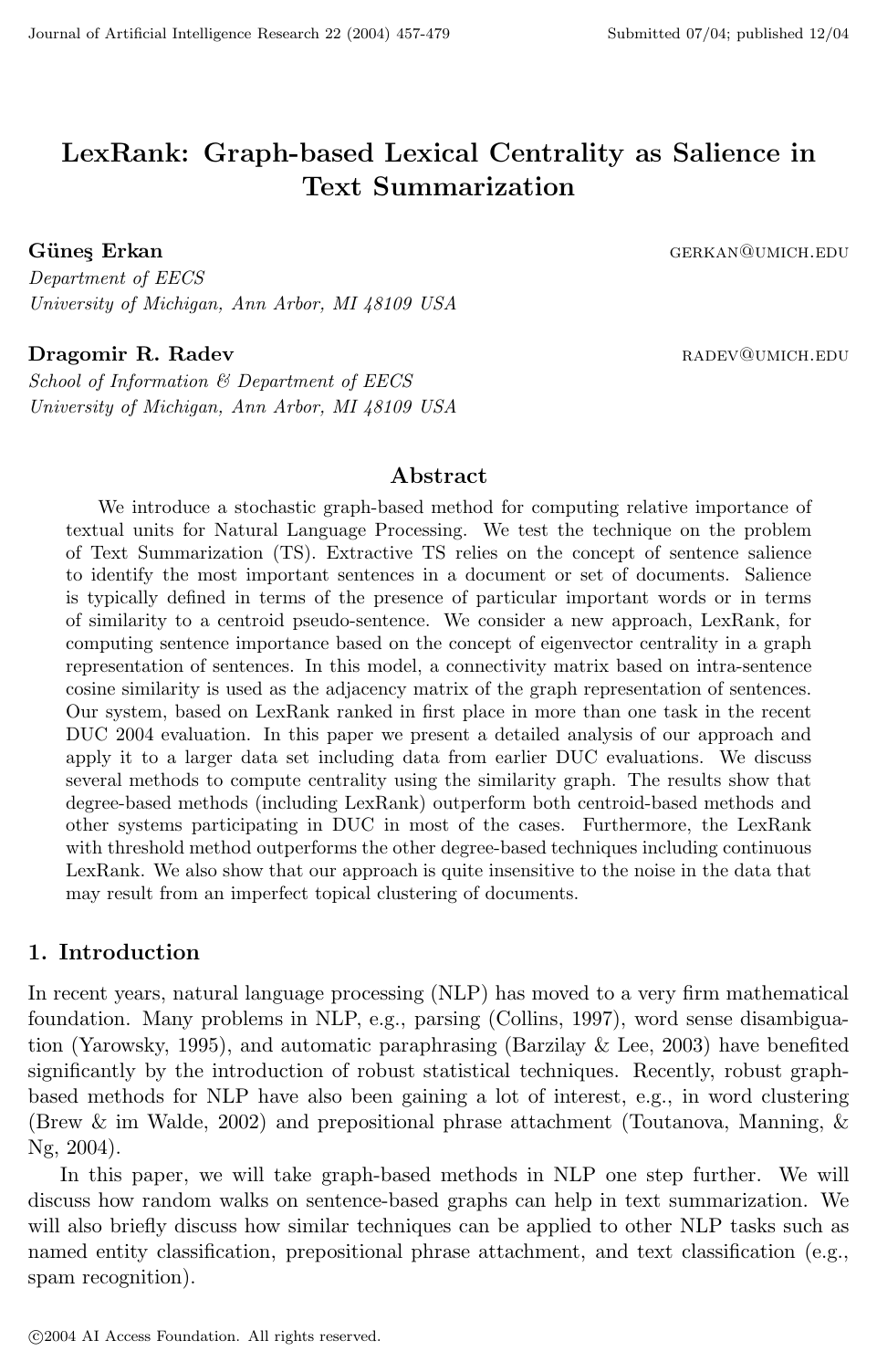
LexRank: Graph-based Lexical Centrality as Salience in Text Summarization
Günes Erkan, Dragomir R. Radev
Why you should read this
Introduces LexRank, a foundational graph-based algorithm that determines sentence importance using eigenvector centrality on lexical similarity graphs, consistently outperforming centroid methods in extractive text summarization.
We introduce a stochastic graph-based method for computing relative importance of textual units for Natural Language Processing. We test the technique on the problem of Text Summarization (TS). Extractive TS relies on the concept of sentence salience to identify the most important sentences in a document or set of documents. Salience is typically defined in terms of the presence of particular important words or in terms of similarity to a centroid pseudo-sentence. We consider a new approach, LexRank, for computing sentence importance based on the concept of eigenvector centrality in a graph representation of sentences. In this model, a connectivity matrix based on intra-sentence cosine similarity is used as the adjacency matrix of the graph representation of sentences. Our system, based on LexRank ranked in first place in more than one task in the recent DUC 2004 evaluation. In this paper we present a detailed analysis of our approach and apply it to a larger data set including data from earlier DUC evaluations. We discuss several methods to compute centrality using the similarity graph. The results show that degree-based methods (including LexRank) outperform both centroid-based methods and other systems participating in DUC in most of the cases. Furthermore, the LexRank with threshold method outperforms the other degree-based techniques including continuous LexRank. We also show that our approach is quite insensitive to the noise in the data that may result from an imperfect topical clustering of documents.
Added
2026-09-11
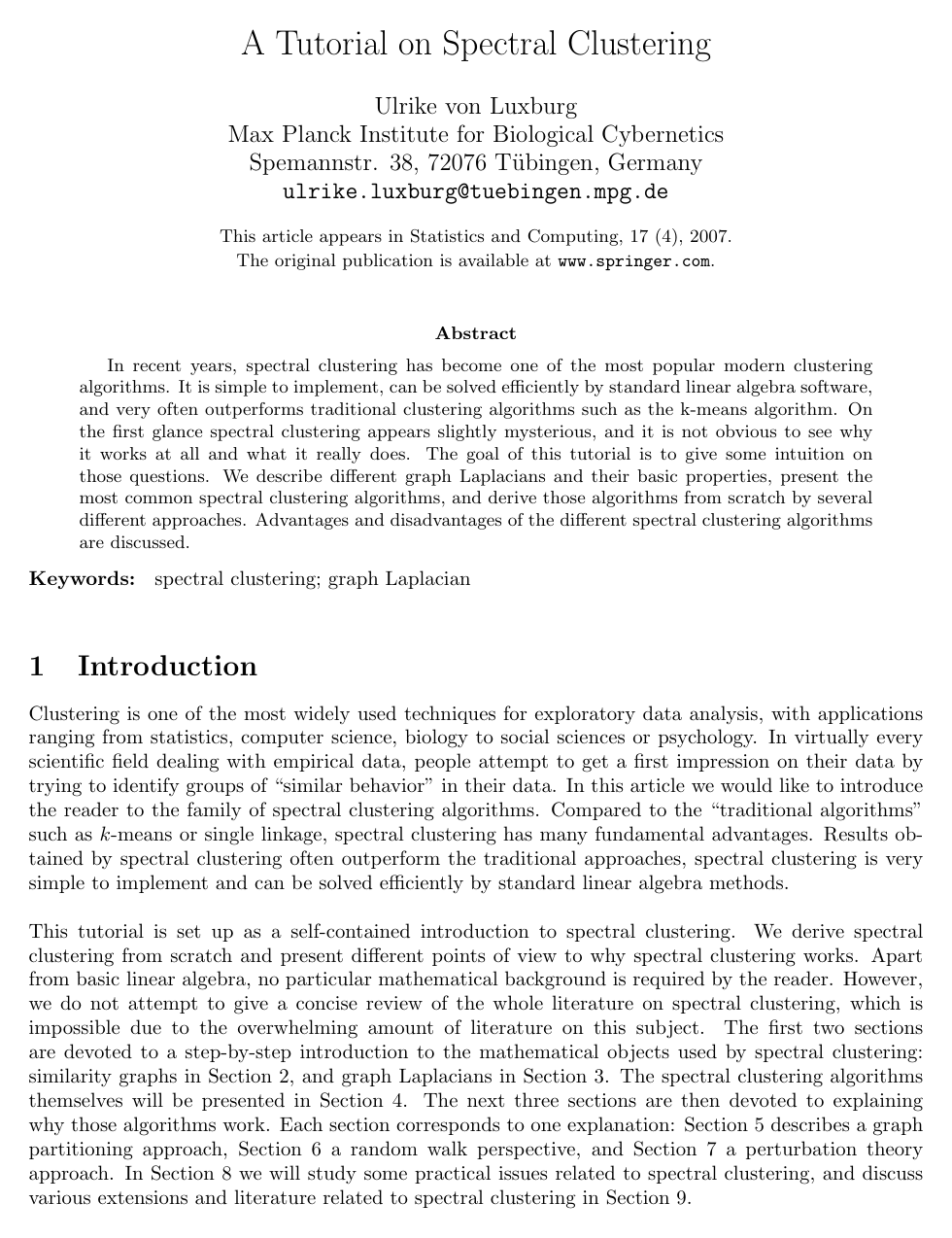
A tutorial on spectral clustering
Ulrike von Luxburg
Why you should read this
Explains the theoretical foundations of spectral clustering by deriving core algorithms from graph Laplacians, graph cuts, and random walks, providing practical guidance on implementation and algorithm selection.
In recent years, spectral clustering has become one of the most popular modern clustering algorithms. It is simple to implement, can be solved efficiently by standard linear algebra software, and very often outperforms traditional clustering algorithms such as the k-means algorithm. On the first glance spectral clustering appears slightly mysterious, and it is not obvious to see why it works at all and what it really does. The goal of this tutorial is to give some intuition on those questions. We describe different graph Laplacians and their basic properties, present the most common spectral clustering algorithms, and derive those algorithms from scratch by several different approaches. Advantages and disadvantages of the different spectral clustering algorithms are discussed.
Source
https://people.csail.mit.edu/dsontag/courses/ml14/notes/Luxburg07_tutorial_spectral_clustering.pdfAdded
2026-09-06