
keyword
short-term forecasting
Short-term forecasting is a time series modeling approach that predicts the future values of a variable over a relatively brief upcoming horizon, typically spanning minutes, hours, days, or a few weeks. This process analyzes historical sequential data to capture immediate temporal dependencies, recurring cyclical dynamics, and localized trends. Unlike long-term forecasting, which addresses broader strategic outlooks where uncertainty accumulates over extended periods, short-term forecasting focuses on high-resolution, near-immediate operational accuracy. It is widely used to support real-time decision-making, scheduling, anomaly identification, and tactical resource management in applications such as weather prediction, electrical grid load management, supply chain operations, and traffic flow control.
2 items
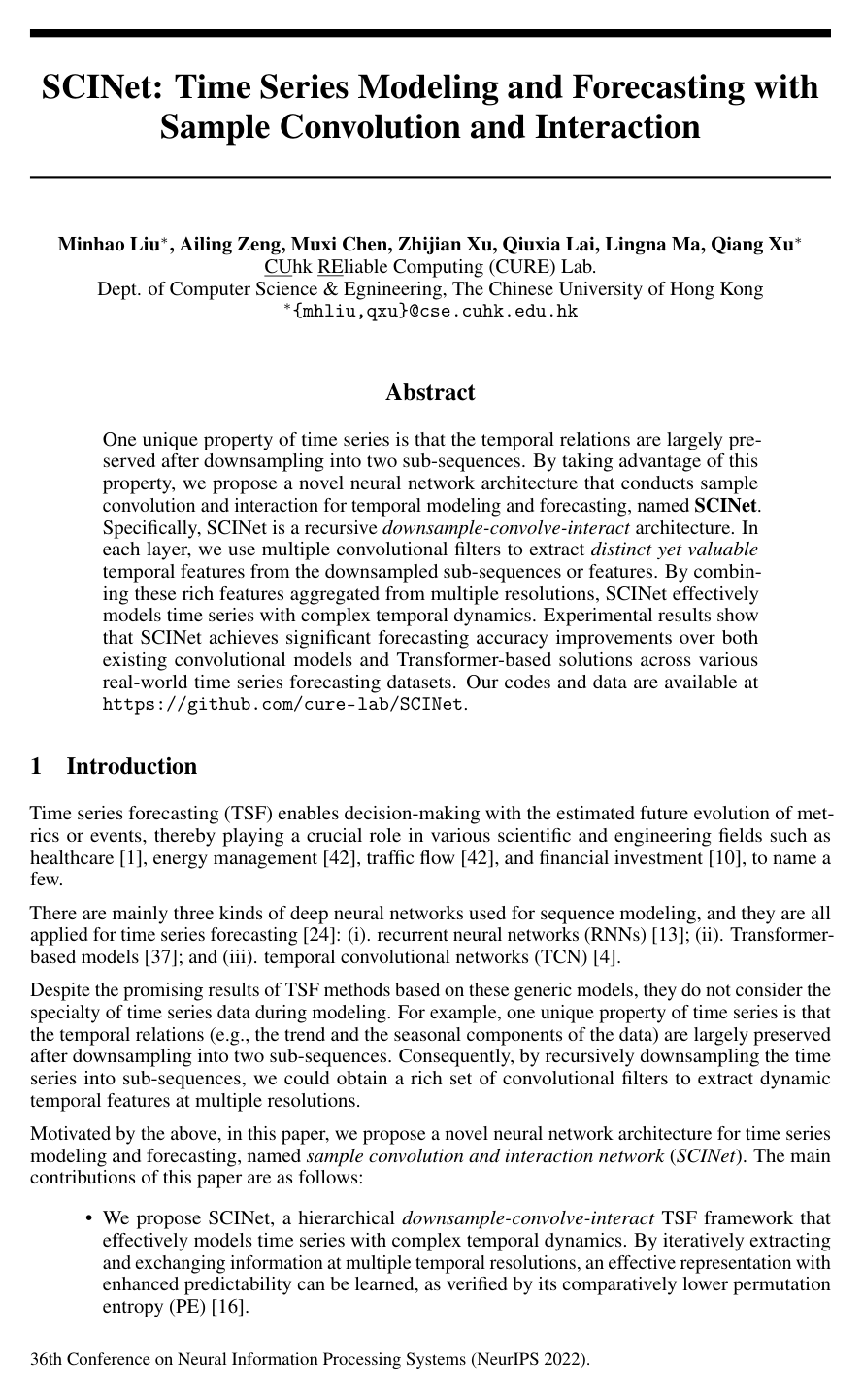
SCINet: Time Series Modeling and Forecasting with Sample Convolution and Interaction
Minhao Liu, Ailing Zeng, Muxi Chen, Zhijian Xu, Qiuxia Lai, Lingna Ma, Qiang Xu
Why you should read this
Proposes a hierarchical downsample-convolve-interact neural network architecture that captures multi-resolution temporal features to outperform existing convolutional and Transformer-based models on complex time series forecasting tasks.
One unique property of time series is that the temporal relations are largely preserved after downsampling into two sub-sequences. By taking advantage of this property, we propose a novel neural network architecture that conducts sample convolution and interaction for temporal modeling and forecasting, named SCINet. Specifically, SCINet is a recursive downsample-convolve-interact architecture. In each layer, we use multiple convolutional filters to extract distinct yet valuable temporal features from the downsampled sub-sequences or features. By combining these rich features aggregated from multiple resolutions, SCINet effectively models time series with complex temporal dynamics. Experimental results show that SCINet achieves significant forecasting accuracy improvements over both existing convolutional models and Transformer-based solutions across various real-world time series forecasting datasets. Our codes and data are available at https://github.com/cure-lab/SCINet.
Added
2026-10-05
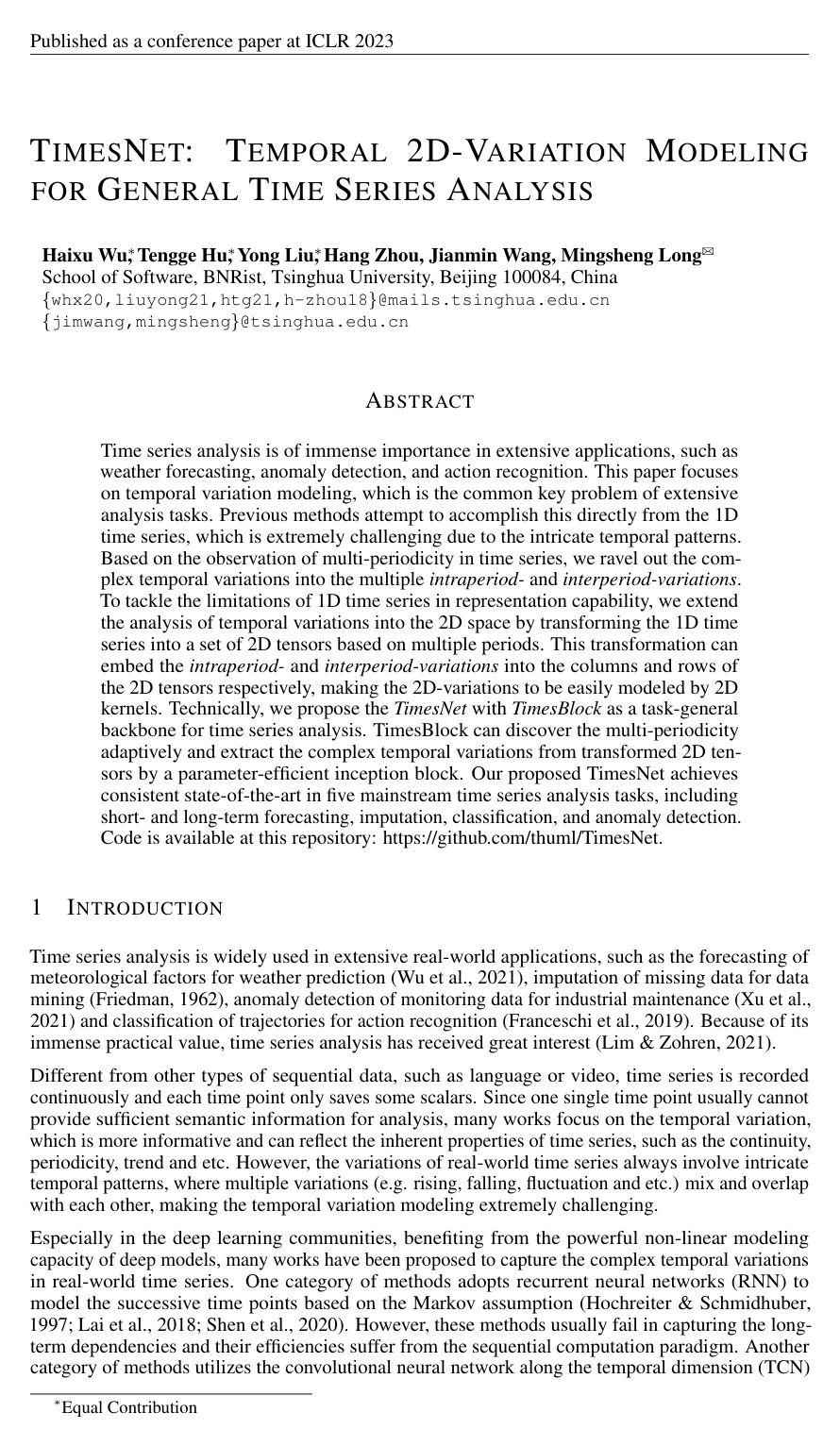
TimesNet: Temporal 2D-Variation Modeling for General Time Series Analysis
Haixu Wu, Teng Hu, Yong Liu, Hang Zhou, Jianmin Wang, Mingsheng Long
Why you should read this
Proposes TimesNet, a general time series backbone that transforms 1D signals into multi-periodic 2D tensors to capture intra- and inter-period variations using 2D kernels, achieving state-of-the-art performance across forecasting, imputation, classification, and anomaly detection.
Time series analysis is of immense importance in extensive applications, such as weather forecasting, anomaly detection, and action recognition. This paper focuses on temporal variation modeling, which is the common key problem of extensive analysis tasks. Previous methods attempt to accomplish this directly from the 1D time series, which is extremely challenging due to the intricate temporal patterns. Based on the observation of multi-periodicity in time series, we ravel out the complex temporal variations into the multiple intraperiod- and interperiod-variations. To tackle the limitations of 1D time series in representation capability, we extend the analysis of temporal variations into the 2D space by transforming the 1D time series into a set of 2D tensors based on multiple periods. This transformation can embed the intraperiod- and interperiod-variations into the columns and rows of the 2D tensors respectively, making the 2D-variations to be easily modeled by 2D kernels. Technically, we propose the TimesNet with TimesBlock as a task-general backbone for time series analysis. TimesBlock can discover the multi-periodicity adaptively and extract the complex temporal variations from transformed 2D tensors by a parameter-efficient inception block. Our proposed TimesNet achieves consistent state-of-the-art in five mainstream time series analysis tasks, including short- and long-term forecasting, imputation, classification, and anomaly detection. Code is available at this repository: this https URL.
Added
2026-09-14