
keyword
shape matching
Shape matching is a computational process in computer vision, pattern recognition, and geometry processing that determines the similarity or correspondence between two or more geometric shapes. It typically involves representing two-dimensional contours or three-dimensional surfaces through features or point sets, establishing meaningful correspondences between equivalent points or regions, and estimating an optimal geometric transformation to align them. The resulting alignment allows algorithms to calculate a quantitative distance or similarity measure while accounting for variations caused by rigid movements, non-rigid deformations, noise, or partial occlusions. This process serves as a foundational technique for applications such as visual object recognition, point set registration, shape retrieval, and geometric data analysis.
4 items
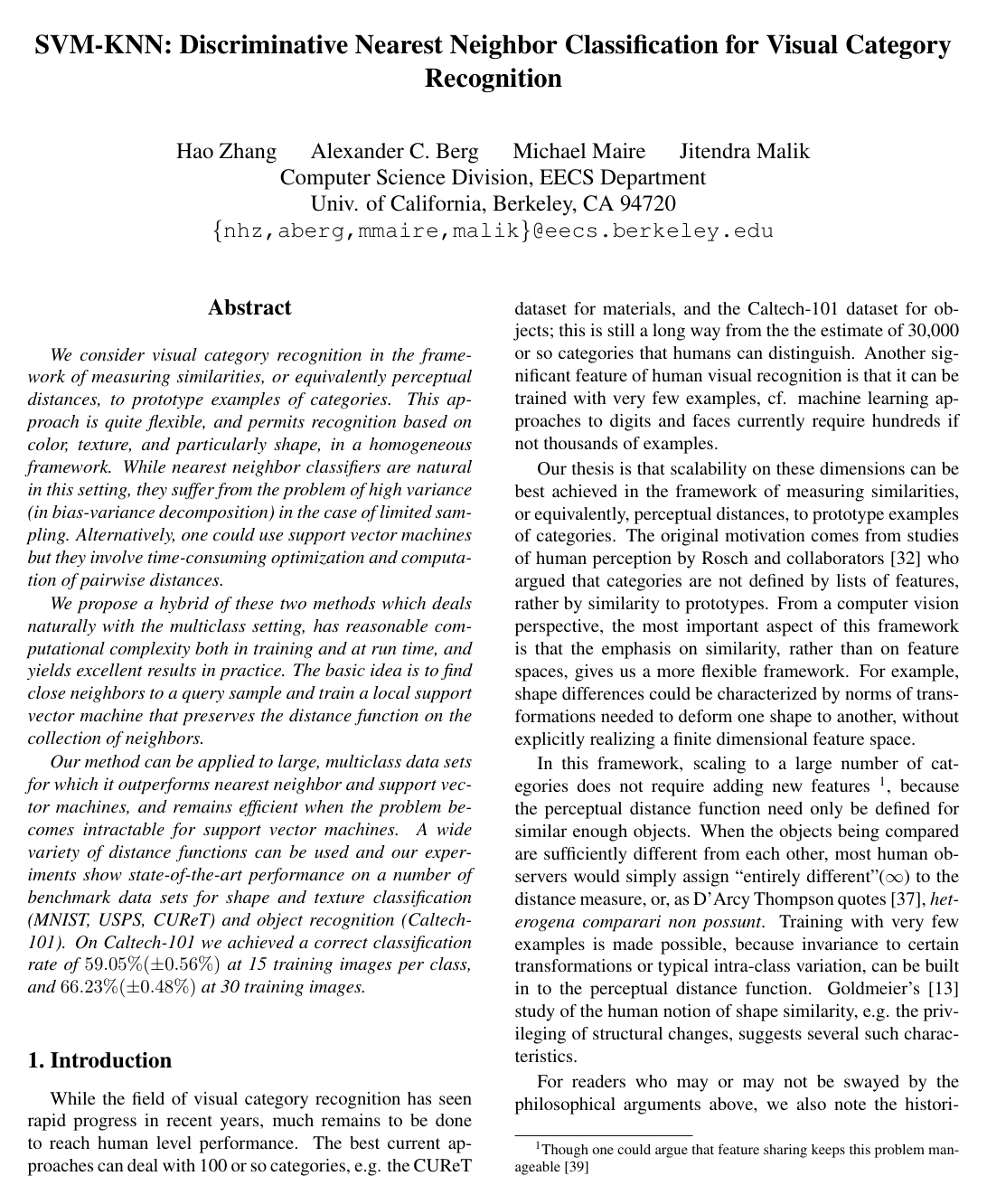
SVM-KNN: Discriminative Nearest Neighbor Classification for Visual Category Recognition
Haotong Zhang, A. Berg, M. Maire, Jitendra Malik
Why you should read this
Combines nearest-neighbor retrieval with local support vector machine training to enable scalable multiclass image classification using complex perceptual distance functions without the steep computational cost of full SVM training.
We consider visual category recognition in the framework of measuring similarities, or equivalently perceptual distances, to prototype examples of categories. This approach is quite flexible, and permits recognition based on color, texture, and particularly shape, in a homogeneous framework. While nearest neighbor classifiers are natural in this setting, they suffer from the problem of high variance (in bias-variance decomposition) in the case of limited sampling. Alternatively, one could use support vector machines but they involve time-consuming optimization and computation of pairwise distances. We propose a hybrid of these two methods which deals naturally with the multiclass setting, has reasonable computational complexity both in training and at run time, and yields excellent results in practice. The basic idea is to find close neighbors to a query sample and train a local support vector machine that preserves the distance function on the collection of neighbors. Our method can be applied to large, multiclass data sets for which it outperforms nearest neighbor and support vector machines, and remains efficient when the problem becomes intractable for support vector machines. A wide variety of distance functions can be used and our experiments show state-of-the-art performance on a number of benchmark data sets for shape and texture classification (MNIST, USPS, CUReT) and object recognition (Caltech-101). On Caltech-101 we achieved a correct classification rate of 59.05%(±0.56%) at 15 training images per class, and 66.23%(±0.48%) at 30 training images.
Added
2026-09-25
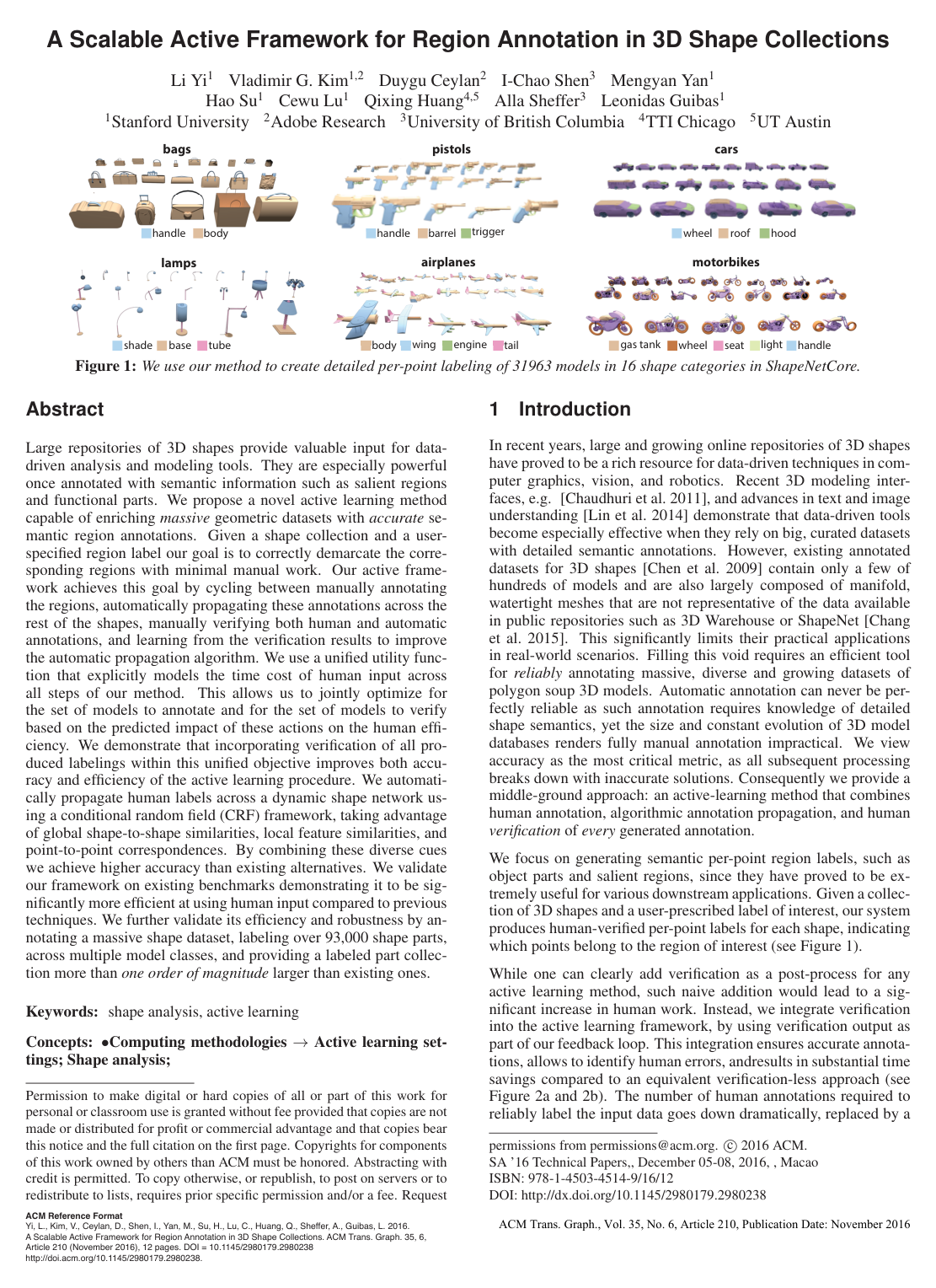
A scalable active framework for region annotation in 3D shape collections
Li Yi, Vladimir G. Kim, Duygu Ceylan, I-Chao Shen, Mengyan Yan, Hao Su, Cewu Lu, Qixing Huang, Alla Sheffer, Leonidas Guibas
Why you should read this
Proposes an active learning framework that integrates automatic label propagation with human verification to efficiently annotate semantic regions across massive 3D shape collections with minimal manual effort.
Large repositories of 3D shapes provide valuable input for data-driven analysis and modeling tools. They are especially powerful once annotated with semantic information such as salient regions and functional parts. We propose a novel active learning method capable of enriching massive geometric datasets with accurate semantic region annotations. Given a shape collection and a user-specified region label our goal is to correctly demarcate the corresponding regions with minimal manual work. Our active framework achieves this goal by cycling between manually annotating the regions, automatically propagating these annotations across the rest of the shapes, manually verifying both human and automatic annotations, and learning from the verification results to improve the automatic propagation algorithm. We use a unified utility function that explicitly models the time cost of human input across all steps of our method. This allows us to jointly optimize for the set of models to annotate and for the set of models to verify based on the predicted impact of these actions on the human efficiency. We demonstrate that incorporating verification of all produced labelings within this unified objective improves both accuracy and efficiency of the active learning procedure. We automatically propagate human labels across a dynamic shape network using a conditional random field (CRF) framework, taking advantage of global shape-to-shape similarities, local feature similarities, and point-to-point correspondences. By combining these diverse cues we achieve higher accuracy than existing alternatives. We validate our framework on existing benchmarks demonstrating it to be significantly more efficient at using human input compared to previous techniques. We further validate its efficiency and robustness by annotating a massive shape dataset, labeling over 93,000 shape parts, across multiple model classes, and providing a labeled part collection more than one order of magnitude larger than existing ones.
Added
2026-09-25
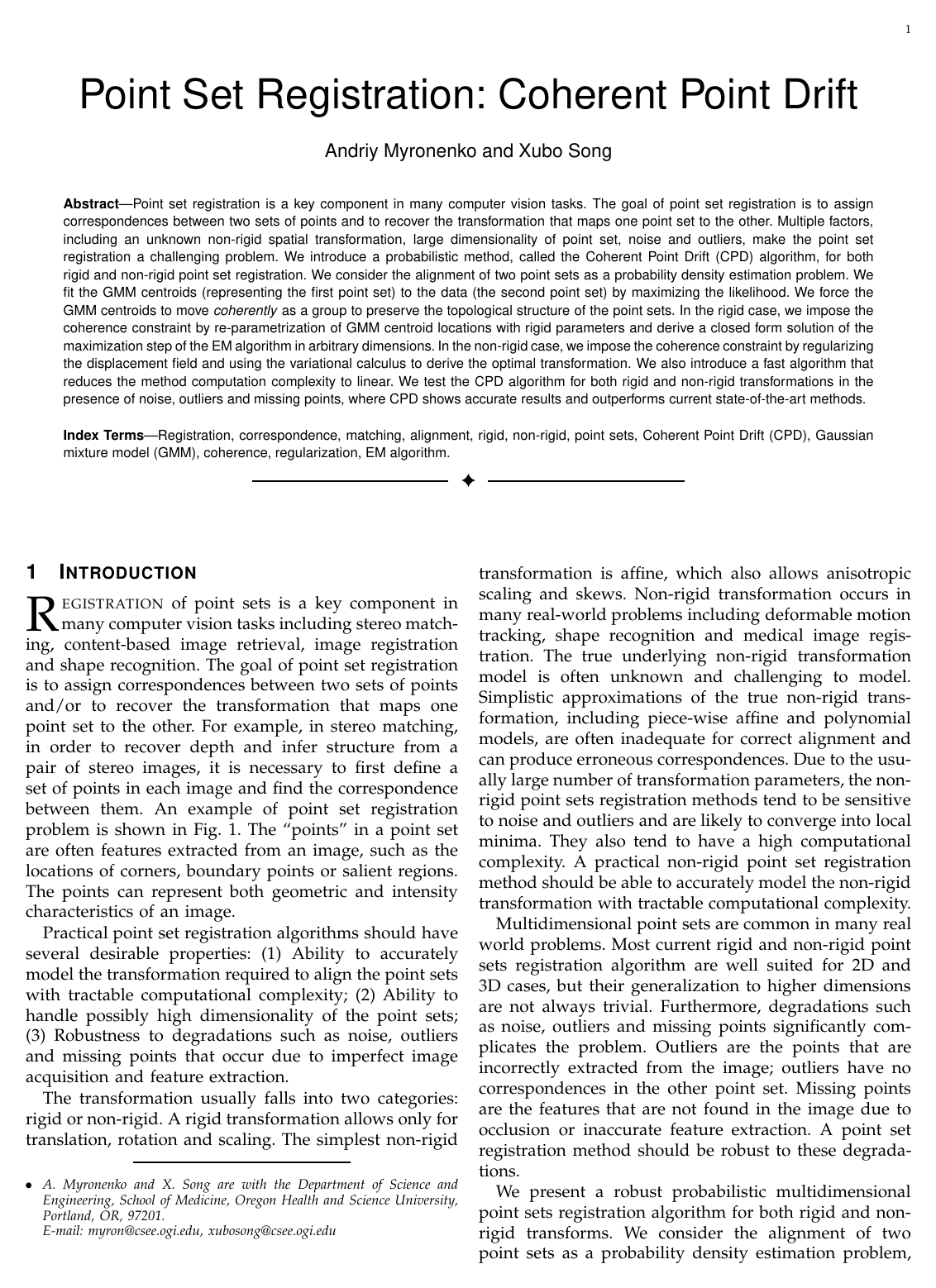
Point Set Registration: Coherent Point Drift
Andriy Myronenko, Xubo B. Song
Why you should read this
Introduces the Coherent Point Drift algorithm, a probabilistic framework that treats point-set registration as a Gaussian mixture model estimation problem to achieve fast, accurate rigid and non-rigid alignment in the presence of noise, outliers, and missing points.
Point set registration is a key component in many computer vision tasks. The goal of point set registration is to assign correspondences between two sets of points and to recover the transformation that maps one point set to the other. Multiple factors, including an unknown non-rigid spatial transformation, large dimensionality of point set, noise and outliers, make the point set registration a challenging problem. We introduce a probabilistic method, called the Coherent Point Drift (CPD) algorithm, for both rigid and non-rigid point set registration. We consider the alignment of two point sets as a probability density estimation problem. We fit the GMM centroids (representing the first point set) to the data (the second point set) by maximizing the likelihood. We force the GMM centroids to move coherently as a group to preserve the topological structure of the point sets. In the rigid case, we impose the coherence constraint by re-parametrization of GMM centroid locations with rigid parameters and derive a closed form solution of the maximization step of the EM algorithm in arbitrary dimensions. In the non-rigid case, we impose the coherence constraint by regularizing the displacement field and using the variational calculus to derive the optimal transformation. We also introduce a fast algorithm that reduces the method computation complexity to linear. We test the CPD algorithm for both rigid and non-rigid transformations in the presence of noise, outliers and missing points, where CPD shows accurate results and outperforms current state-of-the-art methods.
Added
2026-09-14
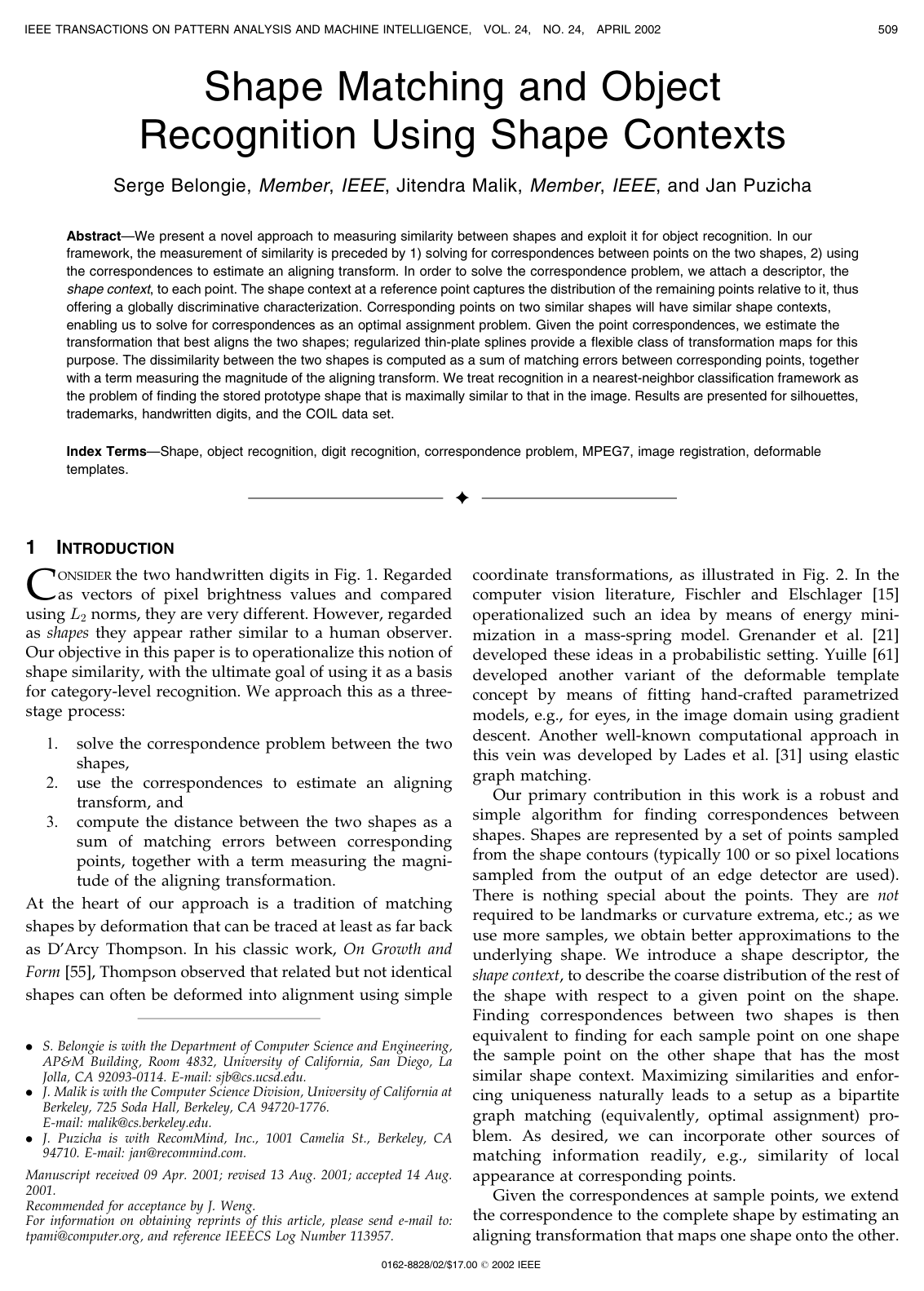
Shape Matching and Object Recognition Using Shape Contexts
Serge Belongie, Jitendra Malik, Jan Puzicha
Why you should read this
Introduces shape contexts, a descriptor capturing relative spatial distributions that enables optimal point correspondences and thin-plate spline alignment for accurate shape matching and object recognition.
We present a novel approach to measuring similarity between shapes and exploit it for object recognition. In our framework, the measurement of similarity is preceded by 1) solving for correspondences between points on the two shapes, 2) using the correspondences to estimate an aligning transform. In order to solve the correspondence problem, we attach a descriptor, the shape context, to each point. The shape context at a reference point captures the distribution of the remaining points relative to it, thus offering a globally discriminative characterization. Corresponding points on two similar shapes will have similar shape contexts, enabling us to solve for correspondences as an optimal assignment problem. Given the point correspondences, we estimate the transformation that best aligns the two shapes; regularized thin-plate splines provide a flexible class of transformation maps for this purpose. The dissimilarity between the two shapes is computed as a sum of matching errors between corresponding points, together with a term measuring the magnitude of the aligning transform. We treat recognition in a nearest-neighbor classification framework as the problem of finding the stored prototype shape that is maximally similar to that in the image. Results are presented for silhouettes, trademarks, handwritten digits, and the COIL data set.
Added
2026-09-09