
Built independently by an author, for readers. Read the story and support ChapterPal

keyword

sentence-level QG

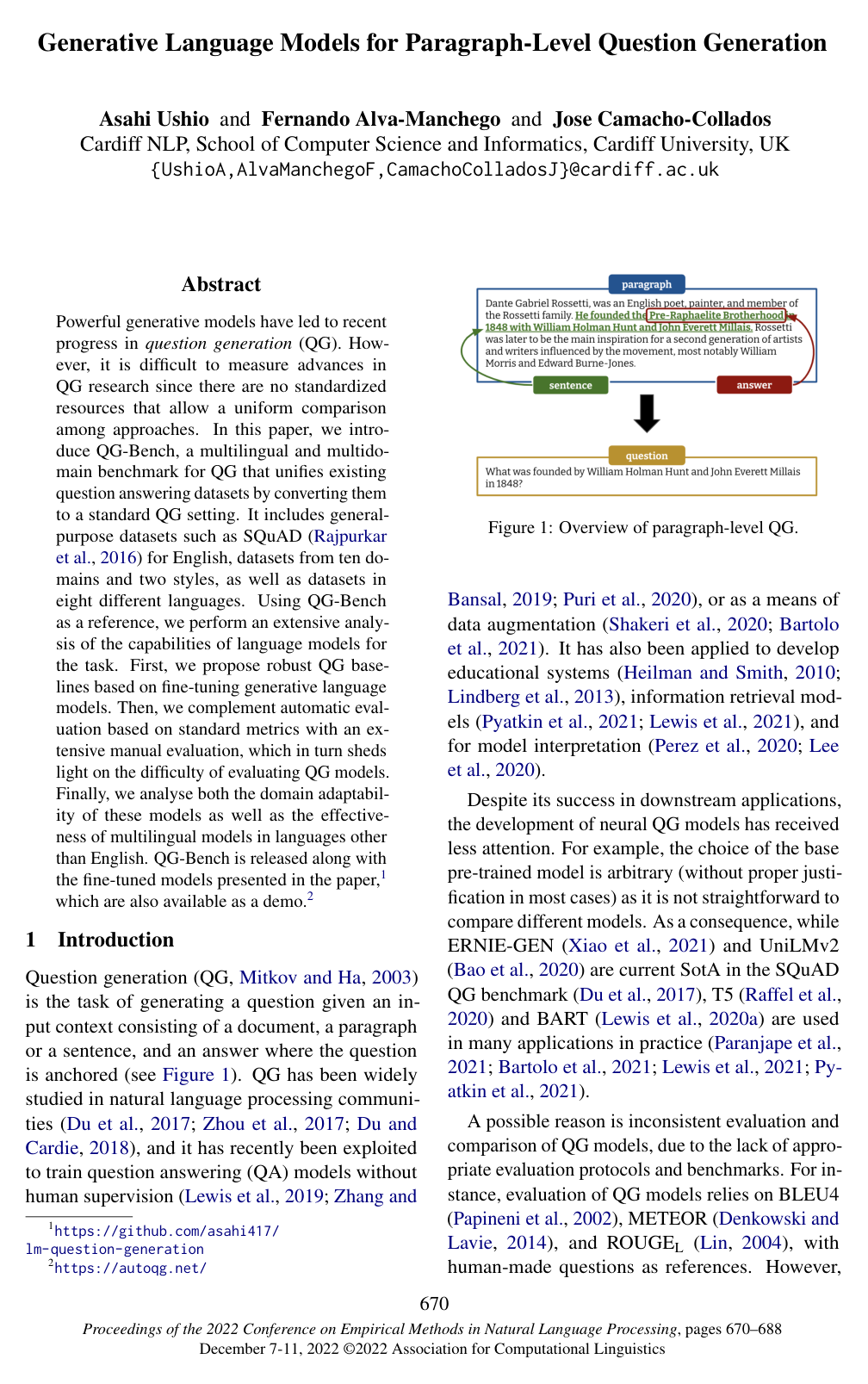
Sentence-level question generation is a natural language processing task that involves automatically producing a fluent and semantically relevant question using an individual sentence as the primary source context. Typically framed as a sequence-to-sequence problem, a model receives a single sentence along with a specified target answer or phrase within that sentence and generates an interrogative sentence that is correctly answered by the target. This setting is distinguished from paragraph-level and document-level question generation because it confines the input strictly to the syntactic and semantic information within one sentence rather than requiring broader discourse-level or cross-sentence reasoning. It is commonly applied in educational assessment creation, intelligent tutoring systems, conversational interfaces, and data augmentation for question answering models.

1 item
Generative Language Models for Paragraph-Level Question Generation

Generative Language Models for Paragraph-Level Question Generation

Asahi Ushio, Fernando Alva-Manchego, José Camacho-Collados

OrganizationsCardiff University

Why you should read this

Introduces QG-Bench, a unified multilingual and multi-domain benchmark that standardizes paragraph-level question generation evaluation across eight languages and multiple domains using sequence-to-sequence language models.

Powerful generative models have led to recent progress in question generation (QG). However, it is difficult to measure advances in QG research since there are no standardized resources that allow a uniform comparison among approaches. In this paper, we introduce QG-Bench, a multilingual and multidomain benchmark for QG that unifies existing question answering datasets by converting them to a standard QG setting. It includes general-purpose datasets such as SQuAD (Rajpurkar et al., 2016) for English, datasets from ten domains and two styles, as well as datasets in eight different languages. Using QG-Bench as a reference, we perform an extensive analysis of the capabilities of language models for the task. First, we propose robust QG baselines based on fine-tuning generative language models. Then, we complement automatic evaluation based on standard metrics with an extensive manual evaluation, which in turn sheds light on the difficulty of evaluating QG models. Finally, we analyse both the domain adaptability of these models as well as the effectiveness of multilingual models in languages other than English. QG-Bench is released along with the fine-tuned models presented in the paper,¹ which are also available as a demo.²

Added

2026-09-26