
keyword
semi-supervised hashing
Semi-supervised hashing is a machine learning technique for fast similarity search and information retrieval that learns mapping functions to convert high-dimensional data points into compact binary codes using a combination of labeled and unlabeled data. The method uses a limited amount of supervision, such as pairwise similarity constraints or class labels, to preserve semantic relationships in Hamming space while leveraging a larger pool of unlabeled data as a regularizer to model the overall data distribution and prevent overfitting. By balancing supervised semantic precision with unsupervised structure preservation, semi-supervised hashing generates compact, discriminative bit representations that significantly reduce memory overhead and accelerate nearest neighbor search in large-scale datasets.
2 items
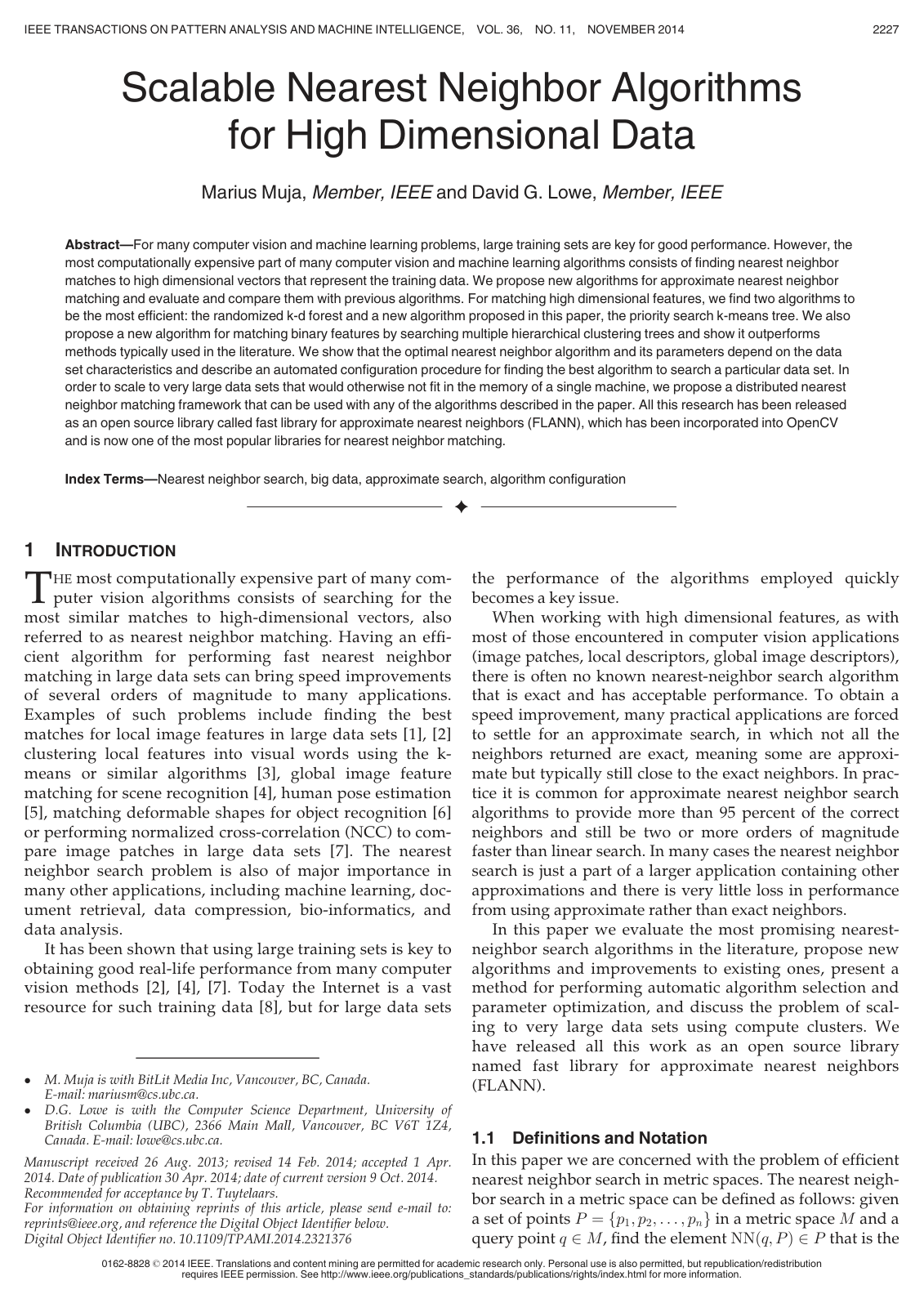
Scalable Nearest Neighbor Algorithms for High Dimensional Data
Marius Muja, D. Lowe
Why you should read this
Presents scalable approximate nearest neighbor search methods, including randomized k-d trees and priority search k-means trees, paired with an automated configuration mechanism implemented in the widely used FLANN library to drastically accelerate high-dimensional matching.
For many computer vision and machine learning problems, large training sets are key for good performance. However, the most computationally expensive part of many computer vision and machine learning algorithms consists of finding nearest neighbor matches to high dimensional vectors that represent the training data. We propose new algorithms for approximate nearest neighbor matching and evaluate and compare them with previous algorithms. For matching high dimensional features, we find two algorithms to be the most efficient: the randomized k-d forest and a new algorithm proposed in this paper, the priority search k-means tree. We also propose a new algorithm for matching binary features by searching multiple hierarchical clustering trees and show it outperforms methods typically used in the literature. We show that the optimal nearest neighbor algorithm and its parameters depend on the data set characteristics and describe an automated configuration procedure for finding the best algorithm to search a particular data set. In order to scale to very large data sets that would otherwise not fit in the memory of a single machine, we propose a distributed nearest neighbor matching framework that can be used with any of the algorithms described in the paper. All this research has been released as an open source library called fast library for approximate nearest neighbors (FLANN), which has been incorporated into OpenCV and is now one of the most popular libraries for nearest neighbor matching.
Added
2026-09-24
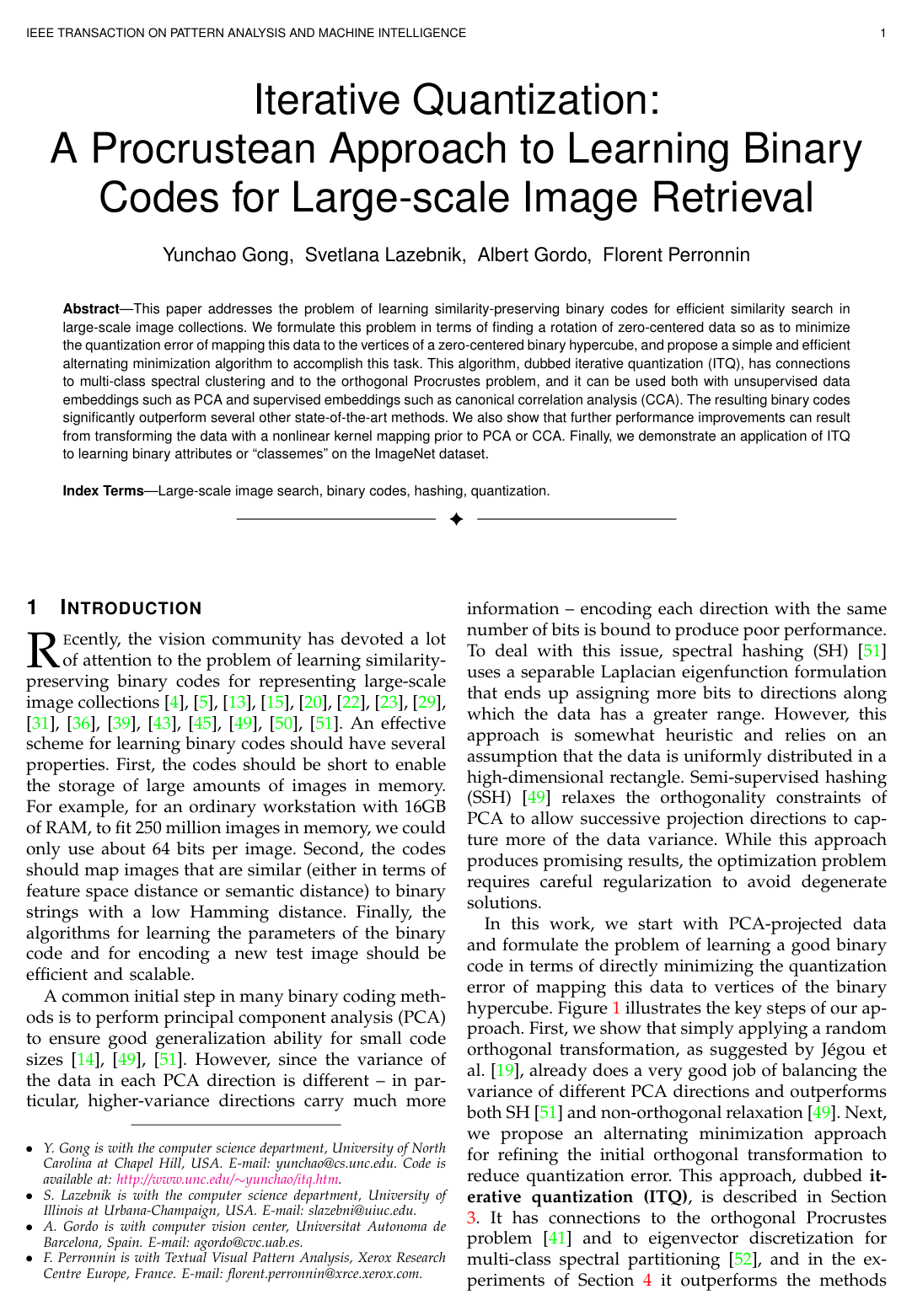
Iterative Quantization: A Procrustean Approach to Learning Binary Codes for Large-Scale Image Retrieval
Yunchao Gong, Svetlana Lazebnik, Albert Gordo, Florent Perronnin
Why you should read this
Proposes an alternating minimization method, Iterative Quantization, that finds an optimal orthogonal rotation to align dimensionally-reduced data with the vertices of a binary hypercube, significantly improving retrieval accuracy and scalability for large-scale image search.
This paper addresses the problem of learning similarity-preserving binary codes for efficient similarity search in large-scale image collections. We formulate this problem in terms of finding a rotation of zero-centered data so as to minimize the quantization error of mapping this data to the vertices of a zero-centered binary hypercube, and propose a simple and efficient alternating minimization algorithm to accomplish this task. This algorithm, dubbed iterative quantization (ITQ), has connections to multi-class spectral clustering and to the orthogonal Procrustes problem, and it can be used both with unsupervised data embeddings such as PCA and supervised embeddings such as canonical correlation analysis (CCA). The resulting binary codes significantly outperform several other state-of-the-art methods. We also show that further performance improvements can result from transforming the data with a nonlinear kernel mapping prior to PCA or CCA. Finally, we demonstrate an application of ITQ to learning binary attributes or “classemes” on the ImageNet dataset.
Added
2026-09-24