
keyword
semantic uncertainty
Semantic uncertainty is a measure of a language model's doubt or variability regarding the underlying meaning of its generated responses, rather than the specific phrasing or surface-level words used. In natural language processing, traditional token-level or sequence-level uncertainty metrics can be misleading because multiple distinct sentences can express the exact same concept or fact. Semantic uncertainty resolves this issue by grouping sampled model outputs into clusters of equivalent meaning, typically using natural language inference or semantic similarity, and evaluating the dispersion or entropy across these distinct semantic classes. High semantic uncertainty occurs when a model produces contradictory or mutually incompatible claims for the same prompt, making the metric especially useful for detecting hallucinations, assessing factual consistency, and calibrating confidence in generative artificial intelligence systems.
8 items
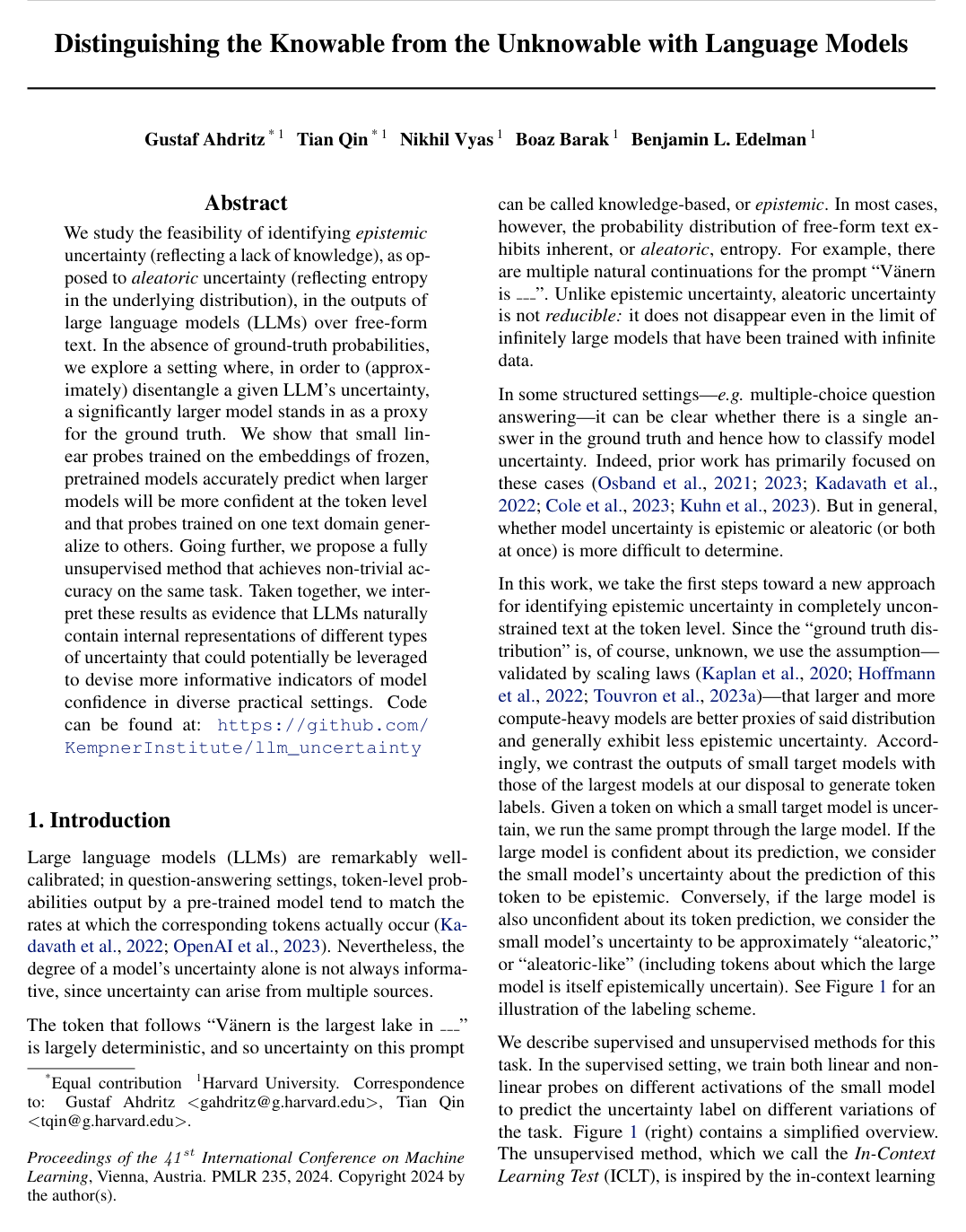
Distinguishing the Knowable from the Unknowable with Language Models
Gustaf Ahdritz, Tian Qin, Nikhil Vyas, Boaz Barak, Benjamin L. Edelman
Why you should read this
Demonstrates that language models internally separate reducible epistemic uncertainty from inherent aleatoric entropy, enabling simple probes and unsupervised methods to accurately detect when an uncertain prediction is caused by a lack of knowledge rather than inherent ambiguity.
We study the feasibility of identifying epistemic uncertainty (reflecting a lack of knowledge), as opposed to aleatoric uncertainty (reflecting entropy in the underlying distribution), in the outputs of large language models (LLMs) over free-form text. In the absence of ground-truth probabilities, we explore a setting where, in order to (approximately) disentangle a given LLM’s uncertainty, a significantly larger model stands in as a proxy for the ground truth. We show that small linear probes trained on the embeddings of frozen, pretrained models accurately predict when larger models will be more confident at the token level and that probes trained on one text domain generalize to others. Going further, we propose a fully unsupervised method that achieves non-trivial accuracy on the same task. Taken together, we interpret these results as evidence that LLMs naturally contain internal representations of different types of uncertainty that could potentially be leveraged to devise more informative indicators of model confidence in diverse practical settings. Code can be found at: https://github.com/KempnerInstitute/llm_uncertainty
Added
2026-10-05
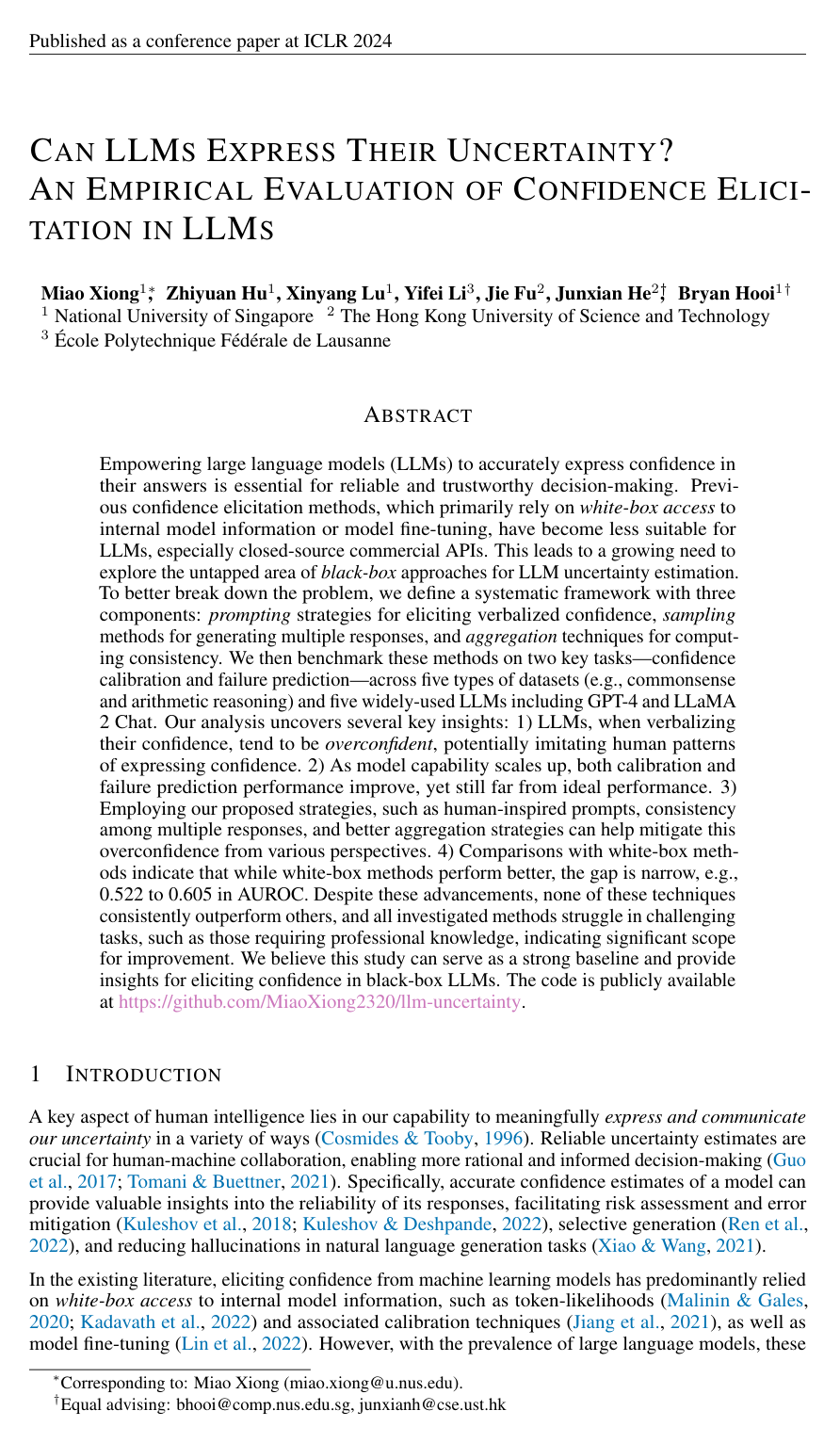
Can LLMs Express Their Uncertainty? An Empirical Evaluation of Confidence Elicitation in LLMs
Miao Xiong, Zhiyuan Hu, Xinyang Lu, Yifei Li, Jie Fu, Junxian He, Bryan Hooi
Why you should read this
Presents a systematic framework for evaluating black-box uncertainty estimation in large language models, showing that verbalized prompting and response consistency can effectively reduce overconfidence to rival white-box calibration methods.
Empowering large language models to accurately express confidence in their answers is essential for trustworthy decision-making. Previous confidence elicitation methods, which primarily rely on white-box access to internal model information or model fine-tuning, have become less suitable for LLMs, especially closed-source commercial APIs. This leads to a growing need to explore the untapped area of black-box approaches for LLM uncertainty estimation. To better break down the problem, we define a systematic framework with three components: prompting strategies for eliciting verbalized confidence, sampling methods for generating multiple responses, and aggregation techniques for computing consistency. We then benchmark these methods on two key tasks-confidence calibration and failure prediction-across five types of datasets (e.g., commonsense and arithmetic reasoning) and five widely-used LLMs including GPT-4 and LLaMA 2 Chat. Our analysis uncovers several key insights: 1) LLMs, when verbalizing their confidence, tend to be overconfident, potentially imitating human patterns of expressing confidence. 2) As model capability scales up, both calibration and failure prediction performance improve. 3) Employing our proposed strategies, such as human-inspired prompts, consistency among multiple responses, and better aggregation strategies can help mitigate this overconfidence from various perspectives. 4) Comparisons with white-box methods indicate that while white-box methods perform better, the gap is narrow, e.g., 0.522 to 0.605 in AUROC. Despite these advancements, none of these techniques consistently outperform others, and all investigated methods struggle in challenging tasks, such as those requiring professional knowledge, indicating significant scope for improvement. We believe this study can serve as a strong baseline and provide insights for eliciting confidence in black-box LLMs.
Added
2026-10-04
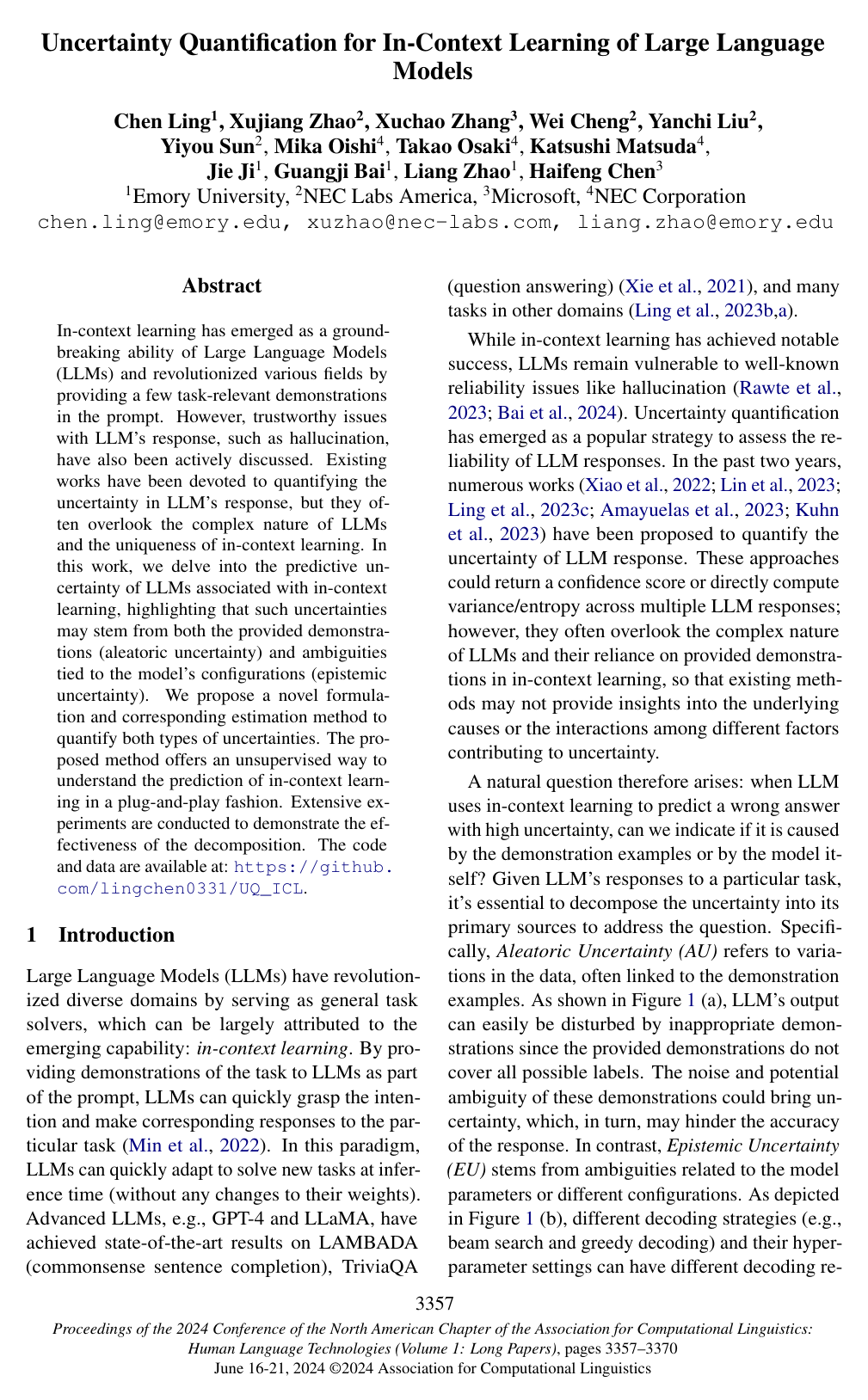
Uncertainty Quantification for In-Context Learning of Large Language Models
Chen Ling, Xujiang Zhao, Xuchao Zhang, Wei Cheng, Yanchi Liu, Yiyou Sun, Mika Oishi, Takao Osaki, Katsushi Matsuda, Jie Ji, Guangji Bai, Liang Zhao, Haifeng Chen
Why you should read this
Presents a Bayesian framework that decomposes predictive uncertainty in large language model in-context learning into prompt-induced aleatoric and model-induced epistemic components, enabling unsupervised diagnostic evaluation of output reliability across both white-box and black-box settings.
In-context learning has emerged as a ground-breaking ability of Large Language Models (LLMs) and revolutionized various fields by providing a few task-relevant demonstrations in the prompt. However, trustworthy issues with LLM’s response, such as hallucination, have also been actively discussed. Existing works have been devoted to quantifying the uncertainty in LLM’s response, but they often overlook the complex nature of LLMs and the uniqueness of in-context learning. In this work, we delve into the predictive uncertainty of LLMs associated with in-context learning, highlighting that such uncertainties may stem from both the provided demonstrations (aleatoric uncertainty) and ambiguities tied to the model’s configurations (epistemic uncertainty). We propose a novel formulation and corresponding estimation method to quantify both types of uncertainties. The proposed method offers an unsupervised way to understand the prediction of in-context learning in a plug-and-play fashion. Extensive experiments are conducted to demonstrate the effectiveness of the decomposition. The code and data are available at: https://github.com/lingchen0331/UQ_ICL.
Added
2026-10-03
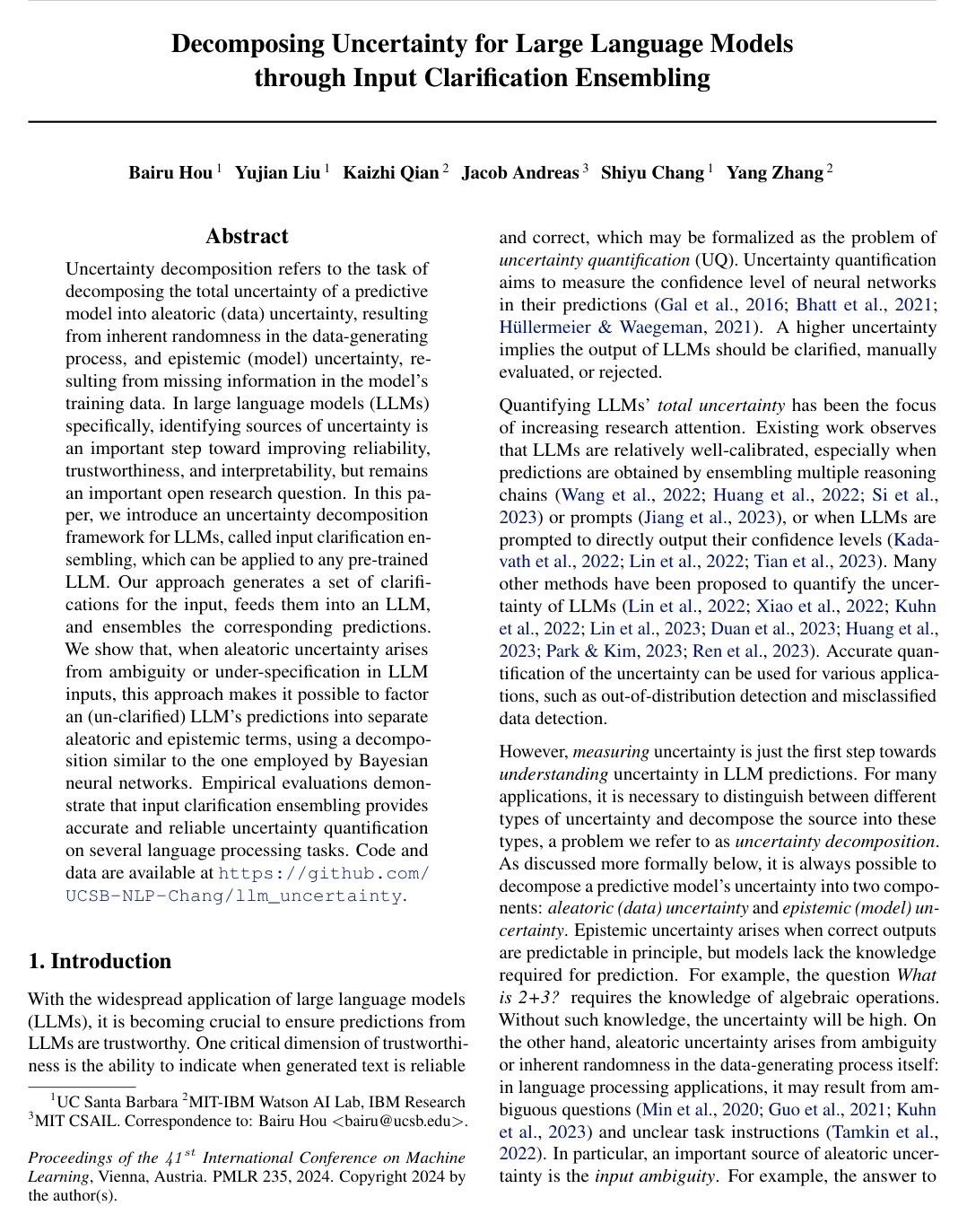
Decomposing Uncertainty for Large Language Models through Input Clarification Ensembling
Bairu Hou, Yujian Liu, Kaizhi Qian, Jacob Andreas, Shiyu Chang, Yang Zhang
Why you should read this
Proposes input clarification ensembling, a practical framework that separates large language model uncertainty into input ambiguity and model knowledge deficits without modifying model parameters or training procedures.
Uncertainty decomposition refers to the task of decomposing the total uncertainty of a predictive model into aleatoric (data) uncertainty, resulting from inherent randomness in the data-generating process, and epistemic (model) uncertainty, resulting from missing information in the model’s training data. In large language models (LLMs) specifically, identifying sources of uncertainty is an important step toward improving reliability, trustworthiness, and interpretability, but remains an important open research question. In this paper, we introduce an uncertainty decomposition framework for LLMs, called input clarification ensembling, which can be applied to any pre-trained LLM. Our approach generates a set of clarifications for the input, feeds them into an LLM, and ensembles the corresponding predictions. We show that, when aleatoric uncertainty arises from ambiguity or under-specification in LLM inputs, this approach makes it possible to factor an (un-clarified) LLM’s predictions into separate aleatoric and epistemic terms, using a decomposition similar to the one employed by Bayesian neural networks. Empirical evaluations demonstrate that input clarification ensembling provides accurate and reliable uncertainty quantification on several language processing tasks. Code and data are available at https://github.com/UCSB-NLP-Chang/llm_uncertainty.
Added
2026-10-01
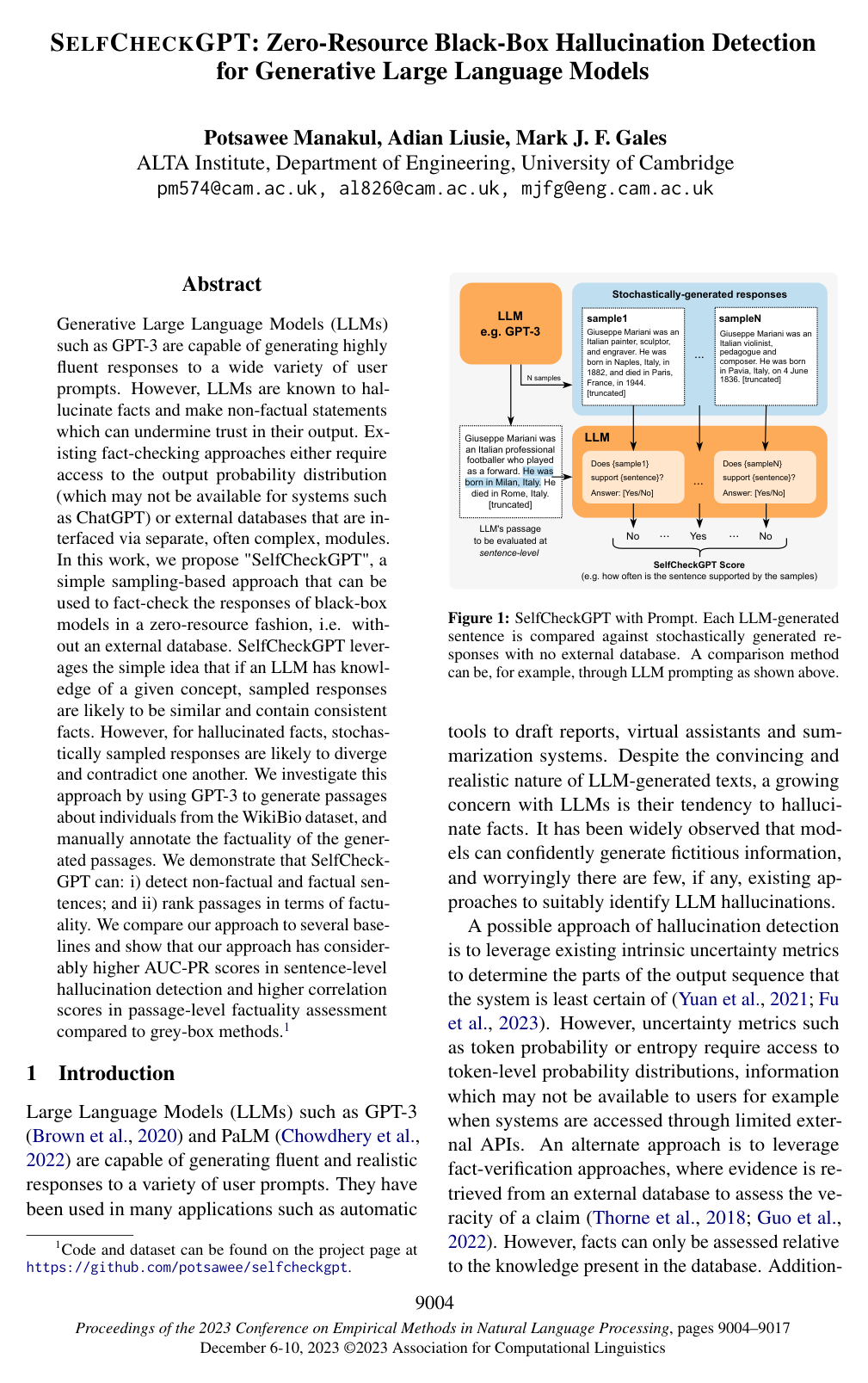
SelfCheckGPT: Zero-Resource Black-Box Hallucination Detection for Generative Large Language Models
Potsawee Manakul, Adian Liusie, Mark J. F. Gales
Why you should read this
Proposes SelfCheckGPT, a zero-resource sampling method that detects hallucinations in black-box large language models by measuring consistency across stochastically generated responses without requiring external databases or token probability distributions.
Generative Large Language Models (LLMs) such as GPT-3 are capable of generating highly fluent responses to a wide variety of user prompts. However, LLMs are known to hallucinate facts and make non-factual statements which can undermine trust in their output. Existing fact-checking approaches either require access to the output probability distribution (which may not be available for systems such as ChatGPT) or external databases that are interfaced via separate, often complex, modules. In this work, we propose "SelfCheckGPT", a simple sampling-based approach that can be used to fact-check the responses of black-box models in a zero-resource fashion, i.e. without an external database. SelfCheckGPT leverages the simple idea that if an LLM has knowledge of a given concept, sampled responses are likely to be similar and contain consistent facts. However, for hallucinated facts, stochastically sampled responses are likely to diverge and contradict one another. We investigate this approach by using GPT-3 to generate passages about individuals from the WikiBio dataset, and manually annotate the factuality of the generated passages. We demonstrate that SelfCheckGPT can: i) detect non-factual and factual sentences; and ii) rank passages in terms of factuality. We compare our approach to several baselines and show that our approach has considerably higher AUC-PR scores in sentence-level hallucination detection and higher correlation scores in passage-level factuality assessment compared to grey-box methods.
Added
2026-09-28
A Survey of Confidence Estimation and Calibration in Large Language Models
Jiahui Geng, Fengyu Cai, Yuxia Wang, Heinz Koeppl, Preslav Nakov, Iryna Gurevych
Why you should read this
Presents a structured taxonomy of methods, metrics, and applications for estimating and calibrating large language model confidence to mitigate factual errors and improve generation reliability.
Large language models (LLMs) have demonstrated remarkable capabilities across a wide range of tasks in various domains. Despite their impressive performance, they can be unreliable due to factual errors in their generations. Assessing their confidence and calibrating them across different tasks can help mitigate risks and enable LLMs to produce better generations. There has been a lot of recent research aiming to address this, but there has been no comprehensive overview to organize it and to outline the main lessons learned. The present survey aims to bridge this gap. In particular, we outline the challenges and we summarize recent technical advancements for LLM confidence estimation and calibration. We further discuss their applications and suggest promising directions for future work.
Added
2026-09-26
MAP: Multimodal Uncertainty-Aware Vision-Language Pre-training Model
Yatai Ji, Junjie Wang, Yuan Gong, Lin Zhang, Yanru Zhu, Hongfa Wang, Jiaxing Zhang, Tetsuya Sakai, Yujiu Yang
Why you should read this
Proposes a vision-language pre-training framework that models multimodal features as Gaussian distributions instead of deterministic points to capture inter- and intra-modal semantic uncertainty across downstream tasks like visual reasoning and image-text retrieval.
Multimodal semantic understanding often has to deal with uncertainty, which means the obtained messages tend to refer to multiple targets. Such uncertainty is problematic for our interpretation, including inter- and intra-modal uncertainty. Little effort has studied the modeling of this uncertainty, particularly in pre-training on unlabeled datasets and fine-tuning in task-specific downstream datasets. In this paper, we project the representations of all modalities as probabilistic distributions via a Probability Distribution Encoder (PDE) by utilizing sequence-level interactions. Compared to the existing deterministic methods, such uncertainty modeling can convey richer multimodal semantic information and more complex relationships. Furthermore, we integrate uncertainty modeling with popular pre-training frameworks and propose suitable pre-training tasks: Distribution-based Vision-Language Contrastive learning (D-VLC), Distribution-based Masked Language Modeling (D-MLM), and Distribution-based Image-Text Matching (D-ITM). The fine-tuned models are applied to challenging downstream tasks, including image-text retrieval, visual question answering, visual reasoning, and visual entailment, and achieve state-of-the-art results.
Added
2026-09-26
Recursive Language Models Meet Uncertainty: The Surprising Effectiveness of Self-Reflective Program Search for Long Context
Keivan Alizadeh, Parshin Shojaee, Minsik Cho, Mehrdad Farajtabar
Why you should read this
Introduces SRLM, a framework augmenting language models with uncertainty-aware self-reflection using intrinsic signals, which substantially improves long-context handling by outperforming recursive language models without explicit recursion.
Long-context handling remains a core challenge for language models: even with extended context windows, models often fail to reliably extract, reason over, and use the information across long contexts. Recent works like Recursive Language Models (RLM) have approached this challenge by agentic way of decomposing long contexts into recursive sub-calls through programmatic interaction at inference. While promising, the success of RLM critically depends on how these context-interaction programs are selected, which has remained largely unexplored. In this paper, we study this problem and introduce SRLM, a framework that augments programmatic context interaction with uncertainty-aware Self-Reflection. SRLM leverages three intrinsic signals: self consistency, reasoning length, and verbalized confidence. These serve as complementary indicators of a model's internal uncertainty, and the model uses them to evaluate and compare candidate context-interaction programs. Extensive experiments across diverse benchmark datasets, context lengths, and backbone models, show that SRLM consistently outperforms state-of-the-art baselines, yielding up to 22% improvement over RLM under the same time budget. Our findings show that recursion itself is not the primary driver of performance in RLM, and a simple self-reflective program search can match or surpass RLM without requiring self-query or explicit recursion mechanisms. We find that for context lengths within the model's window, RLMs with recursion often degrade performance relative to the base model, whereas SRLM yields consistent gains across both short and long contexts. We also find that RLM is less effective in tasks with semantically intensive nature, where heuristic program search is insufficient and broader contextual understanding is required, while self-reflection in SRLM provides a semantic signal that better steers reasoning in these scenarios.
Added
2026-05-07
