
keyword
semantic textual similarity
Semantic textual similarity is a natural language processing task and evaluation metric that measures the degree of meaning equivalence between two pieces of text, such as sentences or phrases. Unlike binary classification frameworks such as textual entailment or paraphrase detection, semantic textual similarity assesses semantic overlap on a graded or continuous scale ranging from complete independence to full semantic equivalence. In computational linguistics and machine learning, it serves as a standard benchmark for evaluating the quality of text representations and sentence embeddings, supporting downstream applications that include information retrieval, semantic search, question answering, automated summarization, and machine translation evaluation.
10 items
PromptBERT: Improving BERT Sentence Embeddings with Prompts
Ting Jiang, Jian Jiao, Shaohan Huang, Zihan Zhang, Deqing Wang, Fuzhen Zhuang, Furu Wei, Haizhen Huang, Denvy Deng, Qi Zhang
Why you should read this
Introduces a prompt-based contrastive learning framework with template denoising that overcomes token embedding biases in pretrained transformers to significantly outperform SimCSE on unsupervised sentence representation benchmarks.
We propose PromptBERT, a novel contrastive learning method for learning better sentence representation. We firstly analyze the drawback of current sentence embedding from original BERT and find that it is mainly due to the static token embedding bias and ineffective BERT layers. Then we propose the first prompt-based sentence embeddings method and discuss two prompt representing methods and three prompt searching methods to make BERT achieve better sentence embeddings. Moreover, we propose a novel unsupervised training objective by the technology of template denoising, which substantially shortens the performance gap between the supervised and unsupervised settings. Extensive experiments show the effectiveness of our method. Compared to SimCSE, PromptBert achieves 2.29 and 2.58 points of improvement based on BERT and RoBERTa in the unsupervised setting. Our code is available at https://github.com/kongds/Prompt-BERT.
Added
2026-09-26
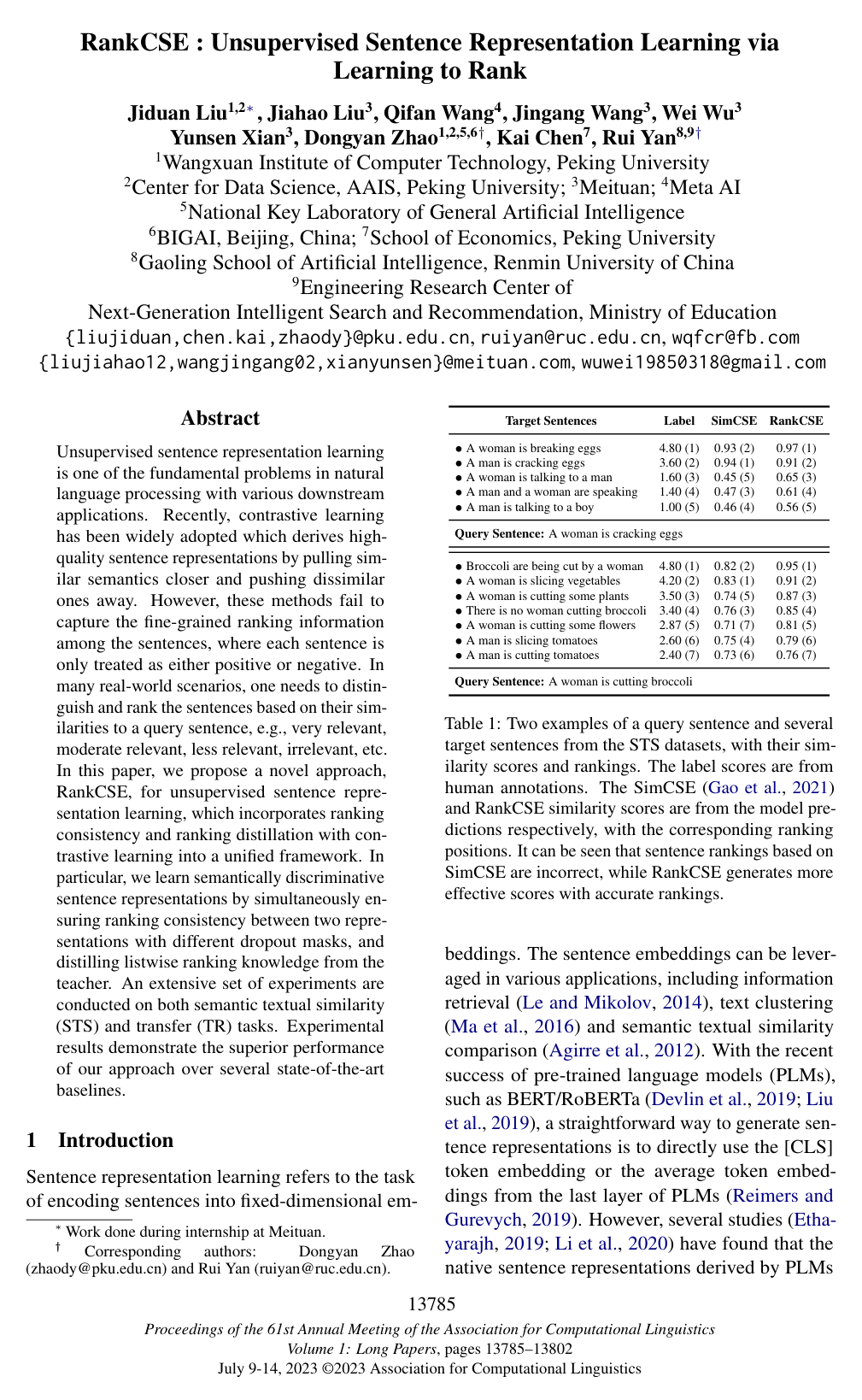
RankCSE: Unsupervised Sentence Representations Learning via Learning to Rank
Jiduan Liu, Jiahao Liu, Qifan Wang, Jingang Wang, Wei Wu, Yunsen Xian, Dongyan Zhao, Kai Chen, Rui Yan
Why you should read this
Proposes RankCSE, an unsupervised sentence representation framework that integrates ranking consistency and listwise ranking distillation into contrastive learning to capture fine-grained semantic similarities and outperform existing baselines on semantic textual similarity tasks.
Unsupervised sentence representation learning is one of the fundamental problems in natural language processing with various downstream applications. Recently, contrastive learning has been widely adopted which derives high-quality sentence representations by pulling similar semantics closer and pushing dissimilar ones away. However, these methods fail to capture the fine-grained ranking information among the sentences, where each sentence is only treated as either positive or negative. In many real-world scenarios, one needs to distinguish and rank the sentences based on their similarities to a query sentence, e.g., very relevant, moderate relevant, less relevant, irrelevant, etc. In this paper, we propose a novel approach, RankCSE, for unsupervised sentence representation learning, which incorporates ranking consistency and ranking distillation with contrastive learning into a unified framework. In particular, we learn semantically discriminative sentence representations by simultaneously ensuring ranking consistency between two representations with different dropout masks, and distilling listwise ranking knowledge from the teacher. An extensive set of experiments are conducted on both semantic textual similarity (STS) and transfer (TR) tasks. Experimental results demonstrate the superior performance of our approach over several state-of-the-art baselines.
Added
2026-09-26
Making Monolingual Sentence Embeddings Multilingual Using Knowledge Distillation
Nils Reimers, Iryna Gurevych
Why you should read this
Proposes a lightweight knowledge distillation technique that transfers monolingual sentence embedding models to over 50 languages by aligning translated sentences into a shared vector space with minimal computational cost.
We present an easy and efficient method to extend existing sentence embedding models to new languages. This allows to create multilingual versions from previously monolingual models. The training is based on the idea that a translated sentence should be mapped to the same location in the vector space as the original sentence. We use the original (monolingual) model to generate sentence embeddings for the source language and then train a new system on translated sentences to mimic the original model. Compared to other methods for training multilingual sentence embeddings, this approach has several advantages: It is easy to extend existing models with relatively few samples to new languages, it is easier to ensure desired properties for the vector space, and the hardware requirements for training is lower. We demonstrate the effectiveness of our approach for 50+ languages from various language families. Code to extend sentence embeddings models to more than 400 languages is publicly available.
Added
2026-09-25
XNLI: Evaluating Cross-lingual Sentence Representations
Alexis Conneau, Guillaume Lample, Ruty Rinott, Adina Williams, Samuel R. Bowman, Holger Schwenk, Veselin Stoyanov
Why you should read this
Introduces the Cross-lingual Natural Language Inference (XNLI) benchmark across 15 diverse languages, establishing a standard evaluation suite and competitive baselines for cross-lingual sentence representations and zero-shot transfer.
State-of-the-art natural language processing systems rely on supervision in the form of annotated data to learn competent models. These models are generally trained on data in a single language (usually English), and cannot be directly used beyond that language. Since collecting data in every language is not realistic, there has been a growing interest in cross-lingual language understanding (XLU) and low-resource cross-language transfer. In this work, we construct an evaluation set for XLU by extending the development and test sets of the Multi-Genre Natural Language Inference Corpus (MultiNLI) to 15 languages, including low-resource languages such as Swahili and Urdu. We hope that our dataset, dubbed XNLI, will catalyze research in cross-lingual sentence understanding by providing an informative standard evaluation task. In addition, we provide several baselines for multilingual sentence understanding, including two based on machine translation systems, and two that use parallel data to train aligned multilingual bag-of-words and LSTM encoders. We find that XNLI represents a practical and challenging evaluation suite, and that directly translating the test data yields the best performance among available baselines.
Added
2026-09-24
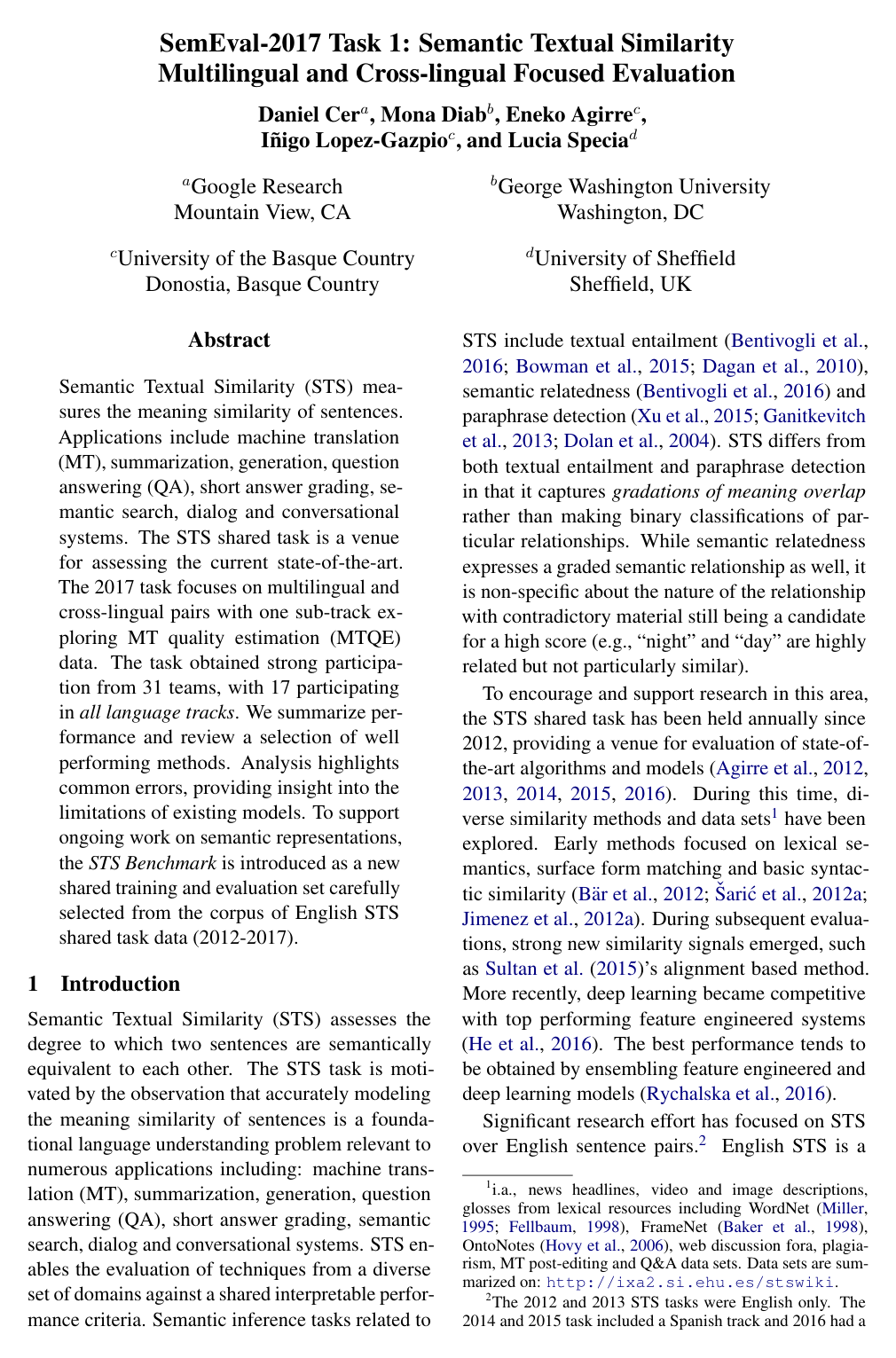
SemEval-2017 Task 1: Semantic Textual Similarity Multilingual and Crosslingual Focused Evaluation
Daniel Cer, Mona Diab, Eneko Agirre, Iñigo Lopez-Gazpio, Lucia Specia
Why you should read this
Introduces the widely used STS Benchmark dataset while evaluating state-of-the-art multilingual and cross-lingual semantic textual similarity systems to identify persistent error patterns across languages.
Semantic Textual Similarity (STS) measures the meaning similarity of sentences. Applications include machine translation (MT), summarization, generation, question answering (QA), short answer grading, semantic search, dialog and conversational systems. The STS shared task is a venue for assessing the current state-of-the-art. The 2017 task focuses on multilingual and cross-lingual pairs with one sub-track exploring MT quality estimation (MTQE) data. The task obtained strong participation from 31 teams, with 17 participating in all language tracks. We summarize performance and review a selection of well performing methods. Analysis highlights common errors, providing insight into the limitations of existing models. To support ongoing work on semantic representations, the STS Benchmark is introduced as a new shared training and evaluation set carefully selected from the corpus of English STS shared task data (2012-2017).
Added
2026-09-16
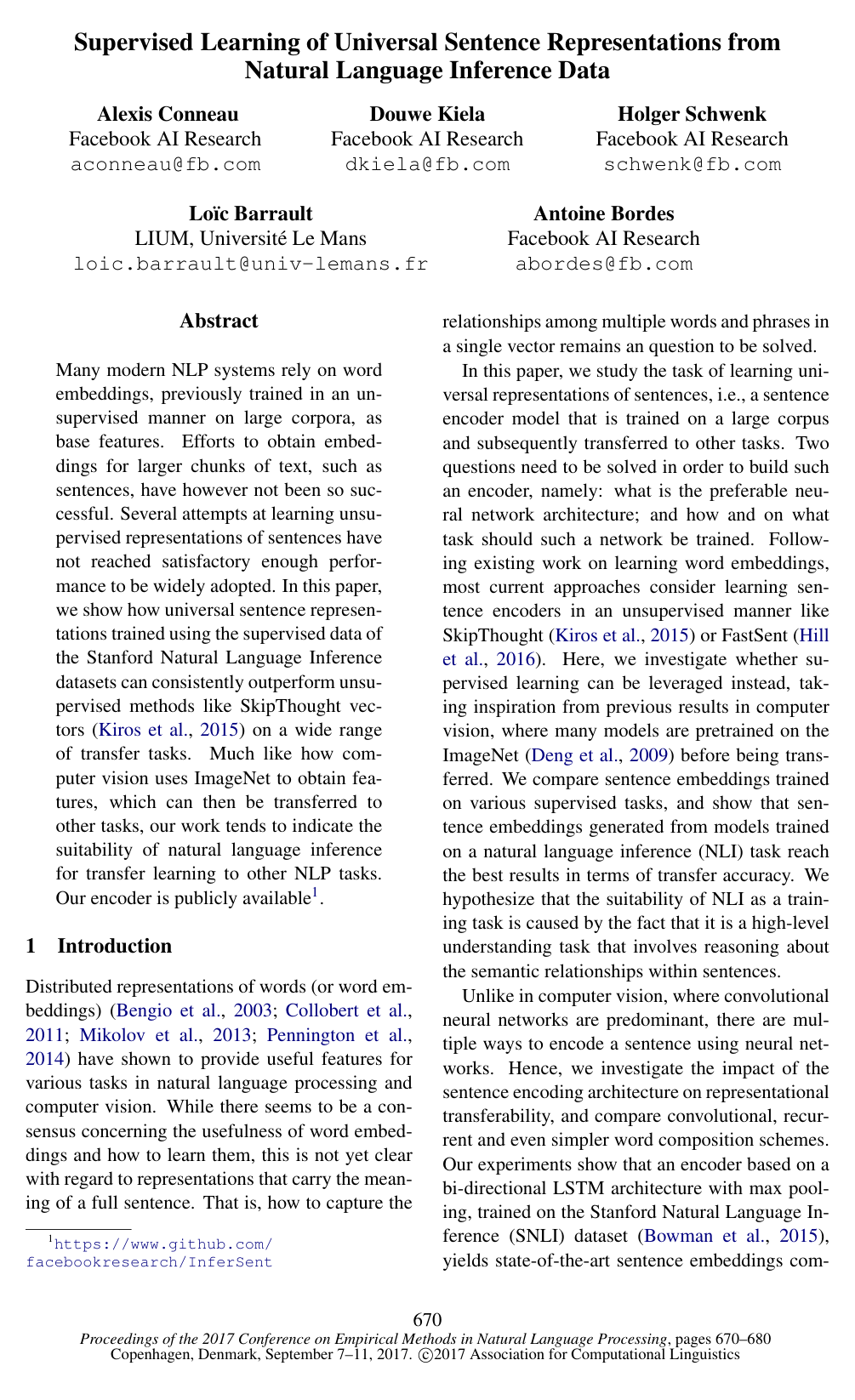
Supervised Learning of Universal Sentence Representations from Natural Language Inference Data
Alexis Conneau, Douwe Kiela, Holger Schwenk, Loïc Barrault, Antoine Bordes
Why you should read this
Demonstrates that training sentence encoders on supervised natural language inference data yields universal embeddings that consistently outperform unsupervised baselines across diverse transfer tasks, establishing inference as an effective pretraining objective for natural language processing.
Many modern NLP systems rely on word embeddings, previously trained in an unsupervised manner on large corpora, as base features. Efforts to obtain embeddings for larger chunks of text, such as sentences, have however not been so successful. Several attempts at learning unsupervised representations of sentences have not reached satisfactory enough performance to be widely adopted. In this paper, we show how universal sentence representations trained using the supervised data of the Stanford Natural Language Inference datasets can consistently outperform unsupervised methods like SkipThought vectors on a wide range of transfer tasks. Much like how computer vision uses ImageNet to obtain features, which can then be transferred to other tasks, our work tends to indicate the suitability of natural language inference for transfer learning to other NLP tasks. Our encoder is publicly available.
Added
2026-09-16
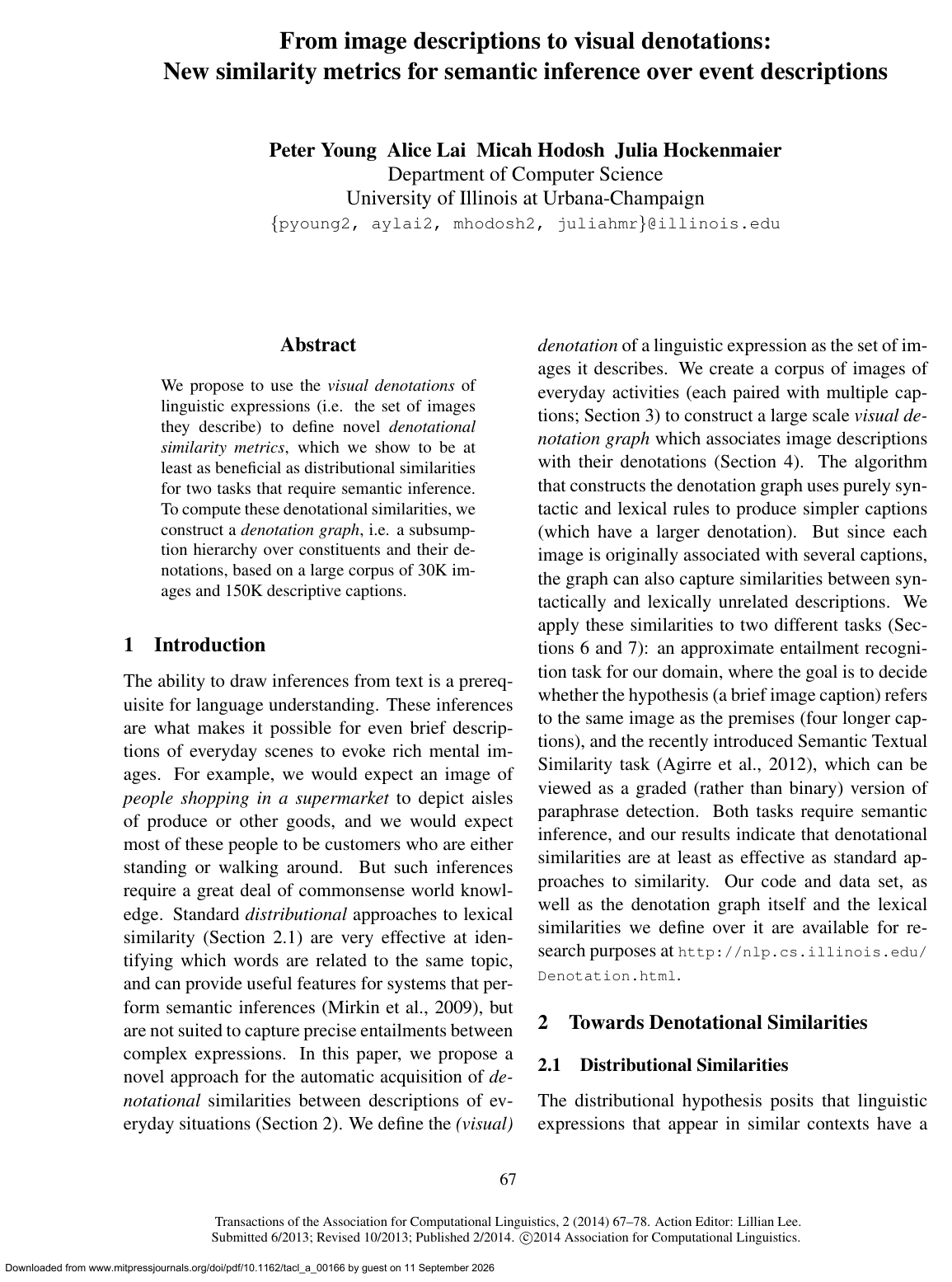
From image descriptions to visual denotations: New similarity metrics for semantic inference over event descriptions
Peter Young, Alice Lai, Micah Hodosh, J. Hockenmaier
Why you should read this
Proposes a method for grounding semantic inference in visual denotation graphs constructed from paired image captions, yielding novel denotational similarity metrics that outperform standard distributional models in recognizing textual entailment and semantic textual similarity.
We propose to use the visual denotations of linguistic expressions (i.e. the set of images they describe) to define novel denotational similarity metrics, which we show to be at least as beneficial as distributional similarities for two tasks that require semantic inference. To compute these denotational similarities, we construct a denotation graph, i.e. a subsumption hierarchy over constituents and their denotations, based on a large corpus of 30K images and 150K descriptive captions.
Added
2026-09-11
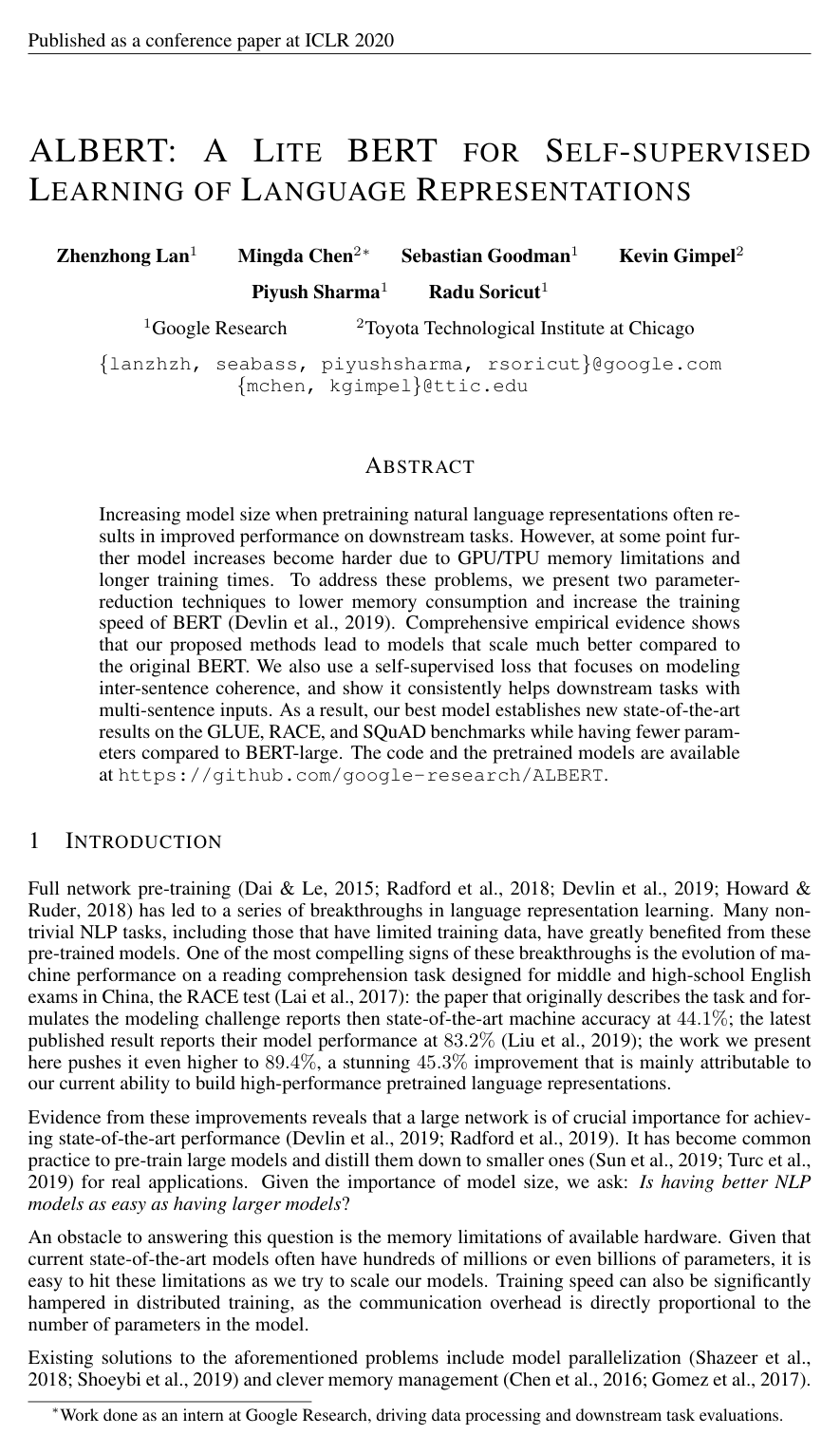
ALBERT: A Lite BERT for Self-supervised Learning of Language Representations
Zhenzhong Lan, Mingda Chen, Sebastian Goodman, Kevin Gimpel, Piyush Sharma, Radu Soricut
Why you should read this
Proposes ALBERT, a lightweight BERT architecture that uses parameter-sharing techniques and a sentence-order prediction objective to surpass BERT-large on GLUE, SQuAD, and RACE while drastically reducing memory footprint and training costs.
Increasing model size when pretraining natural language representations often results in improved performance on downstream tasks. However, at some point further model increases become harder due to GPU/TPU memory limitations and longer training times. To address these problems, we present two parameter-reduction techniques to lower memory consumption and increase the training speed of BERT. Comprehensive empirical evidence shows that our proposed methods lead to models that scale much better compared to the original BERT. We also use a self-supervised loss that focuses on modeling inter-sentence coherence, and show it consistently helps downstream tasks with multi-sentence inputs. As a result, our best model establishes new state-of-the-art results on the GLUE, RACE, and \squad benchmarks while having fewer parameters compared to BERT-large. The code and the pretrained models are available at this https URL.
Added
2026-09-08
License
Published with permission
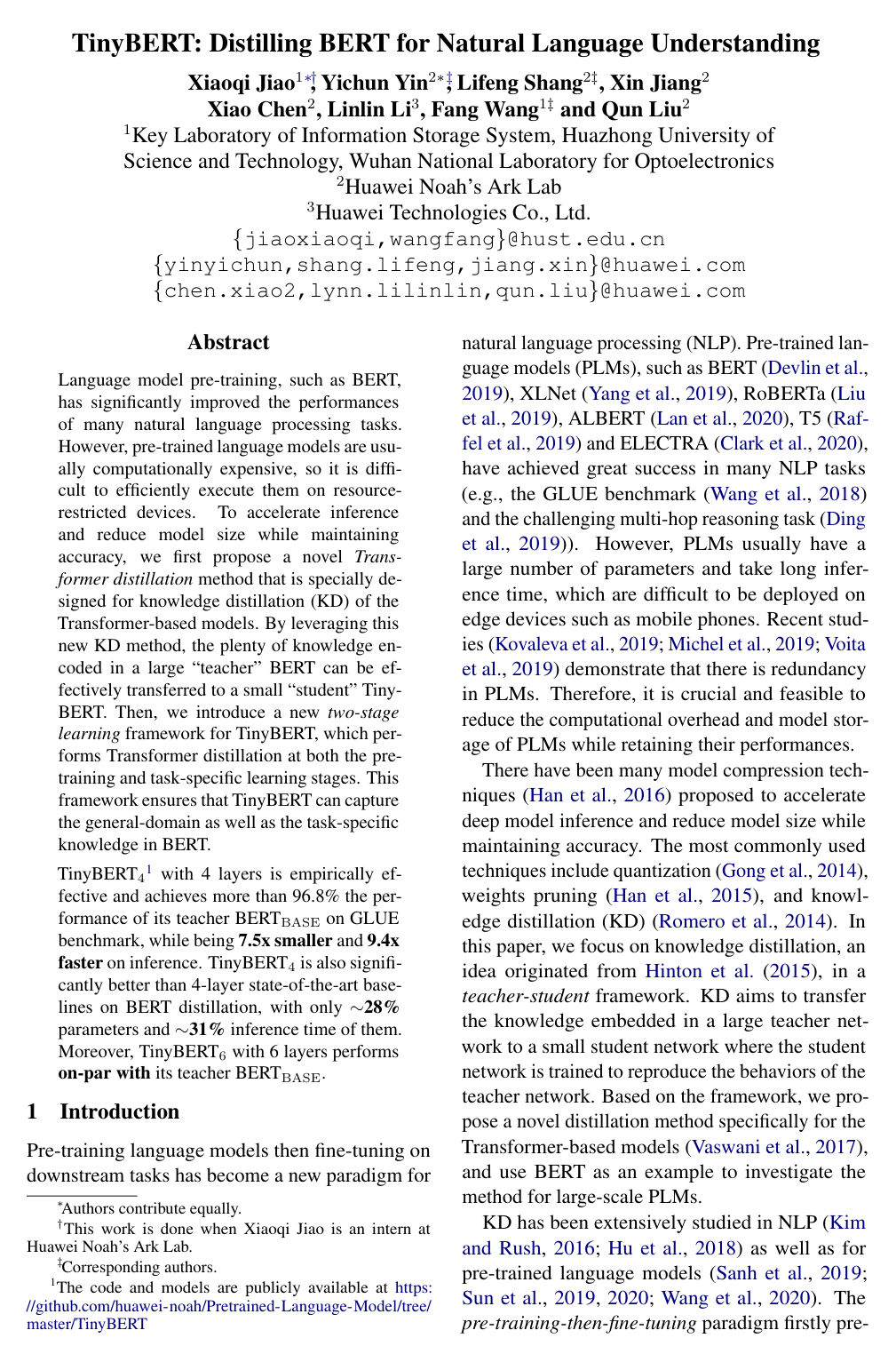
TinyBERT: Distilling BERT for Natural Language Understanding
Xiaoqi Jiao, Yichun Yin, Lifeng Shang, Xin Jiang, Xiao Chen, Linlin Li, Fang Wang, Qun Liu
Why you should read this
Details an indispensable two-stage distillation blueprint that matches transformer embeddings and self-attention matrices during both the pre-training and task-specific fine-tuning phases.
Language model pre-training, such as BERT, has significantly improved the performances of many natural language processing tasks. However, pre-trained language models are usually computationally expensive, so it is difficult to efficiently execute them on resourcerestricted devices. To accelerate inference and reduce model size while maintaining accuracy, we first propose a novel Transformer distillation method that is specially designed for knowledge distillation (KD) of the Transformer-based models. By leveraging this new KD method, the plenty of knowledge encoded in a large "teacher" BERT can be effectively transferred to a small "student" Tiny-BERT. Then, we introduce a new two-stage learning framework for TinyBERT, which performs Transformer distillation at both the pretraining and task-specific learning stages. This framework ensures that TinyBERT can capture the general-domain as well as the task-specific knowledge in BERT.
Added
2026-06-20

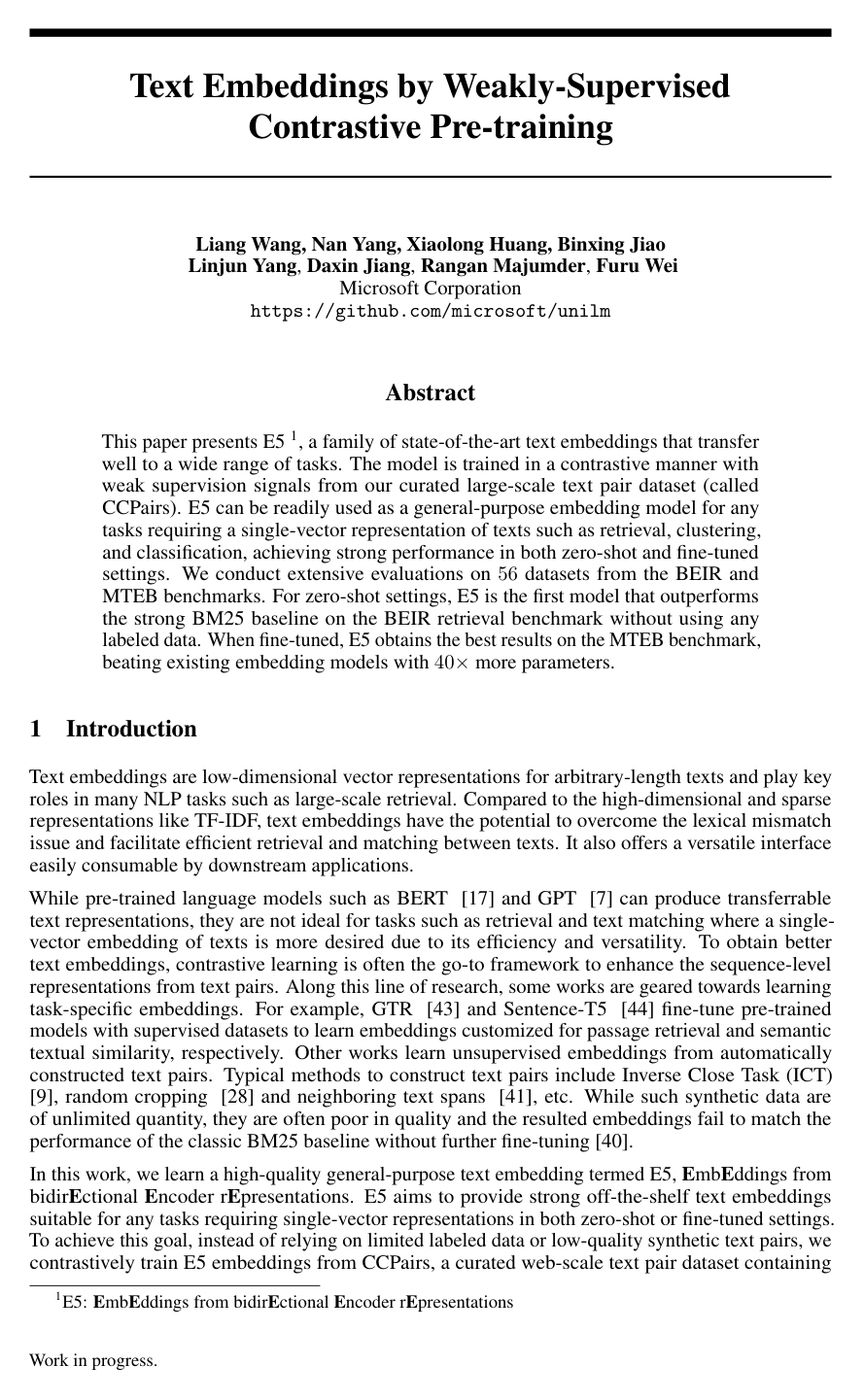
Text Embeddings by Weakly-Supervised Contrastive Pre-training
Liang Wang, Nan Yang, Xiaolong Huang, Binxing Jiao, Linjun Yang, Daxin Jiang, Rangan Majumder, Furu Wei
Why you should read this
Introduces E5, a novel family of text embeddings trained with weakly-supervised contrastive pre-training on a curated large-scale dataset, achieving state-of-the-art performance across diverse NLP tasks, including outperforming BM25 in zero-shot retrieval and setting new records on MTEB with significantly fewer parameters.
This paper presents E5, a family of state-of-the-art text embeddings that transfer well to a wide range of tasks. The model is trained in a contrastive manner with weak supervision signals from our curated large-scale text pair dataset (called CCPairs). E5 can be readily used as a general-purpose embedding model for any tasks requiring a single-vector representation of texts such as retrieval, clustering, and classification, achieving strong performance in both zero-shot and fine-tuned settings. We conduct extensive evaluations on 56 datasets from the BEIR and MTEB benchmarks. For zero-shot settings, E5 is the first model that outperforms the strong BM25 baseline on the BEIR retrieval benchmark without using any labeled data. When fine-tuned, E5 obtains the best results on the MTEB benchmark, beating existing embedding models with 40x more parameters.
Added
2026-05-03