
keyword
semantic similarity
Semantic similarity is a computational and linguistic measure of how closely two units of language, such as words, sentences, or entire texts, correspond in their underlying meaning. Unlike broader semantic relatedness, which encompasses topical associations and functional connections between distinct concepts, semantic similarity specifically evaluates likeness, equivalence, or shared taxonomic characteristics, such as synonymy or shared hypernyms. In natural language processing, it is typically quantified using structural and information-theoretic calculations over lexical taxonomies, statistical analyses of corpus co-occurrences, or geometric distance metrics like cosine similarity applied to dense vector embeddings. Measuring semantic similarity plays a fundamental role in understanding and processing human language, supporting applications such as paraphrase identification, information retrieval, question answering, and automated text evaluation.
25 items
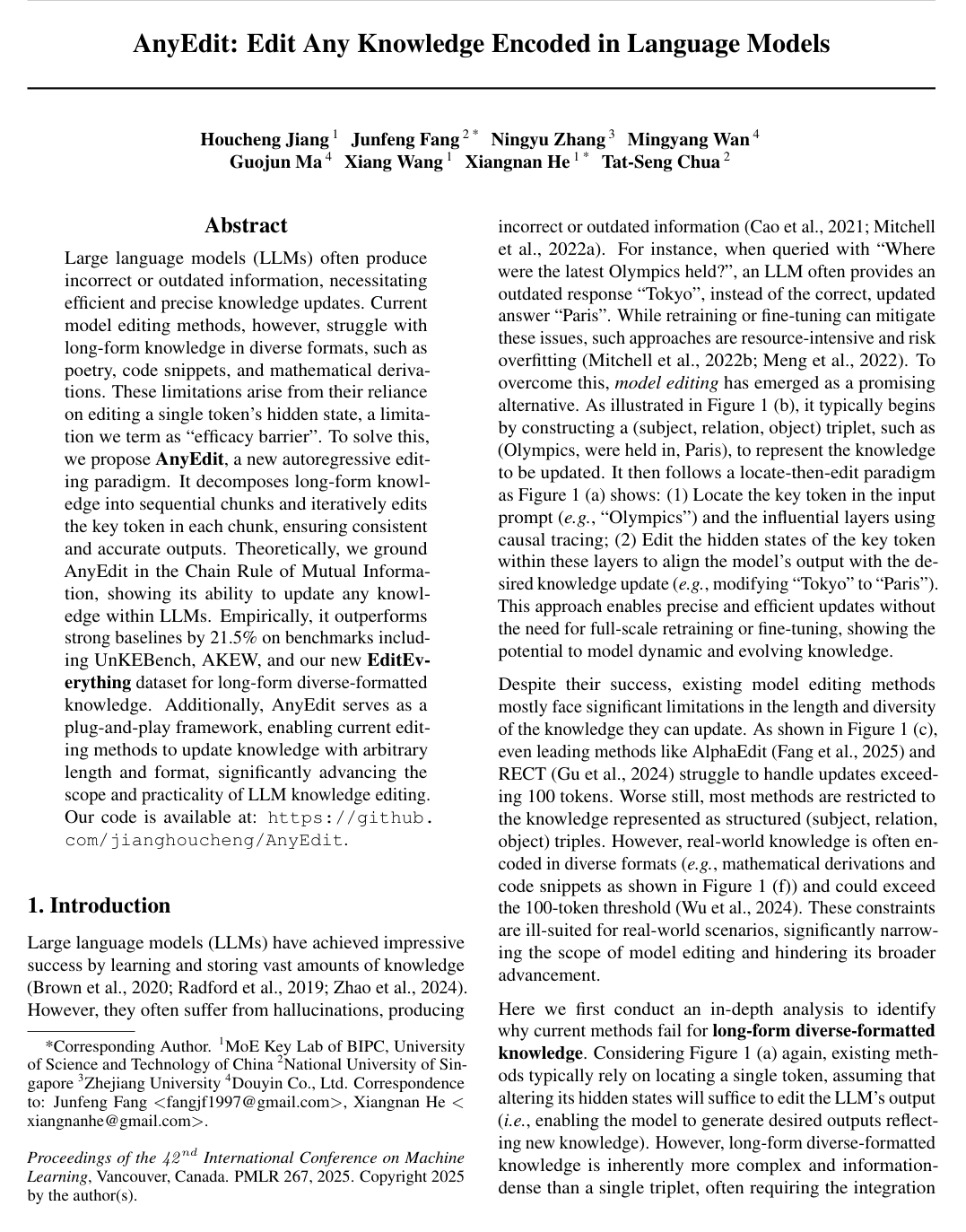
AnyEdit: Edit Any Knowledge Encoded in Language Models
Houcheng Jiang, Junfeng Fang, Ningyu Zhang, Mingyang Wan, Guojun Ma, Xiang Wang, Xiangnan He, Tat-Seng Chua
Why you should read this
Proposes AnyEdit, an autoregressive framework that breaks down complex, long-form knowledge into sequential chunks to iteratively edit key tokens, enabling existing model editing techniques to update diverse formats like code and mathematics without degrading accuracy over long outputs.
Large language models (LLMs) often produce incorrect or outdated information, necessitating efficient and precise knowledge updates. Current model editing methods, however, struggle with long-form knowledge in diverse formats, such as poetry, code snippets, and mathematical derivations. These limitations arise from their reliance on editing a single token’s hidden state, a limitation we term as “efficacy barrier”. To solve this, we propose AnyEdit, a new autoregressive editing paradigm. It decomposes long-form knowledge into sequential chunks and iteratively edits the key token in each chunk, ensuring consistent and accurate outputs. Theoretically, we ground AnyEdit in the Chain Rule of Mutual Information, showing its ability to update any knowledge within LLMs. Empirically, it outperforms strong baselines by 21.5% on benchmarks including UnKEBench, AKEW, and our new EditEverything dataset for long-form diverse-formatted knowledge. Additionally, AnyEdit serves as a plug-and-play framework, enabling current editing methods to update knowledge with arbitrary length and format, significantly advancing the scope and practicality of LLM knowledge editing. Our code is available at: https://github.com/jianghoucheng/AnyEdit.
Added
2026-10-03
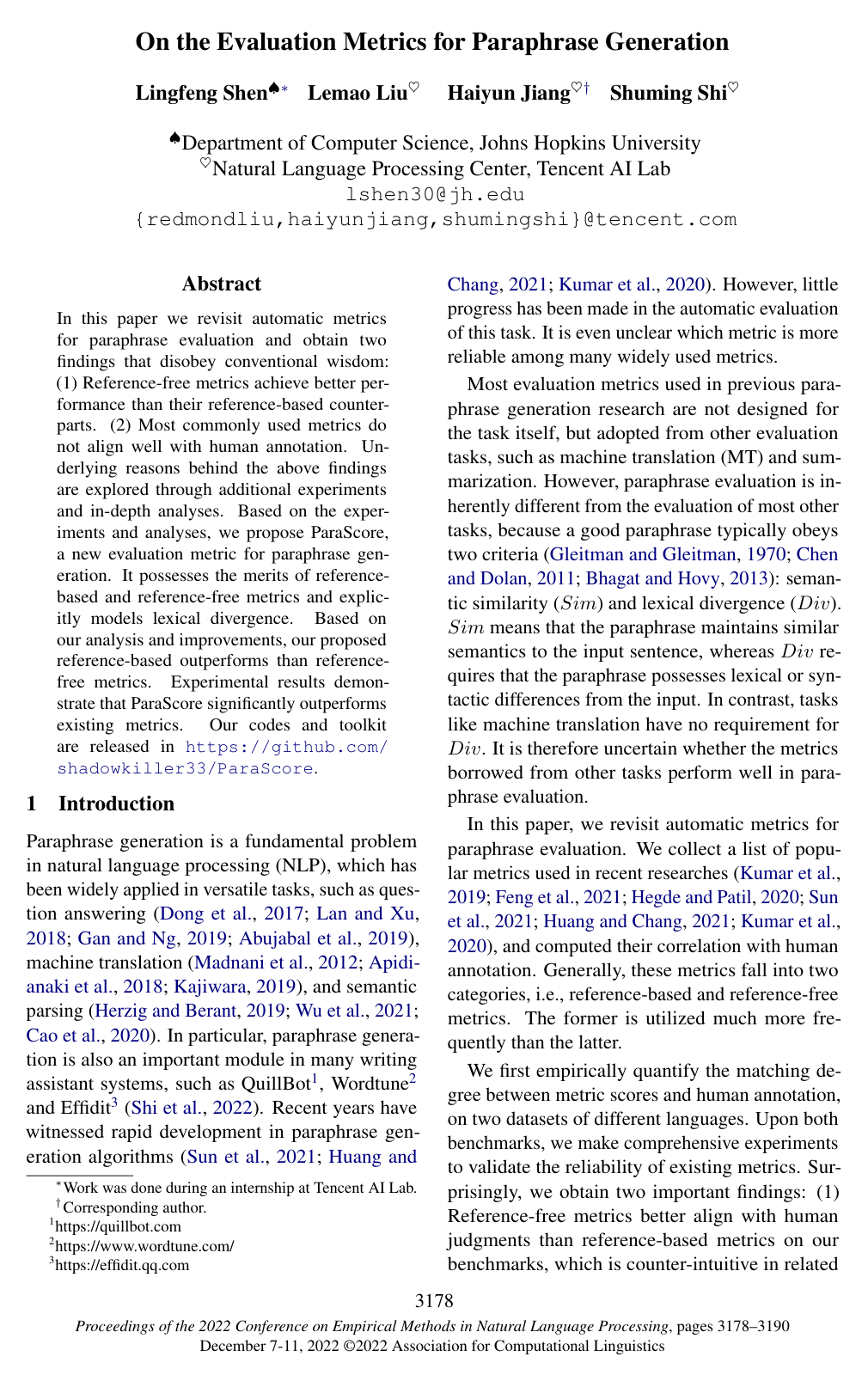
On the Evaluation Metrics for Paraphrase Generation
Lingfeng Shen, Lemao Liu, Haiyun Jiang, Shuming Shi
Why you should read this
Proposes ParaScore, a paraphrase evaluation metric that explicitly incorporates lexical divergence to significantly improve correlation with human judgments over existing automatic metrics.
In this paper we revisit automatic metrics for paraphrase evaluation and obtain two findings that disobey conventional wisdom: (1) Reference-free metrics achieve better performance than their reference-based counterparts. (2) Most commonly used metrics do not align well with human annotation. Underlying reasons behind the above findings are explored through additional experiments and in-depth analyses. Based on the experiments and analyses, we propose ParaScore, a new evaluation metric for paraphrase generation. It possesses the merits of reference-based and reference-free metrics and explicitly models lexical divergence. Based on our analysis and improvements, our proposed reference-based outperforms than reference-free metrics. Experimental results demonstrate that ParaScore significantly outperforms existing metrics. Our codes and toolkit are released in https://github.com/shadowkiller33/ParaScore.
Added
2026-10-03
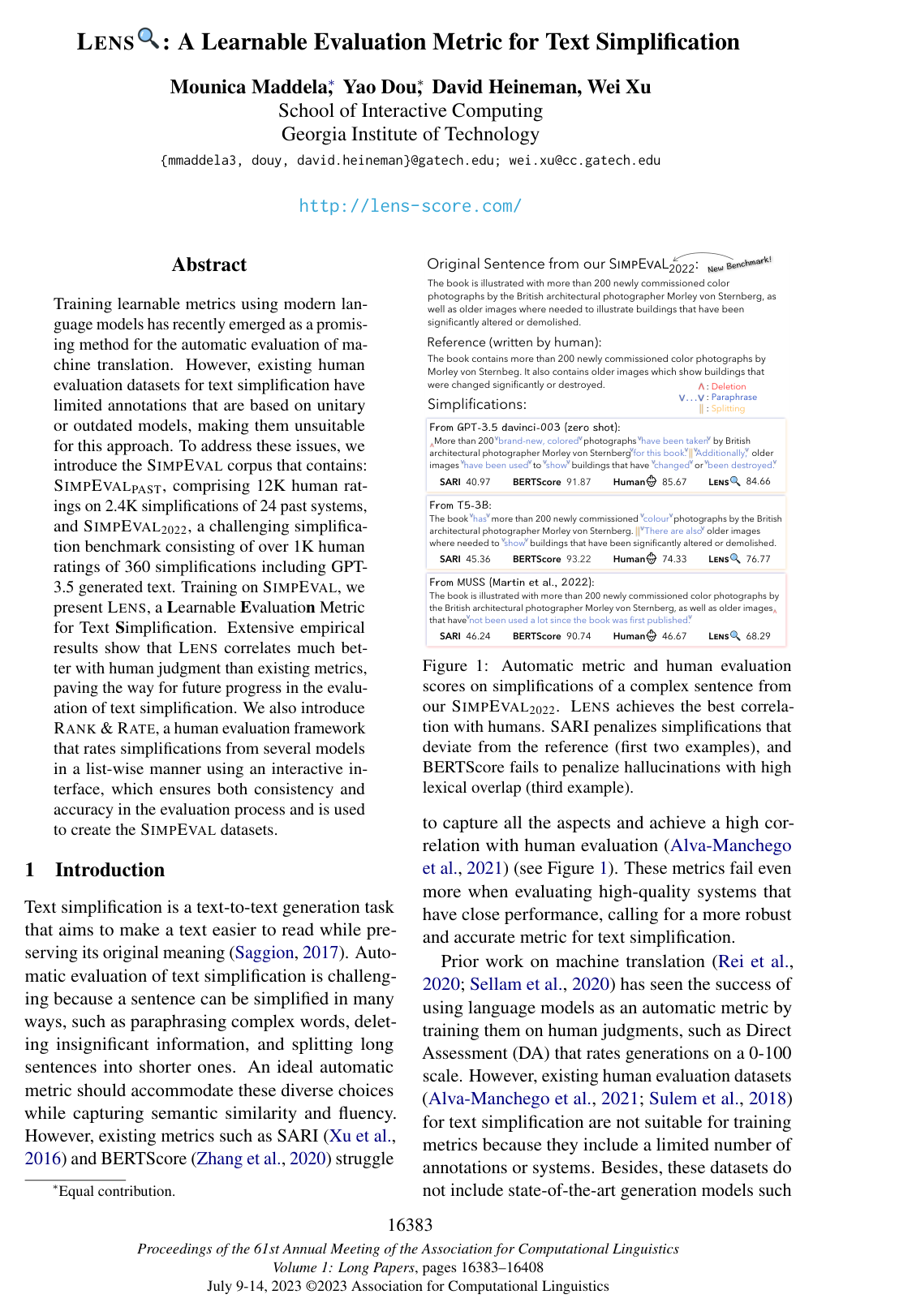
LENS: A Learnable Evaluation Metric for Text Simplification
Mounica Maddela, Yao Dou, David Heineman, Wei Xu
Why you should read this
Introduces LENS, a learnable evaluation metric trained on a comprehensive human-annotated dataset that overcomes the limitations of surface-overlap metrics to achieve state-of-the-art correlation with human judgments in text simplification.
Added
2026-10-02
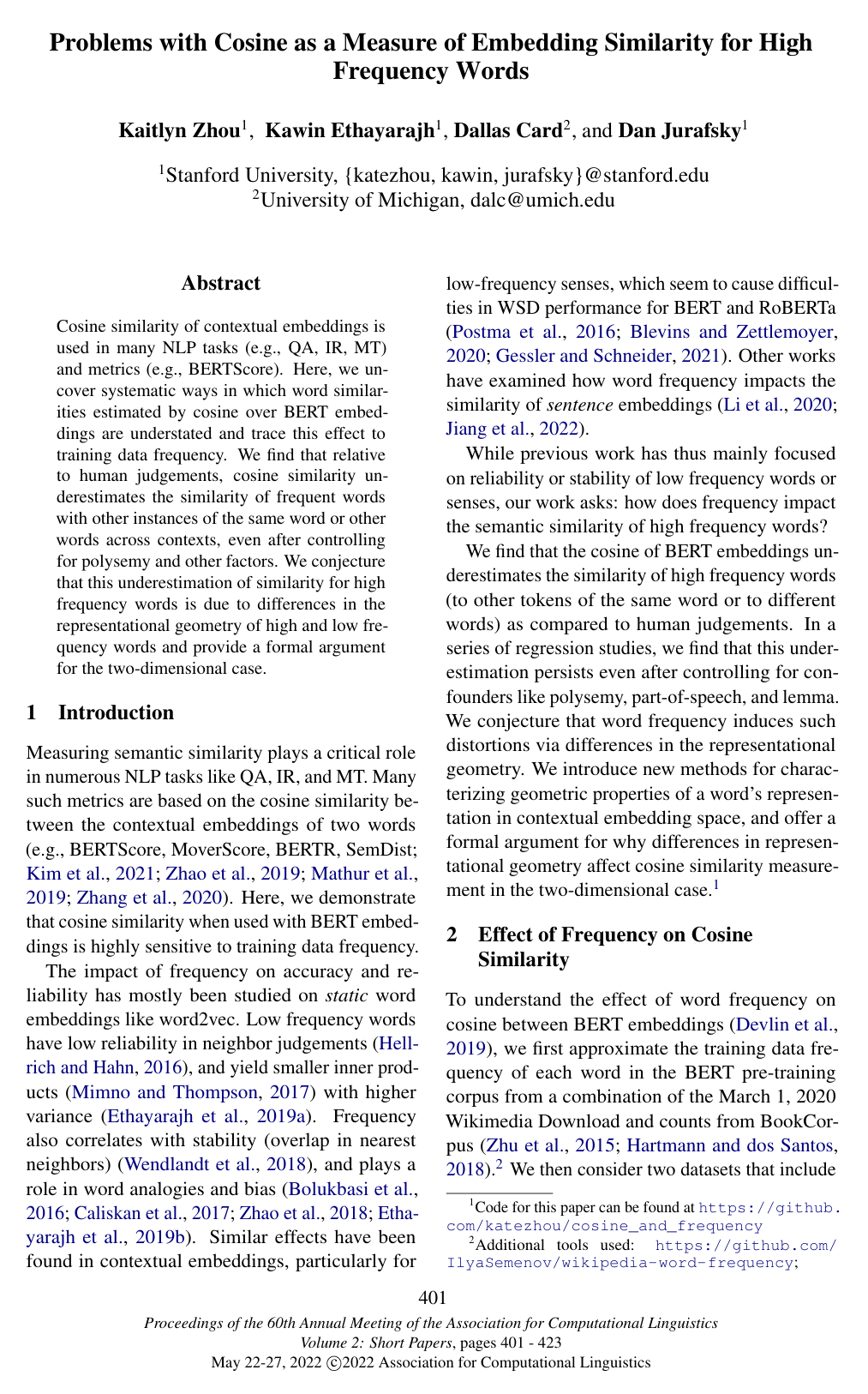
Problems with Cosine as a Measure of Embedding Similarity for High Frequency Words
Kaitlyn Zhou, Kawin Ethayarajh, Dallas Card, Dan Jurafsky
Why you should read this
Demonstrates that cosine similarity systematically underestimates the semantic similarity of high-frequency words in contextual embedding models like BERT relative to human judgment due to frequency-induced geometric distortions in embedding space.
Cosine similarity of contextual embeddings is used in many NLP tasks (e.g., QA, IR, MT) and metrics (e.g., BERTScore). Here, we uncover systematic ways in which word similarities estimated by cosine over BERT embeddings are understated and trace this effect to training data frequency. We find that relative to human judgements, cosine similarity underestimates the similarity of frequent words with other instances of the same word or other words across contexts, even after controlling for polysemy and other factors. We conjecture that this underestimation of similarity for high frequency words is due to differences in the representational geometry of high and low frequency words and provide a formal argument for the two-dimensional case.
Added
2026-10-02
Evaluating Open-Domain Question Answering in the Era of Large Language Models
Ehsan Kamalloo, Nouha Dziri, Charles L. A. Clarke, Davood Rafiei
Why you should read this
Reveals that standard lexical metrics drastically underestimate generative LLM performance on open-domain question answering benchmarks by missing semantically equivalent answers and failing to handle hallucinations, demonstrating why human evaluation remains indispensable.
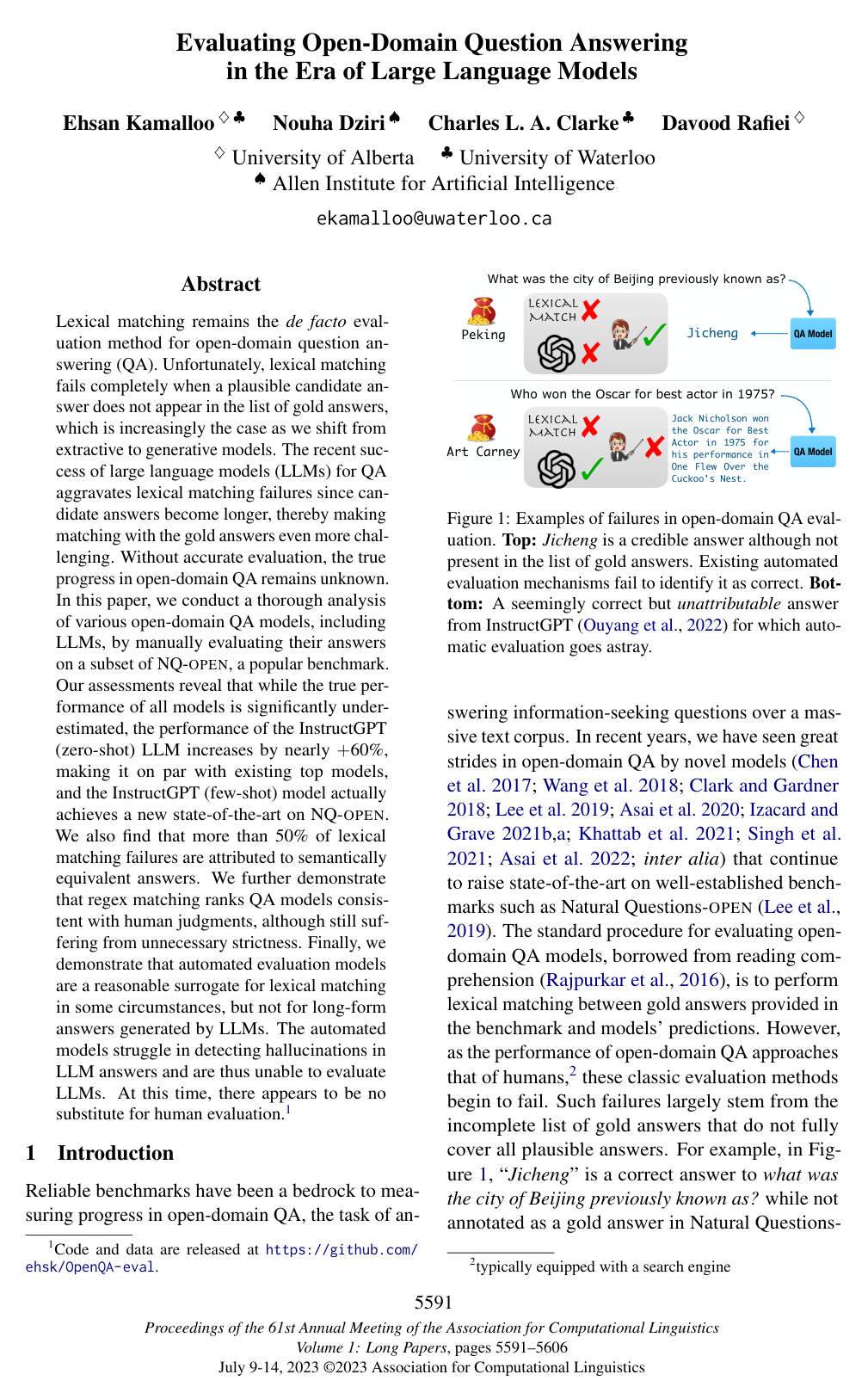
Lexical matching remains the de facto evaluation method for open-domain question answering (QA). Unfortunately, lexical matching fails completely when a plausible candidate answer does not appear in the list of gold answers, which is increasingly the case as we shift from extractive to generative models. The recent success of large language models (LLMs) for QA aggravates lexical matching failures since candidate answers become longer, thereby making matching with the gold answers even more challenging. Without accurate evaluation, the true progress in open-domain QA remains unknown. In this paper, we conduct a thorough analysis of various open-domain QA models, including LLMs, by manually evaluating their answers on a subset of NQ-OPEN, a popular benchmark. Our assessments reveal that while the true performance of all models is significantly underestimated, the performance of the InstructGPT (zero-shot) LLM increases by nearly +60%, making it on par with existing top models, and the InstructGPT (few-shot) model actually achieves a new state-of-the-art on NQ-OPEN. We also find that more than 50% of lexical matching failures are attributed to semantically equivalent answers. We further demonstrate that regex matching ranks QA models consistent with human judgments, although still suffering from unnecessary strictness. Finally, we demonstrate that automated evaluation models are a reasonable surrogate for lexical matching in some circumstances, but not for long-form answers generated by LLMs. The automated models struggle in detecting hallucinations in LLM answers and are thus unable to evaluate LLMs. At this time, there appears to be no substitute for human evaluation.
Added
2026-09-30
Language-agnostic BERT Sentence Embedding
Fangxiaoyu Feng, Yinfei Yang, Daniel Cer, Naveen Arivazhagan, Wei Wang
Why you should read this
Presents a multilingual sentence embedding framework combining pre-trained BERT models with dual-encoder translation ranking to reduce parallel data requirements by 80% while achieving state-of-the-art bitext retrieval performance across more than 100 languages.
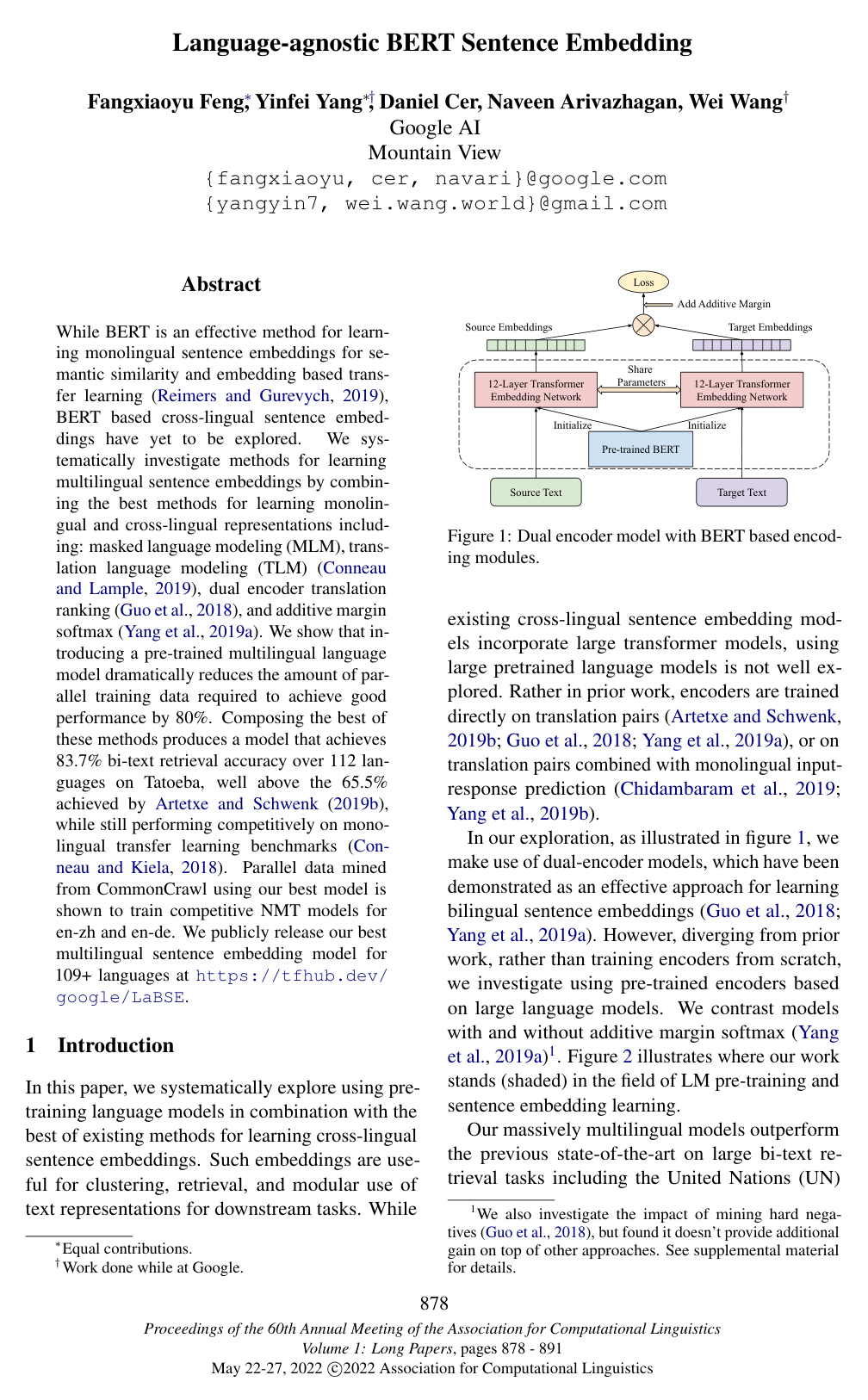
While BERT is an effective method for learning monolingual sentence embeddings for semantic similarity and embedding based transfer learning (Reimers and Gurevych, 2019), BERT based cross-lingual sentence embeddings have yet to be explored. We systematically investigate methods for learning multilingual sentence embeddings by combining the best methods for learning monolingual and cross-lingual representations including: masked language modeling (MLM), translation language modeling (TLM) (Conneau and Lample, 2019), dual encoder translation ranking (Guo et al., 2018), and additive margin softmax (Yang et al., 2019a). We show that introducing a pre-trained multilingual language model dramatically reduces the amount of parallel training data required to achieve good performance by 80%. Composing the best of these methods produces a model that achieves 83.7% bi-text retrieval accuracy over 112 languages on Tatoeba, well above the 65.5% achieved by Artetxe and Schwenk (2019b), while still performing competitively on monolingual transfer learning benchmarks (Conneau and Kiela, 2018). Parallel data mined from CommonCrawl using our best model is shown to train competitive NMT models for en-zh and en-de. We publicly release our best multilingual sentence embedding model for 109+ languages at this https URL.
Added
2026-09-26

PCL: Peer-Contrastive Learning with Diverse Augmentations for Unsupervised Sentence Embeddings
Qiyu Wu, Chongyang Tao, Tao Shen, Can Xu, Xiubo Geng, Daxin Jiang
Why you should read this
Proposes a peer-contrastive learning framework that uses dual cooperating networks and multi-augmentation strategies to prevent shortcut biases and improve unsupervised sentence embeddings across semantic textual similarity benchmarks.
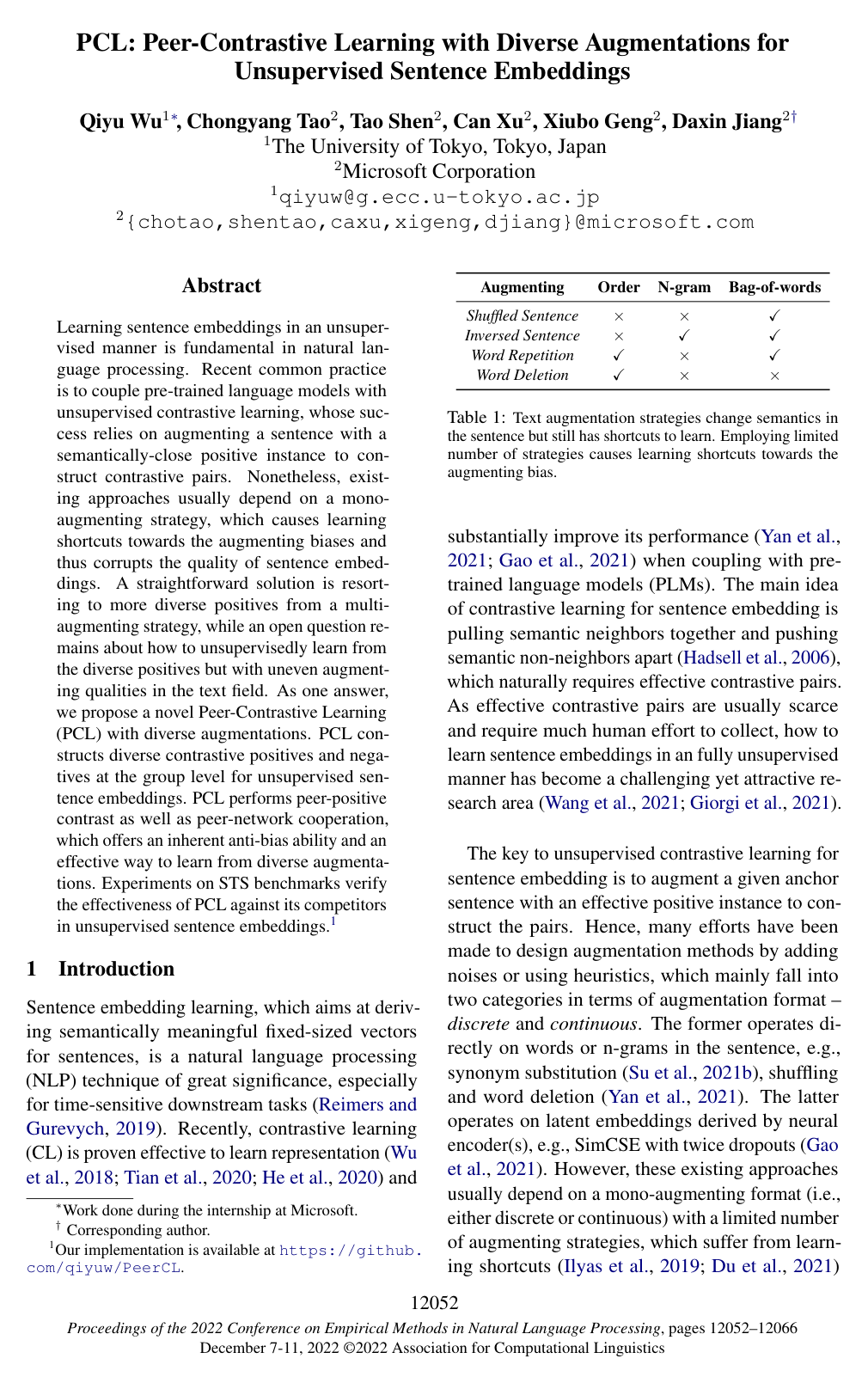
Learning sentence embeddings in an unsupervised manner is fundamental in natural language processing. Recent common practice is to couple pre-trained language models with unsupervised contrastive learning, whose success relies on augmenting a sentence with a semantically-close positive instance to construct contrastive pairs. Nonetheless, existing approaches usually depend on a mono-augmenting strategy, which causes learning shortcuts towards the augmenting biases and thus corrupts the quality of sentence embeddings. A straightforward solution is resorting to more diverse positives from a multi-augmenting strategy, while an open question remains about how to unsupervisedly learn from the diverse positives but with uneven augmenting qualities in the text field. As one answer, we propose a novel Peer-Contrastive Learning (PCL) with diverse augmentations. PCL constructs diverse contrastive positives and negatives at the group level for unsupervised sentence embeddings. PCL performs peer-positive contrast as well as peer-network cooperation, which offers an inherent anti-bias ability and an effective way to learn from diverse augmentations. Experiments on STS benchmarks verify the effectiveness of PCL against its competitors in unsupervised sentence embeddings.^1
Added
2026-09-26
SimLex-999: Evaluating Semantic Models With (Genuine) Similarity Estimation
Felix Hill, Roi Reichart, Anna Korhonen
Why you should read this
Introduces SimLex-999, a gold-standard evaluation benchmark that isolates true semantic similarity from conceptual association across diverse parts of speech and concreteness levels, exposing performance gaps in vector space models.
We present SimLex-999, a gold standard resource for evaluating distributional semantic models that improves on existing resources in several important ways. First, in contrast to gold standards such as WordSim-353 and MEN, it explicitly quantifies similarity rather than association or relatedness, so that pairs of entities that are associated but not actually similar [Freud, psychology] have a low rating. We show that, via this focus on similarity, SimLex-999 incentivizes the development of models with a different, and arguably wider range of applications than those which reflect conceptual association. Second, SimLex-999 contains a range of concrete and abstract adjective, noun and verb pairs, together with an independent rating of concreteness and (free) association strength for each pair. This diversity enables fine-grained analyses of the performance of models on concepts of different types, and consequently greater insight into how architectures can be improved. Further, unlike existing gold standard evaluations, for which automatic approaches have reached or surpassed the inter-annotator agreement ceiling, state-of-the-art models perform well below this ceiling on SimLex-999. There is therefore plenty of scope for SimLex-999 to quantify future improvements to distributional semantic models, guiding the development of the next generation of representation-learning architectures.
Added
2026-09-25
Corpus-based and Knowledge-based Measures of Text Semantic Similarity
Rada Mihalcea, Courtney Corley, Carlo Strapparava
Why you should read this
Proposes a framework for evaluating short text semantic similarity by combining word-level corpus and knowledge-based metrics with inverse document frequency weighting, significantly outperforming standard lexical and vector-space models on paraphrase recognition tasks.
This paper presents a method for measuring the semantic similarity of texts, using corpus-based and knowledge-based measures of similarity. Previous work on this problem has focused mainly on either large documents (e.g. text classification, information retrieval) or individual words (e.g. synonymy tests). Given that a large fraction of the information available today, on the Web and elsewhere, consists of short text snippets (e.g. abstracts of scientific documents, image captions, product descriptions), in this paper we focus on measuring the semantic similarity of short texts. Through experiments performed on a paraphrase data set, we show that the semantic similarity method outperforms methods based on simple lexical matching, resulting in up to 13% error rate reduction with respect to the traditional vector-based similarity metric.
Added
2026-09-25
Automatic Word Sense Discrimination
Hinrich Schütze
Why you should read this
Introduces an unsupervised vector-space clustering method that automatically induces and separates word senses using second-order co-occurrence without requiring manually labeled data or external dictionaries.
This paper presents context-group discrimination, a disambiguation algorithm based on clustering. Senses are interpreted as groups (or clusters) of similar contexts of the ambiguous word. Words, contexts, and senses are represented in Word Space, a high-dimensional, real-valued space in which closeness corresponds to semantic similarity. Similarity in Word Space is based on second-order co-occurrence: two tokens (or contexts) of the ambiguous word are assigned to the same sense cluster if the words they co-occur with in turn occur with similar words in a training corpus. The algorithm is automatic and unsupervised in both training and application: senses are induced from a corpus without labeled training instances or other external knowledge sources. The paper demonstrates good performance of context-group discrimination for a sample of natural and artificial ambiguous words.
Added
2026-09-25
Mining the Web for Synonyms: PMI-IR versus LSA on TOEFL
Peter D. Turney
Why you should read this
Introduces PMI-IR, an unsupervised algorithm that uses web search engine query statistics to measure word similarity, outperforming Latent Semantic Analysis by ten percentage points on standard TOEFL synonym tests.
This paper presents a simple unsupervised learning algorithm for recognizing synonyms, based on statistical data acquired by querying a Web search engine. The algorithm, called PMI-IR, uses Pointwise Mutual Information (PMI) and Information Retrieval (IR) to measure the similarity of pairs of words. PMI-IR is empirically evaluated using 80 synonym test questions from the Test of English as a Foreign Language (TOEFL) and 50 synonym test questions from a collection of tests for students of English as a Second Language (ESL). On both tests, the algorithm obtains a score of 74%. PMI-IR is contrasted with Latent Semantic Analysis (LSA), which achieves a score of 64% on the same 80 TOEFL questions. The paper discusses potential applications of the new unsupervised learning algorithm and some implications of the results for LSA and LSI (Latent Semantic Indexing).
Added
2026-09-25
Don’t count, predict! A systematic comparison of context-counting vs. context-predicting semantic vectors
Marco Baroni, Georgiana Dinu, Germán Kruszewski
Why you should read this
Demonstrates through an extensive empirical evaluation across multiple lexical semantics benchmarks that context-predicting word embedding models consistently outperform traditional count-based distributional semantic vectors across various parameter configurations.
Context-predicting models (more commonly known as embeddings or neural language models) are the new kids on the distributional semantics block. Despite the buzz surrounding these models, the literature is still lacking a systematic comparison of the predictive models with classic, count-vector-based distributional semantic approaches. In this paper, we perform such an extensive evaluation, on a wide range of lexical semantics tasks and across many parameter settings. The results, to our own surprise, show that the buzz is fully justified, as the context-predicting models obtain a thorough and resounding victory against their count-based counterparts.
Added
2026-09-25
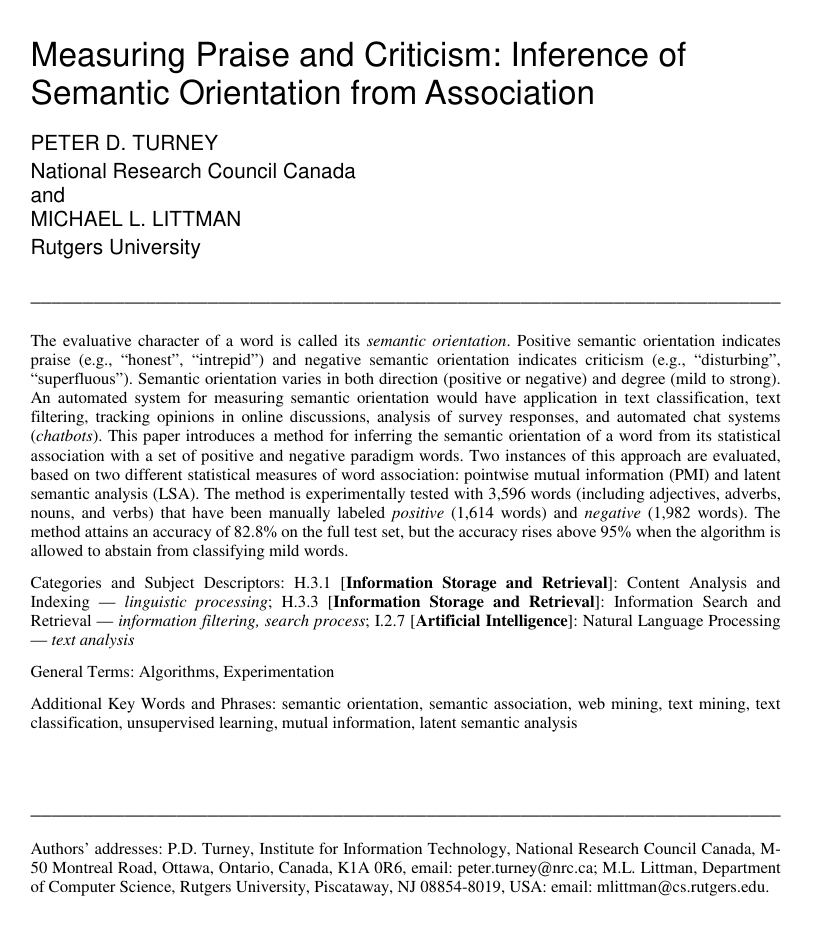
Measuring praise and criticism: Inference of semantic orientation from association
Peter D. Turney, Michael L. Littman
Why you should read this
Proposes a method for automatically determining the positive or negative semantic orientation of words across diverse parts of speech by measuring their statistical association with paradigm seed words using pointwise mutual information and latent semantic analysis.
The evaluative character of a word is called its semantic orientation. Positive semantic orientation indicates praise (e.g., "honest", "intrepid") and negative semantic orientation indicates criticism (e.g., "disturbing", "superfluous"). Semantic orientation varies in both direction (positive or negative) and degree (mild to strong). An automated system for measuring semantic orientation would have application in text classification, text filtering, tracking opinions in online discussions, analysis of survey responses, and automated chat systems (chatbots). This paper introduces a method for inferring the semantic orientation of a word from its statistical association with a set of positive and negative paradigm words. Two instances of this approach are evaluated, based on two different statistical measures of word association: pointwise mutual information (PMI) and latent semantic analysis (LSA). The method is experimentally tested with 3,596 words (including adjectives, adverbs, nouns, and verbs) that have been manually labeled positive (1,614 words) and negative (1,982 words). The method attains an accuracy of 82.8% on the full test set, but the accuracy rises above 95% when the algorithm is allowed to abstain from classifying mild words.
Added
2026-09-24
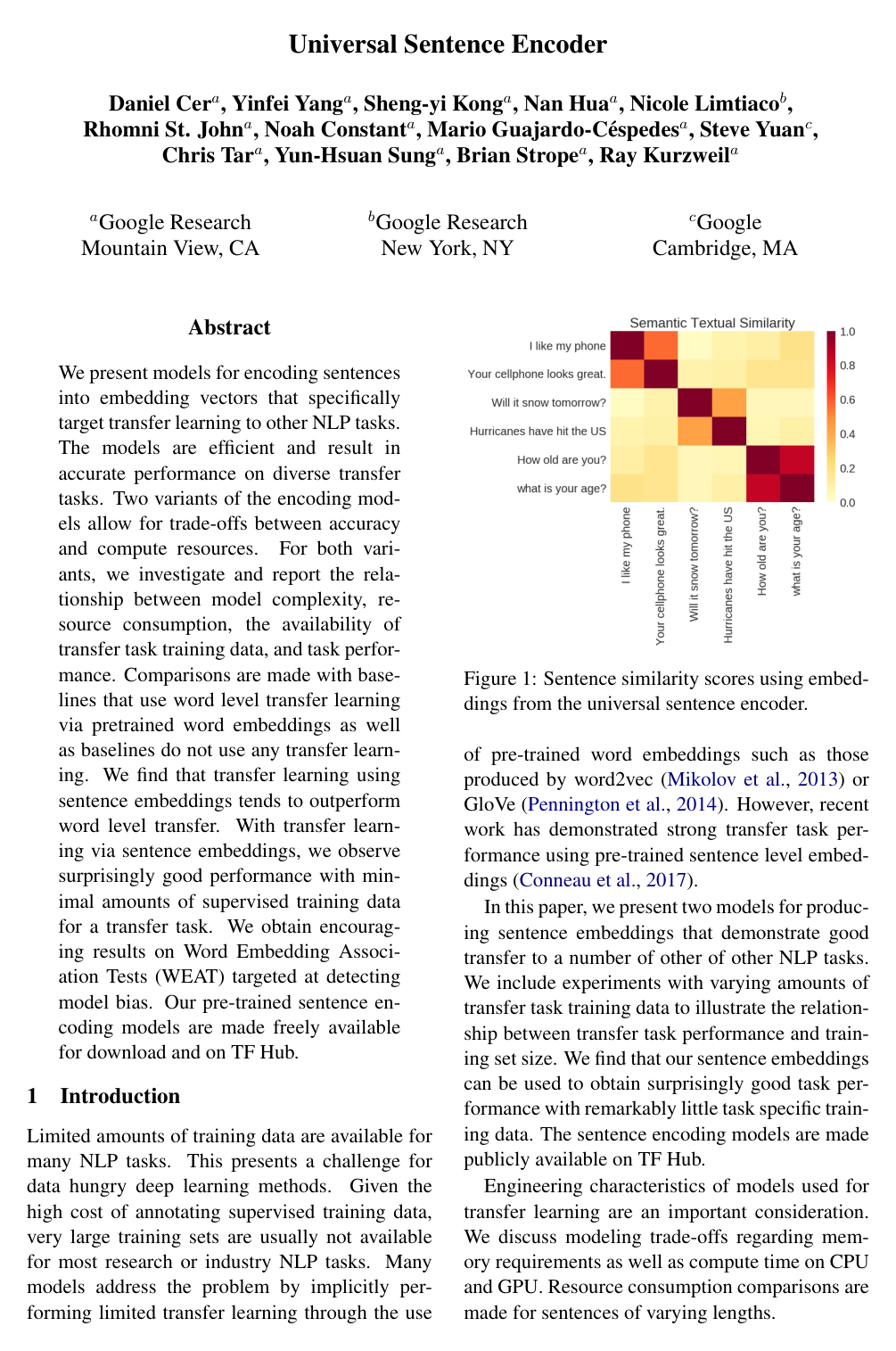
Universal Sentence Encoder
Daniel Cer, Yinfei Yang, Sheng-yi Kong, Nan Hua, Nicole Limtiaco, Rhomni St. John, Noah Constant, Mario Guajardo-Cespedes, Steve Yuan, Chris Tar, Yun-Hsuan Sung, Brian Strope, Ray Kurzweil
Why you should read this
Introduces the Universal Sentence Encoder, providing two pre-trained embedding architectures that balance computational efficiency with accuracy to deliver strong transfer learning performance across diverse language tasks with minimal training data.
We present models for encoding sentences into embedding vectors that specifically target transfer learning to other NLP tasks. The models are efficient and result in accurate performance on diverse transfer tasks. Two variants of the encoding models allow for trade-offs between accuracy and compute resources. For both variants, we investigate and report the relationship between model complexity, resource consumption, the availability of transfer task training data, and task performance. Comparisons are made with baselines that use word level transfer learning via pretrained word embeddings as well as baselines do not use any transfer learning. We find that transfer learning using sentence embeddings tends to outperform word level transfer. With transfer learning via sentence embeddings, we observe surprisingly good performance with minimal amounts of supervised training data for a transfer task. We obtain encouraging results on Word Embedding Association Tests (WEAT) targeted at detecting model bias. Our pre-trained sentence encoding models are made freely available for download and on TF Hub.
Added
2026-09-16
Semantic Similarity in a Taxonomy: An Information-Based Measure and its Application to Problems of Ambiguity in Natural Language
Philip Resnik
Why you should read this
Proposes an information-theoretic measure of semantic similarity that overcomes the limitations of traditional edge-counting in taxonomies and successfully resolves both syntactic and word sense ambiguities in natural language processing.
This article presents a measure of semantic similarity in an IS-A taxonomy based on the notion of shared information content. Experimental evaluation against a benchmark set of human similarity judgments demonstrates that the measure performs better than the traditional edge-counting approach. The article presents algorithms that take advantage of taxonomic similarity in resolving syntactic and semantic ambiguity, along with experimental results demonstrating their effectiveness.
Added
2026-09-15
Computing Semantic Relatedness Using Wikipedia-based Explicit Semantic Analysis
Evgeniy Gabrilovich, Shaul Markovitch
Why you should read this
Shows how Explicit Semantic Analysis turns Wikipedia concepts into interpretable text vectors and substantially improves agreement with human semantic-relatedness judgments.
Computing semantic relatedness of natural language texts requires access to vast amounts of common-sense and domain-specific world knowledge. We propose Explicit Semantic Analysis (ESA), a novel method that represents the meaning of texts in a high-dimensional space of concepts derived from Wikipedia. We use machine learning techniques to explicitly represent the meaning of any text as a weighted vector of Wikipedia-based concepts. Assessing the relatedness of texts in this space amounts to comparing the corresponding vectors using conventional metrics (e.g., cosine). Compared with the previous state of the art, using ESA results in substantial improvements in correlation of computed relatedness scores with human judgments: from r = 0.56 to 0.75 for individual words and from r = 0.60 to 0.72 for texts. Importantly, due to the use of natural concepts, the ESA model is easy to explain to human users.
Added
2026-09-14
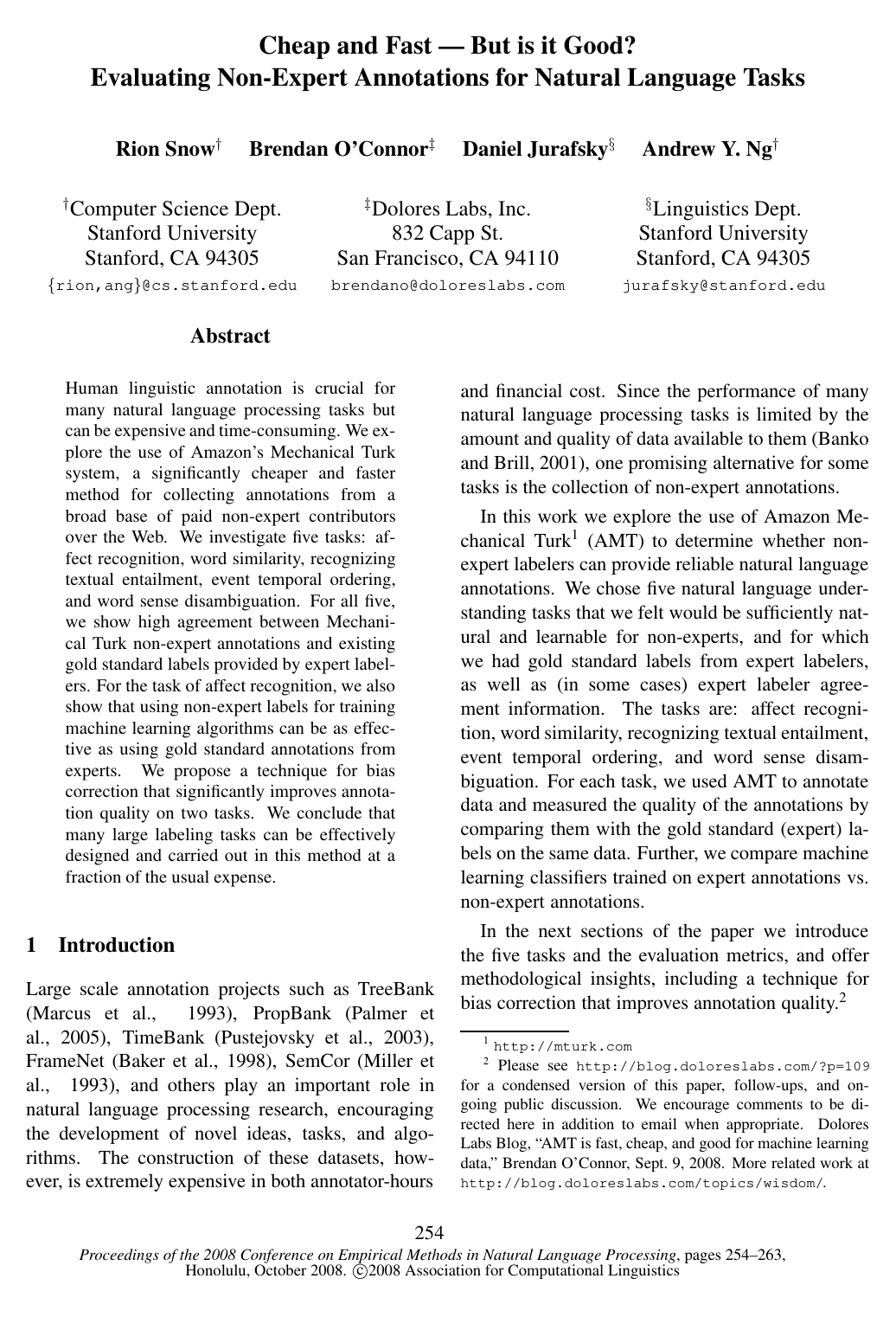
Cheap and Fast – But is it Good? Evaluating Non-Expert Annotations for Natural Language Tasks
Rion Snow, Brendan O'Connor, Daniel Jurafsky, Andrew Y. Ng
Why you should read this
Demonstrates that carefully designed non-expert crowdsourcing can produce reliable NLP labels at a fraction of expert annotation cost.
Human linguistic annotation is crucial for many natural language processing tasks but can be expensive and time-consuming. We explore the use of Amazon’s Mechanical Turk system, a significantly cheaper and faster method for collecting annotations from a broad base of paid non-expert contributors over the Web. We investigate five tasks: affect recognition, word similarity, recognizing textual entailment, event temporal ordering, and word sense disambiguation. For all five, we show high agreement between Mechanical Turk non-expert annotations and existing gold standard labels provided by expert labelers. For the task of affect recognition, we also show that using non-expert labels for training machine learning algorithms can be as effective as using gold standard annotations from experts. We propose a technique for bias correction that significantly improves annotation quality on two tasks. We conclude that many large labeling tasks can be effectively designed and carried out in this method at a fraction of the usual expense.
Added
2026-09-14
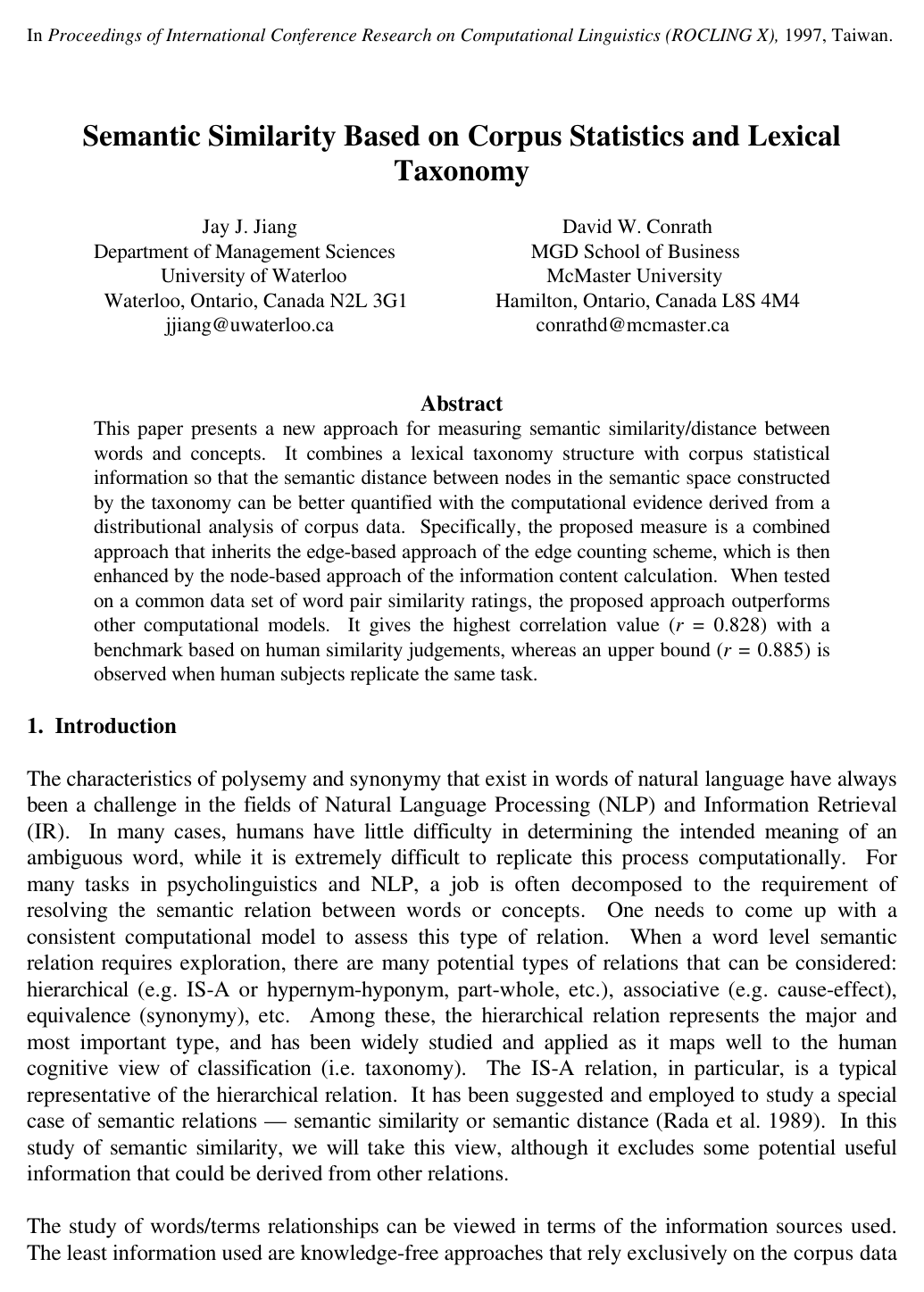
Semantic Similarity Based on Corpus Statistics and Lexical Taxonomy
Jay J. Jiang, David W. Conrath
Why you should read this
Proposes a hybrid semantic similarity measure that integrates lexical taxonomy structure with corpus-derived information content, achieving near-human correlation on standard word-pair similarity benchmarks.
This paper presents a new approach for measuring semantic similarity/distance between words and concepts. It combines a lexical taxonomy structure with corpus statistical information so that the semantic distance between nodes in the semantic space constructed by the taxonomy can be better quantified with the computational evidence derived from a distributional analysis of corpus data. Specifically, the proposed measure is a combined approach that inherits the edge-based approach of the edge counting scheme, which is then enhanced by the node-based approach of the information content calculation. When tested on a common data set of word pair similarity ratings, the proposed approach outperforms other computational models. It gives the highest correlation value (r = 0.828) with a benchmark based on human similarity judgements, whereas an upper bound (r = 0.885) is observed when human subjects replicate the same task.
Added
2026-09-11
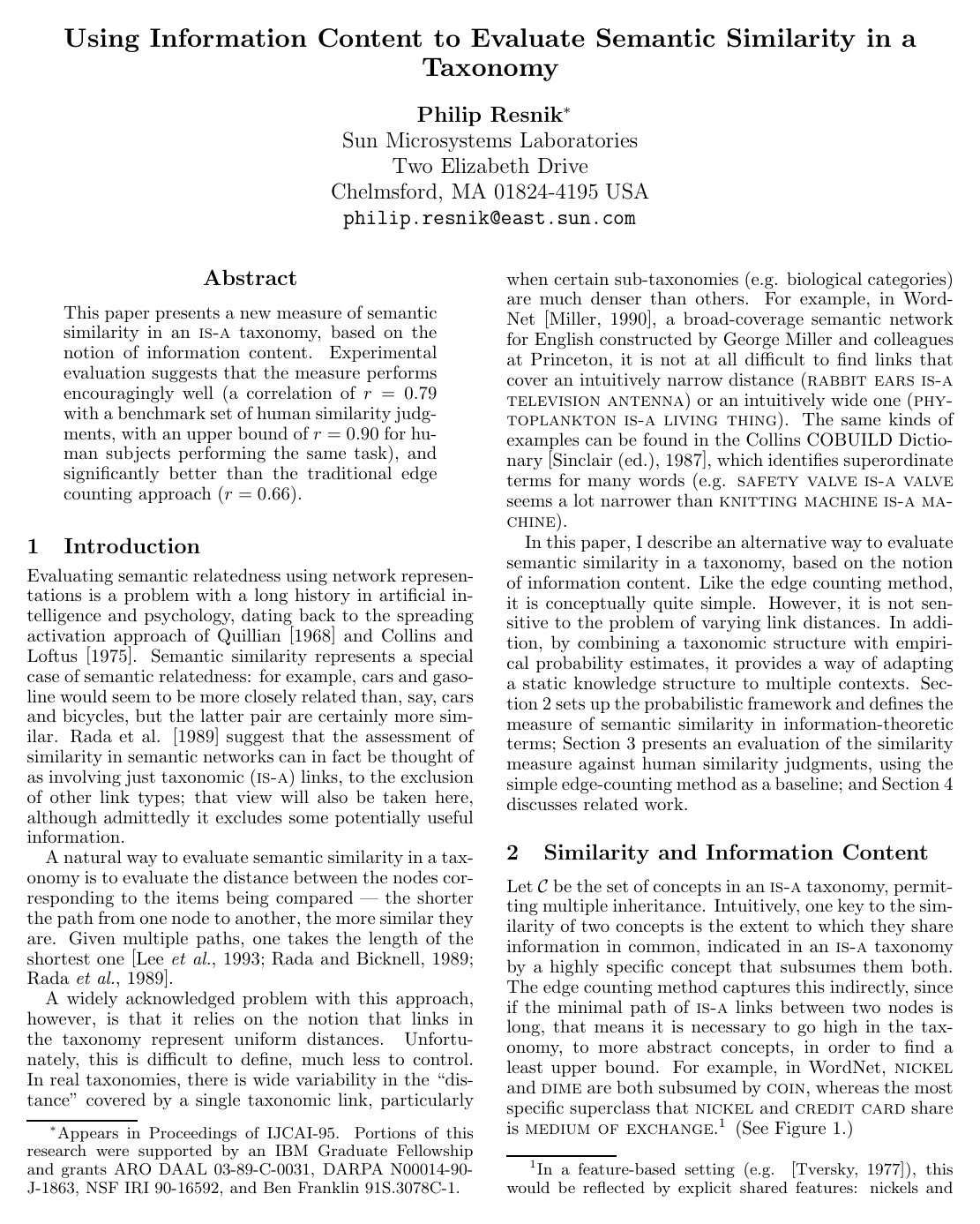
Using Information Content to Evaluate Semantic Similarity in a Taxonomy
Philip Resnik
Why you should read this
Introduces an information-theoretic approach to measuring semantic similarity in concept taxonomies, demonstrating that probability-weighted shared content predicts human judgments far more accurately than standard edge-counting methods.
This paper presents a new measure of semantic similarity in an IS-A taxonomy, based on the notion of information content. Experimental evaluation suggests that the measure performs encouragingly well (a correlation of r = 0.79 with a benchmark set of human similarity judgments, with an upper bound of r = 0.90 for human subjects performing the same task), and significantly better than the traditional edge counting approach (r = 0.66).
Added
2026-09-11
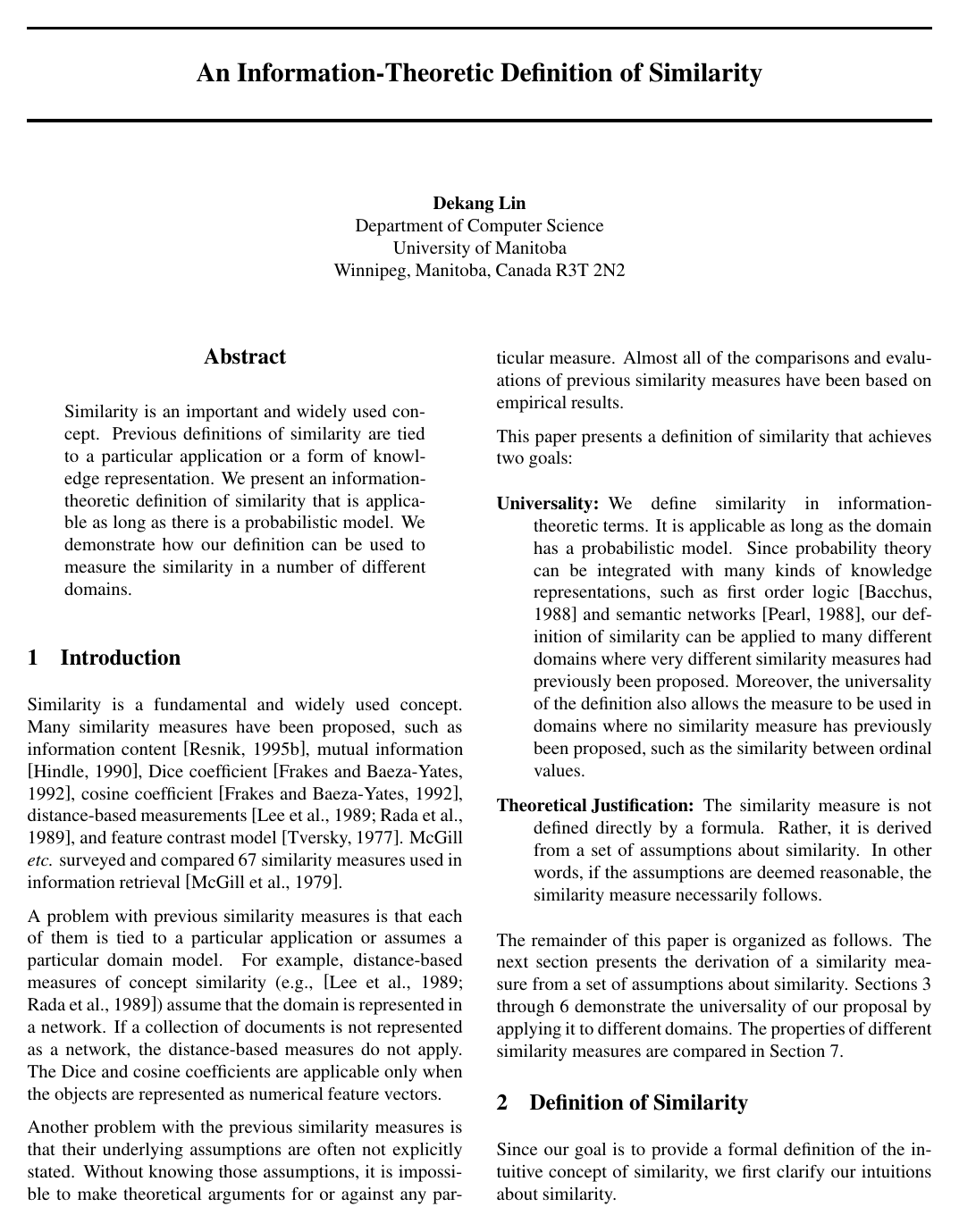
An Information-Theoretic Definition of Similarity
Dekang Lin
Why you should read this
Proposes a universal, information-theoretic similarity metric that quantifies the commonality between objects relative to their total information content across any domain with a probabilistic model.
Similarity is an important and widely used concept. Previous definitions of similarity are tied to a particular application or a form of knowledge representation. We present an information-theoretic definition of similarity that is applicable as long as there is a probabilistic model. We demonstrate how our definition can be used to measure the similarity in a number of different domains.
Added
2026-09-10