
keyword
semantic entropy
Semantic entropy is a method for quantifying uncertainty in generative language models by calculating the entropy across distinct meanings rather than literal text sequences. Traditional token-level entropy metrics often overestimate uncertainty because a model can express a single concept through multiple syntactic variations and paraphrases. To address this, semantic entropy samples multiple candidate answers from a model, groups them into equivalence classes based on shared semantic meaning, and computes the Shannon entropy over this aggregated distribution of meanings. By measuring the spread of probability across distinct interpretations rather than surface-level wording differences, semantic entropy provides a more accurate estimate of epistemic uncertainty, helping to detect hallucinations and evaluate model reliability in text generation tasks.
6 items
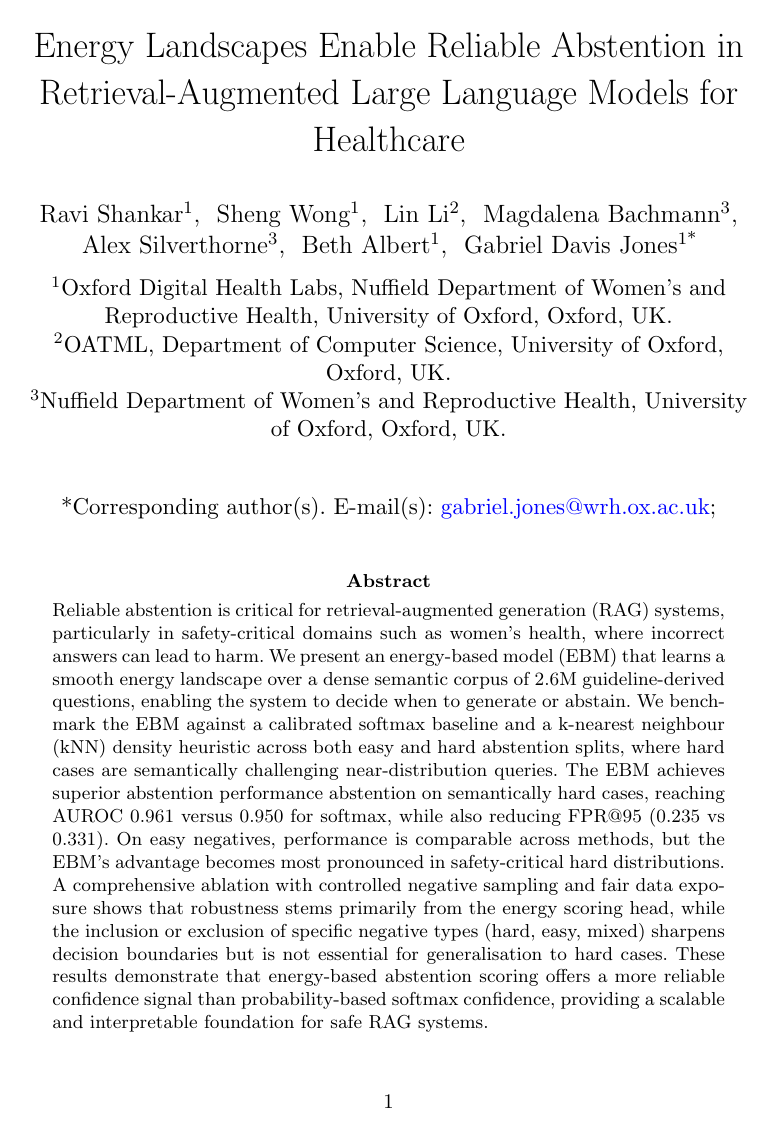
Energy Landscapes Enable Reliable Abstention in Retrieval-Augmented Large Language Models for Healthcare
Ravi Shankar, Sheng Wong, Lin Li, Magdalena Bachmann, Alex Silverthorne, Beth Albert, Gabriel Jones
Why you should read this
Proposes an energy-based modeling approach that significantly outperforms calibrated softmax confidence for selective abstention in healthcare retrieval-augmented generation, substantially reducing false positive rates on hard near-distribution queries.
Reliable abstention is critical for retrieval-augmented generation (RAG) systems, particularly in safety-critical domains such as women's health, where incorrect answers can lead to harm. We present an energy-based model (EBM) that learns a smooth energy landscape over a dense semantic corpus of 2.6M guideline-derived questions, enabling the system to decide when to generate or abstain. We benchmark the EBM against a calibrated softmax baseline and a k-nearest neighbour (kNN) density heuristic across both easy and hard abstention splits, where hard cases are semantically challenging near-distribution queries. The EBM achieves superior abstention performance abstention on semantically hard cases, reaching AUROC 0.961 versus 0.950 for softmax, while also reducing FPR@95 (0.235 vs 0.331). On easy negatives, performance is comparable across methods, but the EBM's advantage becomes most pronounced in safety-critical hard distributions. A comprehensive ablation with controlled negative sampling and fair data exposure shows that robustness stems primarily from the energy scoring head, while the inclusion or exclusion of specific negative types (hard, easy, mixed) sharpens decision boundaries but is not essential for generalisation to hard cases. These results demonstrate that energy-based abstention scoring offers a more reliable confidence signal than probability-based softmax confidence, providing a scalable and interpretable foundation for safe RAG systems.
Added
2026-10-04
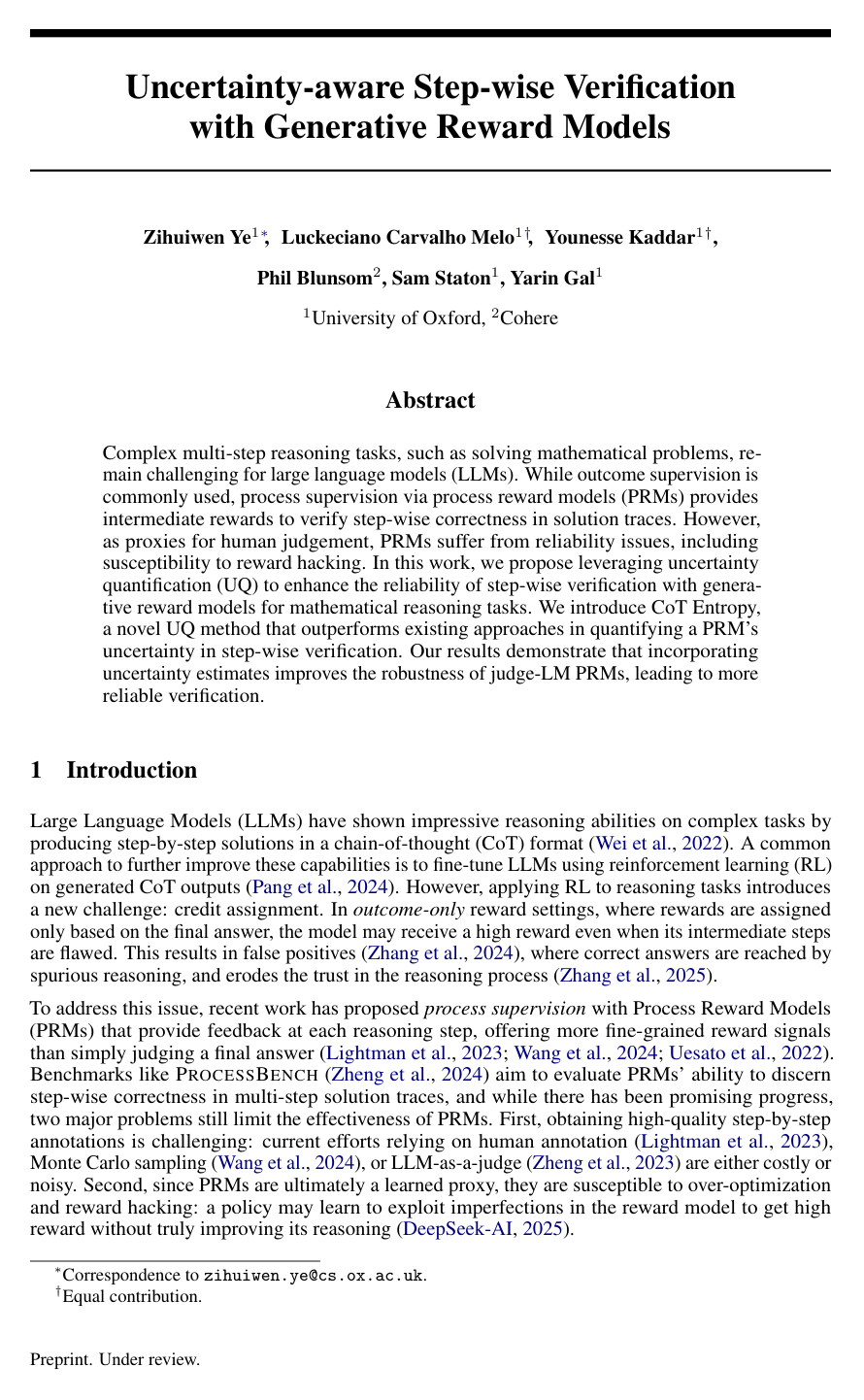
Uncertainty-Aware Step-wise Verification with Generative Reward Models
Daniella (Zihuiwen) Ye, Luckeciano Carvalho Melo, Younesse Kaddar, Phil Blunsom, Sam Staton, Yarin Gal
Why you should read this
Develops CoT Entropy, an uncertainty quantification method for generative process reward models that improves the reliability of step-wise verification and mitigates reward hacking in complex mathematical reasoning.
Complex multi-step reasoning tasks, such as solving mathematical problems, remain challenging for large language models (LLMs). While outcome supervision is commonly used, process supervision via process reward models (PRMs) provides intermediate rewards to verify step-wise correctness in solution traces. However, as proxies for human judgement, PRMs suffer from reliability issues, including susceptibility to reward hacking. In this work, we propose leveraging uncertainty quantification (UQ) to enhance the reliability of step-wise verification with generative reward models for mathematical reasoning tasks. We introduce CoT Entropy, a novel UQ method that outperforms existing approaches in quantifying a PRM's uncertainty in step-wise verification. Our results demonstrate that incorporating uncertainty estimates improves the robustness of judge-LM PRMs, leading to more reliable verification.
Added
2026-10-04
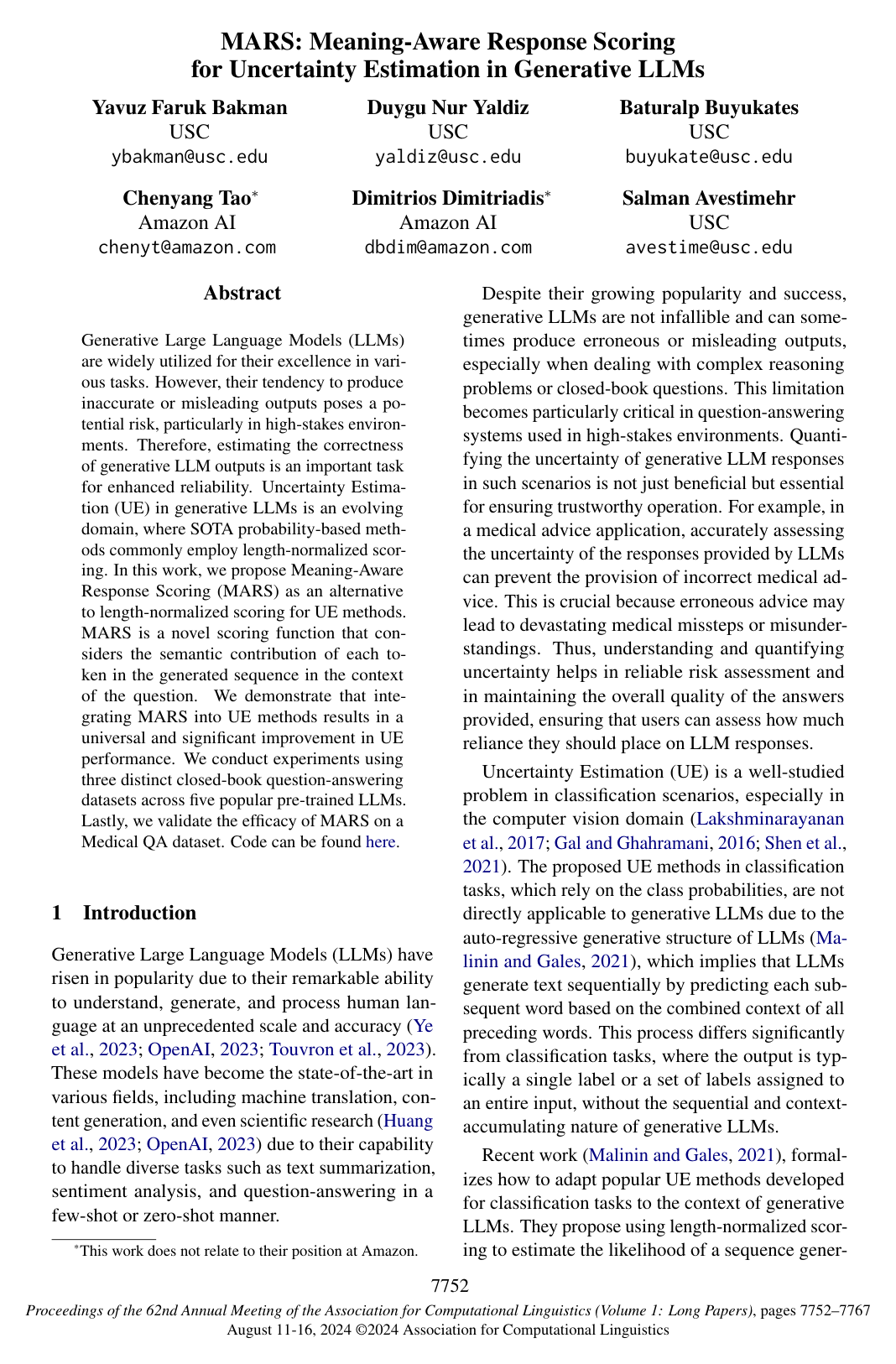
MARS: Meaning-Aware Response Scoring for Uncertainty Estimation in Generative LLMs
Yavuz Faruk Bakman, Duygu Nur Yaldiz, Baturalp Buyukates, Chenyang Tao, Dimitrios Dimitriadis, Salman Avestimehr
Why you should read this
Presents Meaning-Aware Response Scoring (MARS), a framework that weights each token by its semantic contribution to the answer rather than applying uniform length normalization, substantially improving uncertainty estimation and error detection across multiple large language models and question-answering benchmarks.
Generative Large Language Models (LLMs) are widely utilized for their excellence in various tasks. However, their tendency to produce inaccurate or misleading outputs poses a potential risk, particularly in high-stakes environments. Therefore, estimating the correctness of generative LLM outputs is an important task for enhanced reliability. Uncertainty Estimation (UE) in generative LLMs is an evolving domain, where SOTA probability-based methods commonly employ length-normalized scoring. In this work, we propose Meaning-Aware Response Scoring (MARS) as an alternative to length-normalized scoring for UE methods. MARS is a novel scoring function that considers the semantic contribution of each token in the generated sequence in the context of the question. We demonstrate that integrating MARS into UE methods results in a universal and significant improvement in UE performance. We conduct experiments using three distinct closed-book question-answering datasets across five popular pre-trained LLMs. Lastly, we validate the efficacy of MARS on a Medical QA dataset. Code can be found here.
Added
2026-10-04
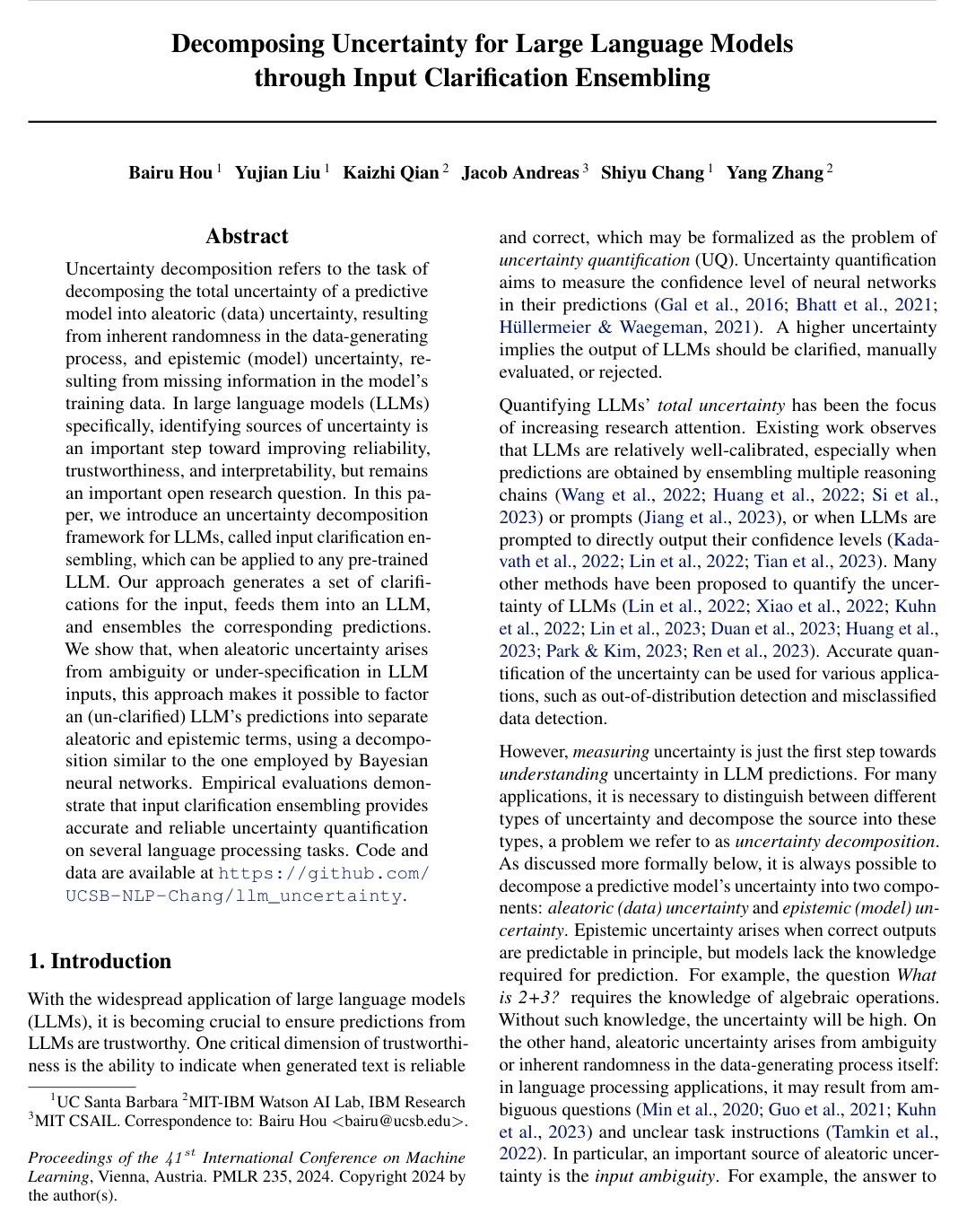
Decomposing Uncertainty for Large Language Models through Input Clarification Ensembling
Bairu Hou, Yujian Liu, Kaizhi Qian, Jacob Andreas, Shiyu Chang, Yang Zhang
Why you should read this
Proposes input clarification ensembling, a practical framework that separates large language model uncertainty into input ambiguity and model knowledge deficits without modifying model parameters or training procedures.
Uncertainty decomposition refers to the task of decomposing the total uncertainty of a predictive model into aleatoric (data) uncertainty, resulting from inherent randomness in the data-generating process, and epistemic (model) uncertainty, resulting from missing information in the model’s training data. In large language models (LLMs) specifically, identifying sources of uncertainty is an important step toward improving reliability, trustworthiness, and interpretability, but remains an important open research question. In this paper, we introduce an uncertainty decomposition framework for LLMs, called input clarification ensembling, which can be applied to any pre-trained LLM. Our approach generates a set of clarifications for the input, feeds them into an LLM, and ensembles the corresponding predictions. We show that, when aleatoric uncertainty arises from ambiguity or under-specification in LLM inputs, this approach makes it possible to factor an (un-clarified) LLM’s predictions into separate aleatoric and epistemic terms, using a decomposition similar to the one employed by Bayesian neural networks. Empirical evaluations demonstrate that input clarification ensembling provides accurate and reliable uncertainty quantification on several language processing tasks. Code and data are available at https://github.com/UCSB-NLP-Chang/llm_uncertainty.
Added
2026-10-01
Inducing Artificial Uncertainty in Language Models
Sophia Hager, Simon Zeng, Nicholas Andrews
Why you should read this
Demonstrates that training uncertainty probes on artificially induced uncertainty in language models significantly improves confidence calibration on difficult tasks where naturally challenging training data is scarce.
In safety-critical applications, language models should be able to characterize their uncertainty with meaningful probabilities. Many uncertainty quantification approaches require supervised data; however, finding suitable unseen challenging data is increasingly difficult for large language models trained on vast amounts of scraped data. If the model is consistently (and correctly) confident in its predictions, the uncertainty quantification method may consistently overestimate confidence on new and unfamiliar data. Finding data which exhibits enough uncertainty to train supervised uncertainty quantification methods for high-performance models may therefore be challenging, and will increase in difficulty as LLMs saturate datasets. To address this issue, we first introduce the problem of inducing artificial uncertainty in language models, then investigate methods of inducing artificial uncertainty on trivially easy data in the absence of challenging data at training time. We use probes trained to recognize artificial uncertainty on the original model, and find that these probes trained on artificial uncertainty outperform probes trained without artificial uncertainty in recognizing real uncertainty, achieving notably higher calibration on hard data with minimal loss of performance on easy data.
Added
2026-09-29
Fine-Tuning Language Models for Factuality
Katherine Tian, Eric Mitchell, Huaxiu Yao, Christopher D. Manning, Chelsea Finn
Why you should read this
Demonstrates that training language models with direct preference optimization on automatically generated factuality rankings reduces open-ended generation errors by up to 58% without requiring human annotation.
The fluency and creativity of large pre-trained language models (LLMs) have led to their widespread use, sometimes even as a replacement for traditional search engines. Yet language models are prone to making convincing but factually inaccurate claims, often referred to as 'hallucinations.' These errors can inadvertently spread misinformation or harmfully perpetuate misconceptions. Further, manual fact-checking of model responses is a time-consuming process, making human factuality labels expensive to acquire. In this work, we fine-tune language models to be more factual, without human labeling and targeting more open-ended generation settings than past work. We leverage two key recent innovations in NLP to do so. First, several recent works have proposed methods for judging the factuality of open-ended text by measuring consistency with an external knowledge base or simply a large model's confidence scores. Second, the direct preference optimization algorithm enables straightforward fine-tuning of language models on objectives other than supervised imitation, using a preference ranking over possible model responses. We show that learning from automatically generated factuality preference rankings, generated either through existing retrieval systems or our novel retrieval-free approach, significantly improves the factuality (percent of generated claims that are correct) of Llama-2 on held-out topics compared with RLHF or decoding strategies targeted at factuality. At 7B scale, compared to Llama-2-chat, we observe 58% and 40% reduction in factual error rate when generating biographies and answering medical questions, respectively.
Added
2026-09-26