
keyword
self-driving cars
Self-driving cars are motor vehicles equipped with automated systems that allow them to perceive their surroundings and navigate roadways without direct human control. These vehicles utilize an integrated suite of sensors, such as cameras, radar, and lidar, along with artificial intelligence, computer vision, and machine learning software to interpret sensory data, detect road features, identify obstacles, and execute essential driving tasks like steering, acceleration, and braking. Autonomous driving systems can range from partial automation that assists a human operator to full automation where the onboard computer independently handles all navigation and control decisions across diverse traffic and environmental conditions.
2 items
End to End Learning for Self-Driving Cars
Mariusz Bojarski, Davide Del Testa, Daniel Dworakowski, Bernhard Firner, Beat Flepp, Prasoon Goyal, Lawrence D. Jackel, Mathew Monfort, Urs Muller, Jiakai Zhang, Xin Zhang, Jake Zhao, Karol Zieba
Why you should read this
Demonstrates that a single convolutional neural network can steer an autonomous vehicle directly from raw camera pixels, proving that end-to-end deep learning can replace traditional modular pipelines for lane detection and path planning.
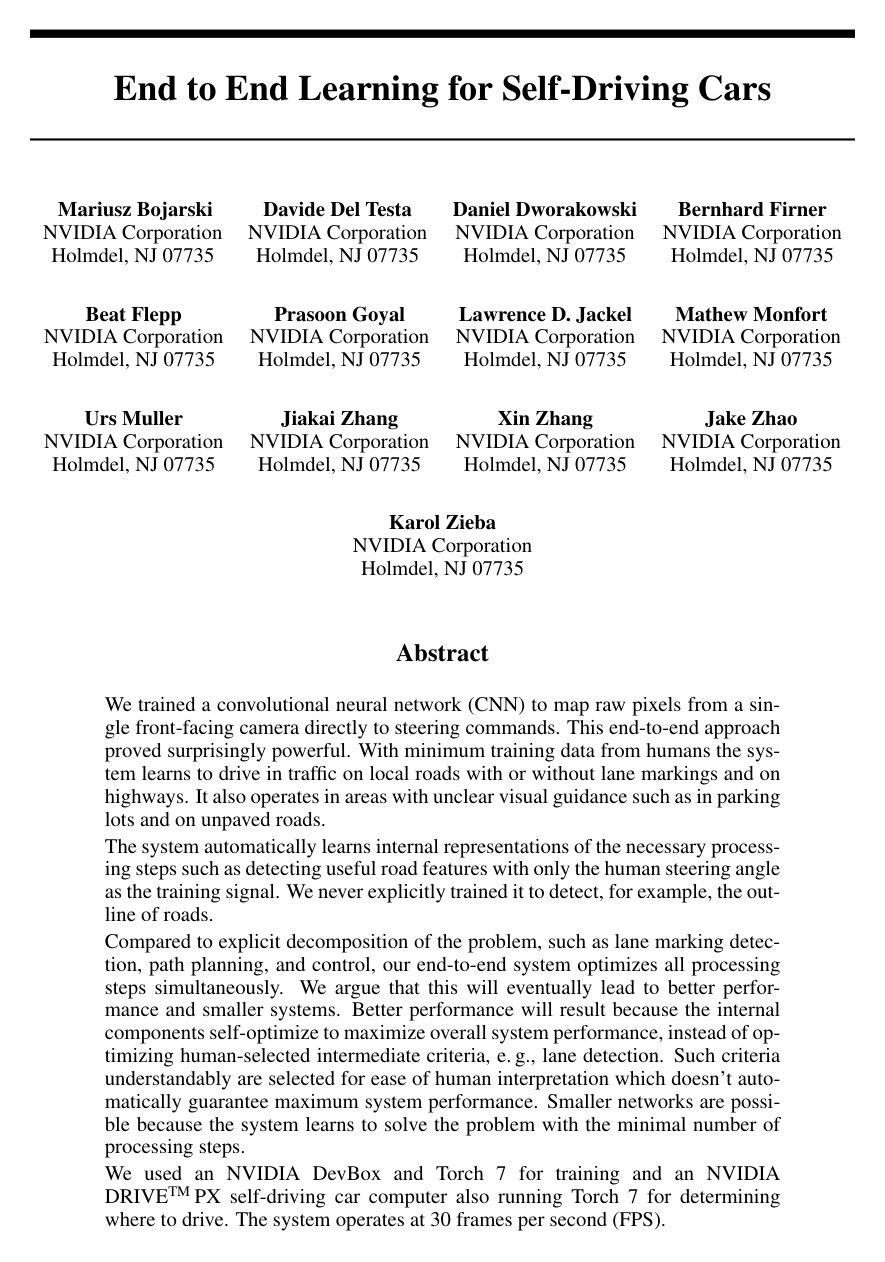
We trained a convolutional neural network (CNN) to map raw pixels from a single front-facing camera directly to steering commands. This end-to-end approach proved surprisingly powerful. With minimum training data from humans the system learns to drive in traffic on local roads with or without lane markings and on highways. It also operates in areas with unclear visual guidance such as in parking lots and on unpaved roads. The system automatically learns internal representations of the necessary processing steps such as detecting useful road features with only the human steering angle as the training signal. We never explicitly trained it to detect, for example, the outline of roads. Compared to explicit decomposition of the problem, such as lane marking detection, path planning, and control, our end-to-end system optimizes all processing steps simultaneously. We argue that this will eventually lead to better performance and smaller systems. Better performance will result because the internal components self-optimize to maximize overall system performance, instead of optimizing human-selected intermediate criteria, e.g., lane detection. Such criteria understandably are selected for ease of human interpretation which doesn't automatically guarantee maximum system performance. Smaller networks are possible because the system learns to solve the problem with the minimal number of processing steps. We used an NVIDIA DevBox and Torch 7 for training and an NVIDIA DRIVE(TM) PX self-driving car computer also running Torch 7 for determining where to drive. The system operates at 30 frames per second (FPS).
Added
2026-09-10
Viewpoint: Artificial Intelligence Accidents Waiting to Happen?
Federico Bianchi, Amanda Cercas Curry, Dirk Hovy
Why you should read this
Extends Charles Perrow’s Normal Accident Theory to artificial intelligence by introducing the ACCI framework to analyze how the high complexity, tight coupling, and inherent incompleteness of ubiquitous models create a systemic environment where catastrophic accidents are nearly unavoidable.
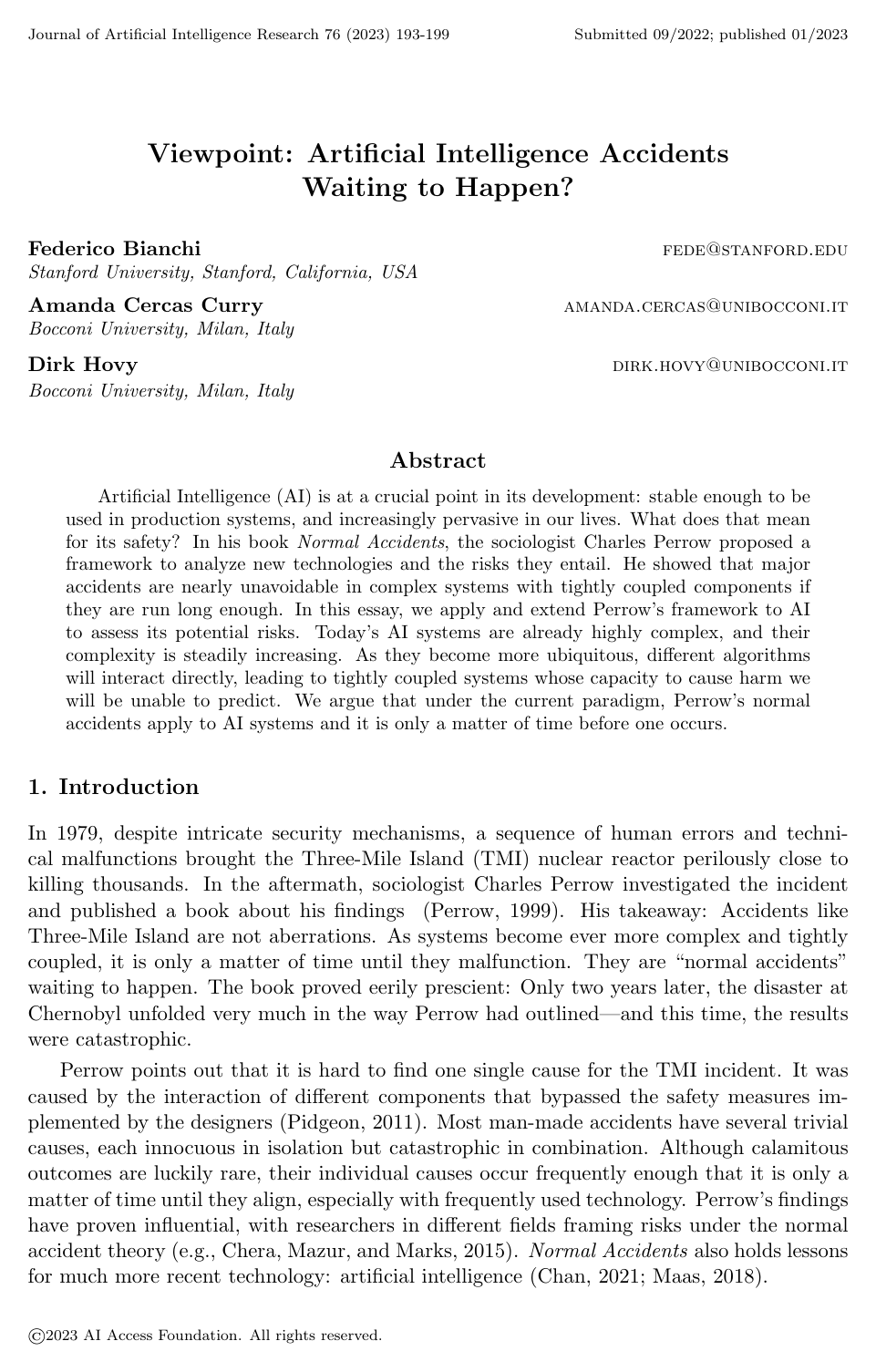
Artificial Intelligence (AI) is at a crucial point in its development: stable enough to be used in production systems, and increasingly pervasive in our lives. What does that mean for its safety? In his book Normal Accidents, the sociologist Charles Perrow proposed a framework to analyze new technologies and the risks they entail. He showed that major accidents are nearly unavoidable in complex systems with tightly coupled components if they are run long enough. In this essay, we apply and extend Perrow’s framework to AI to assess its potential risks. Today’s AI systems are already highly complex, and their complexity is steadily increasing. As they become more ubiquitous, different algorithms will interact directly, leading to tightly coupled systems whose capacity to cause harm we will be unable to predict. We argue that under the current paradigm, Perrow’s normal accidents apply to AI systems and it is only a matter of time before one occurs.
Added
2026-04-10