
keyword
self-attention layers
Self-attention layers are building blocks in neural network architectures, notably Transformers, that enable a model to determine how each element in an input sequence relates to every other element in the same sequence. Instead of processing data in sequential steps or through fixed local receptive fields, a self-attention layer computes attention weights between all pairs of positions across the input by mapping the data into query, key, and value vector representations. The compatibility between queries and keys produces normalized weights that form a weighted average of the value vectors, generating context-rich representations that capture both local interactions and long-range dependencies. Commonly arranged into multiple parallel heads, self-attention layers allow deep learning models to simultaneously track diverse linguistic, spatial, or temporal relationships across modalities such as natural language, images, and time series data.
8 items
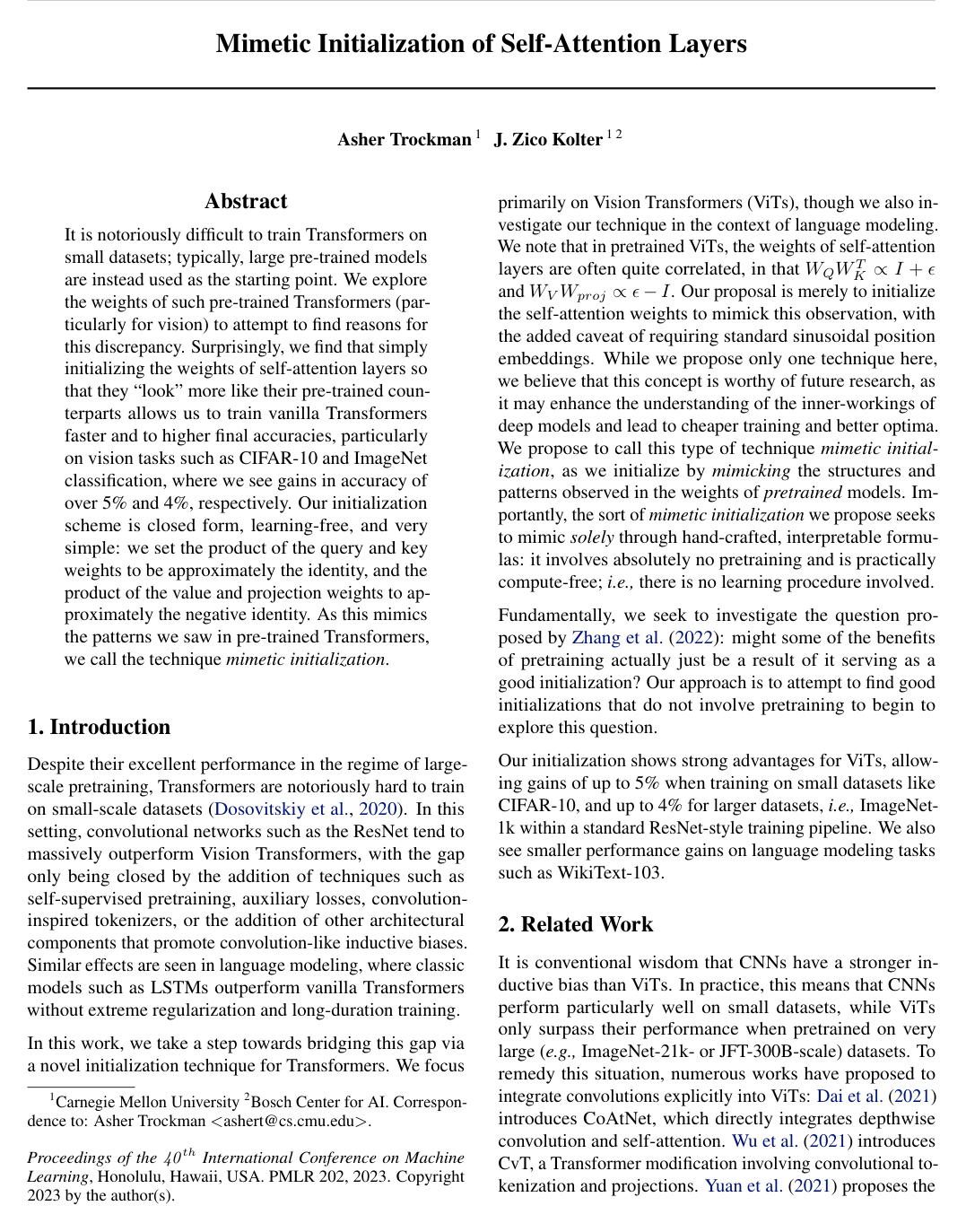
Mimetic Initialization of Self-Attention Layers
Asher Trockman, J. Zico Kolter
Why you should read this
Proposes a simple, learning-free weight initialization strategy for self-attention layers that mimics weight patterns observed in pretrained models, boosting classification accuracy by up to 5% when training vanilla Vision Transformers from scratch on small and medium datasets.
It is notoriously difficult to train Transformers on small datasets; typically, large pre-trained models are instead used as the starting point. We explore the weights of such pre-trained Transformers (particularly for vision) to attempt to find reasons for this discrepancy. Surprisingly, we find that simply initializing the weights of self-attention layers so that they “look” more like their pre-trained counterparts allows us to train vanilla Transformers faster and to higher final accuracies, particularly on vision tasks such as CIFAR-10 and ImageNet classification, where we see gains in accuracy of over 5% and 4%, respectively. Our initialization scheme is closed form, learning-free, and very simple: we set the product of the query and key weights to be approximately the identity, and the product of the value and projection weights to approximately the negative identity. As this mimics the patterns we saw in pre-trained Transformers, we call the technique mimetic initialization.
Added
2026-09-26
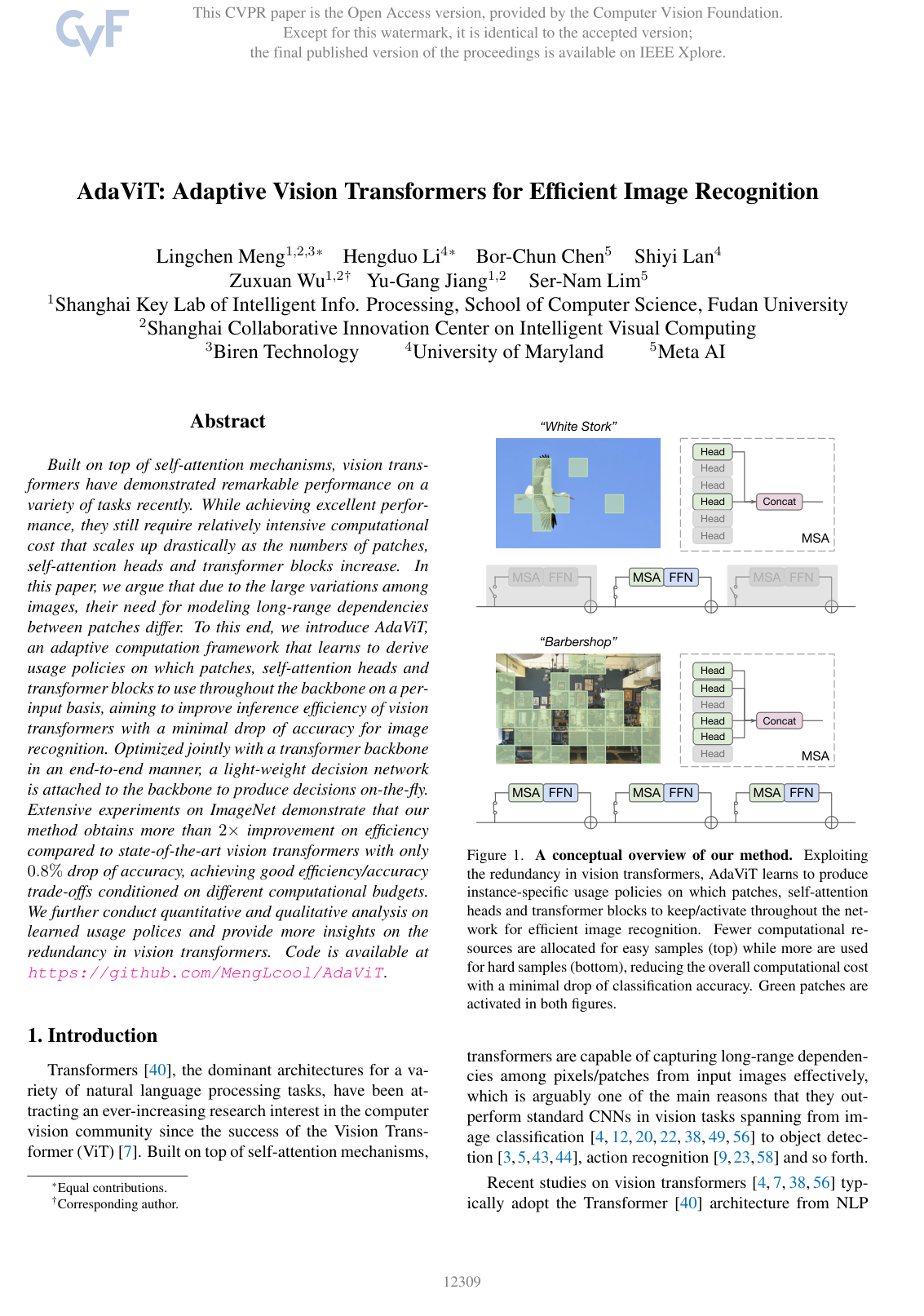
AdaViT: Adaptive Vision Transformers for Efficient Image Recognition
Lingchen Meng, Hengduo Li, Bor-Chun Chen, Shiyi Lan, Zuxuan Wu, Yu-Gang Jiang, Ser-Nam Lim
Why you should read this
Presents AdaViT, an adaptive computation framework that dynamically selects informative image patches, attention heads, and transformer blocks for each input to cut vision transformer inference costs by over half with negligible accuracy loss on ImageNet.
Built on top of self-attention mechanisms, vision transformers have demonstrated remarkable performance on a variety of tasks recently. While achieving excellent performance, they still require relatively intensive computational cost that scales up drastically as the numbers of patches, self-attention heads and transformer blocks increase. In this paper, we argue that due to the large variations among images, their need for modeling long-range dependencies between patches differ. To this end, we introduce AdaViT, an adaptive computation framework that learns to derive usage policies on which patches, self-attention heads and transformer blocks to use throughout the backbone on a per-input basis, aiming to improve inference efficiency of vision transformers with a minimal drop of accuracy for image recognition. Optimized jointly with a transformer backbone in an end-to-end manner, a light-weight decision network is attached to the backbone to produce decisions on-the-fly. Extensive experiments on ImageNet demonstrate that our method obtains more than 2× improvement on efficiency compared to state-of-the-art vision transformers with only 0.8% drop of accuracy, achieving good efficiency/accuracy trade-offs conditioned on different computational budgets. We further conduct quantitative and qualitative analysis on learned usage polices and provide more insights on the redundancy in vision transformers. Code is available at https://github.com/MengLcool/AdaViT.
Added
2026-09-26
Are Sixteen Heads Really Better than One?
Paul Michel, Omer Levy, Graham Neubig
Why you should read this
Reveals that a majority of attention heads in pretrained Transformer models can be pruned at test time without degrading performance, providing simple greedy algorithms that decrease inference latency and memory consumption.
Attention is a powerful and ubiquitous mechanism for allowing neural models to focus on particular salient pieces of information by taking their weighted average when making predictions. In particular, multi-headed attention is a driving force behind many recent state-of-the-art NLP models such as Transformer-based MT models and BERT. These models apply multiple attention mechanisms in parallel, with each attention "head" potentially focusing on different parts of the input, which makes it possible to express sophisticated functions beyond the simple weighted average. In this paper we make the surprising observation that even if models have been trained using multiple heads, in practice, a large percentage of attention heads can be removed at test time without significantly impacting performance. In fact, some layers can even be reduced to a single head. We further examine greedy algorithms for pruning down models, and the potential speed, memory efficiency, and accuracy improvements obtainable therefrom. Finally, we analyze the results with respect to which parts of the model are more reliant on having multiple heads, and provide precursory evidence that training dynamics play a role in the gains provided by multi-head attention.
Added
2026-09-25
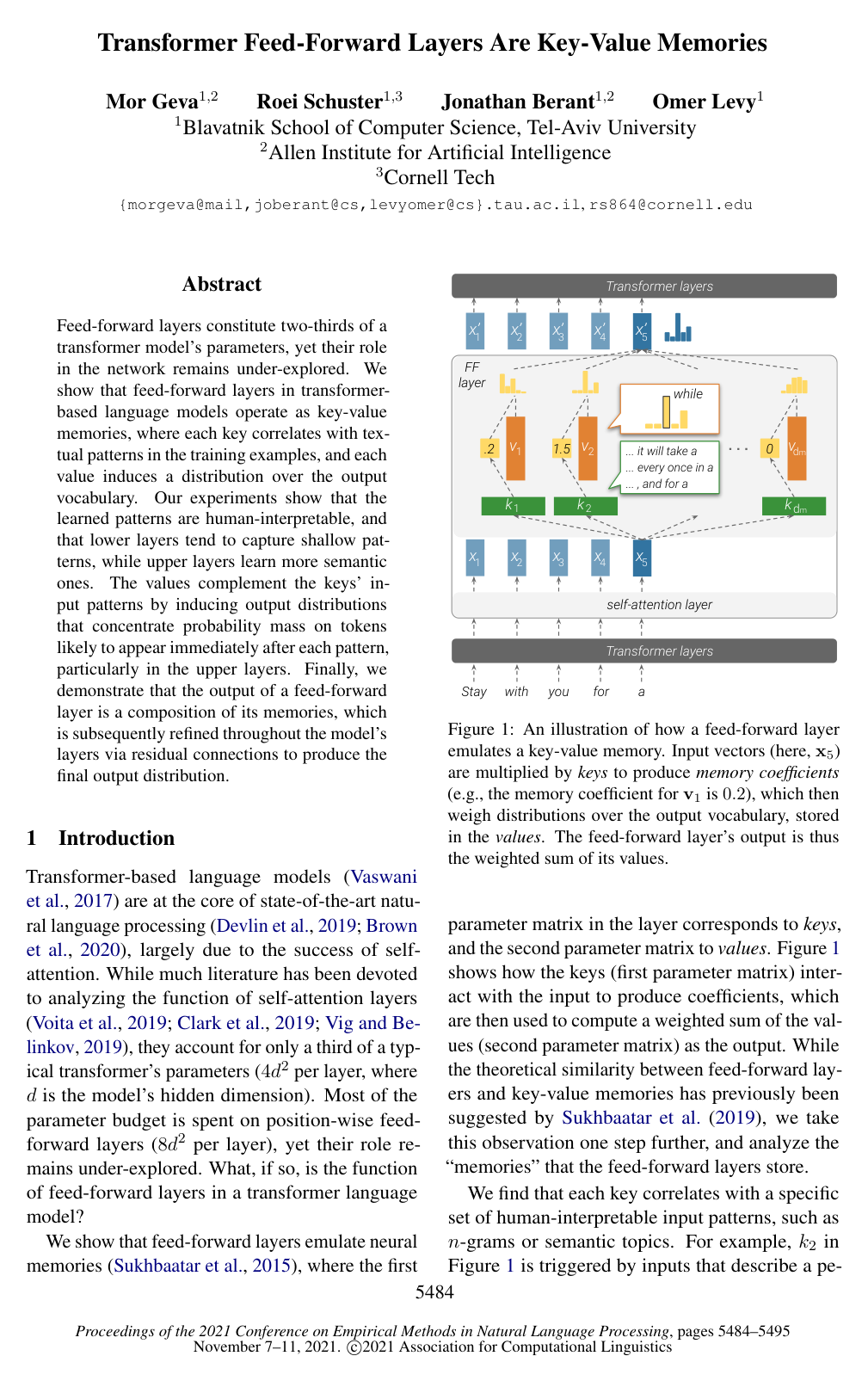
Transformer Feed-Forward Layers Are Key-Value Memories
Mor Geva, Roei Schuster, Jonathan Berant, Omer Levy
Why you should read this
Shows that transformer feed-forward layers function as key-value memories, revealing how the majority of network parameters store human-interpretable textual patterns and directly predict next-token distributions.
Feed-forward layers constitute two-thirds of a transformer model's parameters, yet their role in the network remains under-explored. We show that feed-forward layers in transformer-based language models operate as key-value memories, where each key correlates with textual patterns in the training examples, and each value induces a distribution over the output vocabulary. Our experiments show that the learned patterns are human-interpretable, and that lower layers tend to capture shallow patterns, while upper layers learn more semantic ones. The values complement the keys' input patterns by inducing output distributions that concentrate probability mass on tokens likely to appear immediately after each pattern, particularly in the upper layers. Finally, we demonstrate that the output of a feed-forward layer is a composition of its memories, which is subsequently refined throughout the model's layers via residual connections to produce the final output distribution.
Added
2026-09-24
Enhancing the Locality and Breaking the Memory Bottleneck of Transformer on Time Series Forecasting
SHIYANG LI, Xiaoyong Jin, Yao Xuan, Xiyou Zhou, Wenhu Chen, Yu-Xiang Wang, Xifeng Yan
Why you should read this
Proposes convolutional self-attention and a LogSparse Transformer architecture that reduces memory complexity to O(L(log L)^2), solving the key challenges of local context insensitivity and quadratic memory bottlenecks in long-sequence time series forecasting.
Time series forecasting is an important problem across many domains, including predictions of solar plant energy output, electricity consumption, and traffic jam situation. In this paper, we propose to tackle such forecasting problem with Transformer [1]. Although impressed by its performance in our preliminary study, we found its two major weaknesses: (1) locality-agnostics: the point-wise dot-product self-attention in canonical Transformer architecture is insensitive to local context, which can make the model prone to anomalies in time series; (2) memory bottleneck: space complexity of canonical Transformer grows quadratically with sequence length , making directly modeling long time series infeasible. In order to solve these two issues, we first propose convolutional self-attention by producing queries and keys with causal convolution so that local context can be better incorporated into attention mechanism. Then, we propose LogSparse Transformer with only memory cost, improving forecasting accuracy for time series with fine granularity and strong long-term dependencies under constrained memory budget. Our experiments on both synthetic data and real-world datasets show that it compares favorably to the state-of-the-art.
Added
2026-09-17
Attention Is All You Need
Ashish Vaswani, Noam Shazeer, Niki Parmar, Jakob Uszkoreit, Llion Jones, Aidan N. Gomez, Lukasz Kaiser, Illia Polosukhin
Why you should read this
Proposes the groundbreaking Transformer architecture, which, by solely relying on attention mechanisms without recurrence or convolutions, achieves superior performance, unprecedented parallelization, and significantly reduced training times in sequence transduction tasks like machine translation.
The dominant sequence transduction models are based on complex recurrent or convolutional neural networks in an encoder-decoder configuration. The best performing models also connect the encoder and decoder through an attention mechanism. We propose a new simple network architecture, the Transformer, based solely on attention mechanisms, dispensing with recurrence and convolutions entirely. Experiments on two machine translation tasks show these models to be superior in quality while being more parallelizable and requiring significantly less time to train. Our model achieves 28.4 BLEU on the WMT 2014 English-to-German translation task, improving over the existing best results, including ensembles by over 2 BLEU. On the WMT 2014 English-to-French translation task, our model establishes a new single-model state-of-the-art BLEU score of 41.8 after training for 3.5 days on eight GPUs, a small fraction of the training costs of the best models from the literature. We show that the Transformer generalizes well to other tasks by applying it successfully to English constituency parsing both with large and limited training data.
Added
2026-03-19
License
Published with permission
Perceiver: General Perception with Iterative Attention
Andrew Jaegle, Felix Gimeno, Andrew Brock, Andrew Zisserman, Oriol Vinyals, Joao Carreira
Why you should read this
Presents a novel Transformer-based model, the Perceiver, that achieves state-of-the-art performance across diverse modalities (images, audio, video, point clouds) by replacing modality-specific assumptions with a scalable iterative attention mechanism, offering a unified approach to perception in deep learning.
Biological systems perceive the world by simultaneously processing high-dimensional inputs from modalities as diverse as vision, audition, touch, proprioception, etc. The perception models used in deep learning on the other hand are designed for individual modalities, often relying on domain-specific assumptions such as the local grid structures exploited by virtually all existing vision models. These priors introduce helpful inductive biases, but also lock models to individual modalities. In this paper we introduce the Perceiver - a model that builds upon Transformers and hence makes few architectural assumptions about the relationship between its inputs, but that also scales to hundreds of thousands of inputs, like ConvNets. The model leverages an asymmetric attention mechanism to iteratively distill inputs into a tight latent bottleneck, allowing it to scale to handle very large inputs. We show that this architecture is competitive with or outperforms strong, specialized models on classification tasks across various modalities: images, point clouds, audio, video, and video+audio. The Perceiver obtains performance comparable to ResNet-50 and ViT on ImageNet without 2D convolutions by directly attending to 50,000 pixels. It is also competitive in all modalities in AudioSet.
Added
2026-02-13

On the Relationship between Self-Attention and Convolutional Layers
Jean-Baptiste Cordonnier, Andreas Loukas, Martin Jaggi
Why you should read this
Proves mathematically that multi-head self-attention with sufficient heads can express any convolutional layer, establishing attention as a superset of convolution.
Recent trends of incorporating attention mechanisms in vision have led researchers to reconsider the supremacy of convolutional layers as a primary building block. Beyond helping CNNs to handle long-range dependencies, Ramachandran et al. (2019) showed that attention can completely replace convolution and achieve state-of-the-art performance on vision tasks. This raises the question: do learned attention layers operate similarly to convolutional layers? This work provides evidence that attention layers can perform convolution and, indeed, they often learn to do so in practice. Specifically, we prove that a multi-head self-attention layer with sufficient number of heads is at least as expressive as any convolutional layer. Our numerical experiments then show that self-attention layers attend to pixel-grid patterns similarly to CNN layers, corroborating our analysis. Our code is publicly available.
Added
2026-02-11