
keyword
self-attention layer
A self-attention layer is a fundamental component of artificial neural network architectures, such as transformers, that calculates the relationships and mutual dependencies between all positions within a single input sequence. Rather than processing data sequentially or through fixed local windows, the layer allows each token or element to attend to every other element in the sequence simultaneously, assigning dynamic importance weights based on their semantic relevance. It achieves this by mapping input representations into queries, keys, and values, using their scaled dot-product similarities to produce updated, contextualized representations that capture both local interactions and long-range dependencies. This parallelizable mechanism enables deep learning models to capture global context efficiently across various domains, including natural language processing, computer vision, and sequential recommendation.
5 items
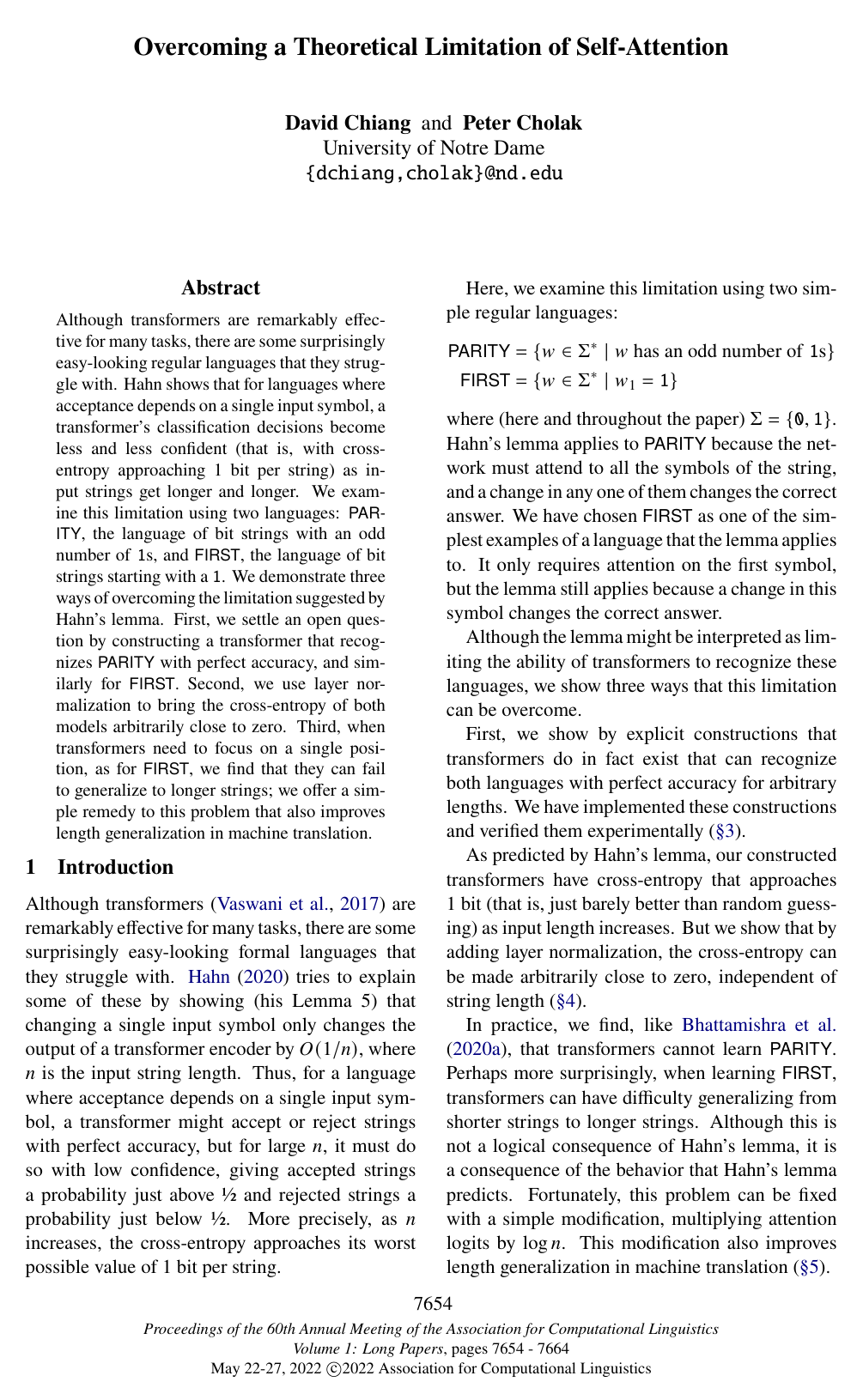
Overcoming a Theoretical Limitation of Self-Attention
David Chiang, Peter Cholak
Why you should read this
Proves that standard transformers can recognize challenging regular languages like PARITY with perfect accuracy and shows that scaling attention logits by the logarithm of sequence length resolves severe length generalization failures in practice.
Although transformers are remarkably effective for many tasks, there are some surprisingly easy-looking regular languages that they struggle with. Hahn shows that for languages where acceptance depends on a single input symbol, a transformer's classification decisions become less and less confident (that is, with cross-entropy approaching 1 bit per string) as input strings get longer and longer. We examine this limitation using two languages: PARITY, the language of bit strings with an odd number of 1s, and FIRST, the language of bit strings starting with a 1. We demonstrate three ways of overcoming the limitation suggested by Hahn's lemma. First, we settle an open question by constructing a transformer that recognizes PARITY with perfect accuracy, and similarly for FIRST. Second, we use layer normalization to bring the cross-entropy of both models arbitrarily close to zero. Third, when transformers need to focus on a single position, as for FIRST, we find that they can fail to generalize to longer strings; we offer a simple remedy to this problem that also improves length generalization in machine translation.
Added
2026-10-01
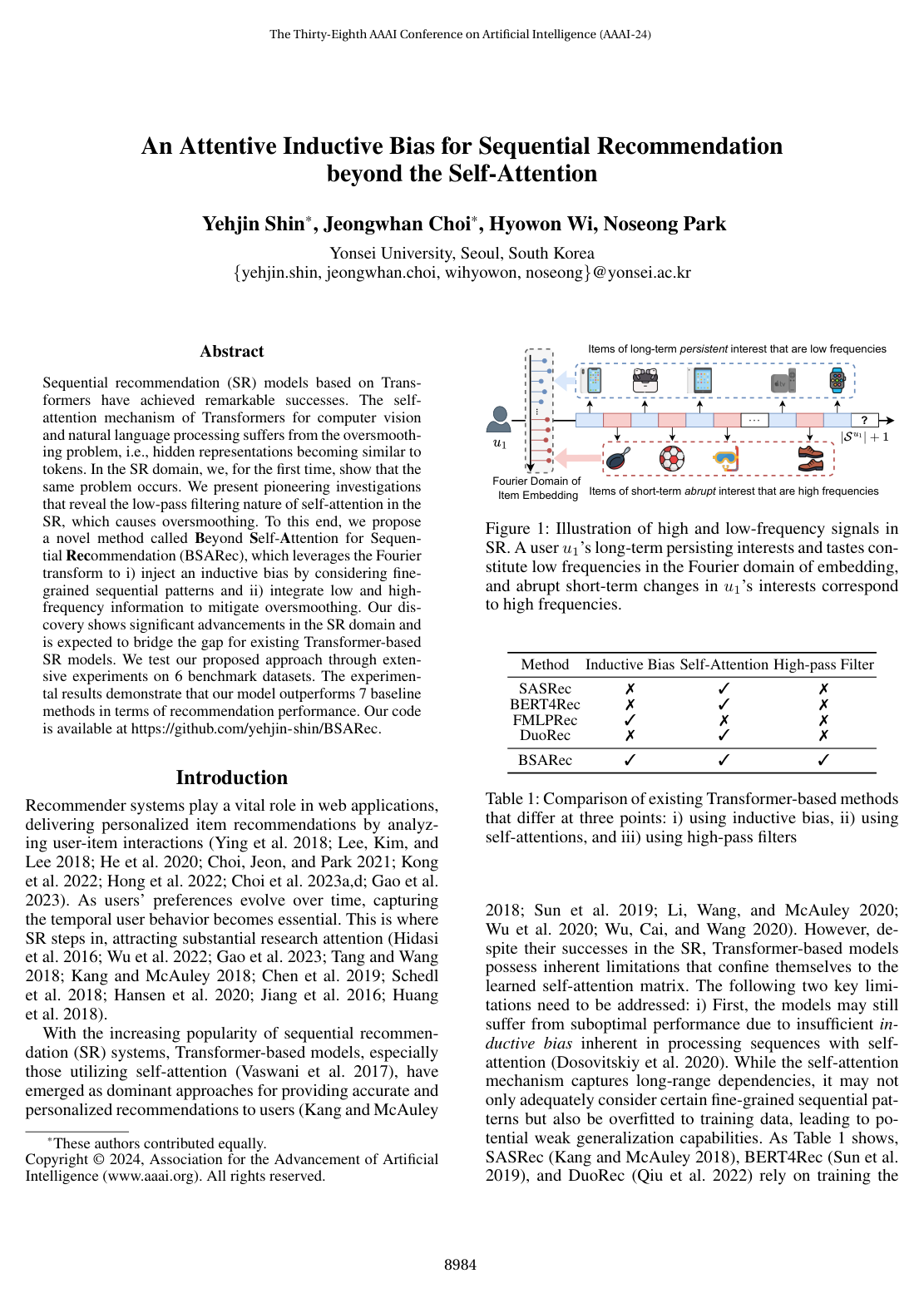
An Attentive Inductive Bias for Sequential Recommendation beyond the Self-Attention
Yehjin Shin, Jeongwhan Choi, Hyowon Wi, Noseong Park
Why you should read this
Reveals that self-attention in sequential recommendation behaves as a low-pass filter causing representation oversmoothing, and introduces BSARec, a Fourier transform-based architecture that integrates high-frequency signals to capture abrupt short-term user preferences alongside long-term interests.
Sequential recommendation (SR) models based on Transformers have achieved remarkable successes. The self-attention mechanism of Transformers for computer vision and natural language processing suffers from the oversmoothing problem, i.e., hidden representations becoming similar to tokens. In the SR domain, we, for the first time, show that the same problem occurs. We present pioneering investigations that reveal the low-pass filtering nature of self-attention in the SR, which causes oversmoothing. To this end, we propose a novel method called Beyond Self-Attention for Sequential Recommendation (BSARec), which leverages the Fourier transform to i) inject an inductive bias by considering fine-grained sequential patterns and ii) integrate low and high-frequency information to mitigate oversmoothing. Our discovery shows significant advancements in the SR domain and is expected to bridge the gap for existing Transformer-based SR models. We test our proposed approach through extensive experiments on 6 benchmark datasets. The experimental results demonstrate that our model outperforms 7 baseline methods in terms of recommendation performance. Our code is available at https://github.com/yehjin-shin/BSARec.
Added
2026-09-26
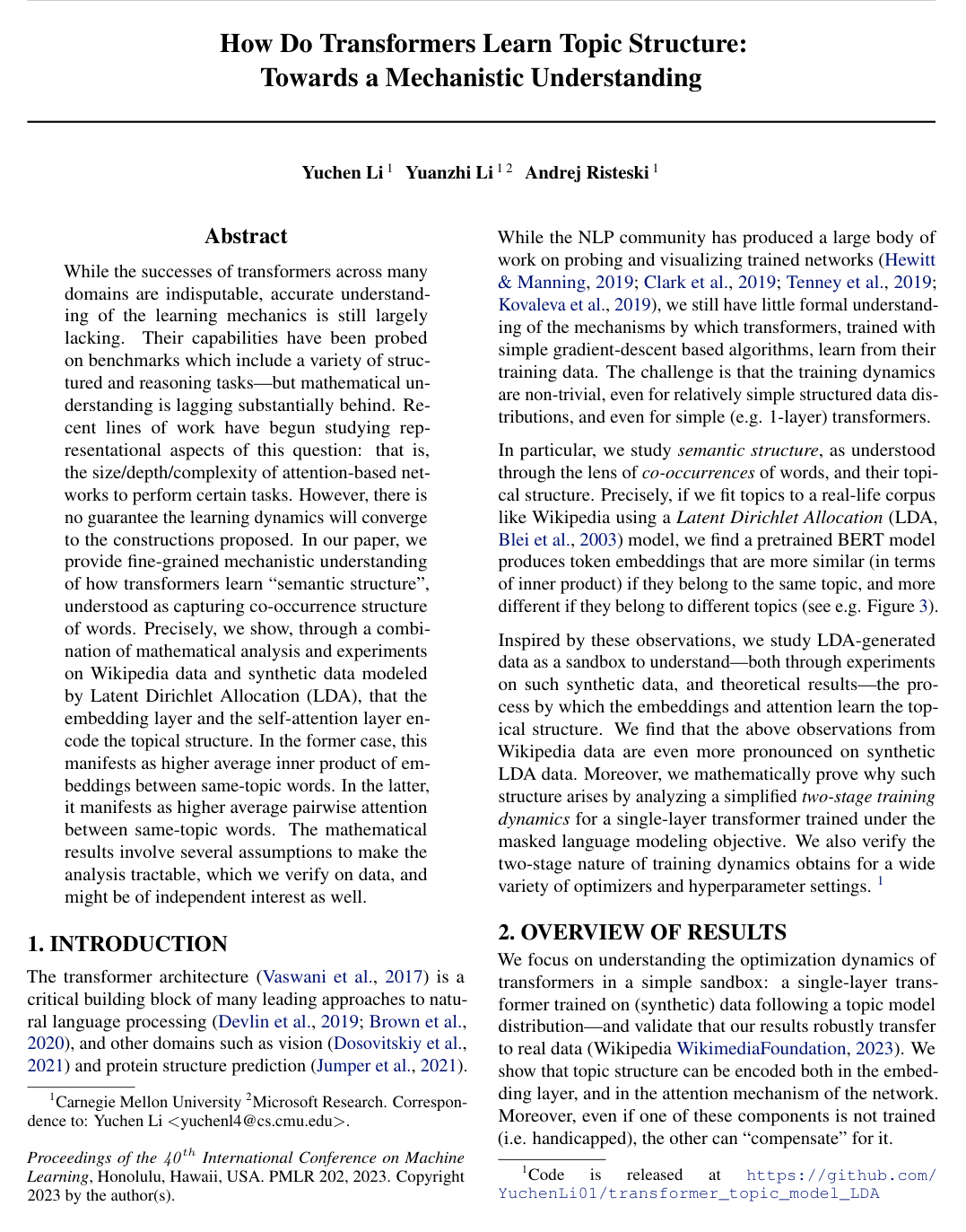
How Do Transformers Learn Topic Structure: Towards a Mechanistic Understanding
Yuchen Li, Yuanzhi Li, Andrej Risteski
Why you should read this
Proves mathematically and verifies empirically on topic-modeled data how transformer embeddings and self-attention mechanisms independently learn word co-occurrence structures through a distinct two-stage training dynamic.
While the successes of transformers across many domains are indisputable, accurate understanding of the learning mechanics is still largely lacking. Their capabilities have been probed on benchmarks which include a variety of structured and reasoning tasks—but mathematical understanding is lagging substantially behind. Recent lines of work have begun studying representational aspects of this question: that is, the size/depth/complexity of attention-based networks to perform certain tasks. However, there is no guarantee the learning dynamics will converge to the constructions proposed. In our paper, we provide fine-grained mechanistic understanding of how transformers learn “semantic structure”, understood as capturing co-occurrence structure of words. Precisely, we show, through a combination of mathematical analysis and experiments on Wikipedia data and synthetic data modeled by Latent Dirichlet Allocation (LDA), that the embedding layer and the self-attention layer encode the topical structure. In the former case, this manifests as higher average inner product of embeddings between same-topic words. In the latter, it manifests as higher average pairwise attention between same-topic words. The mathematical results involve several assumptions to make the analysis tractable, which we verify on data, and might be of independent interest as well.
Added
2026-09-26
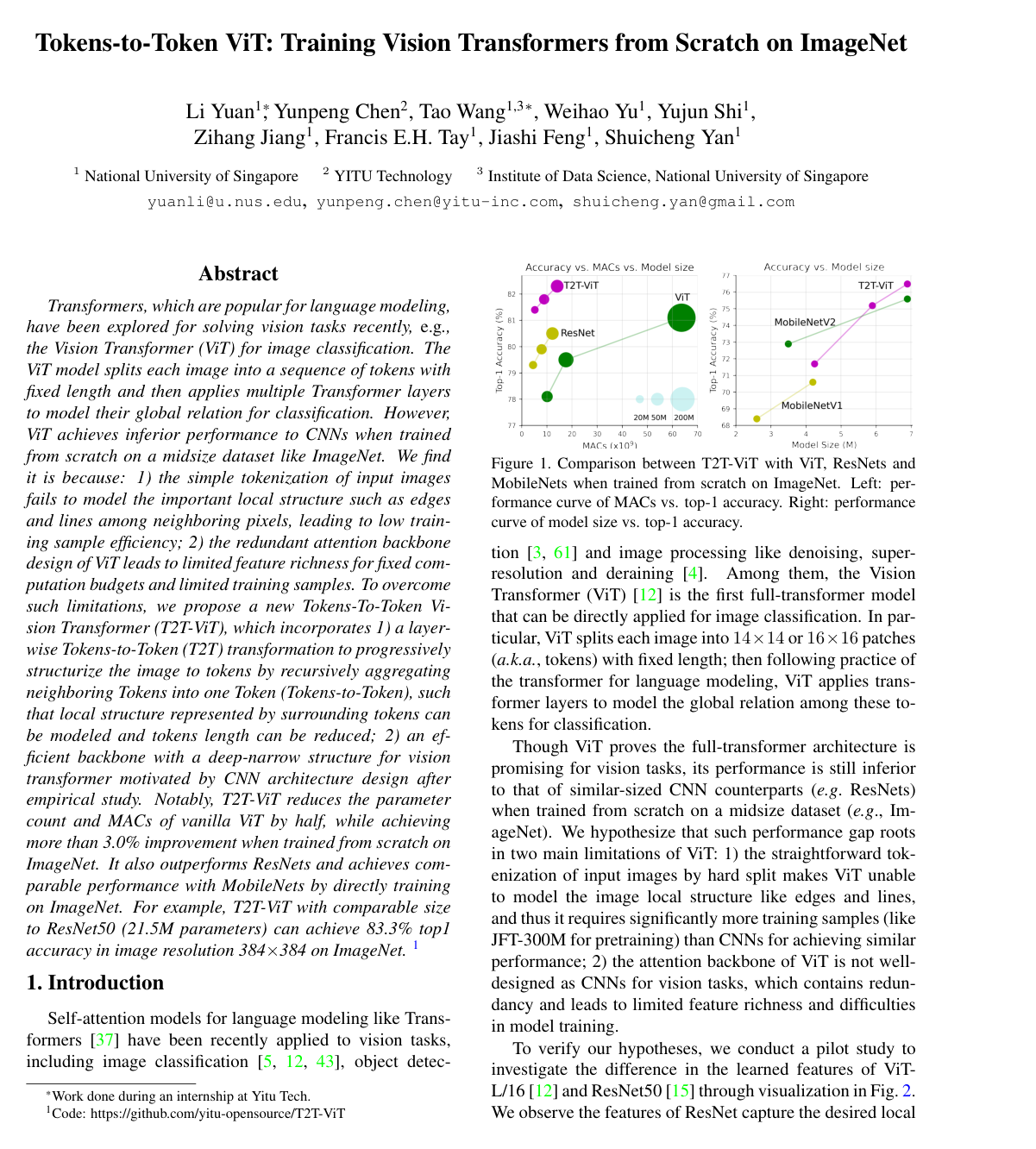
Tokens-to-Token ViT: Training Vision Transformers from Scratch on ImageNet
Li Yuan, Yunpeng Chen, Tao Wang, Weihao Yu, Yujun Shi, Francis E. H. Tay, Jiashi Feng, Shuicheng Yan
Why you should read this
Introduces Tokens-to-Token Vision Transformer (T2T-ViT), which recursively aggregates neighboring tokens to model local image structure, enabling vision transformers to be trained efficiently from scratch on ImageNet while halving computational costs and outperforming standard CNNs.
Transformers, which are popular for language modeling, have been explored for solving vision tasks recently, e.g., the Vision Transformer (ViT) for image classification. The ViT model splits each image into a sequence of tokens with fixed length and then applies multiple Transformer layers to model their global relation for classification. However, ViT achieves inferior performance to CNNs when trained from scratch on a midsize dataset like ImageNet. We find it is because: 1) the simple tokenization of input images fails to model the important local structure such as edges and lines among neighboring pixels, leading to low training sample efficiency; 2) the redundant attention backbone design of ViT leads to limited feature richness for fixed computation budgets and limited training samples. To overcome such limitations, we propose a new Tokens-To-Token Vision Transformer (T2T-ViT), which incorporates 1) a layer-wise Tokens-to-Token (T2T) transformation to progressively structurize the image to tokens by recursively aggregating neighboring Tokens into one Token (Tokens-to-Token), such that local structure represented by surrounding tokens can be modeled and tokens length can be reduced; 2) an efficient backbone with a deep-narrow structure for vision transformer motivated by CNN architecture design after empirical study. Notably, T2T-ViT reduces the parameter count and MACs of vanilla ViT by half, while achieving more than 3.0\% improvement when trained from scratch on ImageNet. It also outperforms ResNets and achieves comparable performance with MobileNets by directly training on ImageNet. For example, T2T-ViT with comparable size to ResNet50 (21.5M parameters) can achieve 83.3\% top1 accuracy in image resolution 384384 on ImageNet. (Code: this https URL)
Added
2026-09-14
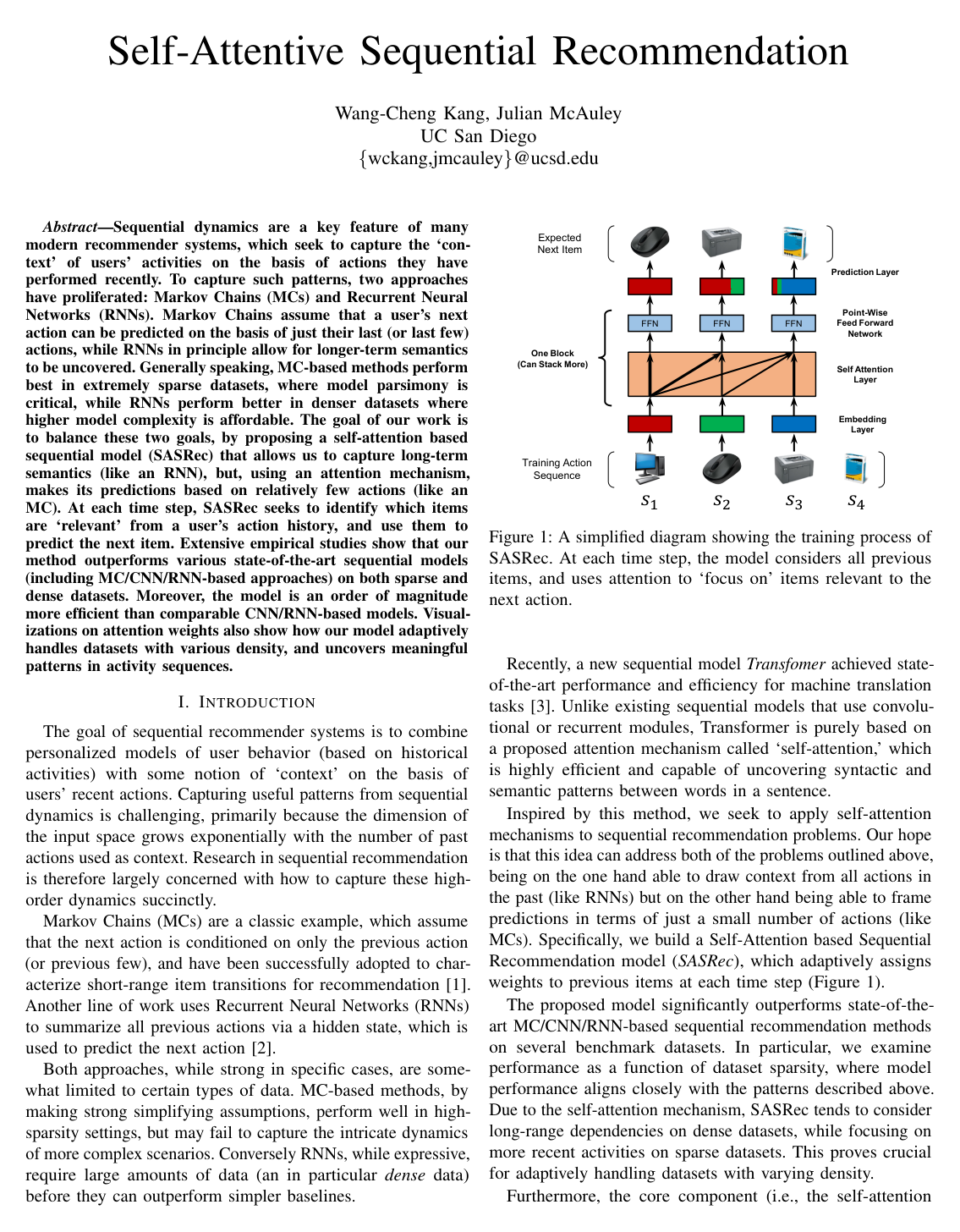
Self-Attentive Sequential Recommendation
Wang-Cheng Kang, Julian McAuley
Why you should read this
Adapts the modern transformer architecture heavily toward behavioral modeling by utilizing pure self-attention mechanisms to weigh isolated historical user actions dynamically for next-item generation.
Sequential dynamics are a key feature of many modern recommender systems, which seek to capture the 'context' of users' activities on the basis of actions they have performed recently. To capture such patterns, two approaches have proliferated: Markov Chains (MCs) and Recurrent Neural Networks (RNNs). Markov Chains assume that a user's next action can be predicted on the basis of just their last (or last few) actions, while RNNs in principle allow for longer-term semantics to be uncovered. Generally speaking, MC-based methods perform best in extremely sparse datasets, where model parsimony is critical, while RNNs perform better in denser datasets where higher model complexity is affordable. The goal of our work is to balance these two goals, by proposing a self-attention based sequential model (SASRec) that allows us to capture long-term semantics (like an RNN), but, using an attention mechanism, makes its predictions based on relatively few actions (like an MC). At each time step, SASRec seeks to identify which items are 'relevant' from a user's action history, and use them to predict the next item. Extensive empirical studies show that our method outperforms various state-of-the-art sequential models (including MC/CNN/RNN-based approaches) on both sparse and dense datasets. Moreover, the model is an order of magnitude more efficient than comparable CNN/RNN-based models. Visualizations on attention weights also show how our model adaptively handles datasets with various density, and uncovers meaningful patterns in activity sequences.
Added
2026-01-25