
Built independently by an author, for readers. Read the story and support ChapterPal

keyword

seasonal-trend representations

Seasonal-trend representations are structured feature embeddings or mathematical characterizations of time series data that explicitly isolate and encode recurring periodic patterns alongside long-term directional shifts. Rooted in classical time series decomposition principles, these representations disentangle the composite dynamics of temporal sequences into distinct components: the seasonal element capturing cyclic, periodic variations across fixed intervals, and the trend element reflecting overarching, persistent progressions over time. In modern statistical and deep learning frameworks, seasonal-trend representations are learned through specialized neural architectures, moving average operations, or frequency-domain transformations to reduce noise, improve model generalizability, and enhance interpretability across temporal analysis tasks such as forecasting, anomaly detection, and data imputation.

1 item
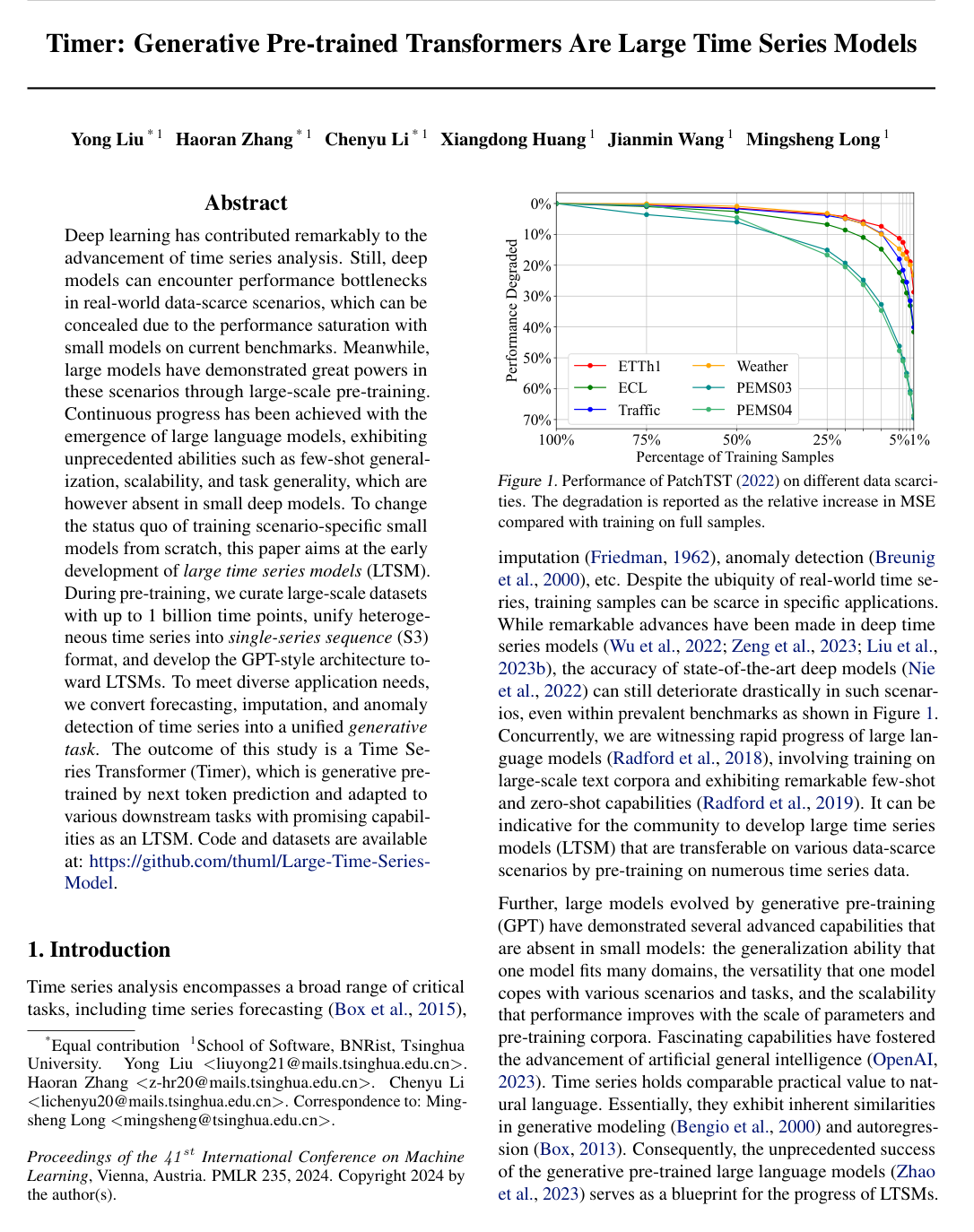
Timer: Generative Pre-trained Transformers Are Large Time Series Models

Timer: Generative Pre-trained Transformers Are Large Time Series Models

Yong Liu, Haoran Zhang, Chenyu Li, Xiangdong Huang, Jianmin Wang, Mingsheng Long

OrganizationsTsinghua University

Why you should read this

Presents a billion-point pre-trained GPT-style model that unifies diverse time series forecasting, imputation, and anomaly detection into next-token prediction to deliver strong few-shot and zero-shot performance across heterogeneous domains.

Deep learning has contributed remarkably to the advancement of time series analysis. Still, deep models can encounter performance bottlenecks in real-world data-scarce scenarios, which can be concealed due to the performance saturation with small models on current benchmarks. Meanwhile, large models have demonstrated great powers in these scenarios through large-scale pre-training. Continuous progress has been achieved with the emergence of large language models, exhibiting unprecedented abilities such as few-shot generalization, scalability, and task generality, which are however absent in small deep models. To change the status quo of training scenario-specific small models from scratch, this paper aims at the early development of large time series models (LTSM). During pre-training, we curate large-scale datasets with up to 1 billion time points, unify heterogeneous time series into single-series sequence (S3) format, and develop the GPT-style architecture toward LTSMs. To meet diverse application needs, we convert forecasting, imputation, and anomaly detection of time series into a unified generative task. The outcome of this study is a Time Series Transformer (Timer), which is generative pre-trained by next token prediction and adapted to various downstream tasks with promising capabilities as an LTSM. Code and datasets are available at: https://github.com/thuml/Large-Time-Series-Model.

Added

2026-09-26