
keyword
scale parameter
A scale parameter is a numerical value that determines the spatial scope, resolution, or effective neighborhood size used when processing, analyzing, or modeling data. In signal processing, computer vision, and machine learning, it commonly governs the width or bandwidth of a kernel, such as the standard deviation of a Gaussian function applied during filtering, feature extraction, or similarity computation. Adjusting this parameter controls the level of detail captured by an algorithm, where smaller values focus on fine, localized structures and high-frequency variations, while larger values emphasize broader, macroscopic patterns and suppress noise. Selecting or dynamically adapting the scale parameter is essential for multiscale representations, edge detection, and clustering, as meaningful patterns and relationships within data often manifest at different observational granularities.
2 items
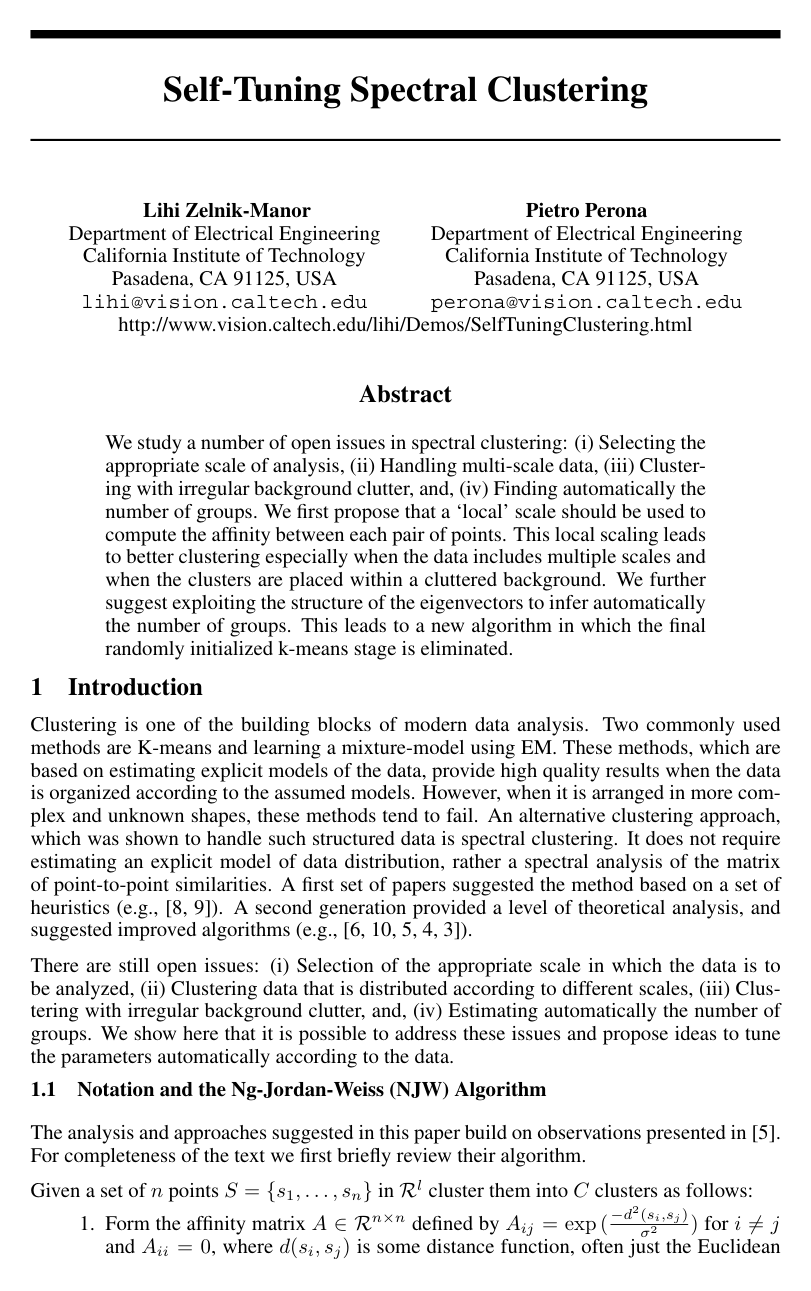
Self-Tuning Spectral Clustering
Lihi Zelnik-Manor, P. Perona
Why you should read this
Introduces a self-tuning spectral clustering method that computes local scaling for each data point and infers the number of groups directly from eigenvector structure, effectively clustering multi-scale, cluttered datasets without manual parameter selection or randomized k-means initialization.
We study a number of open issues in spectral clustering: (i) Selecting the appropriate scale of analysis, (ii) Handling multi-scale data, (iii) Clustering with irregular background clutter, and, (iv) Finding automatically the number of groups. We first propose that a ‘local’ scale should be used to compute the affinity between each pair of points. This local scaling leads to better clustering especially when the data includes multiple scales and when the clusters are placed within a cluttered background. We further suggest exploiting the structure of the eigenvectors to infer automatically the number of groups. This leads to a new algorithm in which the final randomly initialized k-means stage is eliminated.
Added
2026-09-14
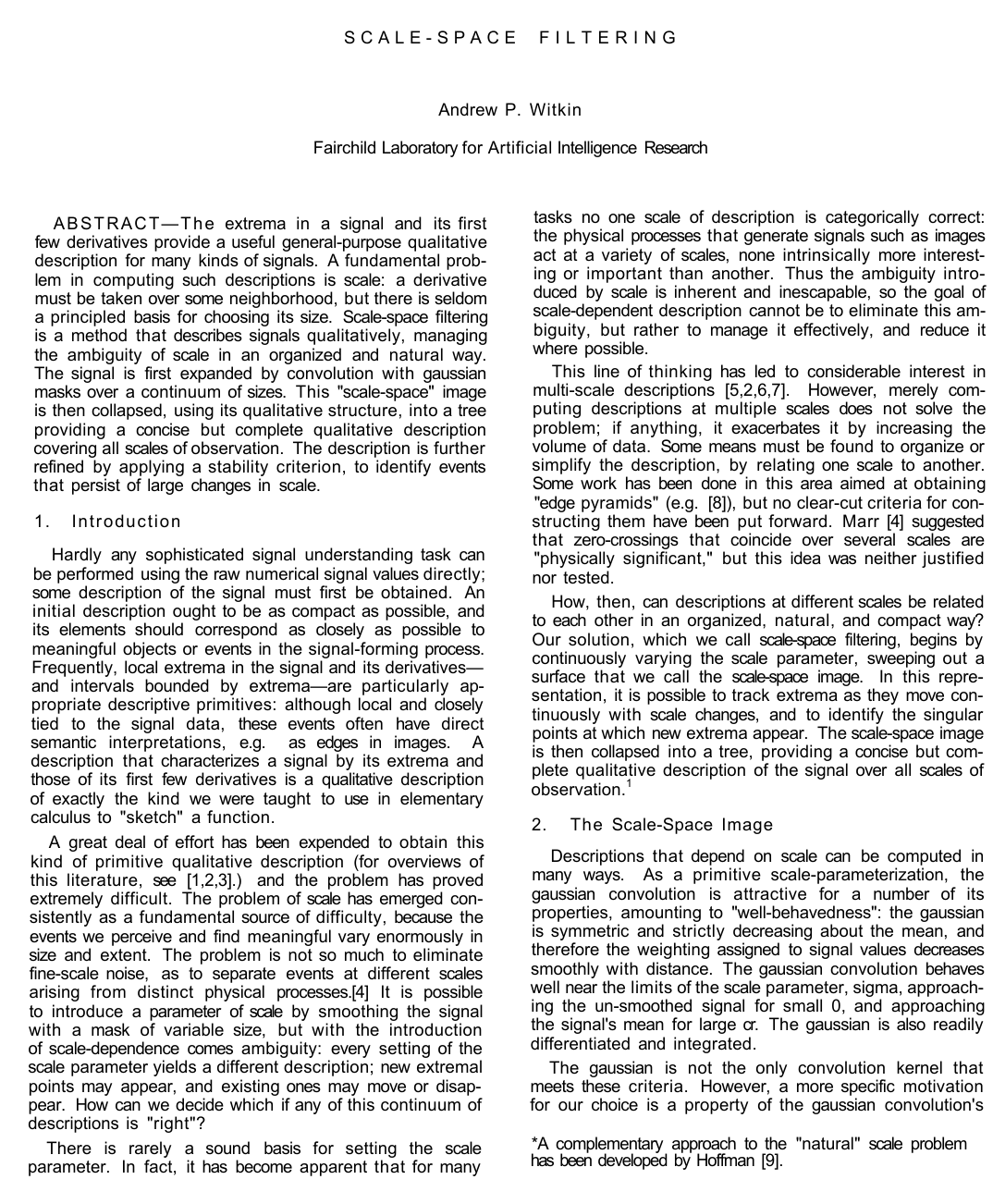
Scale-Space Filtering
Andrew P. Witkin
Why you should read this
Introduces scale-space filtering, a framework that tracks signal extrema across a continuum of Gaussian smoothing scales to construct a threshold-free hierarchical tree that organizes qualitative features according to their stability over scale.
The extrema in a signal and its first few derivatives provide a useful general-purpose qualitative description for many kinds of signals. A fundamental problem in computing such descriptions is scale: a derivative must be taken over some neighborhood, but there is seldom a principled basis for choosing its size. Scale-space filtering is a method that describes signals qualitatively, managing the ambiguity of scale in an organized and natural way. The signal is first expanded by convolution with gaussian masks over a continuum of sizes. This "scale-space" image is then collapsed, using its qualitative structure, into a tree providing a concise but complete qualitative description covering all scales of observation. The description is further refined by applying a stability criterion, to identify events that persist of large changes in scale.
Added
2026-09-14