
keyword
rule induction
Rule induction is a machine learning process that automatically extracts human-interpretable if-then rules from training data to classify instances or predict outcomes. In this supervised learning approach, an algorithm analyzes example records to identify logical conditions relating input features to target labels, producing a structured set of rules or a decision list. Common strategies for generating these models include sequential covering techniques, which iteratively construct individual rules to explain subsets of data, as well as extracting and pruning paths derived from decision trees. Because the resulting rule sets explicitly state the exact conditions under which specific predictions occur, rule induction provides high model transparency and interpretability across structured datasets.
2 items
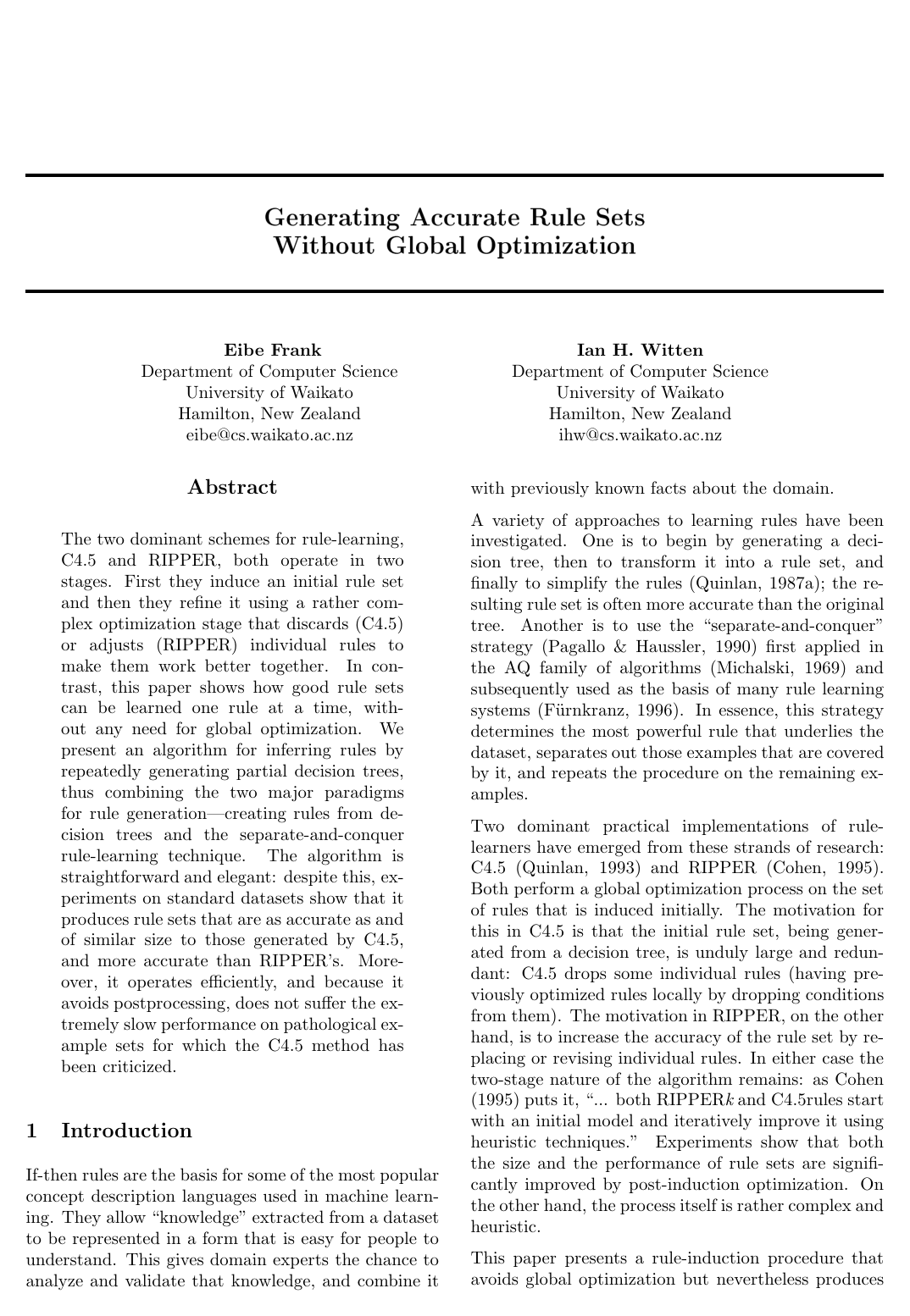
Generating Accurate Rule Sets Without Global Optimization
Eibe Frank, Ian H. Witten
Why you should read this
Presents PART, a fast rule-learning algorithm that avoids complex global optimization by deriving rules from partial decision trees within a separate-and-conquer framework to achieve accuracy and compact model sizes matching or exceeding C4.5 and RIPPER.
The two dominant schemes for rule-learning, C4.5 and RIPPER, both operate in two stages. First they induce an initial rule set and then they refine it using a rather complex optimization stage that discards (C4.5) or adjusts (RIPPER) individual rules to make them work better together. In contrast, this paper shows how good rule sets can be learned one rule at a time, without any need for global optimization. We present an algorithm for inferring rules by repeatedly generating partial decision trees, thus combining the two major paradigms for rule generation—creating rules from decision trees and the separate-and-conquer rule-learning technique. The algorithm is straightforward and elegant: despite this, experiments on standard datasets show that it produces rule sets that are as accurate as and of similar size to those generated by C4.5, and more accurate than RIPPER's. Moreover, it operates efficiently, and because it avoids postprocessing, does not suffer the extremely slow performance on pathological example sets for which the C4.5 method has been criticized.
Source
https://researchcommons.waikato.ac.nz/bitstreams/2e1b230f-cab4-471b-8076-915fd9a2d79c/downloadAdded
2026-09-25
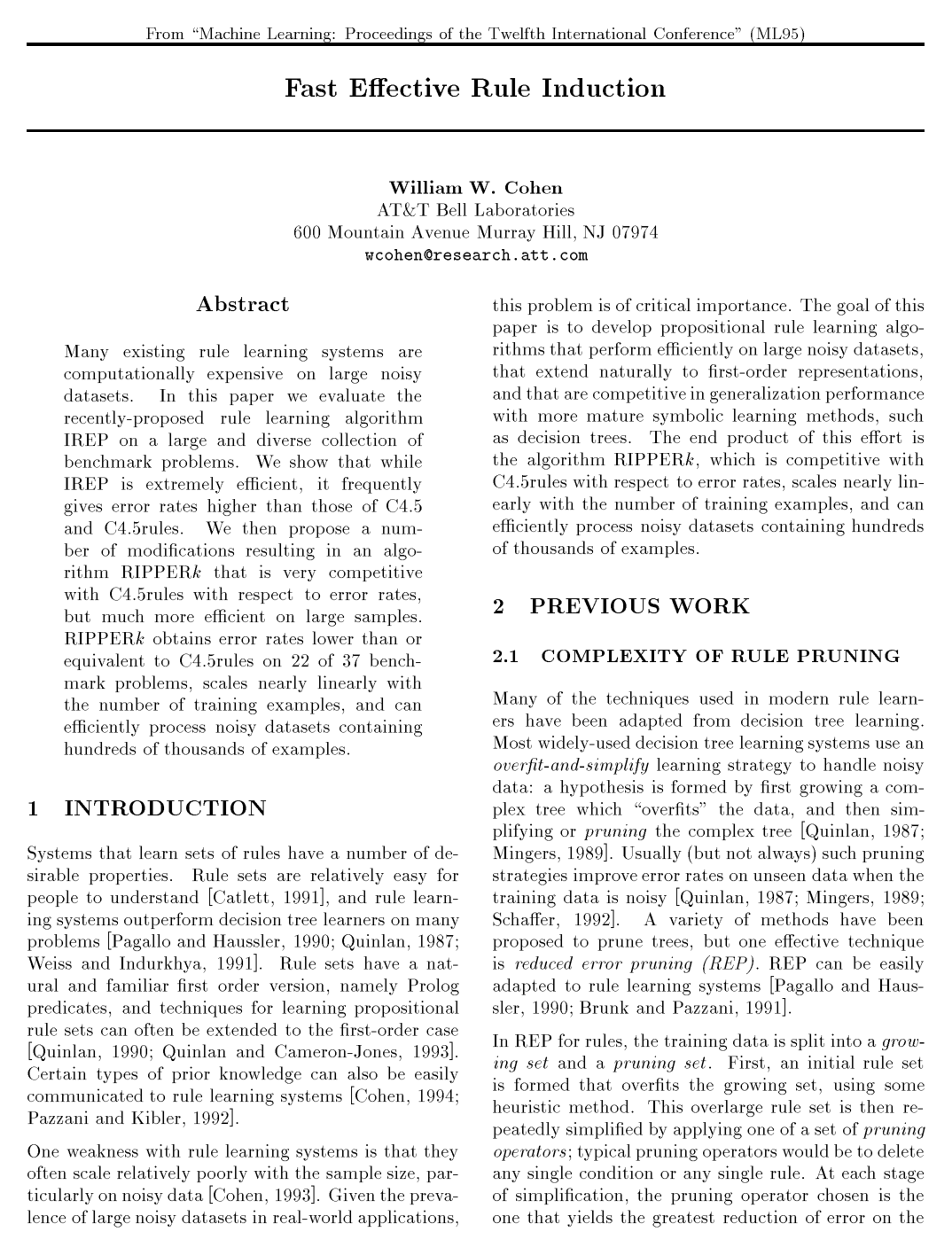
Fast Effective Rule Induction
William W. Cohen
Why you should read this
Introduces RIPPERk, a fast rule learning algorithm that matches the classification accuracy of C4.5rules on benchmark problems while scaling nearly linearly to efficiently handle hundreds of thousands of noisy training examples.
Many existing rule learning systems are computationally expensive on large noisy datasets. In this paper we evaluate the recently-proposed rule learning algorithm IREP on a large and diverse collection of benchmark problems. We show that while IREP is extremely efficient, it frequently gives error rates higher than those of C4.5 and C4.5rules. We then propose a number of modifications resulting in an algorithm RIPPERk that is very competitive with C4.5rules with respect to error rates, but much more efficient on large samples. RIPPERk obtains error rates lower than or equivalent to C4.5rules on 22 of 37 benchmark problems, scales nearly linearly with the number of training examples, and can efficiently process noisy datasets containing hundreds of thousands of examples.
Added
2026-09-11