
keyword
retrieval augmentation
Retrieval augmentation is an artificial intelligence technique that enhances language models by retrieving relevant external information from an external datastore or knowledge base and providing it as context during task processing or text generation. Rather than relying solely on static facts encoded in a model internal parameters during pre-training, this approach dynamically fetches pertinent documents or structured data to assist the model in reasoning and answering queries. By grounding outputs in external evidence, retrieval augmentation improves accuracy on knowledge-intensive tasks, reduces factual errors and hallucinations, and enables language models to access up-to-date or specialized knowledge without requiring continuous parameter retraining.
4 items
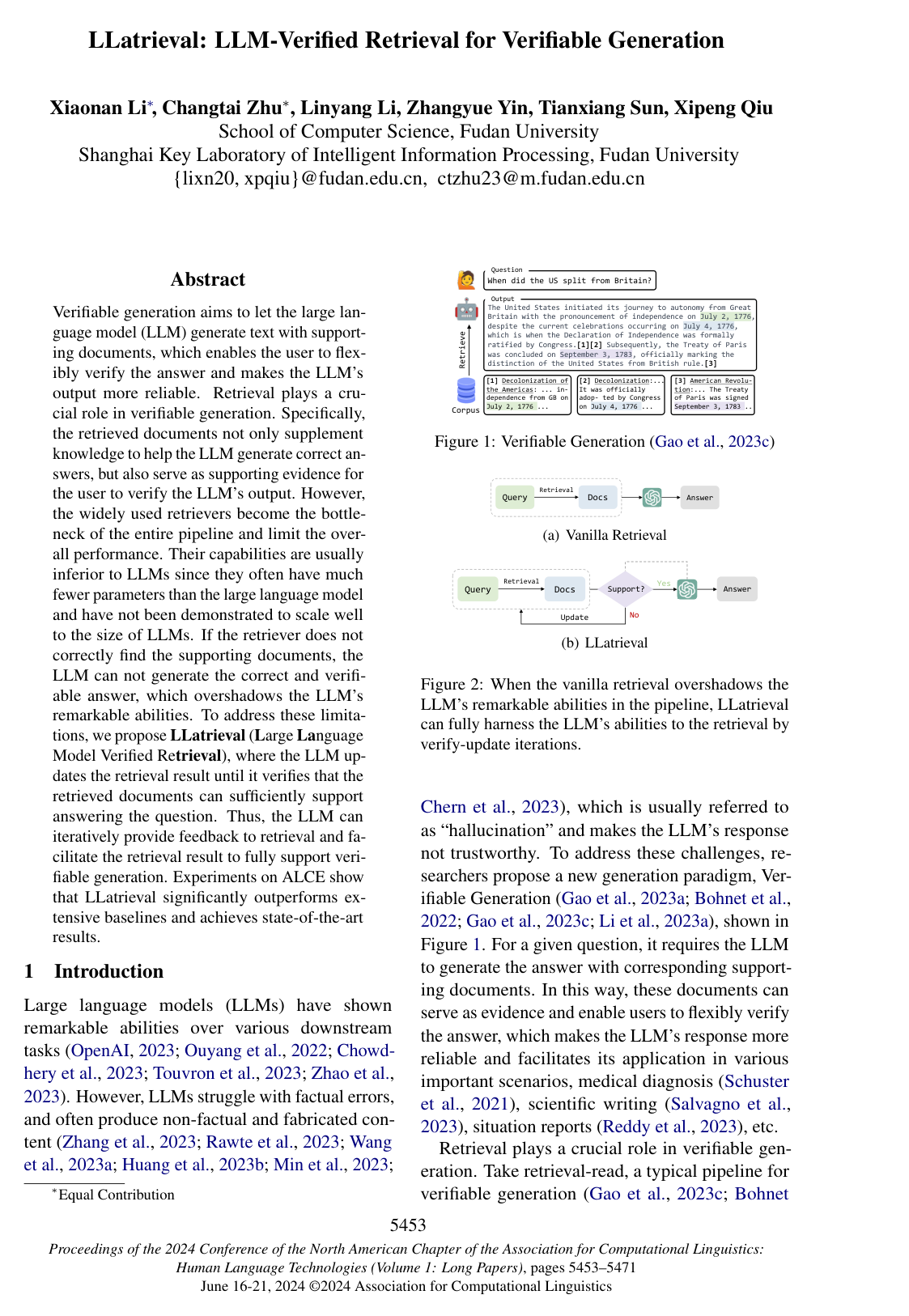
LLatrieval: LLM-Verified Retrieval for Verifiable Generation
Xiaonan Li, Changtai Zhu, Linyang Li, Zhangyue Yin, Tianxiang Sun, Xipeng Qiu
Why you should read this
Proposes an iterative framework where large language models verify and update retrieved documents to overcome retrieval bottlenecks and improve citation accuracy in verifiable text generation.
Added
2026-10-03
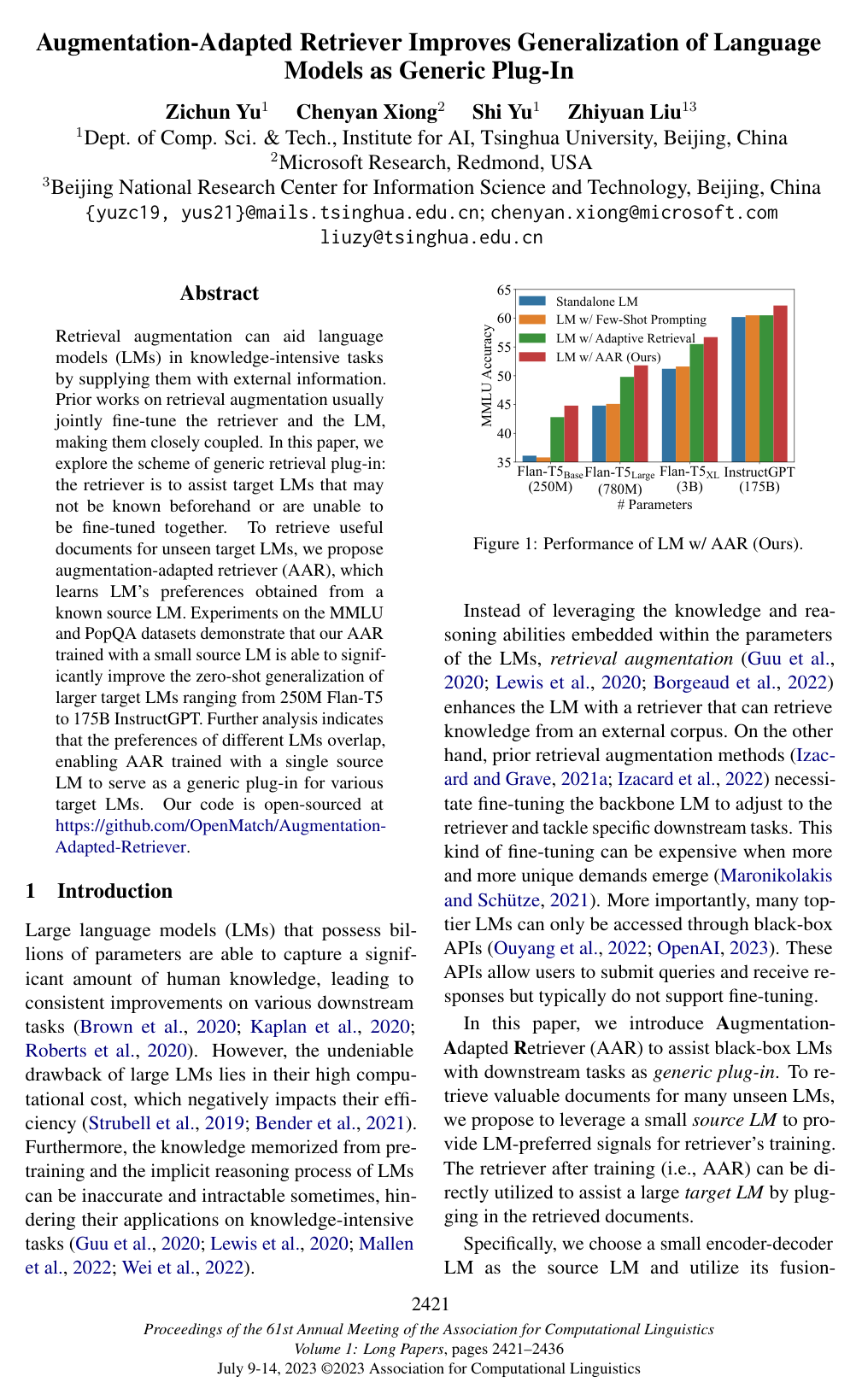
Augmentation-Adapted Retriever Improves Generalization of Language Models as Generic Plug-In
Zichun Yu, Chenyan Xiong, Shi Yu, Zhiyuan Liu
Why you should read this
Proposes an augmentation-adapted retriever that learns document preferences from a small source model to boost the zero-shot generalization of diverse black-box language models without requiring model-specific fine-tuning.
Retrieval augmentation can aid language models (LMs) in knowledge-intensive tasks by supplying them with external information. Prior works on retrieval augmentation usually jointly fine-tune the retriever and the LM, making them closely coupled. In this paper, we explore the scheme of generic retrieval plug-in: the retriever is to assist target LMs that may not be known beforehand or are unable to be fine-tuned together. To retrieve useful documents for unseen target LMs, we propose augmentation-adapted retriever (AAR), which learns LM’s preferences obtained from a known source LM. Experiments on the MMLU and PopQA datasets demonstrate that our AAR trained with a small source LM is able to significantly improve the zero-shot generalization of larger target LMs ranging from 250M Flan-T5 to 175B InstructGPT. Further analysis indicates that the preferences of different LMs overlap, enabling AAR trained with a single source LM to serve as a generic plug-in for various target LMs. Our code is open-sourced at https://github.com/OpenMatch/Augmentation-Adapted-Retriever.
Added
2026-10-02
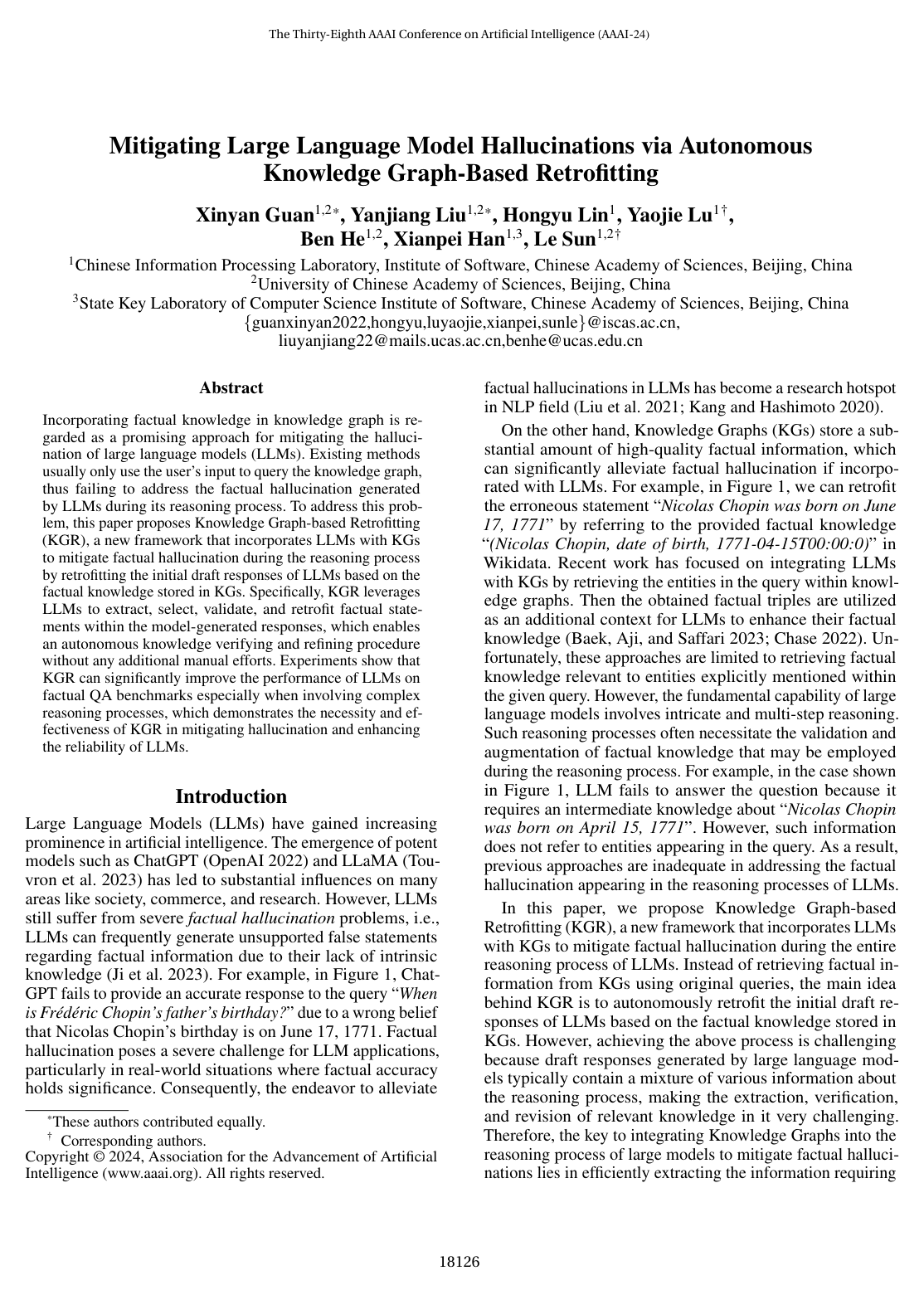
Mitigating Large Language Model Hallucinations via Autonomous Knowledge Graph-Based Retrofitting
Xinyan Guan, Yanjiang Liu, Hongyu Lin, Yaojie Lu, Ben He, Xianpei Han, Le Sun
Why you should read this
Proposes an autonomous framework that iteratively extracts, verifies, and retrofits intermediate factual claims in draft responses using knowledge graphs, effectively eliminating multi-step reasoning hallucinations in large language models.
Incorporating factual knowledge in knowledge graph is regarded as a promising approach for mitigating the hallucination of large language models (LLMs). Existing methods usually only use the user’s input to query the knowledge graph, thus failing to address the factual hallucination generated by LLMs during its reasoning process. To address this problem, this paper proposes Knowledge Graph-based Retrofitting (KGR), a new framework that incorporates LLMs with KGs to mitigate factual hallucination during the reasoning process by retrofitting the initial draft responses of LLMs based on the factual knowledge stored in KGs. Specifically, KGR leverages LLMs to extract, select, validate, and retrofit factual statements within the model-generated responses, which enables an autonomous knowledge verifying and refining procedure without any additional manual efforts. Experiments show that KGR can significantly improve the performance of LLMs on factual QA benchmarks especially when involving complex reasoning processes, which demonstrates the necessity and effectiveness of KGR in mitigating hallucination and enhancing the reliability of LLMs.
Added
2026-09-26
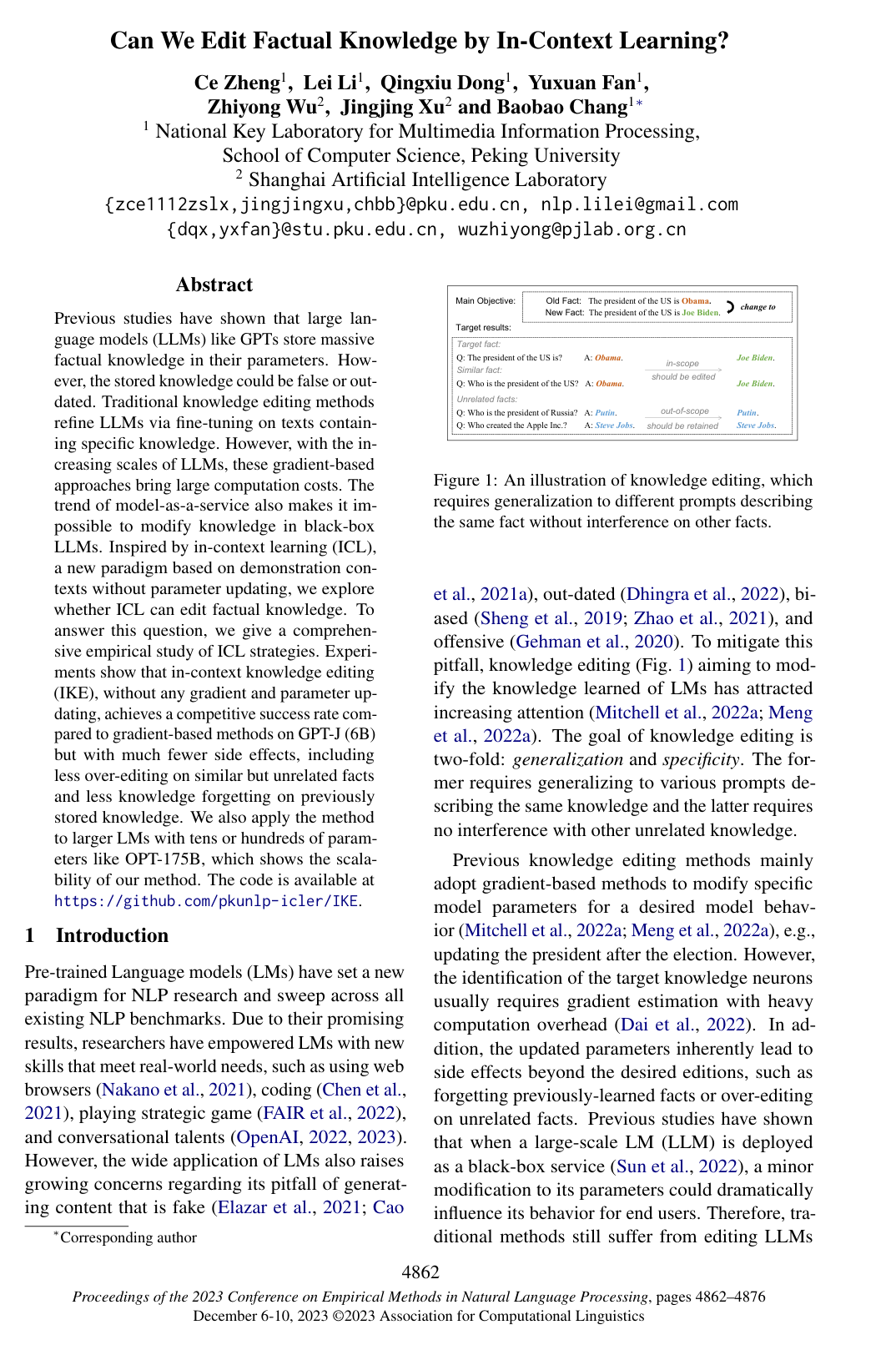
Can We Edit Factual Knowledge by In-Context Learning?
Ce Zheng, Lei Li, Qingxiu Dong, Yuxuan Fan, Zhiyong Wu, Jingjing Xu, Baobao Chang
Why you should read this
Proposes an in-context knowledge editing framework that updates facts in large language models using structured demonstration prompts, achieving competitive editing performance without costly parameter updates or catastrophic forgetting.
Previous studies have shown that large language models (LLMs) like GPTs store massive factual knowledge in their parameters. However, the stored knowledge could be false or out-dated. Traditional knowledge editing methods refine LLMs via fine-tuning on texts containing specific knowledge. However, with the increasing scales of LLMs, these gradient-based approaches bring large computation costs. The trend of model-as-a-service also makes it impossible to modify knowledge in black-box LLMs. Inspired by in-context learning (ICL), a new paradigm based on demonstration contexts without parameter updating, we explore whether ICL can edit factual knowledge. To answer this question, we give a comprehensive empirical study of ICL strategies. Experiments show that in-context knowledge editing (IKE), without any gradient and parameter updating, achieves a competitive success rate compared to gradient-based methods on GPT-J (6B) but with much fewer side effects, including less over-editing on similar but unrelated facts and less knowledge forgetting on previously stored knowledge. We also apply the method to larger LMs with tens or hundreds of parameters like OPT-175B, which shows the scalability of our method. The code is available at https://github.com/pkunlp-icler/IKE.
Added
2026-09-26