
keyword
resource-rich languages
Resource-rich languages are languages with abundant digital and linguistic resources for natural language processing, such as large text collections, training data, and language tools, making them better represented and generally better supported by language technologies than languages with fewer such resources.
2 items
Enhancing Multilingual Capabilities of Large Language Models through Self-Distillation from Resource-Rich Languages
Yuanchi Zhang, Yile Wang, Zijun Liu, Shuo Wang, Xiaolong Wang, Peng Li, Maosong Sun, Yang Liu
Why you should read this
Proposes SDRRL, a self-distillation framework that transfers knowledge from an LLM's own high-resource language outputs to low-resource languages, improving multilingual comprehension and generation while preserving source-language performance.
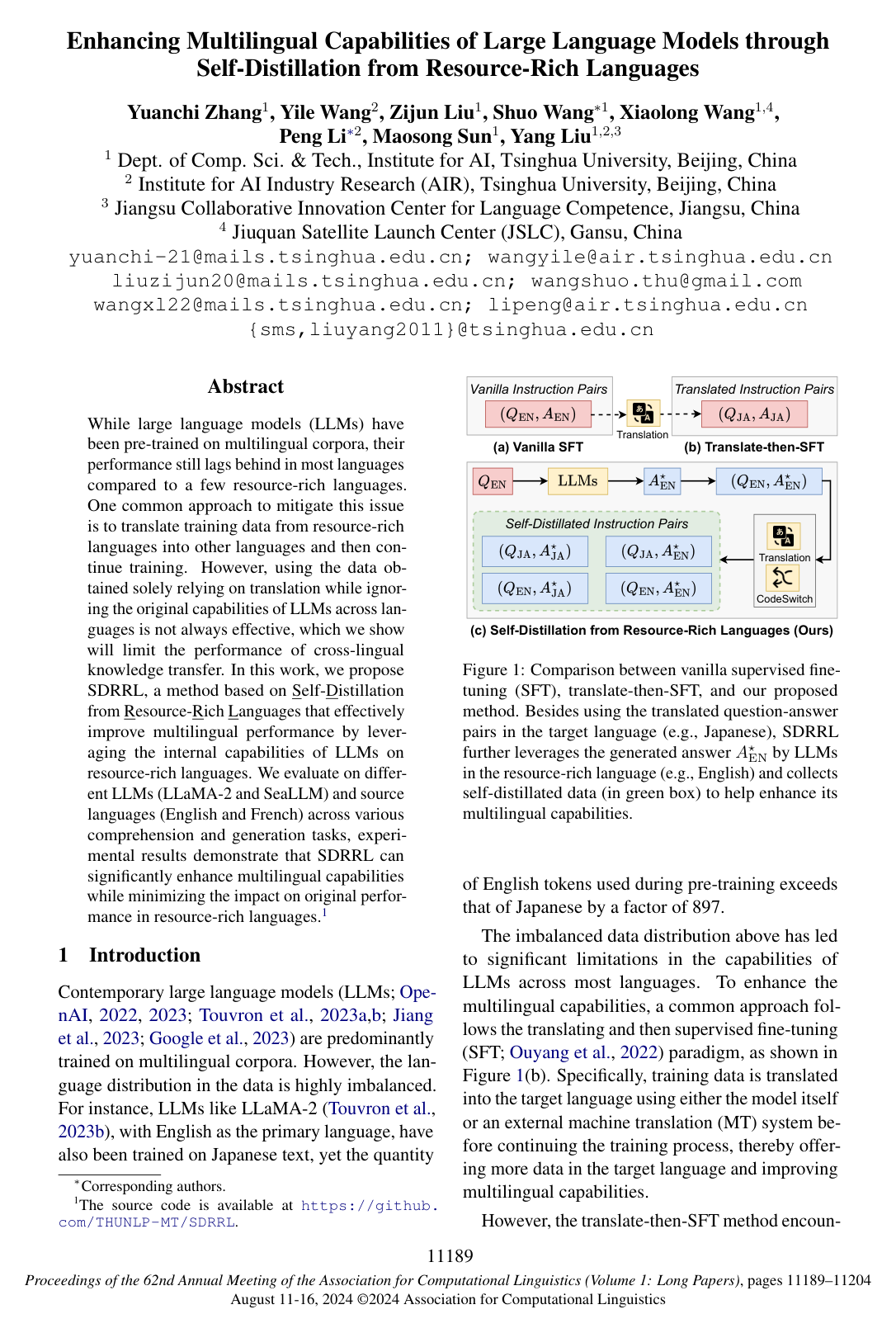
While large language models (LLMs) have been pre-trained on multilingual corpora, their performance still lags behind in most languages compared to a few resource-rich languages. One common approach to mitigate this issue is to translate training data from resource-rich languages into other languages and then continue training. However, using the data obtained solely relying on translation while ignoring the original capabilities of LLMs across languages is not always effective, which we show will limit the performance of cross-lingual knowledge transfer. In this work, we propose SDRRL, a method based on Self-Distillation from Resource-Rich Languages that effectively improve multilingual performance by leveraging the internal capabilities of LLMs on resource-rich languages. We evaluate on different LLMs (LLaMA-2 and SeaLLM) and source languages (English and French) across various comprehension and generation tasks, experimental results demonstrate that SDRRL can significantly enhance multilingual capabilities while minimizing the impact on original performance in resource-rich languages.
Added
2026-10-04
The State and Fate of Linguistic Diversity and Inclusion in the NLP World
Pratik Joshi, Sebastin Santy, Amar Budhiraja, Kalika Bali, Monojit Choudhury
Why you should read this
Quantifies the severe disparity in resources and representation across global languages in NLP research, challenging the claim that modern language technologies are genuinely language-agnostic.
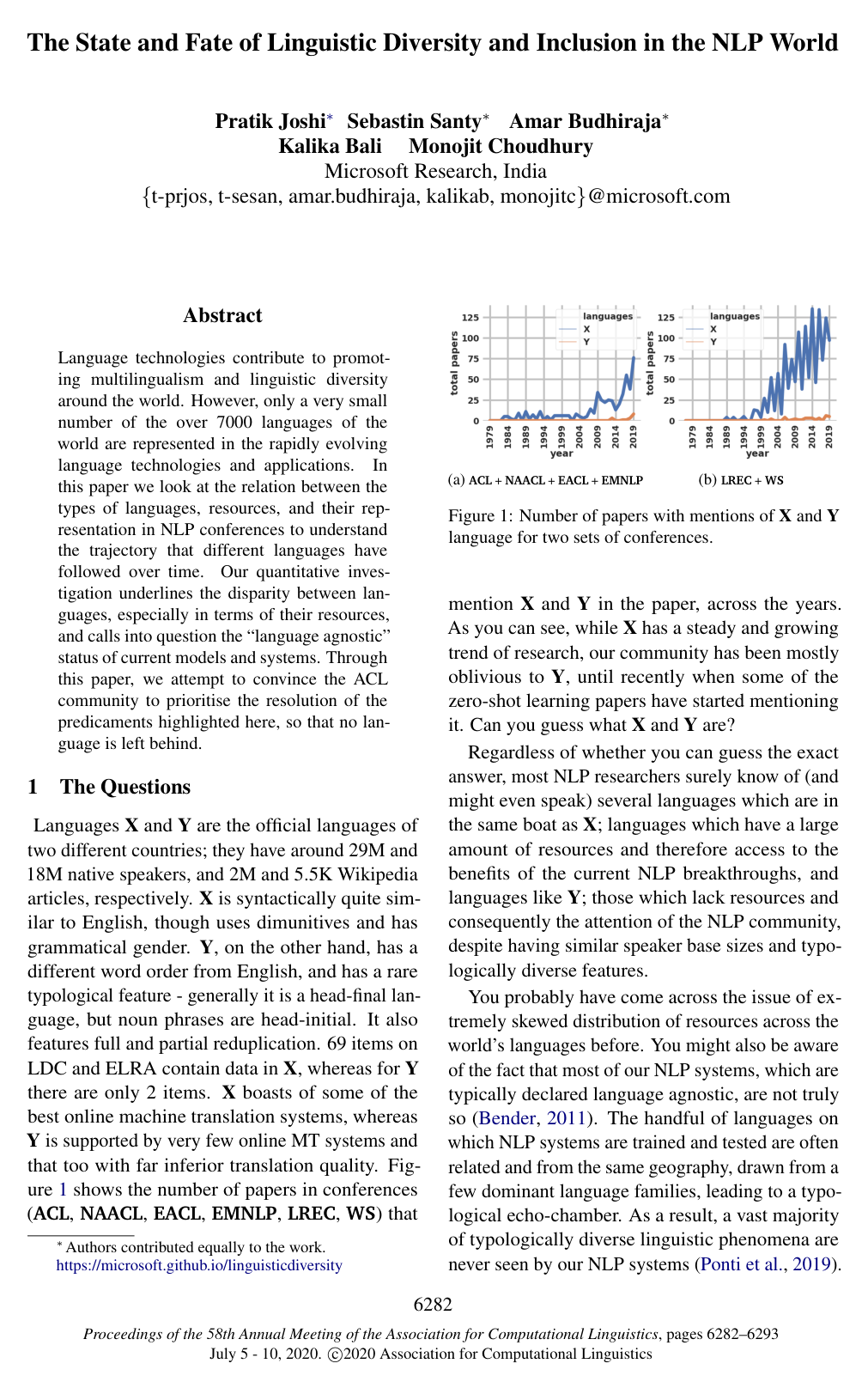
Language technologies contribute to promoting multilingualism and linguistic diversity around the world. However, only a very small number of the over 7000 languages of the world are represented in the rapidly evolving language technologies and applications. In this paper we look at the relation between the types of languages, resources, and their representation in NLP conferences to understand the trajectory that different languages have followed over time. Our quantitative investigation underlines the disparity between languages, especially in terms of their resources, and calls into question the "language agnostic" status of current models and systems. Through this paper, we attempt to convince the ACL community to prioritise the resolution of the predicaments highlighted here, so that no language is left behind.
Added
2026-09-25