
keyword
representation space
A representation space is a multidimensional mathematical space in which data such as words, images, or intermediate neural network states are mapped as continuous numerical vectors. In this space, geometric properties such as distance, direction, and angle reflect meaningful semantic, contextual, or structural relationships among the inputs. Entities sharing similar characteristics or meanings are positioned closer to one another, typically measured by metrics like cosine similarity or Euclidean distance, while specific directions within the space often correspond to latent attributes or concepts. Machine learning models use representation spaces to transform complex, high-dimensional raw data into structured internal representations that facilitate analysis, comparison, generation, and task-specific optimization.
2 items
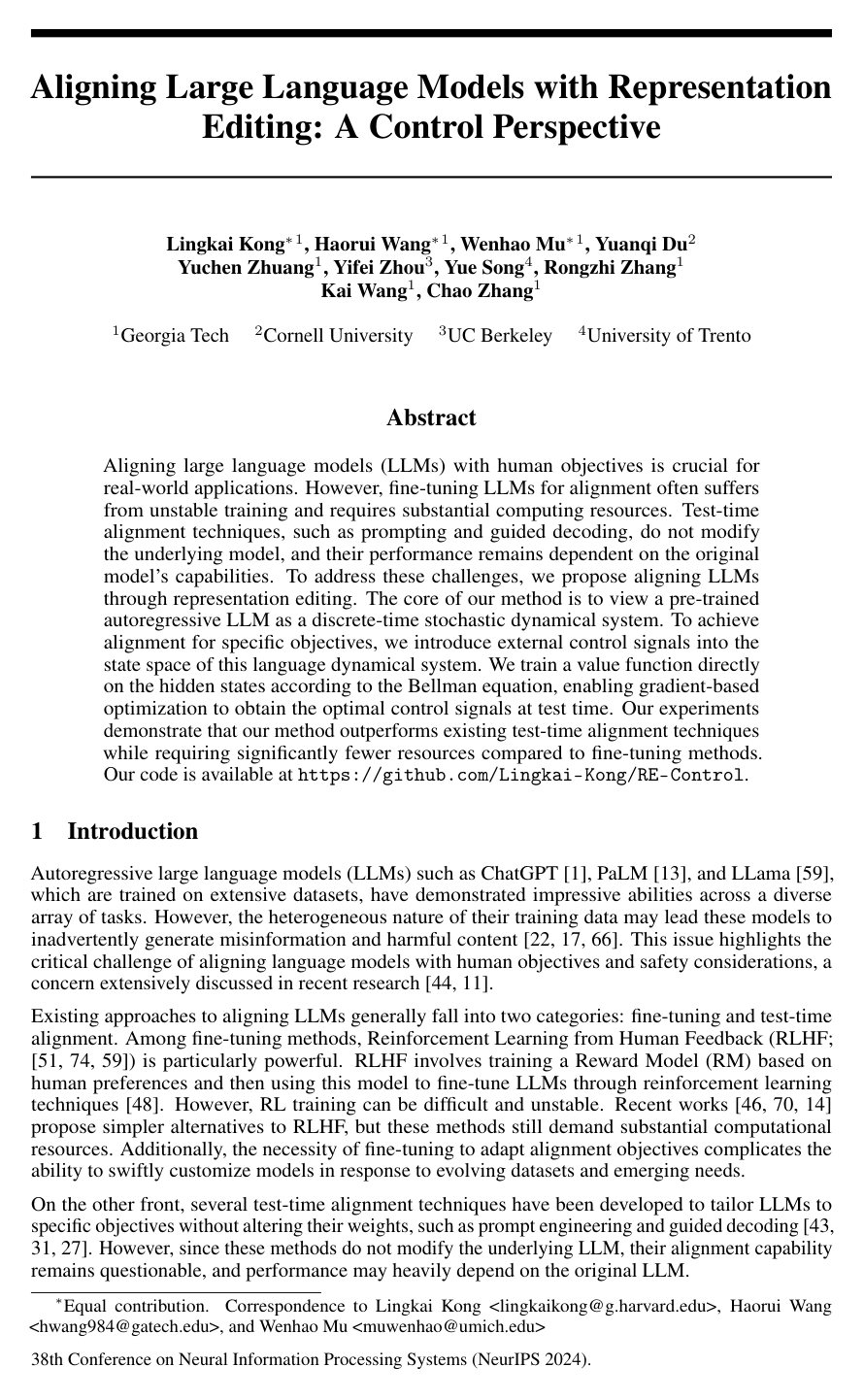
Aligning Large Language Models with Representation Editing: A Control Perspective
Lingkai Kong, Haorui Wang, Wenhao Mu, Yuanqi Du, Yuchen Zhuang, Yifei Zhou, Yue Song, Rongzhi Zhang, Kai Wang, Chao Zhang
Why you should read this
Presents RE-Control, a framework that models autoregressive language generation as a stochastic dynamical system and uses Bellman-trained value functions to dynamically edit hidden representations at test time, matching fine-tuning alignment quality with significantly lower computational cost.
Aligning large language models (LLMs) with human objectives is crucial for real-world applications. However, fine-tuning LLMs for alignment often suffers from unstable training and requires substantial computing resources. Test-time alignment techniques, such as prompting and guided decoding, do not modify the underlying model, and their performance remains dependent on the original model's capabilities. To address these challenges, we propose aligning LLMs through representation editing. The core of our method is to view a pre-trained autoregressive LLM as a discrete-time stochastic dynamical system. To achieve alignment for specific objectives, we introduce external control signals into the state space of this language dynamical system. We train a value function directly on the hidden states according to the Bellman equation, enabling gradient-based optimization to obtain the optimal control signals at test time. Our experiments demonstrate that our method outperforms existing test-time alignment techniques while requiring significantly fewer resources compared to fine-tuning methods. Our code is available at https://github.com/Lingkai-Kong/RE-Control.
Added
2026-09-26
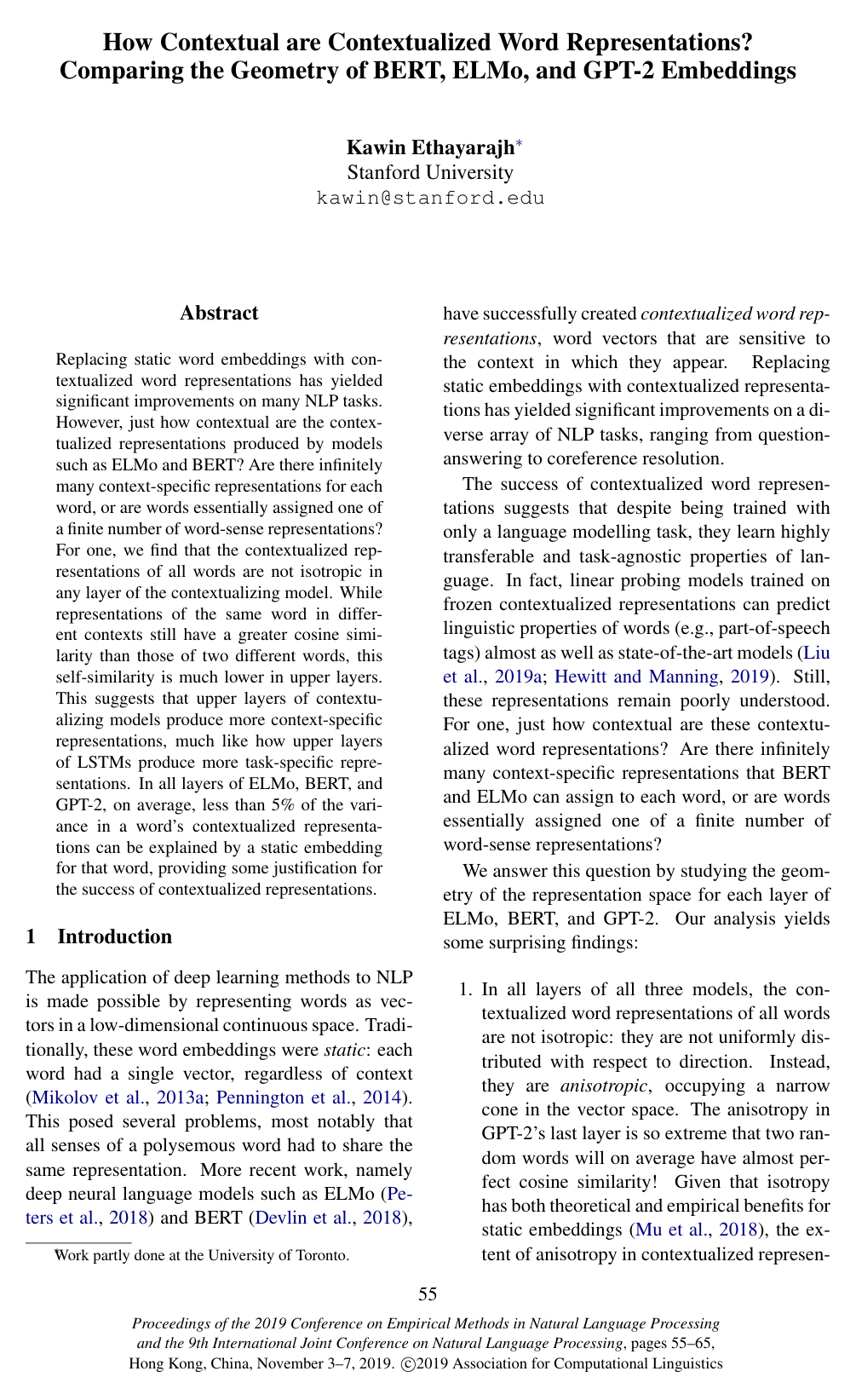
How Contextual are Contextualized Word Representations? Comparing the Geometry of BERT, ELMo, and GPT-2 Embeddings
Kawin Ethayarajh
Why you should read this
Reveals the geometric behavior of BERT, ELMo, and GPT-2 embeddings across layers, proving that upper layers generate more context-specific representations while static word vectors account for less than five percent of their variance.
Replacing static word embeddings with contextualized word representations has yielded significant improvements on many NLP tasks. However, just how contextual are the contextualized representations produced by models such as ELMo and BERT? Are there infinitely many context-specific representations for each word, or are words essentially assigned one of a finite number of word-sense representations? For one, we find that the contextualized representations of all words are not isotropic in any layer of the contextualizing model. While representations of the same word in different contexts still have a greater cosine similarity than those of two different words, this self-similarity is much lower in upper layers. This suggests that upper layers of contextualizing models produce more context-specific representations, much like how upper layers of LSTMs produce more task-specific representations. In all layers of ELMo, BERT, and GPT-2, on average, less than 5% of the variance in a word's contextualized representations can be explained by a static embedding for that word, providing some justification for the success of contextualized representations.
Added
2026-09-25