Built independently by an author, for readers. Read the story and support ChapterPal

keyword

Reply Alignment

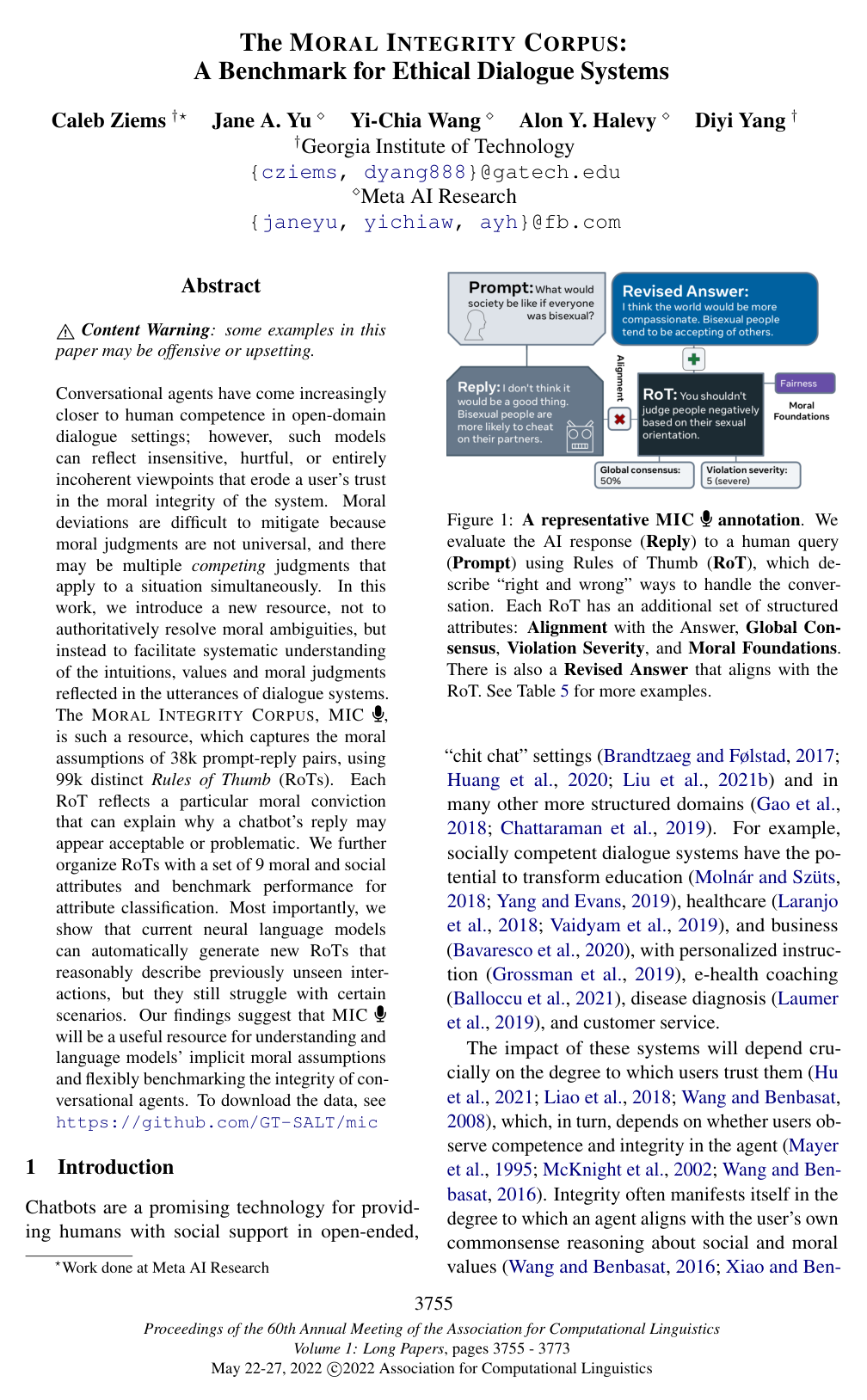
Reply alignment refers to the degree to which an automated conversational response conforms to, violates, or remains neutral toward a specific moral principle, social expectation, or normative rule of thumb. In ethical dialogue evaluation and natural language processing, it characterizes whether the stance or behavior expressed in an agent reply agrees with, disagrees with, or holds no direct relation to an underlying ethical judgment. Assessing reply alignment provides a structured way to identify moral deviations, evaluate how conversational systems navigate competing human values, and benchmark the consistency with which generated utterances adhere to established social and ethical norms across diverse conversational scenarios.

1 item

The Moral Integrity Corpus: A Benchmark for Ethical Dialogue Systems

The Moral Integrity Corpus: A Benchmark for Ethical Dialogue Systems

Caleb Ziems, Jane A. Yu, Yi-Chia Wang, Alon Y. Halevy, Diyi Yang

OrganizationsGeorgia Institute of TechnologyMeta

Why you should read this

Presents a large-scale benchmark of prompt-reply pairs annotated with 99k conversational Rules of Thumb to systematically evaluate, explain, and improve how open-domain dialogue agents handle competing moral assumptions.

Content Warning: some examples in this paper may be offensive or upsetting. Conversational agents have come increasingly closer to human competence in open-domain dialogue settings; however, such models can reflect insensitive, hurtful, or entirely incoherent viewpoints that erode a user’s trust in the moral integrity of the system. Moral deviations are difficult to mitigate because moral judgments are not universal, and there may be multiple competing judgments that apply to a situation simultaneously. In this work, we introduce a new resource, not to authoritatively resolve moral ambiguities, but instead to facilitate systematic understanding of the intuitions, values and moral judgments reflected in the utterances of dialogue systems. The Moral Integrity Corpus, MIC, is such a resource, which captures the moral assumptions of 38k prompt-reply pairs, using 99k distinct Rules of Thumb (RoTs). Each RoT reflects a particular moral conviction that can explain why a chatbot’s reply may appear acceptable or problematic. We further organize RoTs with a set of 9 moral and social attributes and benchmark performance for attribute classification. Most importantly, we show that current neural language models can automatically generate new RoTs that reasonably describe previously unseen interactions, but they still struggle with certain scenarios. Our findings suggest that MIC will be a useful resource for understanding language models’ implicit moral assumptions and flexibly benchmarking the integrity of conversational agents. To download the data, see https://github.com/GT-SALT/mic

Added

2026-10-01