
keyword
replay buffers
A replay buffer is a memory storage mechanism in machine learning that saves past experiences, data samples, or environment transitions encountered during training so they can be reused at later stages. Commonly utilized in reinforcement learning and continual learning frameworks, this buffer stores records such as state transitions, actions, rewards, and historical task data. By sampling and replaying these stored experiences alongside or in place of immediate observations, learning algorithms can break temporal correlations between consecutive data points, improve sample efficiency, and mitigate catastrophic forgetting, thereby enabling neural networks to retain previously acquired skills and knowledge when exposed to non-stationary data streams or sequences of new tasks.
2 items
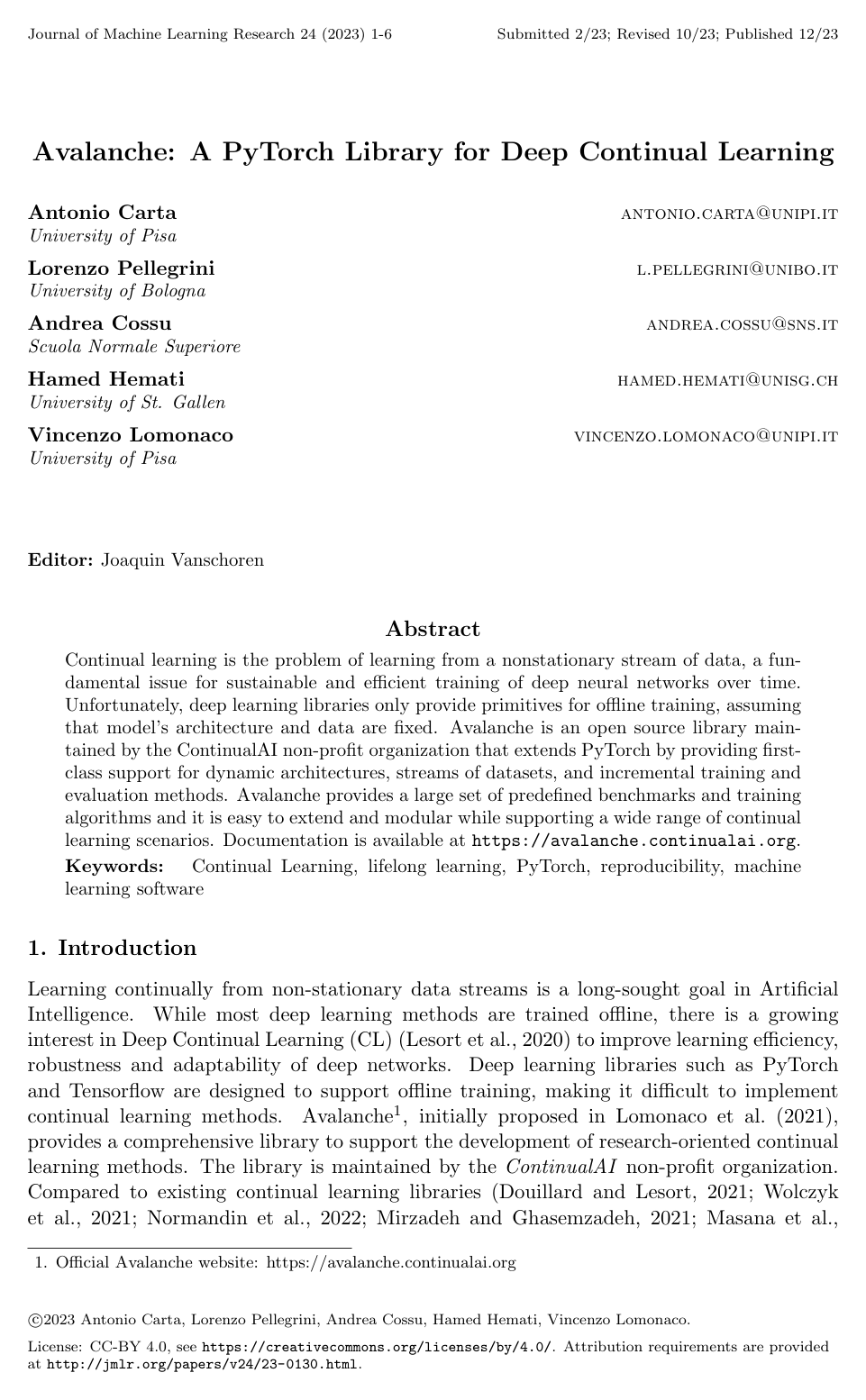
Avalanche: A PyTorch Library for Deep Continual Learning
Antonio Carta, Lorenzo Pellegrini, Andrea Cossu, Hamed Hemati, Vincenzo Lomonaco
Why you should read this
Introduces Avalanche, an open-source PyTorch library that simplifies continual learning research by providing dynamic neural network architectures, streaming data loaders, modular training plugins, and standardized evaluation benchmarks.
Continual learning is the problem of learning from a nonstationary stream of data, a fundamental issue for sustainable and efficient training of deep neural networks over time. Unfortunately, deep learning libraries only provide primitives for offline training, assuming that model’s architecture and data are fixed. Avalanche is an open source library maintained by the ContinualAI non-profit organization that extends PyTorch by providing first-class support for dynamic architectures, streams of datasets, and incremental training and evaluation methods. Avalanche provides a large set of predefined benchmarks and training algorithms and it is easy to extend and modular while supporting a wide range of continual learning scenarios. Documentation is available at https://avalanche.continualai.org.
Added
2026-10-04
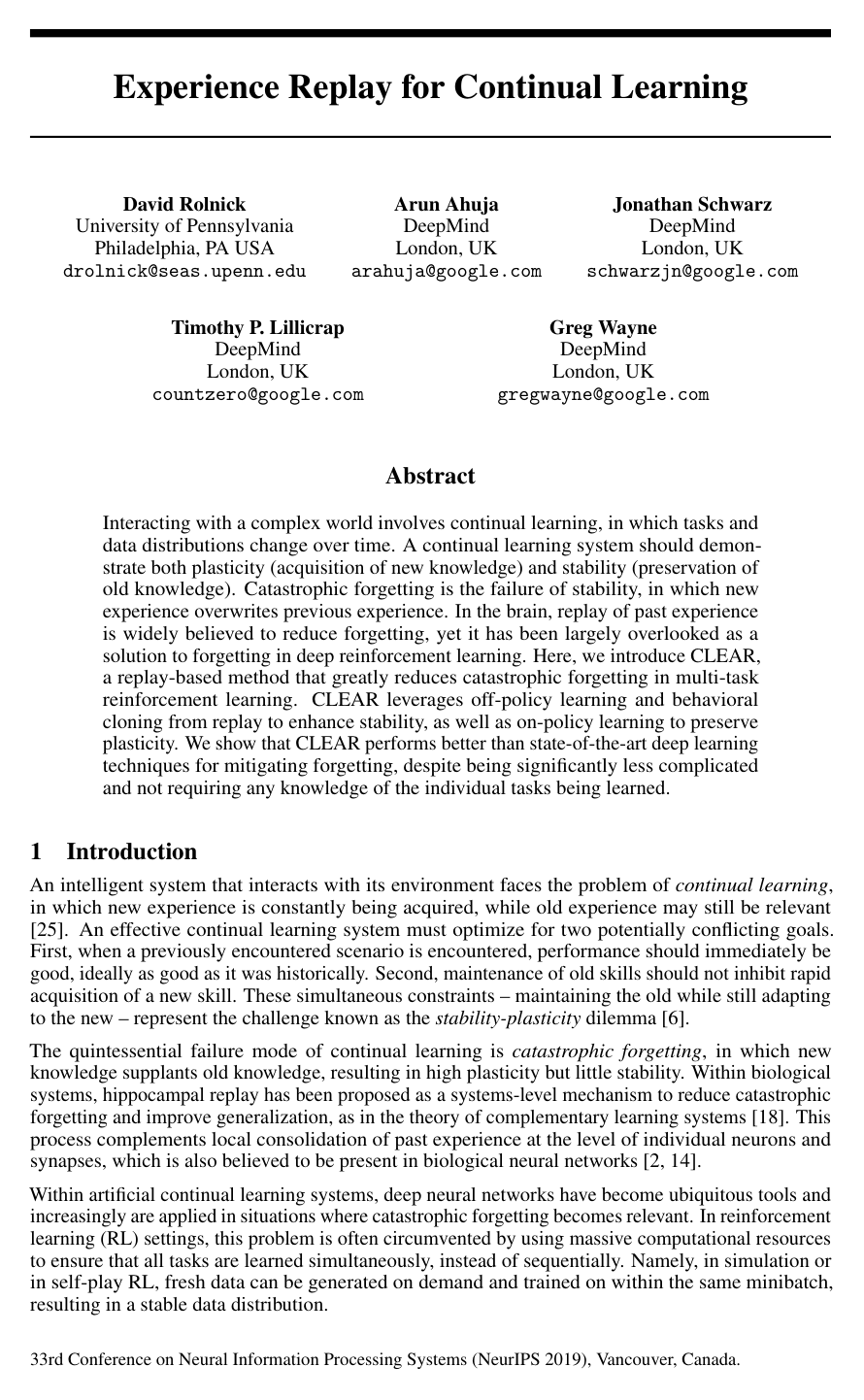
Experience Replay for Continual Learning
David Rolnick, Arun Ahuja, Jonathan Schwarz, Timothy P. Lillicrap, Greg Wayne
Why you should read this
Demonstrates that combining experience replay with behavioral cloning effectively prevents catastrophic forgetting in continual reinforcement learning without requiring task boundary labels, matching the performance of specialized task-aware methods across Atari and DeepMind Lab.
Continual learning is the problem of learning new tasks or knowledge while protecting old knowledge and ideally generalizing from old experience to learn new tasks faster. Neural networks trained by stochastic gradient descent often degrade on old tasks when trained successively on new tasks with different data distributions. This phenomenon, referred to as catastrophic forgetting, is considered a major hurdle to learning with non-stationary data or sequences of new tasks, and prevents networks from continually accumulating knowledge and skills. We examine this issue in the context of reinforcement learning, in a setting where an agent is exposed to tasks in a sequence. Unlike most other work, we do not provide an explicit indication to the model of task boundaries, which is the most general circumstance for a learning agent exposed to continuous experience. While various methods to counteract catastrophic forgetting have recently been proposed, we explore a straightforward, general, and seemingly overlooked solution - that of using experience replay buffers for all past events - with a mixture of on- and off-policy learning, leveraging behavioral cloning. We show that this strategy can still learn new tasks quickly yet can substantially reduce catastrophic forgetting in both Atari and DMLab domains, even matching the performance of methods that require task identities. When buffer storage is constrained, we confirm that a simple mechanism for randomly discarding data allows a limited size buffer to perform almost as well as an unbounded one.
Added
2026-09-18