
keyword
relative position representations
Relative position representations are mathematical encodings used in transformer neural networks to capture the relative distance or displacement between pairs of input elements rather than their absolute coordinates. In standard self-attention mechanisms, elements such as tokens in a sequence or patches in an image lack inherent order; relative position representations resolve this by directly modifying the attention calculations using learned vectors or biases that reflect the directional distance between query and key elements. This approach enables the model to learn invariant spatial or temporal relationships, such as how elements relate to their immediate neighbors or distant counterparts, independent of where they appear within the overall input. By focusing on pairwise offsets instead of fixed indices, networks with relative position representations generalize more effectively across variable input lengths and dimensions across both natural language processing and computer vision domains.
3 items
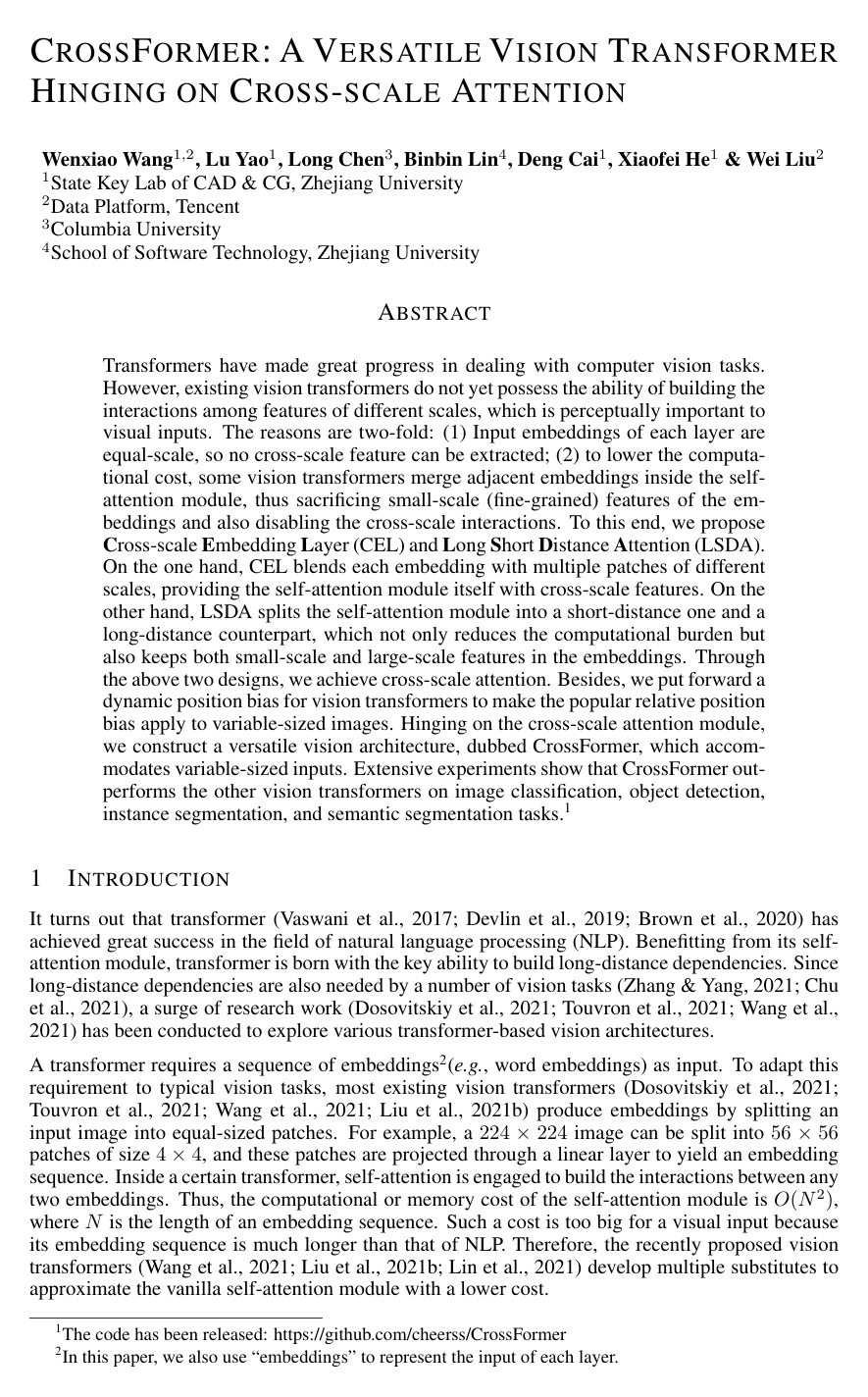
CrossFormer: A Versatile Vision Transformer Hinging on Cross-scale Attention
Wenxiao Wang, Lu Yao, Long Chen, Binbin Lin, Deng Cai, Xiaofei He, Wei Liu
Why you should read this
Proposes CrossFormer, a vision transformer that establishes cross-scale feature interactions using multi-scale patch embeddings and long-short distance attention to achieve superior performance across image classification, object detection, and segmentation benchmarks.
Transformers have made great progress in dealing with computer vision tasks. However, existing vision transformers do not yet possess the ability of building the interactions among features of different scales, which is perceptually important to visual inputs. The reasons are two-fold: (1) Input embeddings of each layer are equal-scale, so no cross-scale feature can be extracted; (2) to lower the computational cost, some vision transformers merge adjacent embeddings inside the self-attention module, thus sacrificing small-scale (fine-grained) features of the embeddings and also disabling the cross-scale interactions. To this end, we propose Cross-scale Embedding Layer (CEL) and Long Short Distance Attention (LSDA). On the one hand, CEL blends each embedding with multiple patches of different scales, providing the self-attention module itself with cross-scale features. On the other hand, LSDA splits the self-attention module into a short-distance one and a long-distance counterpart, which not only reduces the computational burden but also keeps both small-scale and large-scale features in the embeddings. Through the above two designs, we achieve cross-scale attention. Besides, we put forward a dynamic position bias for vision transformers to make the popular relative position bias apply to variable-sized images. Hinging on the cross-scale attention module, we construct a versatile vision architecture, dubbed CrossFormer, which accommodates variable-sized inputs. Extensive experiments show that CrossFormer outperforms the other vision transformers on image classification, object detection, instance segmentation, and semantic segmentation tasks. The code has been released: this https URL.
Added
2026-09-26
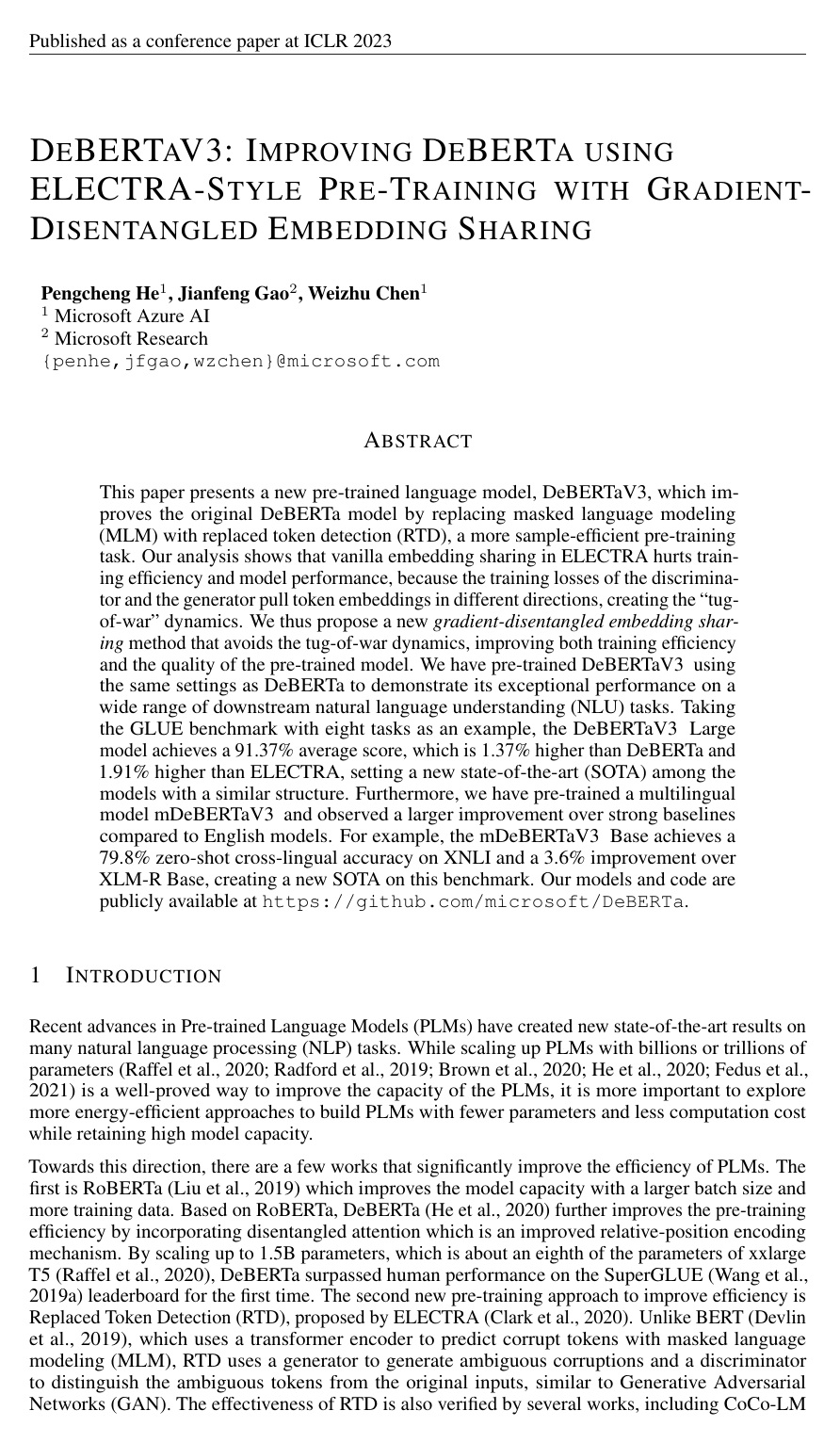
DeBERTaV3: Improving DeBERTa using ELECTRA-Style Pre-Training with Gradient-Disentangled Embedding Sharing
Pengcheng He, Jianfeng Gao, Weizhu Chen
Why you should read this
Proposes a gradient-disentangled embedding sharing method that eliminates optimization conflicts during ELECTRA-style replaced token detection, significantly boosting pre-training efficiency and setting new state-of-the-art performance across English and multilingual natural language understanding benchmarks.
This paper presents a new pre-trained language model, DeBERTaV3, which improves the original DeBERTa model by replacing mask language modeling (MLM) with replaced token detection (RTD), a more sample-efficient pre-training task. Our analysis shows that vanilla embedding sharing in ELECTRA hurts training efficiency and model performance. This is because the training losses of the discriminator and the generator pull token embeddings in different directions, creating the "tug-of-war" dynamics. We thus propose a new gradient-disentangled embedding sharing method that avoids the tug-of-war dynamics, improving both training efficiency and the quality of the pre-trained model. We have pre-trained DeBERTaV3 using the same settings as DeBERTa to demonstrate its exceptional performance on a wide range of downstream natural language understanding (NLU) tasks. Taking the GLUE benchmark with eight tasks as an example, the DeBERTaV3 Large model achieves a 91.37% average score, which is 1.37% over DeBERTa and 1.91% over ELECTRA, setting a new state-of-the-art (SOTA) among the models with a similar structure. Furthermore, we have pre-trained a multi-lingual model mDeBERTa and observed a larger improvement over strong baselines compared to English models. For example, the mDeBERTa Base achieves a 79.8% zero-shot cross-lingual accuracy on XNLI and a 3.6% improvement over XLM-R Base, creating a new SOTA on this benchmark. We have made our pre-trained models and inference code publicly available at this https URL.
Added
2026-09-18
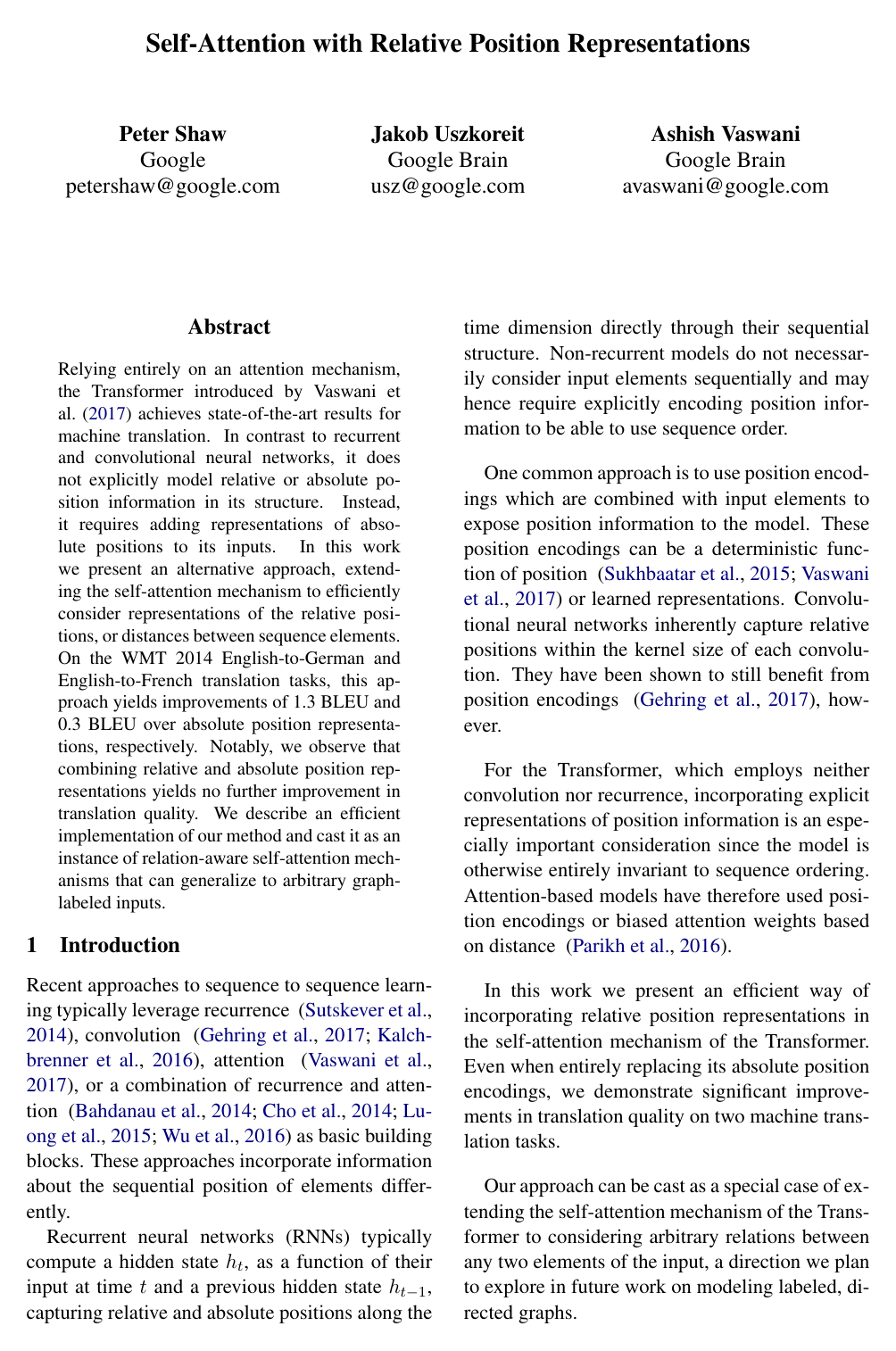
Self-Attention with Relative Position Representations
Peter Shaw, Jakob Uszkoreit, Ashish Vaswani
Why you should read this
Enhances self-attention by incorporating relative distances between tokens directly into the attention graph, fixing the rigidity of absolute positioning.
Relying entirely on an attention mechanism, the Transformer introduced by Vaswani et al. (2017) achieves state-of-the-art results for machine translation. In contrast to recurrent and convolutional neural networks, it does not explicitly model relative or absolute position information in its structure. Instead, it requires adding representations of absolute positions to its inputs. In this work we present an alternative approach, extending the self-attention mechanism to efficiently consider representations of the relative positions, or distances between sequence elements. On the WMT 2014 English-to-German and English-to-French translation tasks, this approach yields improvements of 1.3 BLEU and 0.3 BLEU over absolute position representations, respectively. Notably, we observe that combining relative and absolute position representations yields no further improvement in translation quality. We describe an efficient implementation of our method and cast it as an instance of relation-aware self-attention mechanisms that can generalize to arbitrary graph-labeled inputs.
Added
2026-02-11