
keyword
relational reasoning
Relational reasoning is the cognitive and computational process of identifying, understanding, and drawing inferences from the relationships and interactions between multiple entities rather than solely evaluating their individual properties. This capacity allows an intelligent agent or system to discern how distinct objects, concepts, or agents are connected through spatial, temporal, causal, or abstract structural links, as well as to compose these relationships across multi-step reasoning chains. In artificial intelligence and cognitive modeling, relational reasoning is essential for combinatorial generalization, enabling systems to interpret dynamic physical interactions, perform multi-hop question answering, parse relational graphs, and apply structured knowledge to novel situations.
7 items
Tell me why! Explanations support learning relational and causal structure
Andrew K. Lampinen, Nicholas A. Roy, Ishita Dasgupta, Stephanie C. Y. Chan, Allison C. Tam, James L. McClelland, Chen Yan, Adam Santoro, Neil C. Rabinowitz, Jane X. Wang, Felix Hill
Why you should read this
Demonstrates that training deep reinforcement learning agents to predict auxiliary language explanations enables them to master complex relational reasoning, resolve causal confounds, and perform experimental interventions to generalize to novel settings.
Inferring the abstract relational and causal structure of the world is a major challenge for reinforcement-learning (RL) agents. For humans, language—particularly in the form of explanations—plays a considerable role in overcoming this challenge. Here, we show that language can play a similar role for deep RL agents in complex environments. While agents typically struggle to acquire relational and causal knowledge, augmenting their experience by training them to predict language descriptions and explanations can overcome these limitations. We show that language can help agents learn challenging relational tasks, and examine which aspects of language contribute to its benefits. We then show that explanations can help agents to infer not only relational but also causal structure. Language can shape the way that agents to generalize out-of-distribution from ambiguous, causally-confounded training, and explanations even allow agents to learn to perform experimental interventions to identify causal relationships. Our results suggest that language description and explanation may be powerful tools for improving agent learning and generalization.
Added
2026-10-03
Do Transformers Use their Depth Adaptively? Evidence from a Relational Reasoning Task
Alicia Curth, Rachel Lawrence, Sushrut Karmalkar, Niranjani Prasad
Why you should read this
Demonstrates that transformers adaptively allocate layer depth to match reasoning difficulty in multi-hop tasks, using logit lens and causal patching to reveal how computational depth scales with relationship chain length.
We investigate whether transformers use their depth adaptively across tasks of increasing difficulty. Using a controlled multi-hop relational reasoning task based on family stories, where difficulty is determined by the number of relationship hops that must be composed, we monitor (i) how predictions evolve across layers via early readouts (the logit lens) and (ii) how task-relevant information is integrated across tokens via causal patching. For pretrained models, we find some limited evidence for adaptive depth use: some larger models need fewer layers to arrive at plausible answers for easier tasks, and models generally use more layers to integrate information across tokens as chain length increases. For models finetuned on the task, we find clearer and more consistent evidence of adaptive depth use, with the effect being stronger for less constrained finetuning regimes that do not preserve general language modeling abilities.
Added
2026-09-29
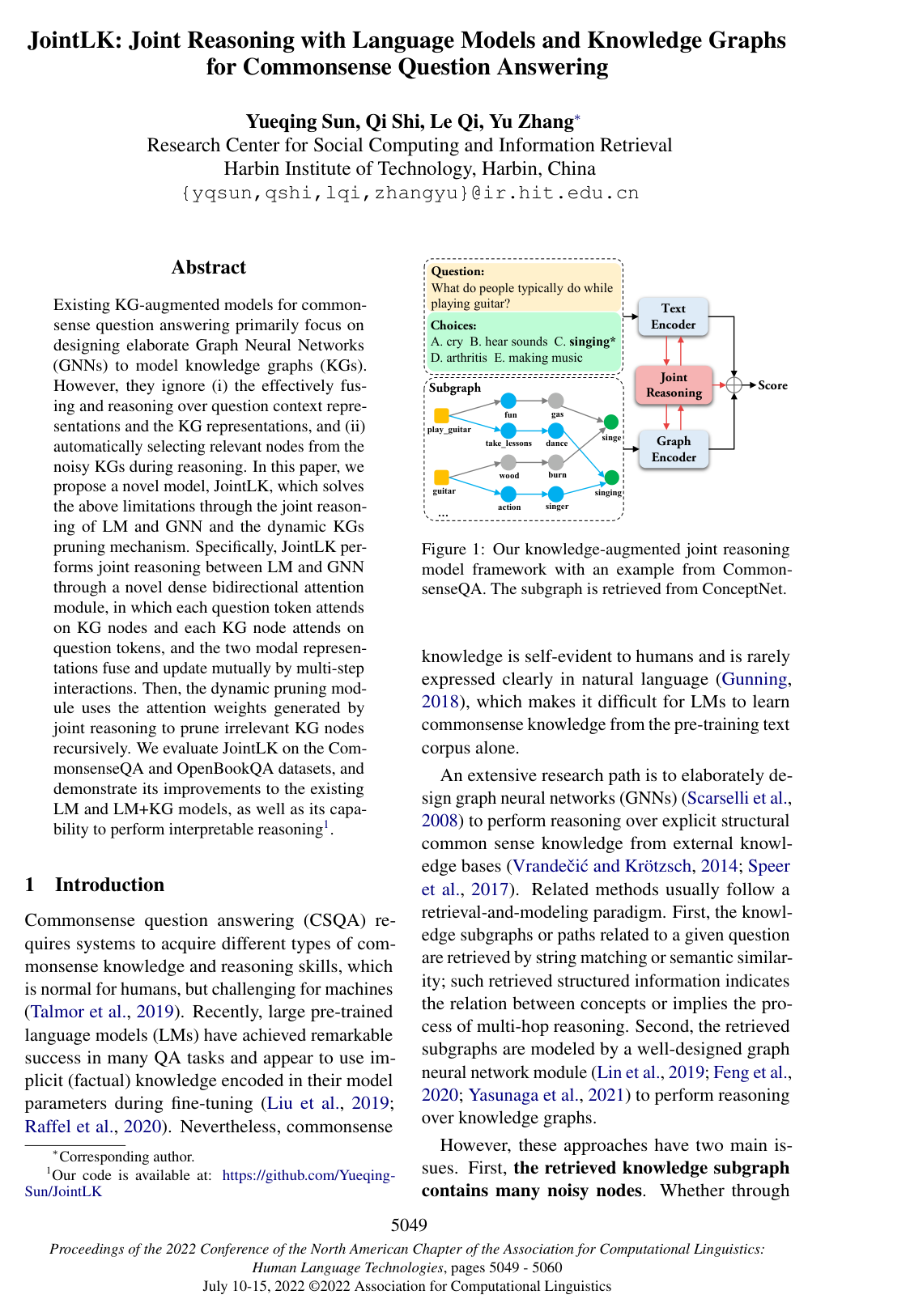
JointLK: Joint Reasoning with Language Models and Knowledge Graphs for Commonsense Question Answering
Yueqing Sun, Qi Shi, Le Qi, Yu Zhang
Why you should read this
Proposes JointLK, a model that unites pretrained language models and graph neural networks through fine-grained bidirectional attention and dynamic node pruning to filter irrelevant knowledge and deliver interpretable commonsense question answering.
Existing KG-augmented models for common-sense question answering primarily focus on designing elaborate Graph Neural Networks (GNNs) to model knowledge graphs (KGs). However, they ignore (i) the effectively fusing and reasoning over question context representations and the KG representations, and (ii) automatically selecting relevant nodes from the noisy KGs during reasoning. In this paper, we propose a novel model, JointLK, which solves the above limitations through the joint reasoning of LM and GNN and the dynamic KGs pruning mechanism. Specifically, JointLK performs joint reasoning between LM and GNN through a novel dense bidirectional attention module, in which each question token attends on KG nodes and each KG node attends on question tokens, and the two modal representations fuse and update mutually by multi-step interactions. Then, the dynamic pruning module uses the attention weights generated by joint reasoning to prune irrelevant KG nodes recursively. We evaluate JointLK on the CommonsenseQA and OpenBookQA datasets, and demonstrate its improvements to the existing LM and LM+KG models, as well as its capability to perform interpretable reasoning¹.
Added
2026-09-26
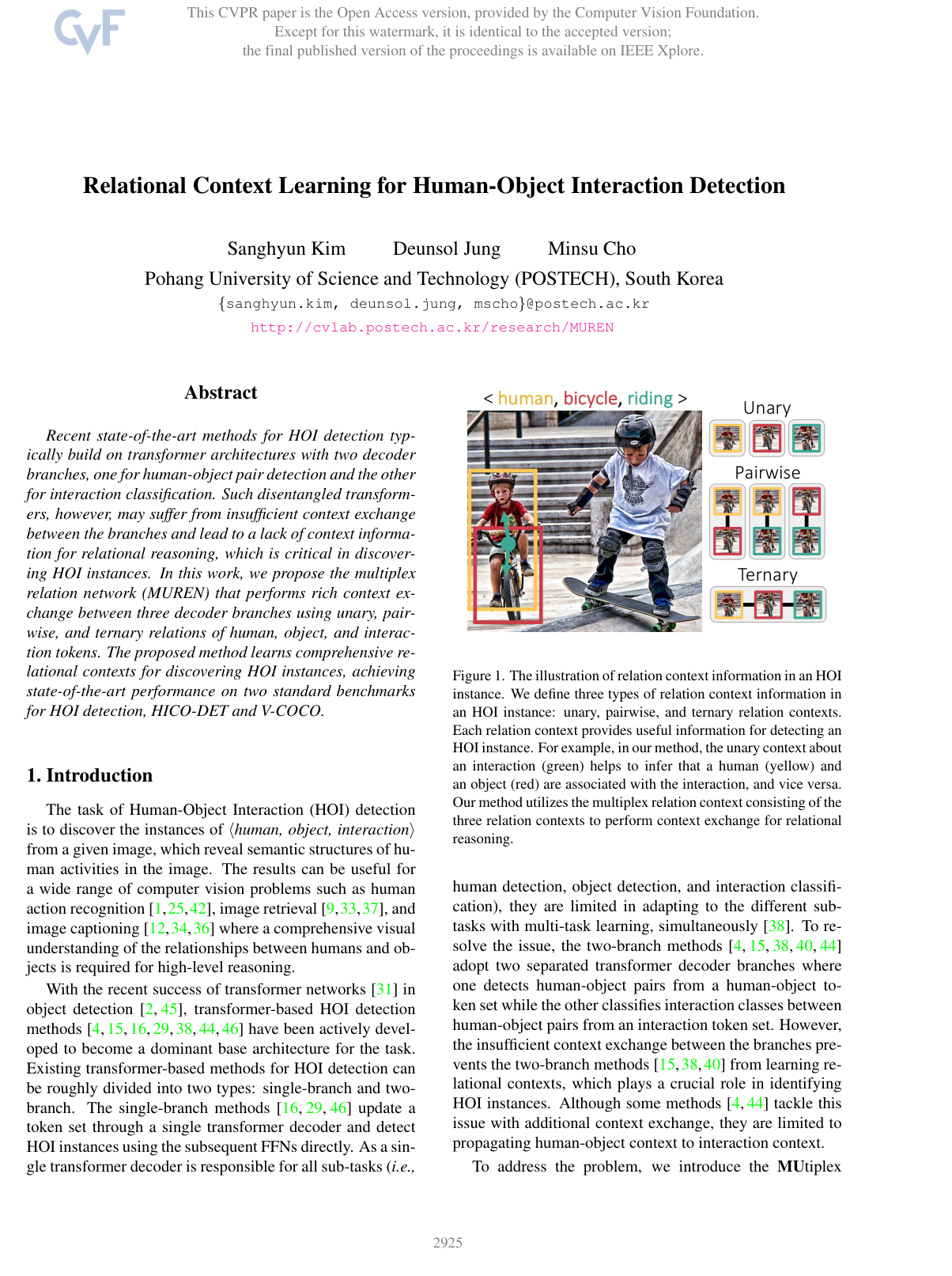
Relational Context Learning for Human-Object Interaction Detection
Sanghyun Kim, Deunsol Jung, Minsu Cho
Why you should read this
Proposes a multiplex relation network with a three-branch transformer architecture that systematically exchanges unary, pairwise, and ternary context across human, object, and interaction tokens to advance state-of-the-art detection on HICO-DET and V-COCO benchmarks.
Recent state-of-the-art methods for HOI detection typically build on transformer architectures with two decoder branches, one for human-object pair detection and the other for interaction classification. Such disentangled transformers, however, may suffer from insufficient context exchange between the branches and lead to a lack of context information for relational reasoning, which is critical in discovering HOI instances. In this work, we propose the multiplex relation network (MUREN) that performs rich context exchange between three decoder branches using unary, pairwise, and ternary relations of human, object, and interaction tokens. The proposed method learns comprehensive relational contexts for discovering HOI instances, achieving state-of-the-art performance on two standard benchmarks for HOI detection, HICO-DET and V-COCO.
Added
2026-09-26
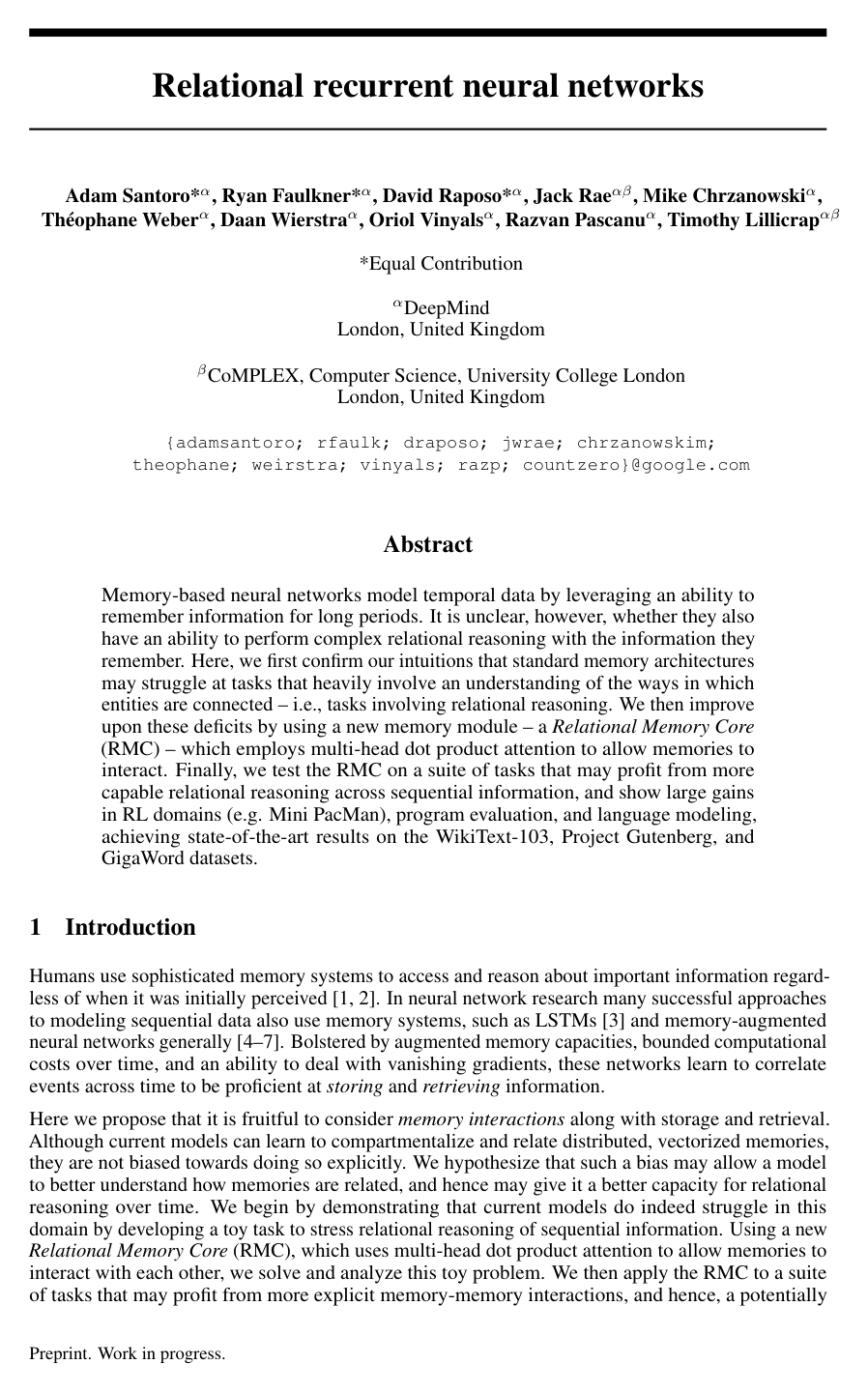
Relational recurrent neural networks
Adam Santoro, Ryan Faulkner, David Raposo, Jack Rae, Mike Chrzanowski, Théophane Weber, Daan Wierstra, Oriol Vinyals, Razvan Pascanu, Timothy Lillicrap
Why you should read this
Shows that memory-based neural networks struggle to reason about relationships between things they've remembered across time, then fixes this by letting memory slots attend to each other, enabling the model to compare and relate stored information—leading to breakthrough performance on tasks requiring temporal reasoning like language modeling and partially-observed reinforcement learning.
Memory-based neural networks model temporal data by leveraging an ability to remember information for long periods. It is unclear, however, whether they also have an ability to perform complex relational reasoning with the information they remember. Here, we first confirm our intuitions that standard memory architectures may struggle at tasks that heavily involve an understanding of the ways in which entities are connected -- i.e., tasks involving relational reasoning. We then improve upon these deficits by using a new memory module -- a \textit{Relational Memory Core} (RMC) -- which employs multi-head dot product attention to allow memories to interact. Finally, we test the RMC on a suite of tasks that may profit from more capable relational reasoning across sequential information, and show large gains in RL domains (e.g. Mini PacMan), program evaluation, and language modeling, achieving state-of-the-art results on the WikiText-103, Project Gutenberg, and GigaWord datasets.
Added
2026-02-21
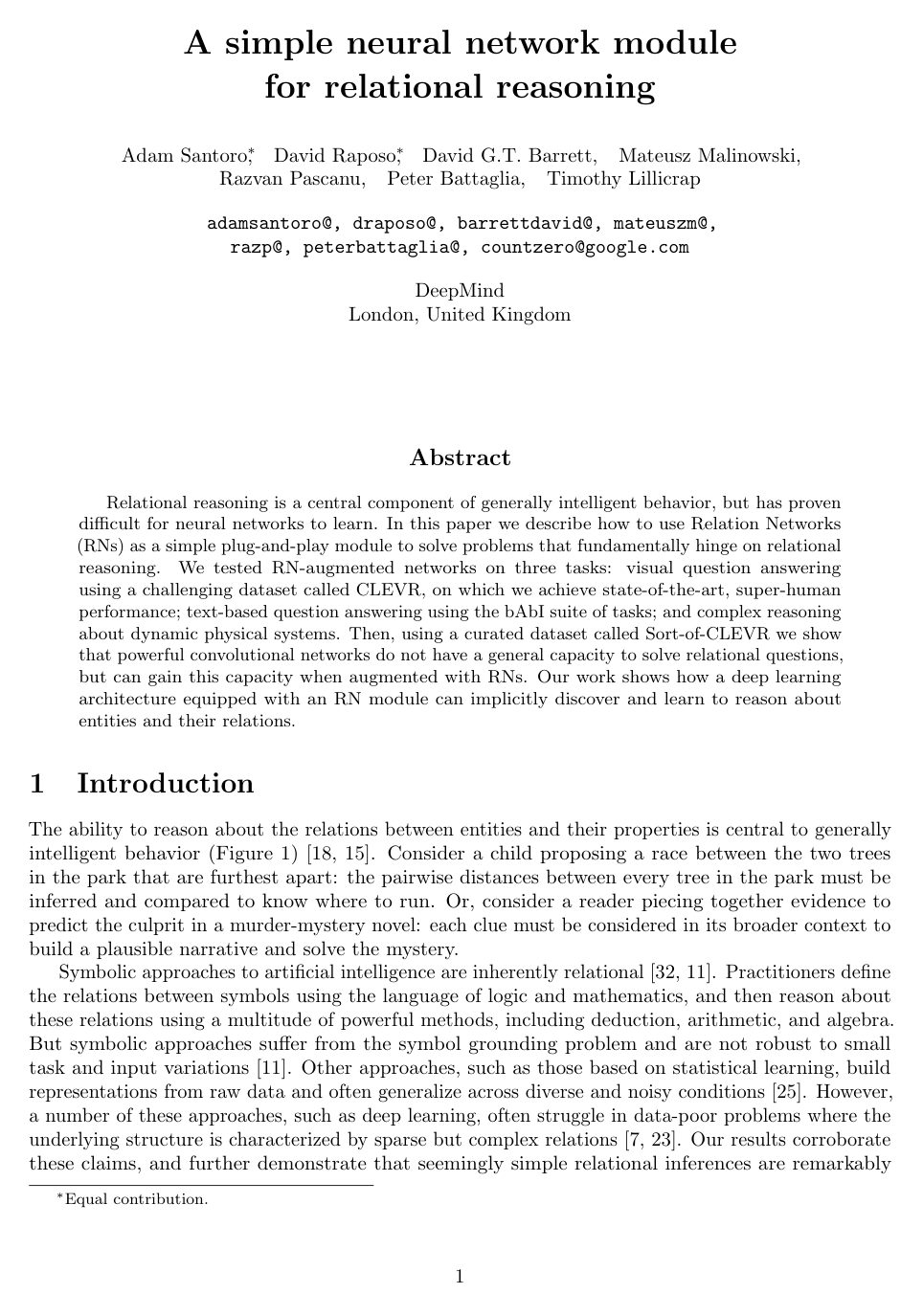
A simple neural network module for relational reasoning
Adam Santoro, David Raposo, David G. T. Barrett, Mateusz Malinowski, Razvan Pascanu, Peter W. Battaglia, Timothy P. Lillicrap
Why you should read this
Shows that powerful neural networks surprisingly fail at simple relational questions like "which object is furthest from the red one," but adding a small module that explicitly compares all pairs of objects solves this fundamental limitation and achieves breakthrough results across multiple reasoning tasks.
Relational reasoning is a central component of generally intelligent behavior, but has proven difficult for neural networks to learn. In this paper we describe how to use Relation Networks (RNs) as a simple plug-and-play module to solve problems that fundamentally hinge on relational reasoning. We tested RN-augmented networks on three tasks: visual question answering using a challenging dataset called CLEVR, on which we achieve state-of-the-art, super-human performance; text-based question answering using the bAbI suite of tasks; and complex reasoning about dynamic physical systems. Then, using a curated dataset called Sort-of-CLEVR we show that powerful convolutional networks do not have a general capacity to solve relational questions, but can gain this capacity when augmented with RNs. Our work shows how a deep learning architecture equipped with an RN module can implicitly discover and learn to reason about entities and their relations.
Added
2026-02-21
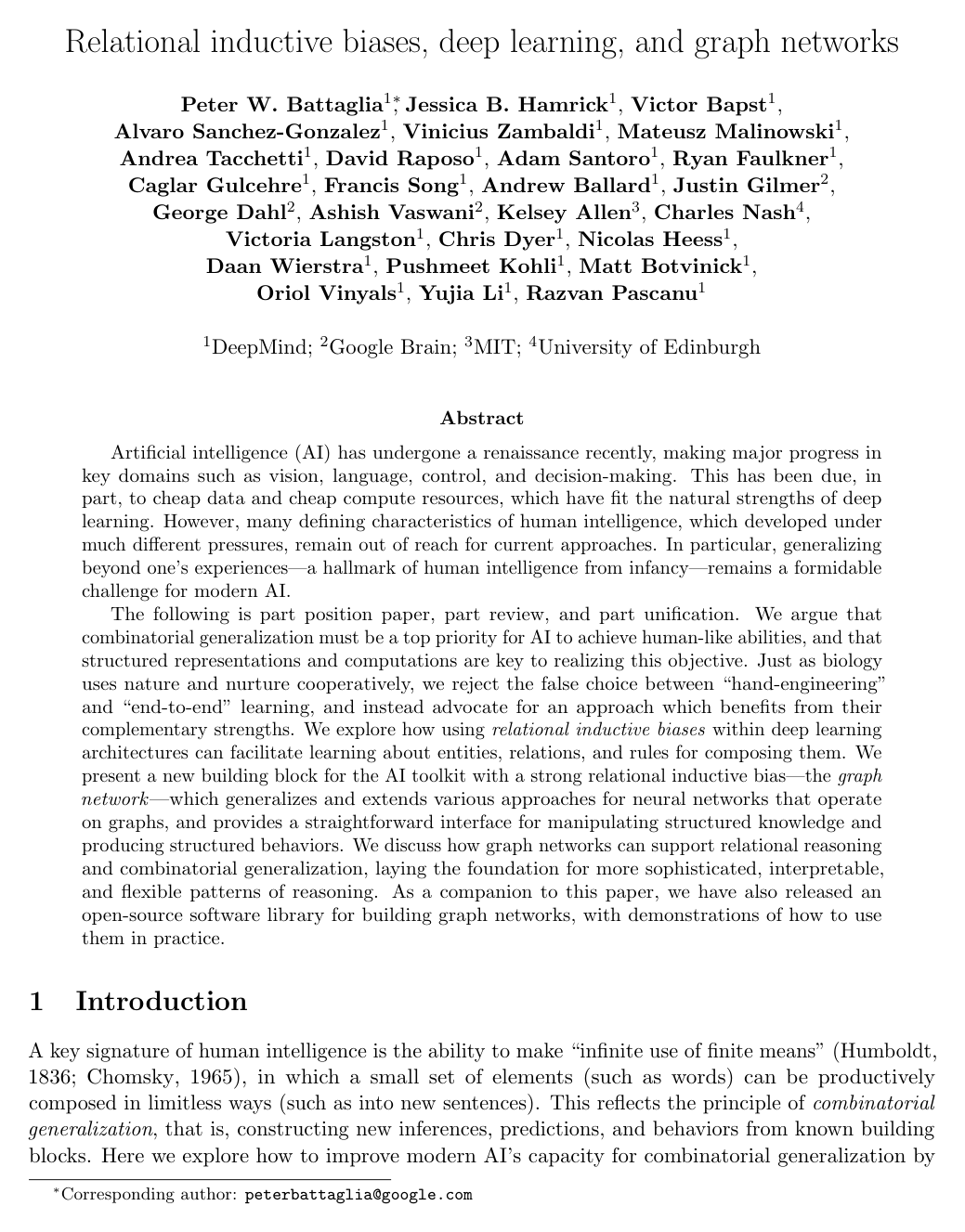
Relational inductive biases, deep learning, and graph networks
Peter W. Battaglia, Jessica B. Hamrick, Victor Bapst, Alvaro Sanchez-Gonzalez, Vinicius Zambaldi, Mateusz Malinowski, Andrea Tacchetti, David Raposo, Adam Santoro, Ryan Faulkner, Caglar Gulcehre, Francis Song, Andrew Ballard, Justin Gilmer, George Dahl, Ashish Vaswani, Kelsey Allen, Charles Nash, Victoria Langston, Chris Dyer, Nicolas Heess, Daan Wierstra, Pushmeet Kohli, Matt Botvinick, Oriol Vinyals, Yujia Li, Razvan Pascanu
Why you should read this
Shows how explicitly structuring data as graphs of entities and relationships enables AI systems to learn more efficiently and generalize better than treating all inputs as unstructured vectors or grids.
Artificial intelligence (AI) has undergone a renaissance recently, making major progress in key domains such as vision, language, control, and decision-making. This has been due, in part, to cheap data and cheap compute resources, which have fit the natural strengths of deep learning. However, many defining characteristics of human intelligence, which developed under much different pressures, remain out of reach for current approaches. In particular, generalizing beyond one's experiences--a hallmark of human intelligence from infancy--remains a formidable challenge for modern AI. The following is part position paper, part review, and part unification. We argue that combinatorial generalization must be a top priority for AI to achieve human-like abilities, and that structured representations and computations are key to realizing this objective. Just as biology uses nature and nurture cooperatively, we reject the false choice between "hand-engineering" and "end-to-end" learning, and instead advocate for an approach which benefits from their complementary strengths. We explore how using relational inductive biases within deep learning architectures can facilitate learning about entities, relations, and rules for composing them. We present a new building block for the AI toolkit with a strong relational inductive bias--the graph network--which generalizes and extends various approaches for neural networks that operate on graphs, and provides a straightforward interface for manipulating structured knowledge and producing structured behaviors. We discuss how graph networks can support relational reasoning and combinatorial generalization, laying the foundation for more sophisticated, interpretable, and flexible patterns of reasoning. As a companion to this paper, we have released an open-source software library for building graph networks, with demonstrations of how to use them in practice.
Added
2026-02-21